A real Mensch

In memoriam Herbert C. Kelman s. A. | (* 18. März 1927 in Wien; † 1. März 2022 in Cambridge, Massachusetts)

Ofer Zalzberg, Autor verschiedener Beiträge in unserer Zeitschrift israel & palästina, seines Zeichens Middle East program director at the Herbert C. Kelman Institute for Interactive Conflict Transformation,
erinnert in einem persönlichen Nachruf an der jüngst verstorbenen Friedens- und Konfliktforscher.

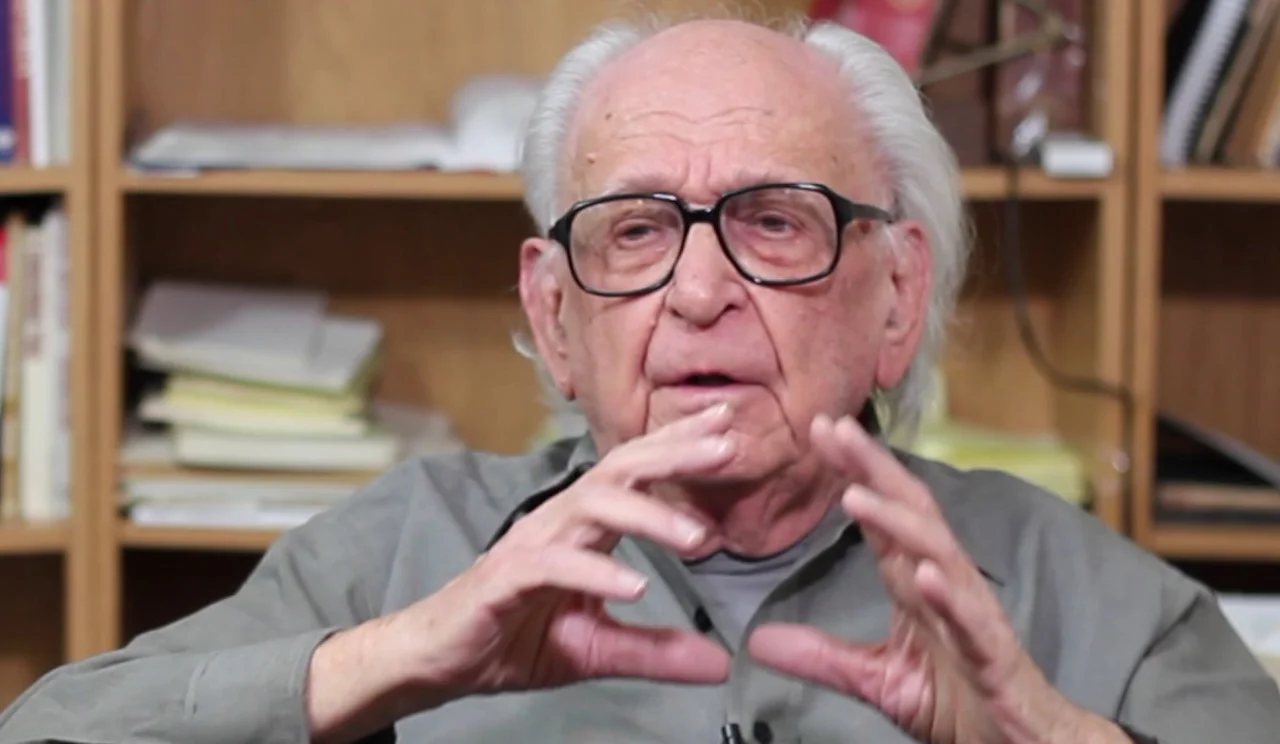
Herbert C. Kelman, a social psychologist who pioneered the fields of peace studies and conflict resolution, holding dozens of Israeli-Palestinian dialogue workshops over the last 40 years, died March 1, 2022 at 94.

Prof. Kelman was born in Vienna, where already as a boy he studied Hebrew language and literature. He was active in a Zionist youth group affiliated with the Religious Kibbutz Movement.

He fled Austria with his family roughly a year after Nazi Germany’s 1938 annexation, eventually launching a new chapter of his life in New York. His deep interest in social psychology was shaped by the traumatic events of World War II and the Holocaust.

Kelman – with whom I exchanged ideas and didn’t always agree – was a towering figure in the area of conflict studies stressing that human beings are not infinitely malleable. Rather, they hold on to certain nonnegotiables for which they are ready to die and kill.

One cannot, it follows, compel people to embrace certain values or behaviors, even when the price is incredibly high. Indeed, efforts to negotiate resolution solely based on interests fail in conflicts involving such nonnegotiables. Worse, they risk escalating them.

Kelman consequently posited that addressing conflict requires structured interaction between the parties so that they adequately appreciate their adversaries’ profound human needs, as well as their own.

Durable accommodation can be achieved only after such carefully facilitated encounters. Repeated foreign-policy failures seeking to subdue people into positions they cannot embrace have underlined the relevance of Kelman’s scholarship.

Herb began his work with influential Israelis and Palestinians in the late 1970s when, much like today, political prospects for a peace agreement seemed dim. Still, he sought avenues for achieving progress despite the reputational risks of tackling core-conflict issues with decision-makers on both sides. The very fact of his meetings with Yasser Arafat in Beirut in the early ‘80s was both groundbreaking and controversial.

So was his convening of Israeli and Palestinian leaders to explore ways to move toward mutual recognition and address core-conflict issues. During and between workshops his wife, Rose Brousman Kelman, indefatigably assisted him.

Legions of scholars speak of Herb as their mentor, confiding deep appreciation of his transformative contribution to their personal development. While I did not study under him, I did experience this caring quality of his.

I sometimes differed with his approach on significant issues, such as advocating conflict transformation rather than conflict resolution, while working mostly in the local offices and homes of the parties to the conflict rather than in workshops abroad. Plus I called for moves beyond liberal peacemaking so as to include non-liberal worldviews, notably religious ones. But even when I differed with his approach, he continued to generously support my professional and academic growth.

Kelman became one of the most influential scholars and educators in social psychology and conflict studies, securing senior positions at Harvard, training numerous academics and authoring a raft of groundbreaking books and articles. His CV suggests that he won every possible academic award for research, yet he was clearly most moved when he gained increasing recognition in his Austrian homeland over the last two decades.

Herb recounted how tears came to his eyes when he read a request by a prominent Vienna-based organization for conflict transformation: It was renaming the institute after him. The institute’s Austrian leaders, Wilfried Graf and Gudrun Kramer, who lived in Jerusalem at the time, saw this as a way to continue Herb’s work between Vienna and Jerusalem – under new conditions and in new forms. They noted that this was also symbolic acknowledgment of Austria’s wrongdoing against the Jews and a re-welcoming of Herb’s thoughtful academic contribution by the nation that chased him away.

I feel fortunate to have known him, to have exchanged views with him both theoretically and politically, and to currently work at the Herbert C. Kelman Institute for Interactive Conflict Transformation. He was a truly kind man, of utmost integrity, with incredible sensitivity to people’s human needs, whatever their origins. A real mensch.

Black Panthers Haggadah

The Israeli Black Panthers Haggadah was first written in 1971, at the beginning of their movement. It was written in a dark tin shack in Jerusalem on a stolen typewriter. In the introduction to this 50th Anniversary Edition, Reuven Abergel, one of the founders of the movement, writes that the Haggadah talks „about the pain, discrimination, and oppression that we were subjected to as part of Israel’s policy of separation between Jews from Muslim countries and Jews from Eastern Europe.“

​A year later, a fire destroyed most of the Israeli Black Panthers‘ archives, including the Haggadah. It was thought lost for some 40 years until a rabbi who collected Haggadot reached out to Abergel with a copy.

​In 2019, a second edition of the Haggadah was published in Hebrew as a pamphlet, an effort initiated through The Civil Archive of Social Struggles in Israel, led by Sapir Sluzker-Amran. After that, groups came together with the purpose of making the Israeli Black Panthers struggle and the Haggadah story accessible in both Hebrew and English as a way of promoting dialogue about the potential of Mizrahi struggle in Israel/Palestine.

​Translator Itamar Haritan worked closely with Abergel to translate the Haggadah into English starting in 2017 and has updated parts of it since then with his help. The Israeli Black Panthers Haggadah will be a completely bilingual (Hebrew-English) book and in addition to the new translation from Haritan and introduction from Abergel, there will be other essays that reflect on the Israeli Black Panthers and the Haggadah text. It will also include powerful archival images of the Panthers and their activism.

​On this site, we have also provided a free preview of a section of the Haggadah that you can use at your Seder table. Click here to download it.

​We are so proud to present this new book project.

​In solidarity,

Reuven Abergel and Marcelle Edery | Sapir Sluzker-Amran (Production and Consulting)

Libby Lenkinski (New Israel Fund) | Ari Bloomekatz (Jewish Currents Press)

Video Credits

Producer: Barak Heymann, Director and Editor: Alon Levi, Director of Photography: Yaniv Linton, Script: Amir Pavlovitch – Participants: Reuven Abergel, Sapir Slutzker-Amran, Shirly Karvani, Neta Hamami-Tabib, Avner Gvaryahu, Avi Yalou, Adi Tufik, Yossi Tsabari, Michel (Micado) Warshavsky, Fania Ben Sasson, Yonah Ben Sasson, Itamar Bellaiche, Elinor Arazi, Ram Spinoza (RamZi), Leah Zohar, Menashe Halif, Yossi Cohen, Libby Lenkinski

Vorbestellung hier möglich!

Diskriminierungserfahrung und Zivilcourage

Anläßlich der internationalen Wochen gegen Rassismus / Vorstellung der Ergebnisse einer Befragung von arabischen Migrant/-innen in Gera

Am 14. März 2022 von 18 – 19.30 Uhr
Vor Ort oder im Livestream unter https://www.youtube.com/watch?v=zw-5CaACFz0

Sehr geehrte Damen und Herren,

die Bundeszentrale für politische Bildung/bpb lädt Sie herzlich ein zur hybriden Veranstaltung „Diskriminierungserfahrung und Zivilcourage. Eine Befragung von arabischen Migrant/-innen in Gera“ am Montag, den 14. März 2022 um 18 Uhr im Eiscafé de Bernardo, Schloßstraße 2 in Gera. Der Vortrag von Soha Hallawe und die Diskussion wird auch als Livestream auf YouTube übertragen.

Soha Hallawe, Angestellte bei der Stadtverwaltung Gera, führte im Rahmen ihrer Studienabschlussarbeit eine Befragung zu Diskriminierungserfahrungen unter arabischen Migrant/-innen im Jahr 2021 durch. Dabei wurden ca. 150 syrische und irakische Bürger/-innen der Stadt Gera befragt, um ihre Erfahrungen der letzten fünf Jahre zu schildern.

Am 14. März 2022 stellt Frau Hallawe die Ergebnisse ihrer Studie vor und gibt einen Überblick über die Lebenssituation von Migrant/-innen in Gera. Im Anschluß an ihren Vortrag gibt es die Möglichkeit zur Diskussion.

Zeit: 14. März 2022, 18 – 19.30 Uhr

Ort: Vor Ort in Gera oder im Livestream unter https://www.youtube.com/watch?v=zw-5CaACFz0

Richten Sie sich jetzt die Erinnerungsfunktion auf YouTube ein, um die Veranstaltung nicht zu verpassen.

Weitere Informationen zur Veranstaltung und den Livestream finden Sie auf unserer Website www.bpb.de/505591

Adina Shibli – Neue Literatur

„Wenn man schreibt, verschwindet man.“

Über Bücher, die kommen. Von Angela Schader – Ausführlicher Beitrag auf Perlentaucher

Verschwinden – das bedeutet für Adania Shibli nicht nur die völlige Hingabe ans entstehende Werk. Für die 1974 geborene Autorin reflektiert es auch eine Alltagserfahrung, der sie als in Israel lebende Palästinenserin ausgesetzt ist. In ihren Romanen nähert sie sich dieser Situation auf innovativen Wegen an; mit „Eine Nebensache“ ist ihr der internationale Durchbruch gelungen.“

Adania Shibli 2020. Photo: National Book Foundation / Wikipedia unter cc-Lizenz
Adania Shibli: Eine Nebensache
Aus dem Arabischen von Günther Orth.
Berenberg Verlag, Berlin 2022. 120 S., gebunden, 22,00 €.

Erscheint am 15. März 2022

Mehr Infos beim Berenberg Verlag

Wem nützt hier was warum?

Herzog is to visit Turkey in March with some reports saying that the visit will take place from March 9-10.

Relations between the two countries have been cold for more than a decade, but recently the countries have been working on reconciling.

Palestine UNSETTLED

Kunst und Widerstand – Über die Arbeit und die Veröffentlichungen des in Jerusalem geborenen und in Berlin lebenden Künstlers Steve Sabella

Palestine UNSETTLED | Steve Sabella

Margarete Susman 1872 | 1966 | 2022

Heftvernissage Neue Wege 1/2.22 (Online 27. Januar 2022 – 19.30 Uhr)

Einführung von Elisa Klapheck, Rabbinerin in Frankfurt und Professorin in Paderborn
Gespräch mit Antje Schrupp, Politikwissenschaftlerin, und Matthias Hui, Neue Wege, über die Aktualität von Margarete Susman

Texte von Margarete Susman – Lesung der Schauspielerin Ilknur Bahadir

Mitträgerschaft: Omanut – Forum für jüdische Kunst und Kultur

Link Online-Streaming | Link Veranstaltungflyer

Dr. Conrad Schick – geboren am 27.01.1822

Zum 200. Geburtstag dieses ganz besonderen Jerusalemers hier ein kleines Portrait aus Israel:

25 Jahre Dar al-Kalima

Wie eine Universität entsteht …. Eine Investition in Hoffnung und Creativität!

Dar al-Kalima University is a Palestinian success story per excellence. It started 25 years ago as a vision. With perseverance, it grew to become a full-fledged university. We were planning to celebrate this important occasion in person, but regrettably, the Covid-19 Pandemic did not allow for it. Yet, It is with great pleasure that we share with you this booklet that tells our story with its major milestones.

Eine kurzer Film … und mehr in der Zunkunft!

VN-Truppen in Palästina?

Könnte ein derartiges internationales Engagement (mit robustem Mandat) die Situation verändern, hätte es überhaupt eine Chance auf eine entsprechende Beschlußfassung im Sicherheitsrat der Vereinten Nationen. Hier jedenfalls eine entsprechende Position von Daoud Kuttab, einem palästinensischen Journalisten und Aktivisten, der genau dafür plädiert.

Opinion: With absence of a desire for peace by Israeli side and its rejection of globally accepted two-state solution, UN-sponsored blue helmets are needed more than ever in West Bank