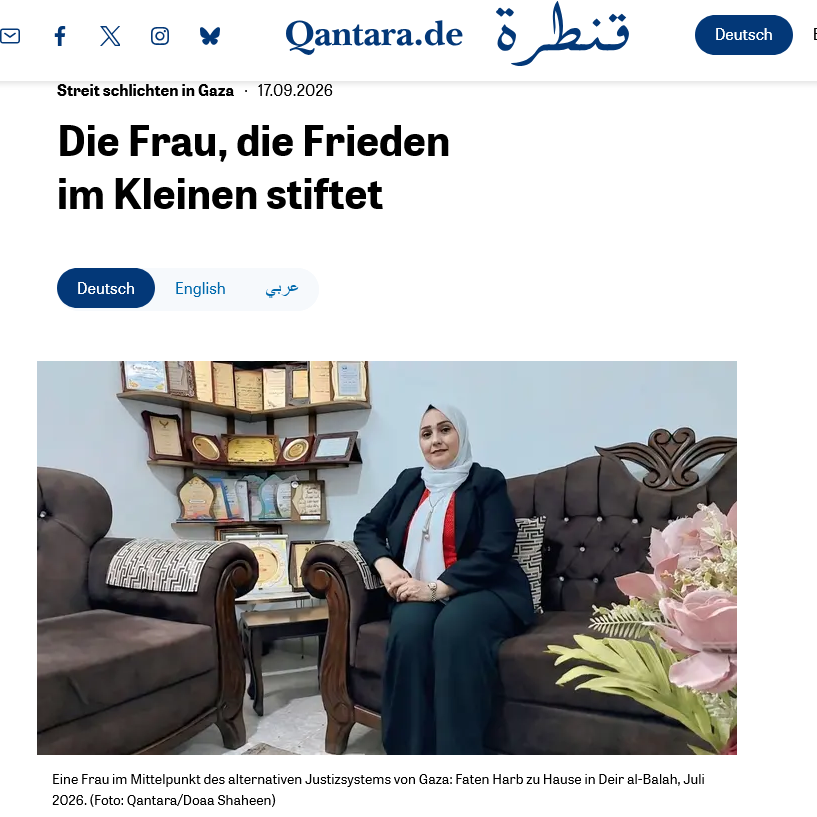
Ein Beitrag von Fanny Oz-Salzberger auf Qantara.de (Zuerst: Ein neues Israel, Internationale Politik, Mai 2026)
Ein Zitat daraus:
„Ein neuer Naher Osten mag in der Entstehung begriffen sein. Die dringlichere Frage ist aber, ob damit auch ein neues Israel entsteht – und ob dieses Israel auf lange Sicht demokratisch bleiben wird. Sollte das nicht geschehen, dann wird es von keinem militärischen Sieg aufgewogen werden können.“
Zur Quelle die Selbstauskunft: „Jacobin ist eine führende Publikation der sozialistischen Linken. Wir bringen Euch scharfe und lesbare Analysen zu Politik, Wirtschaft und Kultur. 2011 in New York geboren, erscheint Jacobin auf Englisch, Spanisch, Italienisch, Portugiesisch, Griechisch und Niederländisch – und seit 2020 auch auf Deutsch.“
Over the past three years, Israel has dramatically reshaped the West Bank area around Jerusalem, often referred to in Israeli political discourse as “Greater Jerusalem.” Through accelerated settlement expansion, the establishment of outposts and related infrastructure, and escalating state and settler violence against Palestinian communities, annexation of this area is advancing at full force.
While annexation has largely been understood as the deepening of Israeli control over the space, application of Israeli sovereignty, and the obstruction of a future Palestinian state, Ir Amim’s new report underscores how the forcible transfer of Palestinian communities is central to the annexation paradigm. Expulsion and displacement are not side effects of annexation, but rather inextricable components of it.
These developments are part of a broader Israeli government agenda across the West Bank: expanding Israeli territorial contiguity while pushing Palestinians into disconnected enclaves within an increasingly fragmented Palestinian space. This strategy is unfolding throughout the West Bank, but it is especially visible around Jerusalem.
The report details the cumulative system of pressure being used to make life unsustainable for Palestinian communities, including land confiscation, settlement and outpost expansion, demolition orders and denial of building permits, military closure orders, new permit regimes, settler and military violence, severe restrictions on movement, and the closure of entire areas to Palestinian access.
Israelis who won’t join the army straight out of high school tell Haaretz why October 7 – and the massive Israeli military response to it – was a major catalyst in their decision, and why they are not persuaded by arguments of peace through violence | Linda Dayan
Entering the West Bank from Israel is like passing into a parallel universe, with a military checkpoint serving as portal. One overarching structure but two realities: in people, law and policing.
Israel has been steadily altering the West Bank’s human and physical landscape since it first occupied the territory in 1967. As Crisis Group expert Joost Hiltermann found, it now controls Palestinians’ freedom of movement to an unprecedented degree, with ruinous socio-economic effects.
Nimrod Flaschenberg: Israelische Friedensarbeit in Deutschland / Israeli Peace Work in Germany
Welche Erfahrungen machen friedensbewegte Israelis in der deutschen Diaspora nach dem 7. Oktober? Wie funktioniert progressives politisches Engagement in Zeiten von “Staatsräson”? Über diese und andere Fragen wollen wir am 16. Juni 2026 mit Nimrod Flaschenberg sprechen, Ko-Gründer der Initiative “Israelis for Peace” in Berlin und ehemaliger politischer Berater für die sozialistische israelische Partei Chadash. Im Mittelpunkt unseres einstündigen Gesprächs soll es um israelischen Aktivismus in Berlin und die Zukunft von Friedensarbeit im Angesicht des Gaza-Krieges und der kommenden Parlamentswahlen in Israel gehen.
Das Gespräch findet von 19 bis 20 Uhr online auf Zoom und in englischer Sprache statt. Eine Anmeldung ist nicht erforderlich.
What experiences do peace-oriented Israelis have in the German diaspora after October 7? How does progressive political engagement work in times of “Staatsräson”? These are the questions we will discuss with Nimrod Flaschenberg on June 16, 2026. Nimrod is the co-founder of the initiative “Israelis for Peace” in Berlin and a former political advisor to the socialist Israeli party Hadash. The focus of our one-hour discussion will be Israeli activism in Berlin and the future of peace work in the face of the Gaza war and the upcoming parliamentary elections in Israel.
The event will take place online via Zoom from 7PM to 8PM and will be held in English. No registration is required.
DienstagZoom des diAk Zeit: 16. Juni 2026 06:45 PM Amsterdam, Berlin, Rom, Stockholm, Wien
I just stepped out of the room where civil society took its seat at the table.
This week began with renewed conflict in the region, as Israelis and Palestinians faced missiles, bombs, and terror. But the week ends with a powerful glimpse at a path to break out of this violent deadlock. As I write this, I am finishing up an intensive day in Paris, where I joined my ALLMEP colleagues and 150 peacebuilders from across our network, alongside foreign ministers and senior figures from more than 20 states from the G7 and beyond. Over the last 48 hours ALLMEP has marked two major milestones in a journey we’ve been on for two decades: the launch of an international fund, and the experience of Israeli and Palestinian civil society being integrated into the diplomatic plans of world leaders.
Building momentum step-by-step: The journey to the International Fund
Our momentum began with groundbreaking news out of the UK, originally published across major wire services (you can read the announcement on Reuters here). At a foreign ministerial meeting in Chevening, UK Foreign Secretary Yvette Cooper, Canadian Foreign Minister Anita Anand, and Australian Foreign Minister Penny Wong announced that their governments will launch and fund a new International Fund for Israeli-Palestinian Peace.
First conceived by ALLMEP in 2004 and inspired by the transformative success of the International Fund for Ireland, this new multilateral institution presents the chance to scale and institutionalize the reach and impact of civil society. Our field has learned how to create real impact, trust and partnerships on the ground — from humanitarian relief, environmental cooperation, and tech partnerships to economic development, educational programs, and inter-faith projects.
Now, this fund can radically scale the critical work of our 200+ member organizations (and counting — we welcomed 9 new members just this week). As Foreign Secretary Cooper noted in her announcement, while diplomats sign the agreements, there must be support for the civil society organizations building the dialogue, trust, and parallel constituencies required to make a two-state solution a reality.
This fund announcement is a major victory in the global campaign we first launched in 2009. It involved thousands of meetings and events, unheard-of coalitions of allies across the political spectrum, and six different bills in the U.S. Congress, leading Congress to pass MEPPA in 2020 with $250 million. We then enlisted Pope Francis, dozens of UK and European parliamentarians, and over 350 NGOs around the world in an appeal to the G7. Now, these three countries have delivered a new international fund, and are seeking others to help scale up.
Taking the stage in Paris as full partners
Following that historic announcement, our day in Paris began with a diplomatic breakfast, where I met, alongside leaders from our field, French Foreign Minister Jean-Noël Barrot, UK Foreign Secretary Cooper, and Canadian Foreign Minister Anand to discuss recommendations developed across civil society to deliver to the G7 leaders.
We then spent the day at a summit hosted by the French Ministry of Foreign Affairs. Leading experts and diplomats moderated five intensive working groups, each addressing a different aspect of the conflict. Our civil society representatives brought with them the ideas, input, and lived experiences of hundreds of leaders in our field, feeding them directly into this intensive policy conference.
Together, they generated concrete, actionable policy recommendations for a diplomatic community contending with a frozen political process. These ideas were presented in panels alongside remarks from ministers representing over a dozen countries, culminating in the official announcement of the 2026 Paris Call — a clear, united, and tangible roadmap delivered directly to the G7 Leaders’ Summit convening in France on Monday.
We are not starting from zero
This is a marathon, not a sprint. Hitting major milestones after years of work confirms the path we’re on. Getting here required building an entire network and organization. And now, through continuous, data-driven advocacy — from our AI Pulse research to last year’s New York Declaration and the inclusion of hundreds’ of civil society leaders’ voices in the Paris Call conversation — we are steadily bridging the gap between changemakers on the ground and the international community, making the people an indispensable part of the process.
As the day closed, a remarkable and all-too-rare scene unfolded in the streets of Paris. Hundreds of summit participants — Israelis and Palestinians — walked together along the Seine River to the Pont de la Tournelle bridge, sharing a resounding message: Peace is Possible.
After three years of devastating war, Israelis, Palestinians, and the international community are ready to pivot from war toward stabilization, recovery, and true conflict resolution. We are finally putting the infrastructure in place to offer a generational alternative to endless violence. With global diplomats now working hand-in-hand with an organized, resilient civil society network, we have the best fighting chance yet to ensure a secure, lasting future for both peoples.
We did not get here alone. This week’s achievements were only possible with your support, and building on them in the journey ahead will require even more from all of us. Thank you for standing with us and the Israeli and Palestinian peacebuilders. This week we saw just how much we can do together, step by step.