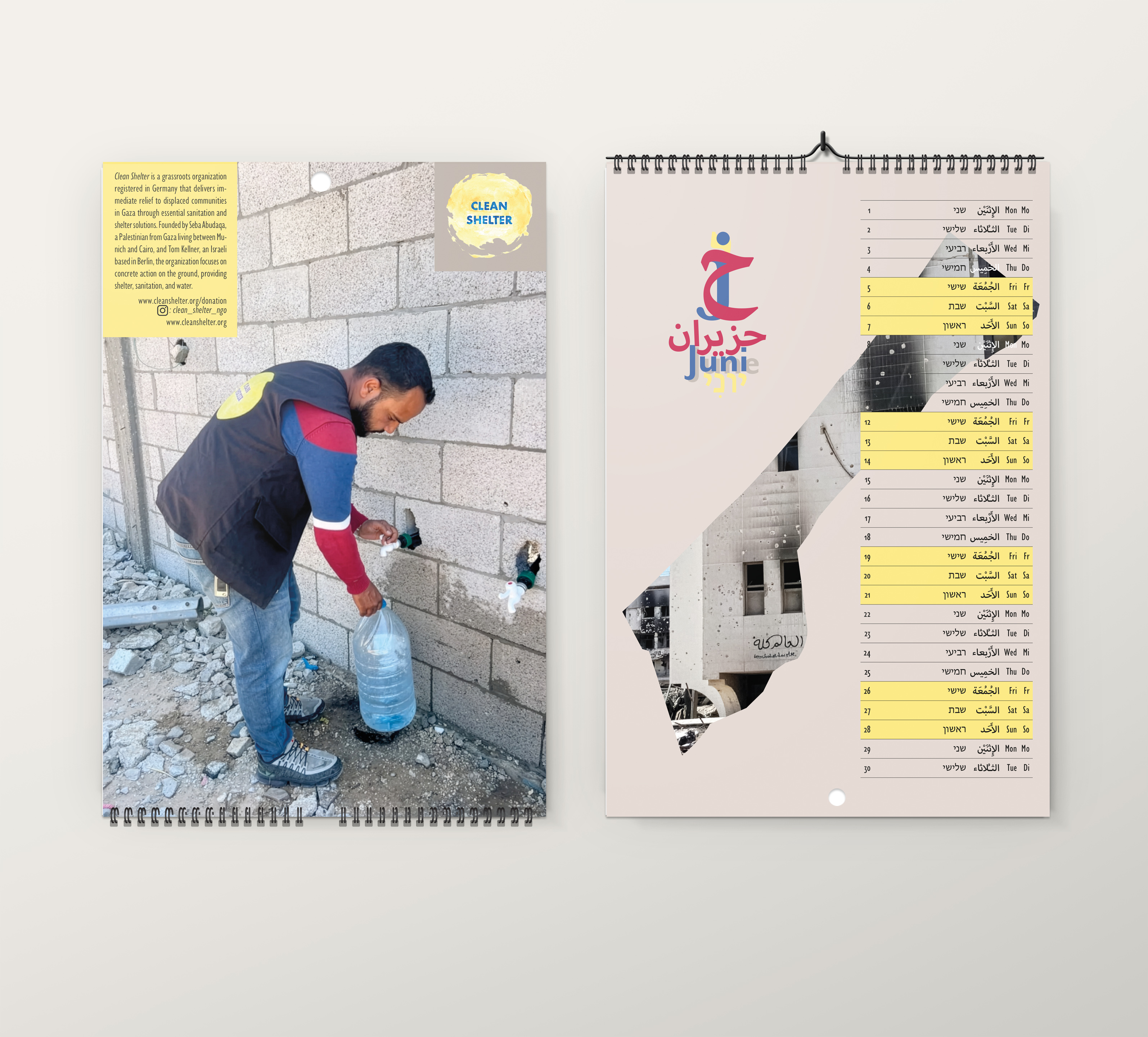
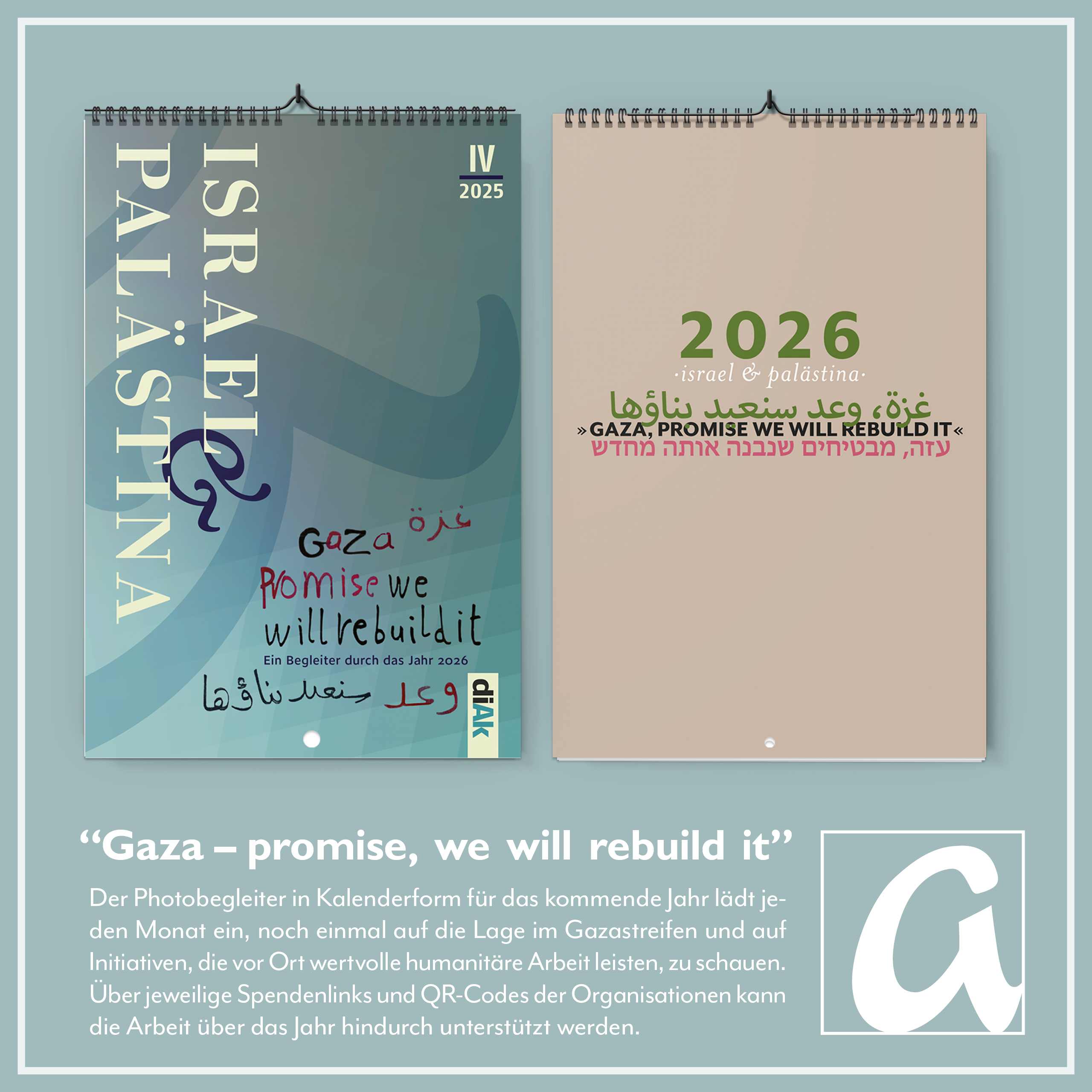
Nachrichten aus Israel-Palästina/Palästina-Israel gibt es viele und auch nicht wenige, in denen das Dreieck Deutschland-Israel-Palästina eine Rolle spielt, genau die Schnittstelle, die uns in der Arbeit des diAk besonders interessiert.
Zusammen denken und zusammendenken – dafür bieten wir an dieser Stelle jeden Tag einen Beitrag, manchmal mit einer Einordnung/Einleitung, oft ein Hinweis auf eine spannende Verstaltung oder ein Onlineformat, dann auch wieder eine Erinnerung, zu der die Kalender und die unterschiedlichen Narrationen Anlaß geben.
Das wollen wir möglichst vielfältig tun, ohne uns jeden Beitrag oder jede Position zu eigen zu machen, aber immer in dem Bemühen über die Zeit hin die Vielfalt und die Verwobenheiten erkennbar werden zu lassen …
Zum Jahresausklang ein Hinweis auf ein längere Geschichte… voller „spirit“ für das Kommende.
Mit guten Wünschen für ein besseres 2026 und Dank für das Interesse am täglichen Blog des diAk.
Empfehlt uns / empfehlen Sie uns weiter – diAk-Vorstand
…
„Ceasefire is a step in a journey of a thousand steps, but it is not peace. As I write, the last of the living hostages are reunited with their families while thousands of former prisoners are bussed from life sentences in sunless dungeons to the wreckage and rubble of Gaza. They, too, might reunite with their families—starved, emaciated, evicted, but breathing—all praise to God. I watched one former prisoner reunite with his young children whom he’d been tortured to believe were dead, and another rock back and forth on his knees with a bracelet he’d woven for his daughter clutched in his hands as he wailed, “My family is dead, my family is dead… my home, my children, everything is gone… my family is dead.”
Über die Herausgeber: At BitterSweet we look to tell stories of hope, of good at work in the world. And while Combatants for Peace is certainly that, we are also committed to telling counternarratives. As the story of a conquering „peace“ gains traction, trumpeted by those who personally stand to gain power, prestige, and payment, let the courage of activists such as Sulaiman and Avner, Rana and Eszter remind us not to look away. “Don’t talk about us without us,” Rana reminds us. “If you want to be part of the solution, you need to hear all the voices of people involved and affected by that conflict. And we need to be part of the discussion whether you agree or not. Everybody who lives here needs to be involved in the peace process.” „Peace“ is not dictated into being, but grown, a fragile seed planted in hope of a future safe enough for it to flourish. Thank you to Elie and Kai, Fatima and Ahmed, Koren and Orí, and the many courageous activists committed to true peace, to a more excellent way. – Avery Marks, Features Editor
In this episode of Nullpunkt, Hanno Hauenstein speaks with Mouin Rabbani, an incisive Palestinian analysts of Israel-Palestine. We examine the so-called ceasefire in Gaza – and why the killing has continued. Rabbani dissects Germany’s role and Friedrich Merz’s claim that Israel is “doing the dirty work” for Germany.The conversation moves from the repression of debate in Germany to the collapse of the two-state framework in Israel-Palestine. Rabbani explains why he, himself once a proponent of the two-state-solution, now no longer believes in it. Video & Editing: Tom WillsLogo: Laura Selma KoeranYou can find Rabbani’s writing & analysis here:– https://mouinrabbani.substack.com–https://www.jadaliyya.com
Timestamps0:00 – Intro1:45 – Has Israel’s Global Image Changed?4:00 – Silencing Debate on Israel–Palestine5:15 – “Israel Is Doing the Dirty Work”10:00 – How Germany Looks from the Outside13:30 – The Palestinian National Movement: Where To Now?19:30 – Ceasefire: Temporary Pause / Turning Point?25:00 – Gaza’s “Westbank-ification”28:00 – Fragile Western Consensus on Israel32:20 – Two States vs. One State39:30 – Who Can Pressure Israel?42:45 – The Israeli Opposition48:00 – Media Failure & Distortions
Die größten Herausforderungen für ein friedliches Miteinander in Nahost liegen nicht in den Beziehungen der Staaten, sondern auf der Ebene der gesellschaftlichen Versöhnung. Vier Neuerscheinungen vermitteln ein Gefühl für eine mögliche Zukunft der Region.
Muriel Asseburg: Der 7. Oktober und der Krieg in Gaza. Hintergrund, Eskalation, Folgen. München: C. H. Beck 2025. 286 Seiten, 20,00 Euro
Sabine Adler: Israel. Fragen an ein Land. Berlin: Ch. Links 2025. 270 Seiten, 24,00 Euro
Natalie Amiri: Der Nahost-Komplex. Von Menschen, Träumen und Zerstörung. München: Penguin 2025. 416 Seiten, 25,00 Euro
Daniel Gerlach: Die Kunst des Friedens. Eine andere Geschichte des Nahen Ostens – Deals, Friedensverhandlungen & Geheimdiplomatie. München: C. Bertelsmann 2025. 351 Seiten, 25,00 Euro
I would like to wish you first of all, health as in our age it is extremely important to feel well and also happiness and of course change of the present era of authoritarianism that plagues the world.
For many years I made it a habit to send New Year wishes to people I met along my path. During the last two years, however, I lacked the energy to continue this tradition, feeling helpless and hopeless. This year, as I approached my 80th birthday, I felt that I must overcome myself. Perhaps this will be the last time I follow this ritual, but I feel a strong need to write.
The truth is that the world has fallen upon me. The genocide carried out by Israeli Jews in Gaza bears, for me, the mark of Cain—one that cannot be erased and will haunt us for centuries. I am part of this and bear responsibility, both as a citizen of Israel and as a Jew whose family was almost entirely annihilated in Treblinka. My grandmother, aunts, uncles, and their children were murdered. Only my mother and her sister survived—two out of nine siblings.
Growing up without a family is incomprehensible, and this absence became a central reason I devoted my academic career to studying how evil evolves within the framework of intractable conflicts. I found a moral model in my aunt, who was sixteen years old and a member of a leftist youth movement. She was on the “safe” side of Warsaw and could have survived, but on April 19, 1943, she returned to the ghetto when her comrades called her to join the uprising. My life’s mission was not only to honor her courage and values, but also to uncover her fate. Three years ago, I finally did. Sent out on April 25, 1943; to seek Polish assistance, she was killed by a German Nazi policeman.
The genocide carried out in Gaza by victims of the Holocaust is appalling and violates all my values—especially as it is largely denied by its perpetrators, who have killed approximately 70,000 Palestinians, wounded about 170,000, and flattened the Gaza Strip. These acts have not ceased; they continue in both the West Bank and Gaza.
The murderous attack on 7th of October 2023 by Hamas in which were murdered about 850 civilians and about 350 soldiers and abducted 251 civilians with women and children cannot justify the genocide. The extreme rightist, religious, racist, and messianic government led to these acts and now denies its responsibility directing the anger solely to 7th of October. At the same time the government under the leadership of Netanyahu turns Israel into dictatorial and anti-democratic country.
Israel has been governed by the right since 2000, following the failure of the Camp David summit and the outbreak of the Second Palestinian Intifada. In the aftermath of the atrocities of October 7, many Israelis shifted further to the right, opposing the establishment of a Palestinian state and increasingly delegitimizing Palestinians as a people. I moved in the opposite direction. I came to understand more deeply the brutality of 58 years of occupation and the consistent trajectory of Israeli governments since 1967: the expansion of Jewish settlements in the occupied territories, the refusal to withdraw fully from them, and—already during the Mandate period—the aspiration to incorporate the West Bank into the future State of Israel.
It is well documented that the majority of Israeli Jews, as well as a large portion of Jews in the diaspora, are indoctrinated from an early age by successive Israeli governments with a sense of collective victimhood, feelings of superiority, the perception of non-Jews as an existential threat, chronic insecurity and fear, heightened patriotism, the delegitimization of Palestinians, and the belief in the moral justness of retaining control over the West Bank.
My state of mind is also deeply affected by developments in the United States under the leadership of Trump, who is undermining the foundations of a democratic state. The world as a whole appears to be moving in an authoritarian direction, painfully reminiscent of the 1930s. We, the older generation, are no longer able to reverse this trajectory. It is the younger generation that must bring about profound change if the world is to be saved.
It is deeply painful. Since 2022, approximately 200,000 Israelis have left the country—mostly young, progressive, and highly professional individuals. My beloved daughter, Galiya, is planning to relocate to the United Kingdom to study social work, driven by a desire to contribute to repairing the world.
I will not leave Israel. There are many reasons, one of them being that I have invested too much of my life in this state. Instead, I am fully committed to documenting what is happening here for future generations. Fortunately, I am invited to write chapters for handbooks and edited volumes, which gives me the intellectual freedom to choose the themes I address.
Thus, with the arrival of Christmas and the New Year—moments that invite at least a pause for reflection—I hope that a light will come to this world. Yet such a light will not emerge on its own. We must help illuminate the path for the younger generation.
Am ersten Dienstag im neuen Jahr, am 6. Januar 2026, wird unser nächster Gesprächsabend auf Zoom stattfinden. Zu Gast haben wir diesmal den Soziologen und Kulturwissenschaftler Dr. Dr. Peter Ullrich, Fellow am Zentrum für Antisemitismusforschung und Senior Researcher im Zentrum Technik und Gesellschaft der TU Berlin. Zuletzt erschien im Wallstein-Verlag der von ihm herausgegebene Sammelband „Was ist Antisemitismus?“. Im Januar wird er mit uns über Antisemitismus im deutschen Nahost-Diskurs und dessen politische Instrumentalisierung sprechen – insbesondere über das Phänomen des „autoritären Anti-Antisemitismus“. Die Veranstaltung beginnt um 19 Uhr und dauert etwa eine Stunde.
Zoom-Link für die Veranstaltung im Blog am 6. Januar
Nächste Veranstaltung:
3. Februar 2026 – Marina Klimchuk, freie Journalistin
Vergangene Veranstaltungen:
7. Oktober 2025 – Sally Azar (Jerusalem), Evangelisch-Lutherische Kirche in Jordanien und im Heiligen Land: Die Situation palästinensischer Christ*innen nach dem 7. Oktober 2023
4. November 2025 – Prof. Dr. Markus Dreßler (Leipzig), Religionswissenschaftler und Türkeiexperte: Türkische Perspektiven auf den Nahostkonflikt und die Antisemitismusdebatte
2. Dezember 2025 – Dr. Maya Rosenfeld (Jerusalem), Soziologin an der Hebräischen Universität in Jerusalem: The Anthropology of Occupation – The Case of Dheheishe Refugee Camp
A coalition of eight Jewish organizations sent a letter this morning to President Donald Trump and Secretary of State Marco Rubio expressing alarm over the Trump administration’s expanded Travel Ban.
The letter sharply criticizes the decision to target Palestinians, noting that the Travel Ban further weakens the Palestinian Authority in a manner that will make stabilizing Gaza more difficult. Here the full text of the letter, signed by
New Jewish Narrative Bend the Arc: Jewish Action J Street National Council of Jewish Women New York Jewish Agenda (NYJA) Partners for Progressive Israel T’ruah: The Rabbinic Call for Human Rights The Workers Circle
Therefore, since we are surrounded by so great a cloud of witnesses [Greek: martyrōn], let us also lay aside every weight and the sin that clings so closely, and let us run with perseverance the race that is set before us, looking to Jesus the pioneer and perfecter of our faith . . . (Hebrews 12:1–2a)
During these continuing times of hardship and strife throughout our region, We, the Patriarchs and Heads of the Churches in Jerusalem, remain resolute in proclaiming and affirming to both our communities and the faithful around the world the message of hope revealed in Christ’s Incarnation and Holy Nativity in Bethlehem more than two millennia ago.
For in similarly difficult times, an angel of the Lord suddenly appeared to shepherds of that region, beseeching them to cast aside their fears. “For behold,” said the angel, “I bring you good news of a great joy that will be for all the people. For unto you is born this day in the city of David a Savior, who is Christ the Lord” (Luke 2:10).
It was in kneeling before the manger in that sacred cave that the shepherds first witnessed God’s gracious gift of love. They beheld “Immanuel,” “God-with-us” (Matthew 1:23, Isaiah 7:14)—a divine Savior who “emptied himself, taking on the form of a slave, being born in human likeness” (Philippians 2:7).
In his great compassion for us, the Almighty deigned to take on our flesh and blood: to live among us and feel our pain; to later preach a message of repentance and God’s redemption for all people; and to serve the downtrodden and afflicted before finally offering up his life on our behalf, that we might be raised with him to new life through faith in God’s gracious act of love (Romans 6:4; Ephesians 2:6).
While this year we rejoice that a ceasefire has allowed many of our communities to more publicly celebrate the joys of Christmas, we nevertheless pay heed to the Prophet Jeremiah’s warning against those saying “‘Peace, peace,’ when there is no peace” (Jeremiah 6:14). For we are fully aware that, despite a declared cessation of hostilities, hundreds have continued to be killed or suffer grievous injury. Many more have experienced violent assaults against themselves, their properties, and their freedoms—not only in the Holy Land, but also in neighboring countries.
We, the Patriarchs and Heads of the Churches in Jerusalem, following in the example of our Lord in His Incarnation, continue to stand in solidarity with all those who are suffering and downcast, and we call upon Christians and others of goodwill around the world to persevere in praying and advocating for a true and just peace in the homeland of our Lord’s birth—and, indeed, throughout the earth.
For those facing these afflictions, we recall from the Epistle to the Hebrews how many of the faithful over the centuries stood firm in faith through extreme hardships (Hebrews 11) and how Christ himself serves as the wellspring of our devotion to God (Hebrews 12:1–2a, above). We therefore encourage you to look to Him for your spiritual strength, even as the larger Body of Christ seeks to relieve your suffering and to strengthen you in your resolve to persevere in the Lord’s work.
It is with these many sentiments that we extend our Christmas greetings to our congregations and to Christians around the world, wishing you and your loved ones the joy and peace that comes from encountering the boundless love of God made more fully manifest in the birth of our Lord Jesus Christ in Bethlehem.
—The Patriarchs and Heads of the Churches in Jerusalem