As this time of violence and unfathomable loss threatens to divide us, Combatants for Peace calls on us to come together. Please join CfP this Sunday, October 29th, for a conversation, „Solidarity: A Path to Liberation.“
The talk will be led by Palestinian activists, Rana Salman and Souli Khatib, and Israeli activists, Eszter Koranyi and Avner Wishnitzer. It will be moderated by the Director and Producer of „Disturbing the Peace,“ Stephen Apkon, and A’ida Shibli, Palestinian Bedouin activist and co-worker at the Tamera biotope in Portugal.
Solidarity: A Path to Liberation
Sunday October 29th 9pm Jerusalem | 7pm London | 1pm New York
Der 19. Tag – was läßt sich noch sagen? Wohin schauen, um jenen Teufelskreis der Gewalt, der mit dem 7. Oktober begonnen wurde, zu durchbrechen? Was soll, was kann, was muß „danach“ kommen?
Ein Blick auf ein Webinar am 29. Oktober … (Register): Solidarity speaks
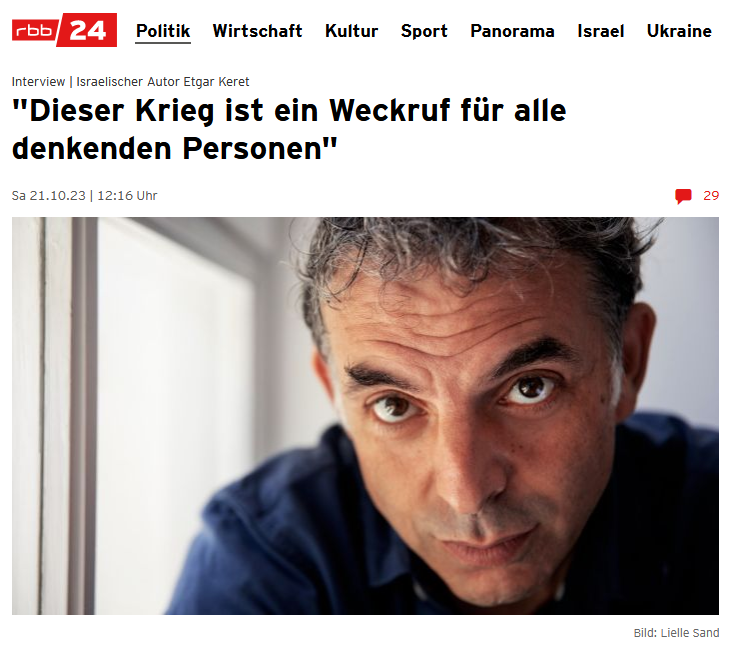
Dieser Krieg ist ein Weckruf für alle denkenden Personen
Etgar Keret ist einer der bekanntesten Autoren Israels und hat sich immer wieder für einen Frieden mit den Palästinensern ausgesprochen. Ein Gespräch über das, was der Krieg ihn gelehrt hat – und welche Art von Solidarität er sich nun wünscht. (rbb, 21. Oktober 2023) [Auszug:]
Welche Art von Solidarität wünschen Sie sich?
Ich würde mir wünschen, dass Menschen ihre Augen und ihr Herz öffnen, reflektieren, kritisch sind, wenn sie helfen wollen. Ich habe das Gefühl, dass wir in einer Zeit leben, in der Aktivismus bedeutet, jemand anderen zu beleidigen und anzugreifen. Hier im Nahen Osten haben wir Bedürfnisse. Wirkliche Bedürfnisse. Aktivismus heißt also Medikamente schicken, Freiwilligenarbeit leisten. Ich schätze jeden, der Freiwilligenarbeit für Palästinenser leistet und der Israelis hilft. Wenn man etwas machen möchte: Macht etwas, das menschlich ist.
Zur Ergänzung ein Interview mit E.Keret im Stern (13. Oktober 2023).
DIe Zerissenheit und die Spannung aushalten, die Menschen nicht auch noch in unseren Herzen trennen, ernstnehmen, wie unterschiedlich die Zugänge sind, wie verschieden die Verbindungen sind und wir am Gemeinsamen, am Zusammendenken festhalten wollen, dazu zwei Hinweise:
Noch mitten in der Gewalt, mit all den Bildern im Kopf und ohne, daß wir wissen, wohin sich alles noch entwickeln wird, gibt es keinen Weg daran vorbei, rational zu bedenken, was in der Region geschieht, wer welche Interessen verfolgt, was die Optionen sind, was Politik jetzt leisten kann und muß.
Das aktuelle Podcast Spezial der Stiftung Wissenschaft und Politik hat die „Eskalation im Nahen Osten“ zum Thema:
Der Nahost-Konflikt eskaliert. Wie kann eine Ausweitung der kriegerischen Auseinandersetzungen verhindert werden? Welche Rolle spielen die Nachbarn Ägypten, Saudi-Arabien sowie der Iran und welche Handlungsoptionen hat die internationale Gemeinschaft? Darüber diskutieren Azadeh Zamirirad, Guido Steinberg, Stephan Roll und Muriel Asseburg.
Wie reden, über das was geschieht? Was ist nötig, was ist möglich, was geboten?
In (hoffentlich) allen Medien stellen sich diese Fragen. An diesem Abend fogt hier ein Brief des Verlegers/Herausgebers von Jewish Current*, Daniel May, der die Spannungen und Zerrissenheiten, aber auch die Herausforderungen bemerkswert klar und eindringlich benennt.
***
* Jewish Currents, founded in 1946, a magazine committed to the rich tradition of thought, activism, and culture on the Jewish left and the left more broadly, based in New York (US).
Seit einer Woche wühlt die aktuelle Gewaltspirale Menschen an unterschiedlichen Orten und in den verschiedensten Kontexten auf. Verzweiflung der Angehörigen, Wut über das Leid, aber auch Aktionismus, um etwas zu tun angesichts des Furchtbaren.
Auch wir haben keine Antwort, auch keine „Lösung“, auch wir ringen in dieser Woche um Fassung und um Solidarität.
Vier kleine Hinweise an diesem Abend, (zwei davon) die in unsere eigene Wirklichkeit zurückführen:
# . Beim Freitagsgebet in der Dar Assalam-Moschee in Neukölln ruft Imam Mohamed Taha Sabri am Freitag zu Vernunft auf. (ein für den Berliner Tagsspiegel eher ungewöhnlicher Artikel von Frank Bachner).
# . Stefan Hunglinger versucht in der taz eine vorsichtige und respektvolle Annährung an den Kosmos „Sonnenallee“, Neukölln in all der Komplexität und Widersprüchlichkeit (auch mit einer Sequenz von/zu Mati Shemoelof).
**
Über Zusammenstehen und -arbeiten in diesen Tagen im ‚Heiligen Land‘: Netta Ahituv und Nadin Abou Laban am 12. Oktober 2023 in einem Beitrag in Haaretz (ausnahmsweise auch einmal als Datei zum herunterladen)
Martin Griffiths, Under-Secretary-General for Humanitarian Affairs and Emergency Relief Coordinator, resümiert aus der Sicht der Vereinten Nationen diese „furchtbare Woche und hält uns, hällt allen den Spiegel vor:
„The past week has been a test for humanity, and humanity is failing“
Nicht zu verwechseln mit den sog. Abraham Accords sind die Abraham Iniatives, ihr heutiger Newsletter und sein kooperativer Geist mögen in diesen Schabbat begleiten….
Dear Friends,
During this impossible time, it is easy to feel paralyzed. As we navigate the waves of grief and fear, I continue to be moved by the determined insistence of my friends and colleagues in Israel that a shared future for Jewish and Palestinians is not only something to work towards in the future when times are easier, but a dedicated practice that can help guide us through this impossible time.
I am proud to share that in the face of this immeasurable horror, we have achieved so much as a community this week.
We are using lessons learned from May of 2021 to foster cooperation at the municipal level:
Our Co-Deputy CEOs, Ruth Lewin Chen and Shahira Shalaby, are serving as coordinators for a Municipal Work Team, organized by the Joint Society Organizations Forum, which wrote and distributed recommendations to local leaders for violence prevention and the promotion of mutual aid
These recommendations included monitoring social media for misinformation; ensuring that police forces are protecting all citizens and preventing extremists from entering mixed cities; adjusting welfare services according to the needs of mixed cities; and promoting cooperation between the leaders of Arab and Jewish towns
We are participating in the Negev Situation Room and other coalitions of organizations in Arab civil society to ensure that the needs of Palestinian citizens are met. This work includes:
Documenting cases of violence, discrimination, and harm against Palestinian citizens
Expanding trainings in the mental healthcare system and connecting with service providers
Monitoring fake news on social media
Liaising with leaders in Arab society and politics, particularly to address the lack of shelters in the Negev, which the Home Front command claims cannot be placed in unrecognized villages
We are ensuring that shared life is protected:
We are working with our partners in the Ministry of Education to help navigate the points where Jewish and Arab students will come together in our Shared Learning Initiative
We offered invitations to Arab and Jewish psychologists to speak to mixed classrooms and Arab teachers at Jewish schools on the complexity of this moment
We continue to fight bills in the Knesset that promote a racist agenda using the cover of conflict
We are encouraging the incredible young people we have worked with in the past to take positions of leadership:
We have connected those who graduated from our personal security courses in Tel Sheva, Rahat, and Kseifa with volunteer trainings led by the Home Front Command so they can assist in maintaining security during emergencies in their neighborhoods
We must continue our work in this moment and stay rooted in our ideals of shared society and equality. Thank you for standing with us.