
Unwilling and Unable:
Israel’s Whitewashed Investigations of the Great March of Return Protests
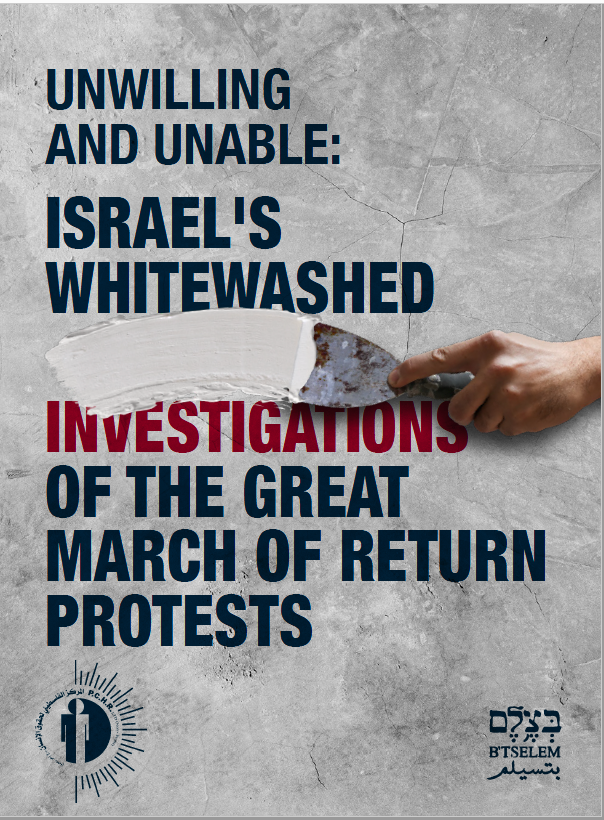
Mit zusätzlichem Material kann der Bericht hier heruntergeladen werden:
Seit 1967 sind Palästinenserinnen und Palästinenser aus den besetzten Gebieten Westjordanland und Gazastreifen bei der Suche nach Beschäftigungsmöglichkeiten auf den Arbeitsmarkt in Israel angewiesen. Gegenwärtig sind offiziell ca. 80.000 Menschen aus den besetzten Gebieten in Unternehmen in Israel tätig. Mit dem angekündigten Ziel, das Anwerbe- und Genehmigungssystem öffentlich zu kontrollieren und illegale Zahlungen für die Vermittler zu unterbinden, hatte die israelische Regierung eine Reform des Systems beschlossen.
Nach Einführung der Reformmaßnahmen legt die israelische NGO Kav La-Oved nun einen weiteren Bericht zur Beschäftigung palästinensischer Arbeiterinnen und Arbeiter in Israel vor.
„Historically, the entry of Palestinian workers lowered employment costs in the agriculture and construction sectors. Subsequently, following the first intifada and the frequent closures in the early 1990s, as well as lobbying on the part of employers and manpower companies, significant numbers of permits were issued to recruit migrant workers to these sectors….
Kav LaOved is the leading organization in Israel working to protect the rights of non-Israeli workers, and, as such, has taken an active part in ushering in significant changes in the employment conditions of Palestinian workers in recent years. This report is based on our collaborative work with Palestinian workers. It reviews developments that have taken place in recent years in a number of significant areas and describes developments that have taken place since the previous report, “Occupation of Labor,” which was published in November 2018.”
Developments and Reform in the Employment Conditions of Palestinians in Israel
„Ausgerechnet in Palästina und im Yemen, wo nur wenige Emissionen in die Atmosphäre gelangen, zeigt sich die Klimakrise mit voller Wucht“, resümiert Eman Mounir, eine junge ägyptische Journalistin. Hier ihr Beitrag auf dem Themenportal der FES: Die Welt gerecht gestalten.
Flüchtlingshilfswerk der Vereinten Nationenen
Seit 1971 unterhalten die Europäische Gemeinschaft / EU und the United Nations Relief and Works Agency for Palestine Refugees in the Near East (UNRWA) eine strategische Partnerschaft mit dem gemeinsamen Ziel, humanitäre Entwicklungserfordernisse palästinensischer Flüchtlinge und Stabilität im Nahen Osten zu unterstützen.
Inzwischen ist die EU die größte multilaterale Unterstützerinstitution, die internationale Hilfe für mehr als 5,8 Millionen palästinensischer Flüchtlinge in Jordanien, Libanon, Syrien, Westjordanland und Gaza leistet.
Am 17. November 2021 unterzeichneten die beiden Vertreter der EU und der UNRWA eine Gemeinsame Erklärung über die weitere Unterstützung der EU für die UNRWA für die Jahre 2021 bis 2024. Josep Borrell, EU High Representative, hob hervor, daß UNRWA in den Kernbereichen bei der Versorgung von Millionen palästinensischer Flüchtlinge eine „essential role“ spiele.
Der Text der gemeinsamen Erklärung ist hier abzurufen:
***
Deutschland erhöht Unterstützung des VN-Flüchtlingshilfswerkes UNRWA
Die Bundesrepublik Deutschland wird das VN-Flüchtlingshilfswerk UNRWA mit weiteren 72 Millionen Euro unterstützen. Dies teilte Staatssekretär Miguel Berger gestern im Rahmen der virtuellen UNRWA-Konferenz in Brüssel mit. In dem Betrag sind zusätzliche 15 Millionen Euro zur Entlastung des Programmbudgets enthalten.
Der Tag der Unabhängigkeitserklärung durch den Palästinensischen Nationalrat in Tunis
138 Mitgliedsstaaten der Vereinten Nationen haben den Staat bislang anerkannt…, seit November 2012 besitzt Palästina den Status eines Beobachterstaates bei den VN, seit 2011 ist es Vollmitglied der UNESCO.
Nicht nur die fortdauernde Besatzung macht aus diesem Tag keinen fröhlichen Tag, auch die politische Verfaßtheit der Palästinensischen Autonomie(behörde) steht vor allergrößten Herausforderungen.
Zu einem zentralen Politikfeld, der Sicherheitspolitik, hier der Hinweis auf einen sehr kritischer Beitrag aus dem palästinensischen Policy Network al Shabaka von Dr. Alaa Tartir:
The Palestinian Security Sector: Entrenching State Repression

Judith Poppe, Korrespondentin der Tageszeitung taz für Israel und die palästinensischen Gebiete, schreibt auf Qantara über die Hope Flowers School und deren Direktor Ibrahim Issa
Prisoner Politics: Palestinians in Israeli Jails
28. September 2021 – 16.00 Uhr Berliner Zeit – Anmeldung erforderlich
“The dramatic escape of six Palestinian prisoners from a high-security prison in Israel earlier this month has cast a bright light on the long-neglected and intensely polarizing issue of Palestinian political prisoners, their status in Palestinian society, and their treatment at the hands of Israel.
Although all six men have since been recaptured by Israeli authorities, their daring escape became a symbol of Palestinian defiance and hope for ordinary Palestinians and leaders alike. For Israelis, most of whom regard the men as little more than terrorists, the incident was seen as a major security failure and an embarrassment for Israel’s vaunted security establishment. Although the Biden administration did not weigh in on the incident, the issue of Palestinian prisoners remains the subject of intense focus and even congressional legislation in Washington.
What are the conditions of Palestinians being held in Israeli jails? Why does the issue generate such intense emotion among both Palestinians and Israelis as well as in Washington?
Speakers:
Jawad Boulus
Jawad Boulus is a renowned Palestinian human rights lawyer, political commentator, and author. Boulus was born into a Christian family in the small Arab Galilee village of Kafr Yaseef in 1956, and graduated from the Hebrew University of Jerusalem in 1980. As a Palestinian with Israeli citizenship, Boulus has been deeply involved in the Israeli-Palestinian conflict and the fight for Palestinian human rights for over 40 years. He currently publishes a notable weekly opinion column in Arabic which is circulated in numerous local and international printed newspapers and online magazines. He is the Director of the Legal Unit of the Palestinian Prisoners‘ Club in Ramallah. He serves as Co-Chair on the Board of Directors to ‘Hand in Hand,’ a network of integrated bilingual schools for Jewish and Arab children in Israel. Boulus also serves as Secretary to the Mahmoud Darwish Association for Innovation. His own law firm is based in Jerusalem, where he resides with his wife Jumana.
Lara Friedman
Lara Friedman is the president of the Foundation for Middle East Peace. With more than 25 years working in the Middle East foreign policy arena, Lara is a leading authority on U.S. foreign policy in the Middle East, with particular expertise on the Israeli-Arab conflict, Israeli settlements, Jerusalem, and the role of the U.S. Congress. Prior to joining FMEP, Lara was the Director of Policy and Government Relations at Americans for Peace Now, and before that she was a U.S. Foreign Service Officer, serving in Jerusalem, Washington, Tunis and Beirut. She tweets @LaraFriedmanDC
Sahar Francis
Sahar Francis is the General Director of Addameer Prisoner Support and Human Rights Association, a Ramallah-based Palestinian NGO that provides legal and advocacy support to Palestinian political prisoners in Israeli and Palestinian prisons. An attorney by training, she joined Addameer in 1998, first as a human rights lawyer, then as head of the Legal Unit. With over sixteen years of human rights experience including legal counseling and representation, Francis is a leader of prisoners rights advocacy. She has also represented Addameer at the UN Human Rights Council, sits on the Board of Defense for Children International-Palestine Section, and was recently appointed to be on the technical committee for the Palestinian National Committee for the follow-up of the International Criminal Court (ICC). Francis earned her law degree from the University of Haifa in 1994, entered the Israeli Bar Association in February 1996, and earned her master’s degree in International Studies from Birzeit University in 2006.
Khaled Elgindy, moderator
is senior fellow and director of the Program on Palestine and Israeli-Palestinian Affairs at the Middle East Institute. He is the author of Blind Spot: America and the Palestinians, from Balfour to Trump, published by Brookings Institution Press in April 2019. Elgindy previously served as a fellow in the Foreign Policy program at the Brookings Institution from 2010 through 2018. Prior to arriving at Brookings, he served as an adviser to the Palestinian leadership in Ramallah on permanent status negotiations with Israel from 2004 to 2009, and was a key participant in the Annapolis negotiations of 2007-08. Elgindy is also an adjunct instructor in Arab Studies at Georgetown University. He tweets @elgindy_“
Hochrangige US-amerikanische Delegation in der der Region
Wahrscheinlich soll die palästinensische Seite dankbar sein, daß die US-Politiker – unter Leitung des Demokratischen Senators Chris Murphy (D-C.T) – überhaupt mit ihnen reden, auch wenn sie dann im Ergebnis die PA für „zu schwach“ halten, den Wiederaufbau in Gaza zu befördern oder zu leiten. …
Aber warum sollte die US-Politik auch überlegen, was die Ursachen solcher Entwicklungen sind, die die PA (auch) zu dem gemacht haben, was sie heute ist und ob die USA damit vielleicht auch etwas zu tun haben, solange sie die PA vorranging zur Assistentin der israelischen Sicherheit gemacht haben?
Hier der Bericht in der Times of Israel dazu.
so die Meinung von Khaled Elgindy, Direktor des Palästina-Programms am Washingtoner Middle East Institute, im Interview mit Andrea Backhaus für Qantara. Und weiter:
„Ich glaube nicht, dass die Mehrheit der Menschen in Gaza die Hamas liebt, weder ihre Ideologie noch ihre Handlungen. Die Hamas-Führer agieren nicht gerade demokratisch, sie wahren die Menschenrechte nicht und sind auch nicht gut im Regieren. Aber die Menschen sind gefangen, sie brauchen die Hamas. Israel kontrolliert den Gazastreifen vom Meer, Land und der Luft aus.
Die Hamas ist die einzige Instanz, die Dienstleistungen für die Menschen bereitstellt und zumindest manchmal durchsetzen kann, dass die Grenzübergänge geöffnet werden und Waren in den Gazastreifen gebracht werden. Vor allem aber profitiert die Hamas vom Versagen der Autonomiebehörde unter Abbas.“
Ein Filmbeitrag über die Arbeit des Edward Said National Conservatory of Music.
Das ESNCM was established in the occupied West Bank city of Ramallah in 1993, and later opened branches in Nablus, Bethlehem and Hebron, as well as Gaza City.
Der Bericht zum Beitrag auf der Seite von EI.
