DJfdV Online Seminar – 27. Januar 2026
Nicht weiter mit uns!
Nie Wieder ist jetzt!
Nie wieder gilt für alle!


„Gaza erzählt: Literatur im Schatten des Genozids“.
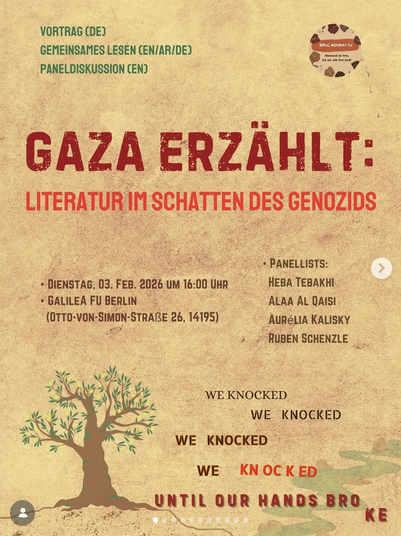
BIPoC Referat des AStA FU lädt ein zu einer Literaturveranstaltung
„Gaza erzählt: Literatur im Schatten des Genozids“.
Gemeinsam mit Autor*innen und Literaturwissenschaftler*innen soll folgenden Fragen nachgegangen werden:
– Was schreiben die Autor*innen — oder können sie überhaupt schreiben —, während ihre Wohngegend, ihr Zuhause und ihre Familien bombardiert werden und Hunger bis hin zum Verhungern erleiden?
– Warum schreiben Autro*innen inmitten des Elends? Um zu überleben? Um zu erinnern? Damit die Welt sie hört und auf ihr Leid aufmerksam wird?
– Ist es sinnvoll, diese Texte als Literatur des Genozids zu bezeichnen und einzuordnen?
– Wie beeinflußt die schnelle Übersetzung die Rezeption dieser Literatur? Verliert sie dadurch ihren Kontext — oder gewinnt sie notwendige Sichtbarkeit?
Dienstag, 03. Februar 2026, 16 Uhr
📍 GalileA @galileafuberlin (über Mensa 2 FU Berlin; Otto-von-Simson-Str. 26)
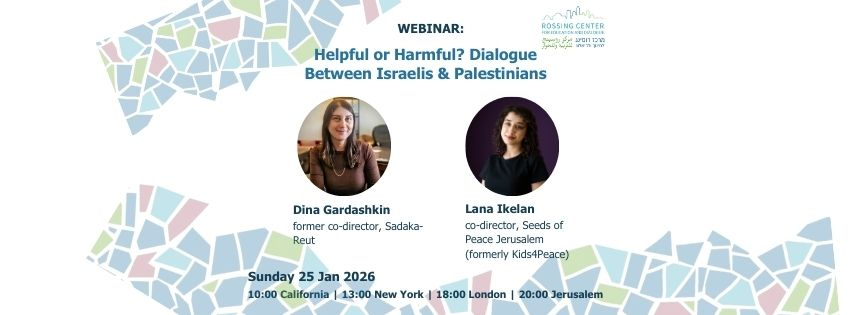
Dialogue Between Israelis & Palestinians
We’re starting from a shared premise: contact alone is not enough. If dialogue is meant to encourage participants to critically examine reality and imagine change, it must be intentionally designed and carefully facilitated. But that raises a central dilemma:
Is dialogue most effective when it happens together or separately?
Both having begun their own journeys as participants in dialogue groups and working their way up to leadership positions, our speakers bring deep, lived experience from the field:
Lana Ikelan, Co-Director of Seeds of Peace Jerusalem (formerly Kids4Peace), engages young people across deep asymmetries of power and narrative.
Dina Gardashkin, former Co-Director of Sadaka-Reut, confronts inequality, education, and political responsibility.
Together with Lana and Dina, questions such as will be explored:
• How does the group setting impact the process participants undergo?
• What kinds of transformation are possible only in mixed groups or only in separate groups?
• What are the risks and limitations of each framework?
 Sunday, January 25, 2026 | 8 pm Jerusalem time (19.00 Uhr MEZ)
Link to register:
https://us02web.zoom.us/…/register/ro4qFnh1RhqE7PpV2vdNaA
This conversation is for educators, facilitators, activists, donors, and anyone grappling seriously with what dialogue can — and cannot — do in our current reality.
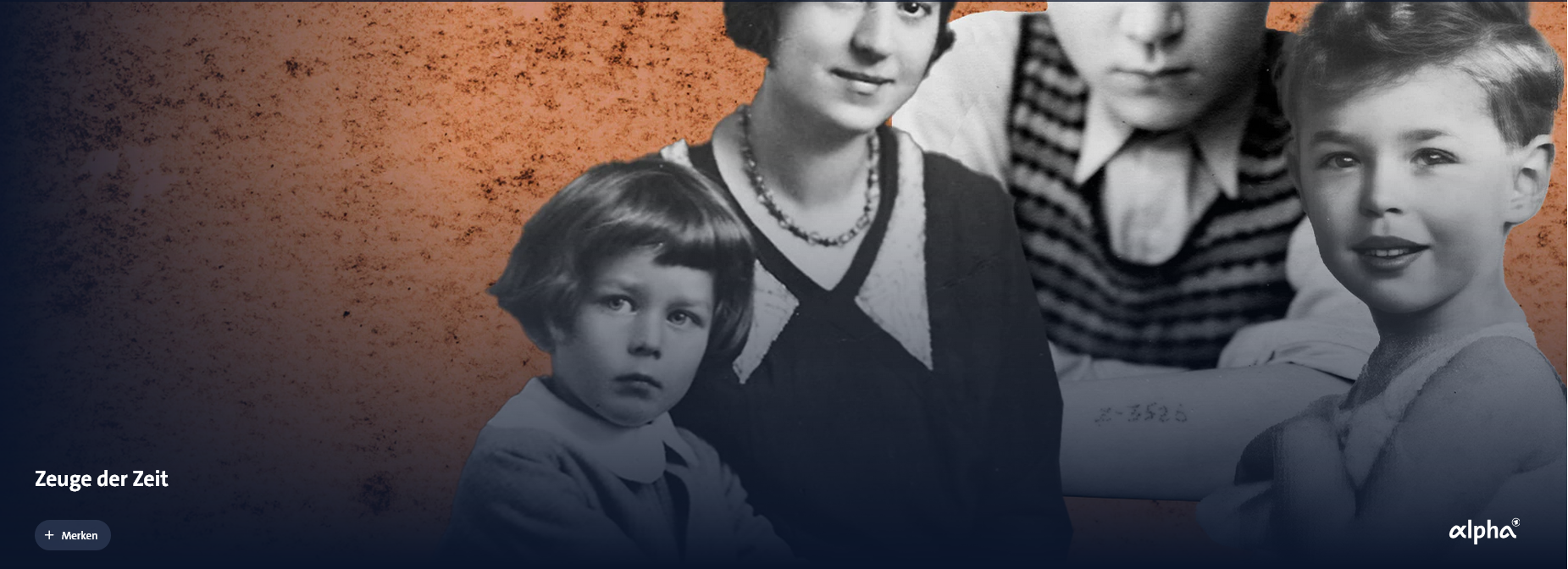
Ein Bericht in der ARD Mediathek über Giden Lev, geboren als Peter Wolfgang Löw 1935 in Karlsbad
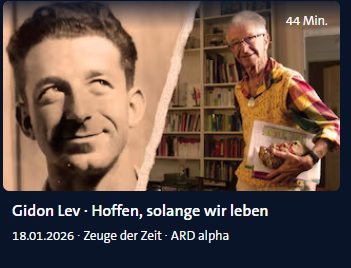
Gidon Lev ist Holocaustüberlebender – und eine der wohl außergewöhnlichsten Stimmen auf Social Media. Dieser Zeitzeugenbericht erzählt von seinem bewegten Leben. Gidon Lev wächst als einziges Kind seiner jüdischen Eltern im böhmischen Ort Karlsbad auf. Mit dem Münchner Abkommen von 1938 endet Gidons Kindheit …
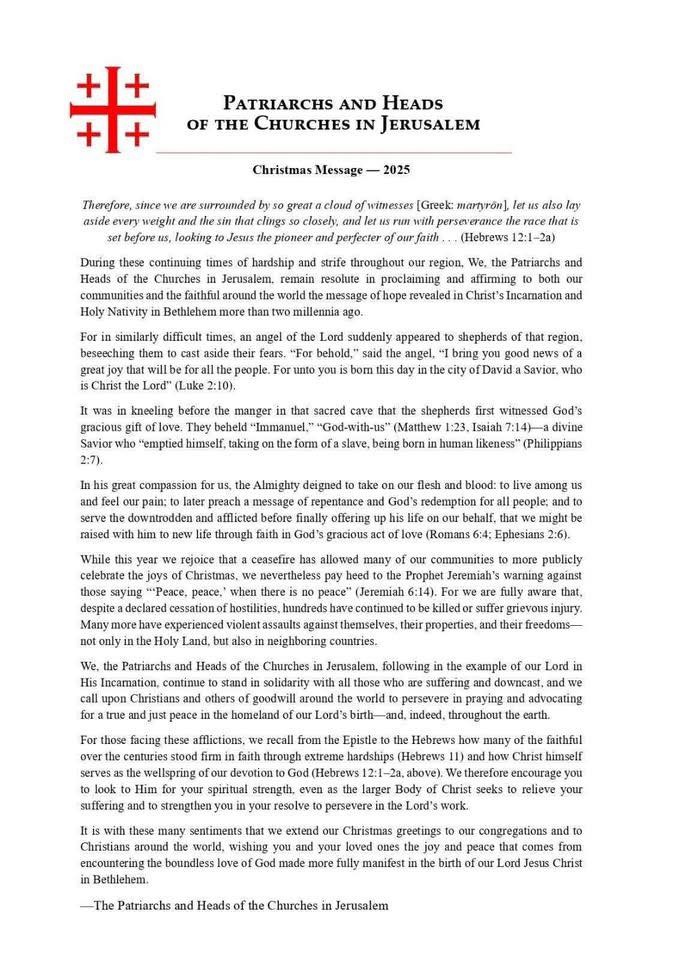
Therefore, since we are surrounded by so great a cloud of witnesses [Greek: martyrōn], let us also lay aside every weight and the sin that clings so closely, and let us run with perseverance the race that is set before us, looking to Jesus the pioneer and perfecter of our faith . . . (Hebrews 12:1–2a)
During these continuing times of hardship and strife throughout our region, We, the Patriarchs and Heads of the Churches in Jerusalem, remain resolute in proclaiming and affirming to both our communities and the faithful around the world the message of hope revealed in Christ’s Incarnation and Holy Nativity in Bethlehem more than two millennia ago.
For in similarly difficult times, an angel of the Lord suddenly appeared to shepherds of that region, beseeching them to cast aside their fears. “For behold,” said the angel, “I bring you good news of a great joy that will be for all the people. For unto you is born this day in the city of David a Savior, who is Christ the Lord” (Luke 2:10).
It was in kneeling before the manger in that sacred cave that the shepherds first witnessed God’s gracious gift of love. They beheld “Immanuel,” “God-with-us” (Matthew 1:23, Isaiah 7:14)—a divine Savior who “emptied himself, taking on the form of a slave, being born in human likeness” (Philippians 2:7).
In his great compassion for us, the Almighty deigned to take on our flesh and blood: to live among us and feel our pain; to later preach a message of repentance and God’s redemption for all people; and to serve the downtrodden and afflicted before finally offering up his life on our behalf, that we might be raised with him to new life through faith in God’s gracious act of love (Romans 6:4; Ephesians 2:6).
While this year we rejoice that a ceasefire has allowed many of our communities to more publicly celebrate the joys of Christmas, we nevertheless pay heed to the Prophet Jeremiah’s warning against those saying “‘Peace, peace,’ when there is no peace” (Jeremiah 6:14). For we are fully aware that, despite a declared cessation of hostilities, hundreds have continued to be killed or suffer grievous injury. Many more have experienced violent assaults against themselves, their properties, and their freedoms—not only in the Holy Land, but also in neighboring countries.
We, the Patriarchs and Heads of the Churches in Jerusalem, following in the example of our Lord in His Incarnation, continue to stand in solidarity with all those who are suffering and downcast, and we call upon Christians and others of goodwill around the world to persevere in praying and advocating for a true and just peace in the homeland of our Lord’s birth—and, indeed, throughout the earth.
For those facing these afflictions, we recall from the Epistle to the Hebrews how many of the faithful over the centuries stood firm in faith through extreme hardships (Hebrews 11) and how Christ himself serves as the wellspring of our devotion to God (Hebrews 12:1–2a, above). We therefore encourage you to look to Him for your spiritual strength, even as the larger Body of Christ seeks to relieve your suffering and to strengthen you in your resolve to persevere in the Lord’s work.
It is with these many sentiments that we extend our Christmas greetings to our congregations and to Christians around the world, wishing you and your loved ones the joy and peace that comes from encountering the boundless love of God made more fully manifest in the birth of our Lord Jesus Christ in Bethlehem.
—The Patriarchs and Heads of the Churches in Jerusalem
Ein Meinungsbild – German Institute for Global and Area Studies (GIGA),Dezember.2025
Eine im August 2025 durchgeführte Umfrage zeigt, daß die Mehrheit der in Deutschland lebenden Menschen eine Außenpolitik gegenüber Gaza und Israel befürwortet, die sich am Völkerrecht orientiert und auf die Wahrung der Menschenrechte abzielt. Eine kritische Reflexion über die Gründe und Konsequenzen der Kluft zwischen öffentlichem Meinungsbild und außenpolitischem Handeln ist daher dringend geboten. Prof. Dr. Thomas Richter (GIGA) und Prof. Dr. Christine Binzel (Friedrich-Alexander Universität Erlangen-Nürnberg) haben die wichtigsten Studienergebnisse jetzt veröffentlicht.
Über die Ansichten der in Deutschland lebenden Bevölkerung zum Angriff der Hamas auf Israel am 7. Oktober 2023 und Israels anschließender militärischer Offensive in Gaza ist wenig bekannt. Eine im August 2025 durchgeführte quotierte, repräsentative Online-Umfrage mit 1.050 Befragten gibt Einblicke in die Meinungen darüber sowie in die Bewertung der Medienberichterstattung, das Verständnis von Antisemitismus und die Haltung zur Erinnerungskultur.
Es stimmen 68 Prozent der Befragten der Aussage zu, daß die Hamas am 7. Oktober 2023 Kriegsverbrechen begangen hat. Ähnlich viele (65 Prozent) sind der Ansicht, daß die israelische Armee Kriegsverbrechen sowie Verbrechen gegen die Menschlichkeit in Gaza begehe. Es stimmen 59 Prozent zu, daß Israels militärisches Vorgehen als Völkermord an der palästinensischen Bevölkerung zu bewerten sei.
Nur zehn Prozent stehen uneingeschränkt hinter der Aussage, daß die Sicherheit Israels deutsche Staatsräson sein sollte. Mehr als zwei Drittel sind der Meinung, daß sich die deutsche Außenpolitik vom Völkerrecht und den universellen Menschenrechten leiten lassen soll.
Über 60 Prozent hätten sich bereits von der Ampelregierung gewünscht, israelische Kriegsverbrechen in Gaza zu benennen und zu verurteilen. Es sprechen sich 68 Prozent dafür aus, daß die aktuelle Bundesregierung die israelische Regierung zu einem Ende der Blockade Gazas und einer permanenten Waffenruhe drängt. Nur 18 Prozent wünschen sich eine stärkere militärische Unterstützung Israels.
Es sind 61 Prozent der Befragten der Ansicht, daß Kritik an Israel von Antisemitismus zu trennen sei. Schließlich sind 56 Prozent der Meinung, dass Deutschlands historische Verantwortung Jüdinnen und Juden gelten solle und nicht dem israelischen Staat.
Insgesamt kann festgehalten werden, daß sich weite Teile der in Deutschland lebenden Bevölkerung für eine Neuausrichtung der deutschen Außenpolitik mit Blick auf Gaza und Israel aussprechen. Die Mehrheit der Befragten wünscht sich eine Außenpolitik, die sich klar am Völkerrecht orientiert. Eine daraus resultierende Konsequenz ist das Vermeiden von Doppelstandards – ein Anliegen, welches ebenfalls mehrheitlich befürwortet wird. Eine kritische Reflexion über die Gründe und Konsequenzen der Kluft zwischen öffentlichem Meinungsbild und außenpolitischem Handeln ist dringend geboten. Eine fortgesetzte Neigung, völkerrechtliche Prinzipien nicht universell anzuwenden, hat das Potenzial, die bestehenden Unterschiede weiter zu vertiefen.
Die Studie wurde von der Friedrich-Ebert-Stiftung finanziert und ist in Kooperation zwischen Prof. Dr. Thomas Richter (GIGA), Prof. Dr. Christine Binzel (Friedrich-Alexander Universität Erlangen-Nürnberg) und Prof. Dr. Peter Wetzels (Universität Hamburg) umgesetzt worden.
Vollständige Fassung: Giga Focus Nahost Nr. 7
Debatte um Untersuchungskommission zum 7. Oktober
Im ORF heißt es dazu: „Mehr als zwei Jahre nach dem beispiellosen Massaker der Terrororganisation Hamas und anderer Extremistengruppen in Israel verweigert Ministerpräsident Benjamin Netanjahu weiterhin eine unabhängige Untersuchung der Vorfälle. Statt der Einrichtung einer staatlichen Untersuchungskommission befürwortet der 76-Jährige die Ernennung einer Regierungskommission.“
Times of Israel: „Lawmakers advance bill for politically appointed Oct. 7 probe in place of state inquiry“
Haaretz: Netanyahu Ministers Approve Government-controlled Oct. 7 Probe, Push Judicial Overhaul Bills – A committee of Israeli ministers has approved on Monday to advance a bill establishing an investigation into Hamas‘ October 7 attack, a Likud-sponsored proposal that would give Prime Minister Benjamin Netanyahu’s government influence over the inquiry’s composition and mandate.
An ecumenical witness for equality and a just peace in Palestine/Israel
Jerusalem, 20. Dezember 2025 | A Christmas Message – 2025
The cities of the Holy Land are adorned with lights and trees during this Christmas season, and markets and festivals abound, spreading a festive atmosphere. Many of us participate in these gatherings, as if we are thirsting for life after witnessing death and destruction over the past two years. Joy radiates from the faces of children and adults alike, in the carols and hymns, and in the markets and gifts.
We must ask: How can we celebrate while our people in Gaza are still suffering the effects of war, destruction, genocide and now face a harsh, rainy winter? Many are exposed to the elements, trying to survive without the most basic necessities. People are still dying: killed by the Israeli army, dying of starvation, disease and exposure to the cold.
How can we celebrate when, in the West Bank, terror reigns as the army imposes its regime of assassinations, mass arrests, house demolitions, land confiscation, while the settlers continue their rampage? Among those suffering under this regime of terror are our Christian brothers and sisters in Taybeh and Abboud. Their villages, like so many others, are attacked, their fields pillaged and their ancient churches desecrated.
We ask ourselves: How can we celebrate? Yet, celebrate we must!
We might indeed be powerless in the face of Israeli intransigence, which prevents life from entering Gaza, preventing law enforcement in the West Bank. However, the message from Bethlehem, Nazareth, and Jerusalem is that equality must come, injustice must end and light must triumph. Our Christmas celebration proclaims a message of life in the face of death and darkness.
Our celebrations are filled with Christmas carols and messages of hope, raised by faithful and pastors from the depths of our hearts, offering us a glimmer of hope after the horrors of the past two years. We revive hope by reliving the memory of Christmas, the birth of the Prince of Peace. Christmas is a holiday for everyone; it is a prayer, a celebration of humanity, and also a national holiday.
Some may ask: Have the celebrations and events become excessive? Have they burdened families already struggling with difficult economic circumstances? However, the number of participants in these celebrations gives the impression that they enrich the Christmas season, revitalize the economy, and bring joy and hope back to families who have waited so long.
This Christmas, we want to celebrate, but we continue, at the same time, to remain committed to our mission and our peaceful resistance, striving for equality, freedom, justice, and peace. Our hope is the hope of the shepherds at the coming of Christ. The angel told them: “I am bringing you good news of great joy for all the people: to you is born this day in the city of David a Savior, who is the Messiah, the Lord.” (Luke 2:10-11).
We rejoice and we celebrate, but with awareness and caution, for we are exposed every day to the danger of death and war in Gaza and throughout Palestine. We celebrate with our souls burdened by death in our land. Even in the heart of our city, Jerusalem, the City of God, at its so-called New Gate, there are attempts to deprive us of the serenity and sanctity of our feast, especially the municipality’s policy aimed at Judaizing the city and undermining the status quo that guarantees pluralism and the unique character of this neighborhood and the city as a whole.
Despite all this, we celebrate with our hearts lifted up to the sublimity of God, filled with the joy of the coming of the eternal Word of God, who became man and dwelt among us, our Savior and the Savior of all humanity. Through Him, we are free, witnesses and messengers of the message of love in our beloved Holy Land. Glory to God in the highest, and on all our land, peace from God, love, justice, and equality. Happy Feast!
Signatories:
Latin Patriarch of Jerusalem Michel Sabbah (emeritus)
Greek Orthodox Archbishop Attallah Hanna
Lutheran Bishop of the Holy Land Munib Younan (emeritus)
Mr. Yusef Daher
Ms. Sawsan Bitar
Mr. Samuel Munayer
Ms. Dina Nasser
Mr. John Munayer
Ms. Sandra Khoury
Rev. David Neuhaus SJ
Rev. Frans Bouwen MAfr
Rev. Firas Abdrabbo
Mr. Rafi Ghattas
Rev. Alessandro Barchi
and other members