Da kommt der Präsident Palästinas nach Berlin. Präsident eines Staates in ein Land, das seinen Staat nicht kennt, aber einer der wichtigsten Geldgeber seiner Behörde ist … in das Land, dessen Geschichte und Verbrechen zutiefst auch mit dem Schicksal seines eigenen Volkes verwoben ist. Er trifft den Kanzler, ohne Zweifel kein Freund seines Landes, hat Gelegenheit für die Sicht der palästinensischen Seite zu werben.
Am nächsten Tag spätestens muß man:frau sich fragen, wer (ihn bei) dieser Reise beraten hat.
Es gibt genug an der Politik Israels zu kritisieren, aus der Sicht der Palästinenser allemal. Aber was am Ende bleibt ist eine unsägliche Wortwahl, ein Vergleich, der überall in der Welt fehl am Platz wäre, hier, einen Kilometer Luftlinie vom Sitz Adolf Eichmann, schrillt er umso mehr.
Die offizielle Erklärung, nachgeschoben über die staatliche palästinensische Agentur Wafa. „The Holocaust is the most heinous crime in modern human history” – dieser Satz wäre in der Pressekonferenz die Antwort eines Staatsmannes gewesen, eines Menschen, (ja auch eines Palästinensers) …
Er hat seiner Sache keinen Dienst erwiesen, er hat den Palästinenser:innen in diesem Land keinen Dienst erwiesen und er hat dafür gesorgt, daß über diese Pressekonferenz und über das unsägliche Schweigen von Beteiligten gesprochen wird, nicht aber über Schritte zu einer anderen Politik, auch Deutschlands.
Wenn es nur eine verpaßte Chance wäre, ja, wenn es nur dumm gewesen wäre …
Manchem mag die Sprache gewöhnungsbedürftig sein, anderen aus der Zeit gefallen, wieder anderen im wahrsten Sinne fort-schriftlich…. Kreuzberg United hat auf seine Hompage einen Reisebericht zu einer Delegation gestellt, die zu dem zum 27. Mal stattgefundenen “Farkha-Festival” (der Palestinian Peoples Party (PPP)) nach Palästina geführt hat… (… einiges dazu ging ja schon durch die Medienlandschaft): Jedenfalls interessant zu lesen:
„Frieden gibt es erst, wenn jedem recht geschieht“
Der Zionismus ist ohne Europas Kolonialismus nicht vorstellbar. Aber zugleich ist er die Befreiungsbewegung einer von Europäern unterdrückten Minderheit. Was folgt daraus für die Debatten der Gegenwart? So führt die FAZ einen Beitrag von Michael Brenner, Professor für Jüdische Geschichte und Kultur an der LMU München.
(…) Diskurs bietet wenig Raum für Komplexitäten
Israels Geschichte ist komplex und teilweise auch paradox. Der Zionismus ist ohne den europäischen Kolonialismus nicht vorstellbar, aber gleichzeitig ist er eine Befreiungsbewegung einer von Europäern unterdrückten Minderheit. Ein Teil der jüdischen Einwanderer nach Israel waren weiße Europäer, die von anderen weißen Europäern vertrieben wurden, ein anderer Teil waren arabische Juden, die von muslimischen Arabern aus ihrer Heimat verwiesen wurden. Die Palästinenser tragen keine Verantwortung am Mord an den europäischen Juden, und doch mussten sie dafür bezahlen. Der von sozialen Medien beherrschte Diskurs bietet immer weniger Raum, um solchen Komplexitäten der Geschichte und ihrer Konsequenzen für die Gegenwart gerecht zu werden. (…)
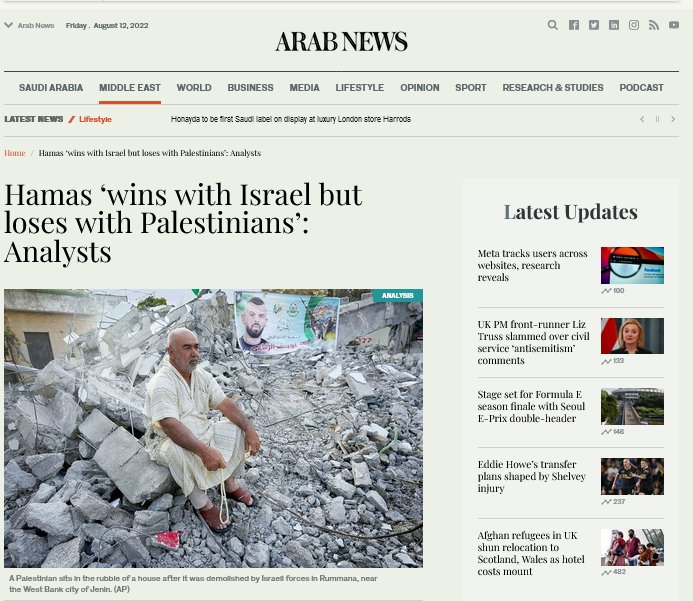
Die Hamas hat sich nicht aktiv an der eltzten Auseinandersetzung beteiligt. Hat sie damit in den Augen der Bevölkerung gewonnen, aber ihre Stellung in Iraels Augen gestärkt, so wie in der Vergangenheit die die PNA oft um ihrer eigenen Vorteile willen, dem Druck „der Straße“ nicht gefolgt ist und mit schwindende Einfluß bezahlt hat?
Ein analytischer Artikel zur aktuellen Situation und Debatte von Daoud Kuttab in den Arab News.
EIn Waffenstillstand, oder sollte man:frau besser sagen, eine Waffenkampfpause ist eingetreten und scheint aktuell zu halten.
Zur Situation im Gazstreifen das Friedensdorf eine Erkärung beschlossen und einen Aufruf.
Neve Shalom • Wahat al-Salam: Stop the attacks on Gaza!
We in the village of Wahat al-Salam / Neve Shalom call for an end to Israel’s attacks on Gaza. The one that has just ended was the fifth in recent years. We condemn every incidence of murderous military action against civilians.
Palestinians and Israelis everywhere deserve to live in safety without suffering and unnecessary grief. We all need a real peace that allows both peoples to enjoy well-being and freedom. …
From our village, we hear the booms and explosions from missile attacks and see the war planes on their way to bombing locations in Gaza. …
We are therefore initiating an emergency campaign to raise funds to send new supplies and equipment to Gaza hospitals. … The delivery will be carried out by Dr. Raid Haj Yehia, a WASNS resident who, in his capacity as a member of Physicians for Human Rights, makes regular journeys to Gaza for the purpose of providing treatment and delivering medical supplies.
Voller Wortlaut des Appells und Spendenmöglichkeit hier.
Escalation in the Gaza Strip and Israel | Flash Update #2 as of 18:00, 8 August 2022
KEY POINTS
Following intense hostilities between Palestinian militant factions, led by Palestinian Islamic Jihad (PIJ), and Israel between 5 and 7 August, a ceasefire brokered by Egypt and the UN came into effect on 7 August at 23:30.

The Israeli army and the PIJ have confirmed the end of their respective military operations.

OHCHR confirmed a total of 46 Palestinian casualties, including 16 children. MoH in Gaza reported 360 Palestinians injured, including at least 151 children, 58 women and 19 older persons.

Magen David Adom reported that 47 Israelis have been injured; Israeli authorities reported 70.

Israeli security started to gradually remove restrictions on crossings with Gaza imposed on 2 August, allowing limited movement of people and authorized commodities, including fuel.

The Gaza Power Plant, shut down since 6 August, resumed function on 8 August in the afternoon.

1,761 housing units have sustained damages. 450 Palestinians have been internally displaced, and 8,500 people have been impacted by the damages.

Gaza is slowly starting to return to routine life with the opening of public and private works, markets and educational facilities.
Escalation in the Gaza Strip and Israel | Flash Update #1 as of 18:00, 6 August 2022
KEY POINTS
On 5 August, Israeli airstrikes were conducted in multiple locations in Gaza, including Gaza city, Beit Hanoun and Khan Younis. Subsequently, several rockets were fired from multiple locations across Gaza towards Israel. Exchanges of fire continued throughout 6 August.

According to the Ministry of Health (MoH) in Gaza, as of 6 August at 15:30, at least 15 Palestinians had been killed, including a 5-year-old girl, and about 125 injured.  The UN has so far verified 14 of these casualties.

The Gaza Power Plant (GPP) shut down at noon on 6 August due to lack of fuel, causing rolling power cuts exceeding 20 hours per day. This places at severe risk the continuation of basic essential services.
The Israeli authorities have kept their border crossings with Gaza closed since 2 August, citing security concerns. As a result, people have not been allowed in and out, medical cases have been unable to exit and essential commodities, including food and fuel, have not entered.

Due to the limited availability of fuel, aggravated by the closure of Gaza’s crossings since 2 August, the general electricity supply in Gaza is already limited and expected to stop in the next days. This will seriously impact economic and social rights, including the supply of clean water, hygiene and healthcare.  The right to health is already severely compromised due to longstanding shortages and the heavily restricted movement in and out of Gaza, including for patients who have been unable to travel for care outside of Gaza.

The UN Humanitarian Coordinator issued a statement calling on all sides for an immediate de-escalation and halt to the violence, to avoid destructive ramifications, particularly for civilians.
Situation overview
On 2 August, Israeli forces arrested a senior operative of the Palestinian Islamic Jihad (PIJ) in Jenin, West Bank. Subsequently, the PIJ warned in a statement that it would “respond to any aggression.” Later that day, the Israeli authorities imposed a complete closure of crossings with Gaza, preventing movement of people and essential commodities in and out, citing security concerns.
On 5 August at 16:00, Israeli forces conducted a targeted airstrike against a senior PIJ official, Taysir Al –Ja’bari, who was reportedly killed in the attack. Several Israeli airstrikes followed during the evening in multiple locations, including in Gaza City, Beit Hanoun and Khan Younis, as part of an operation codenamed “Breaking Dawn”.
At about 21:00 on 5 August, several short- and long-term rockets were fired from multiple locations in Gaza towards Israel. Exchanges of fire continued throughout the day.
Airstrikes in the Gaza Strip resulted in death, injuries and the destruction of a number of residential buildings and rocket fire launched from Gaza resulted in the damage to one home in Israel, injured one person, two military and caused limited damage to property. According to the MoH in Gaza, as of 6 August at 15:30, 15 Palestinians had been killed, including a 5-year-old girl, and about 125 have been injured. According to Israeli media, two Israeli soldiers and one person have reportedly been wounded in southern Israel.
The humanitarian community is preparing for an eventual activation of the Inter-Agency Contingency Plan for the scale-up of the humanitarian response should the situation further deteriorate, and significant displacement occur. UNRWA has not yet opened any Designated Emergency Shelters (DES) for the displaced. Non-food items (NFIs) and ready-to-eat food Items are transferred across Gaza to be ready for distribution inside the DES in case of further displacement.
HUMANITARIAN NEEDS & RESPONSE Protection
The UN has verified 14 fatalities so far. The Gaza MoH has reported an additional fatality, not yet verified by the UN. Of them, at least two have been determined as civilians, including a 5-year-old girl. The injured reported by the Gaza MoH include at least 23 children and 13 women.
Protection Cluster partners are monitoring and documenting possible violations of international humanitarian law and international human rights law, as well as the number of fatalities.
The Mine Action Area of Responsibility (AoR) has started implementing their Emergency Risk Education plan. The messages are to focus on preparedness and protection during the emergency, including safety tips while evacuating and seeking safety, and to be delivered through different mediums, including radio and social media.
The Child Protection AoR is assessing the impact of the escalating conflict on vulnerable groups, especially children, and foresees the need for expanded, structured and specialized child protection, mental health, and psychosocial support services. Remote counseling for children and their families including psychological first aid is being reactivated, including a hotline. Shelter
Forty families are known to be displaced since 5 August in host communities, including 30 families that we in the tower building in Gaza city that sustained damage due to an airstrike. The Ministry of Public Works and Housing confirmed that some 650 housing units have been partially damaged, of which 29 are unhabitable, 11 are totally destroyed, while the others sustained minor damage. Efforts are ongoing with Ministry of Social Development to assist those affected.
The Gaza Electricity Distribution Company (GEDCO) indicated that a number of electricity lines are being fixed after sustaining some damage.
Health
Medical and diagnostic devices are in some cases not functional due to the long-standing restrictions in bringing some supplies into the Gaza strip. Additionally, there are concerns regarding shortages of fuel for ambulances and for generators in hospitals.
Trauma care supplies are in place, but there is a chronic shortage of essential drugs in Gaza. According to the MoH, there is a shortage of 40 per cent in medications, 32 per cent in medical supplies, and 60 per cent in laboratory consumables.
UNRWA’s health centres were open normally on 6 August and received patients with no disruption.
The number of ambulances by the Palestine Red Crescent Society (PRCS) has increased from 11 to 23. PRCS has also increased the number of beds in Al Quds hospital and are ready to support Ash Shifaa hospital by receiving overflow cases in operating theatres in PRCS hospitals.
WHO has pre-positioned supplies in main hospitals and has previously provided training in mass casualty management. Water Sanitation and Hygiene (WASH)
No damage to water or sanitation infrastructure has been reported. Nevertheless, the announced power supply reduction plan in the Gaza Strip, due to lack of fuel, is anticipated to significantly interrupt the delivery of WASH services, including the reduction of water supply from the water wells and desalination plants, in addition to the reduction of the quality of the output of the wastewater treatment.
The replenishment of chemicals for the treatment of water in the desalination plant could be undermined because of lack of access and the entry of supplies to the Gaza Strip. Thus, WASH services providers will not be able to operate the WASH facilities with the required capacities if access constraints continue. Additionally, chemical stocks for the desalination plant need immediate replenishment.
Due to security concerns, the three main wastewater treatment facilities are being operated remotely.
If the electricity supply stops, the wastewater treatment plants will shut down, resulting in 100,000 cubic metres of raw wastewater being discharged to the sea every day. Food security
UNRWA’s food distribution centres were open normally on 6 August and received beneficiaries with no disruption. UNRWA’s current wheat stocks will only sustain a limited segment of the population for one week and a half.
Animal fodder and production is at risk due to the closure of the Israeli goods crossing. The overall capacity of fodder stockpiles in Gaza is no more than seven days. Most fodder traders have not been able to import fodders during the last week. The continued closure of the crossing will lead to a significant damage in this sector and severe lack of white meat in Gaza.
Education
As schools are closed on summer vacation until 28 August, no direct impact on schooling has been observed. At least five higher education institutions in the Gaza Strip have suspended operations until further notice. Reports indicate that at least one higher education institution was damaged in a bombardment that hit nearby.