
Kathrin Wesolowski geht in einem Beitrag auf der Internetseite der Deutschen Welle „Anti-palästinensische/(r) Desinformation und Rassismus gegen Palästinenser „nach. Das DW-Faktencheckteam erklärt, warum solche Propaganda so weit verbreitet ist.

Kathrin Wesolowski geht in einem Beitrag auf der Internetseite der Deutschen Welle „Anti-palästinensische/(r) Desinformation und Rassismus gegen Palästinenser „nach. Das DW-Faktencheckteam erklärt, warum solche Propaganda so weit verbreitet ist.
Erklärung der Combatants for Peace (CfP)
Today is the day we have been working towards.
Today is the day we have been shouting, crying, calling for in all means available to us. Today, we welcome the announcement of a ceasefire deal that allows us to let out a deep breath, but with mixed emotions. There is joy that this nightmare is seemingly coming to an end. There is cynicism that it has taken so long to reach this point. Nevertheless, today, we breathe a sigh of relief with the people of Gaza, with the hostage families, with everyone in the land who has been suffering the consequences of this war.
But we know that our work is far from over. We know the road to reconciliation is long and requires patience. The scars of this war, on bodies, on hearts, on the land itself, will not heal quickly. But we are more committed than ever.
Today, we breathe, and tomorrow we continue to act. We act against injustice, violence, and occupation. We act in support of a just and peaceful solution.
Today is a historical day and an important first step on the road towards achieving true safety, freedom, and equality for all.
– Combatants for Peace –
Hier wieder einmal ein Hinweis auf eine interessante Initiative

The Palestine Institute for Public Diplomacy (PIPD) is a non-governmental independent organization advocating for the liberation of Palestine from all forms of settler colonialism. Our team is dedicated to advancing Palestinian people’s diplomacy as well as strengthening a Palestinian-led movement equipped with the necessary tools and influence to confront the injustices experienced by the Palestinian people, along with the systems, structures and geopolitical arrangements that perpetuate them.
In our outreach and campaigning work, we center a profoundly collaborative approach, engaging with other Palestinian voices, organized groups in Palestine and the diaspora, as well as grassroots movements worldwide. We leverage digital campaigning and educational tools as key mechanisms to strengthen Palestinian presence and discourse worldwide.
We enhance our grassroots advocacy strategy by directly engaging with international policymakers, thought leaders and media outlets in places where Palestinians can build and amplify influence in reshaping political and geopolitical transformations. Serving as a reputable point of contact, we engage with diplomats, parliamentarians, journalists, academics, and other stakeholders worldwide.
The PIPD team and Board of Directors, based both in Palestine and abroad, strive to adopt and promote an institutional model based on values of inclusion, equity, interdependence and solidarity.
Rābet is PIPD’s digital platform serving as our hub for amplifying Palestinian voices, understanding of Palestine and the Palestinian struggle, in addition to international campaigns that aims at ending complicity with the Israeli apartheid regime.
Viele offene Fragen, viel viel Hoffnung, auch mancher Zweifel und manche Skepsis: Eine Möglichkeit für eine andere Zukunft scheint sich aufzutun, sind aber auch beide Seiten schon soweit, nicht mehr an den eigenen Sieg zu glauben? Daniel Kurtz-Phelan im Gespräch mit Philip Gordon

Buchvorstellung mit Muriel Asseburg in der DAFG
Dienstag, 1. Juli 2025, 18:00 Uhr | Ort: DAFG – Wallstraße 61 – 10179 Berlin
Die aus gesundheitlichen Gründen verschobene Veranstaltung wird nun nachgeholt.
Drin. Muriel Asseburg, Senior Fellow, Stiftung Wissenschaft und Politik
Moderation: Botschafter (a.D.) Bernd Mützelburg, Vorstandsmitglied DAFG e.V.
Weitere Informationen entnehmen Sie bitte der Einladung.
Die Anzahl der Plätze ist begrenzt – Zur Anmeldung
Palestinians, Israelis, and allies from around the world gathered on May 15, for the 2025 Joint Nakba Remembrance Ceremony – to commemorate the forced displacement and dispossession of the Palestinian people, to acknowledge that the current bloodshed is a horrifying link in the long chain of conflict and violence over the land, and to insist on another way. Through the ceremony, Combatants for Peace modeled what they affirm – that understanding how each side experiences history is imperative to breaking this chain and forging a different future.
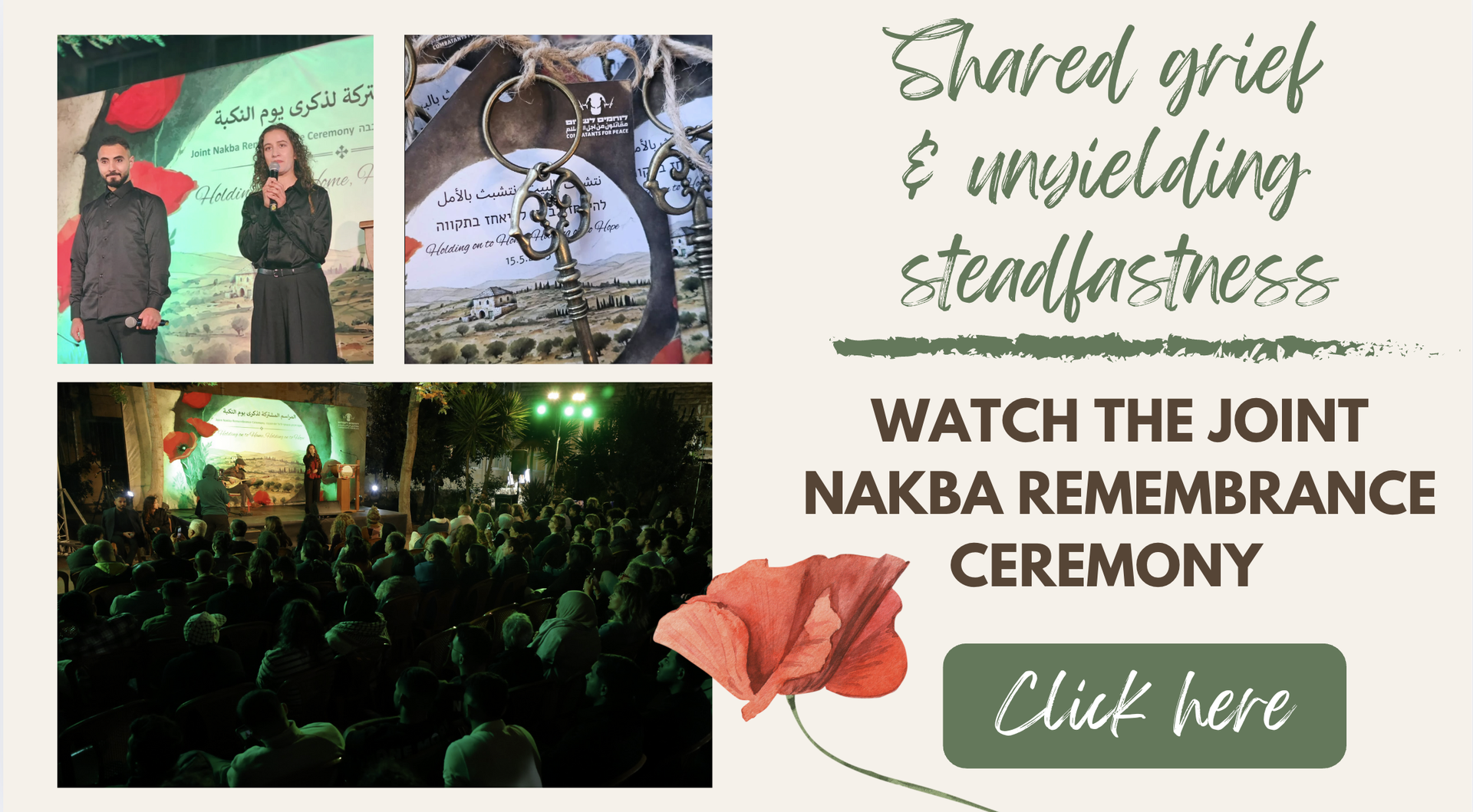
If you were unable to join or if you wish to revisit this powerful ceremony, you can watch the recording here.
Auf der Seite von 972mag reflektiert Fadi Shabita über eine alte Frage, die nichts an Aktualität und auch nichts an Sprengkraft verloren hat: Kann es einen gemeinsamen Kampf von Israelis und Palästinenser.innen (nur?) geben – wenn die Basis echte Gleichheit und Gerechtigkeit ist? Und wie sähe / sieht das dann aus?

16. April 2025 | 19.30 Uhr | Lettrétage in der Veteranenstraße 21

Photo: (c) Bashir Bashir
Kilmé is a monthly talk series dedicated to Palestinian artists, intellectuals, and academics; a platform to present their work and speak about subjects that are important to them. Kilmé means word in Arabic. The organizers are dedicated to presenting palestinian voices in all of their diversity and creativity, thus contributing to the cultural landscape of Berlin, a city with the largest Palestinian population in Europe.
In the April issue of kilmé talks, Bashir Bashir will be the guest. The evening will be moderated by Tyme Khleifi and Michael Barenboim.
Bashir Bashir is associate professor in the department of sociology, political science and communication at the Open University of Israel and a senior research fellow at the Van Leer Jerusalem Institute. Currently, he is a fellow at the Wissenschaftskolleg zu Berlin. His primary research interests are nationalism and citizenship studies, liberalism, democratic theory, decolonization, the politics of reconciliation, and alternatives to partition in Palestine/Israel. Among other numerous publications, he is the co-editor of „The Holocaust and Nakba: A New Grammar of Trauma and History“ (Columbia University Press, 2018); and „The Arab and Jewish Questions: Geographies of Engagement in Palestine and Beyond“ (Columbia University Press, 2020). His writings have appeared in English, Hebrew, Arabic, Italian, German, and Japanese.
***
Ergänzung: 11. April 2025: Hybrid-Veranstaltung im ZMO | 24. April 2025, 17.00 Uhr
There is a growing agreement among scholars, politicians and experts that the oppressive realities and colonial policies in Palestine/Israel are politically unacceptable and morally indefensible. Leading human rights organizations like Human Rights Watch, Amnesty International and B’Tselem have published extensive reports that identify these colonial policies and their disastrous impacts on the lives and rights of the Palestinians. The question of putting an end to these wretched and segregationist realities and policies and moving to more transformative and inclusive solutions has preoccupied several scholars and politicians in Israel/Palestine and beyond. Liberal and national principles in the forms of one-person one-vote or territorial and ethnic partition have been at the center of debates on these transformative solutions.
This talk argues that egalitarian bi-nationalism is better equipped to address the underlying issues of the conflict in Israel/Palestine than the liberal and secessionist national frames. Egalitarian binationalism, the talk goes on to argue, better satisfies the urge for self-determination of Palestinian Arabs and Israeli Jews than the benign neglect majoritarianism of the liberal state or ethnic secession and the partition of the two-state solution. The talk concludes that egalitarian bi-nationalism’s insistence on envisioning affective relations of co-belonging based on an ethics of equality, parity, mutual legitimacy, and cohabitation offers rich resources for historical reconciliation and decolonization in Israel/Palestine.

Auch wenn noch schwer einzuschätzen, was genau geschieht…
Susanne Brunner, Leiterin Auslandredaktion des SFR, in einem Bericht: „Gegen Krieg und Hamas – Proteste in Gaza: «Die Menschen haben genug»“

***
In der Kulturzeit com 28. März ein Beitrag von/über Akram Surany aus Gaza und seinen Brief an die Hamasführung im Ausland. (Ab Minute 22:21, nicht als eigenständiger Beitrag zu finden)

***
Ibrahim Dahman and Nadeen Ebrahim bei CNN: ‘Enough war’: Why Gazans are protesting Hamas now – sowie Beitrag mit Filmmaterial

***
Und noch der Bericht auf +972mag:

