
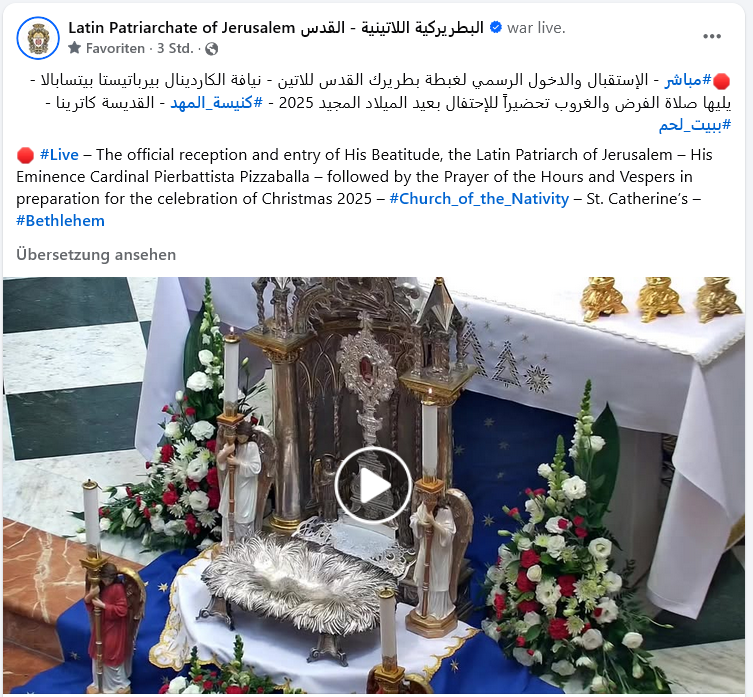
Kategorie: Heiliges Land
𝐂𝐡𝐫𝐢𝐬𝐭𝐦𝐚𝐬 𝐌𝐞𝐬𝐬𝐚𝐠𝐞 — 𝟐𝟎𝟐𝟓
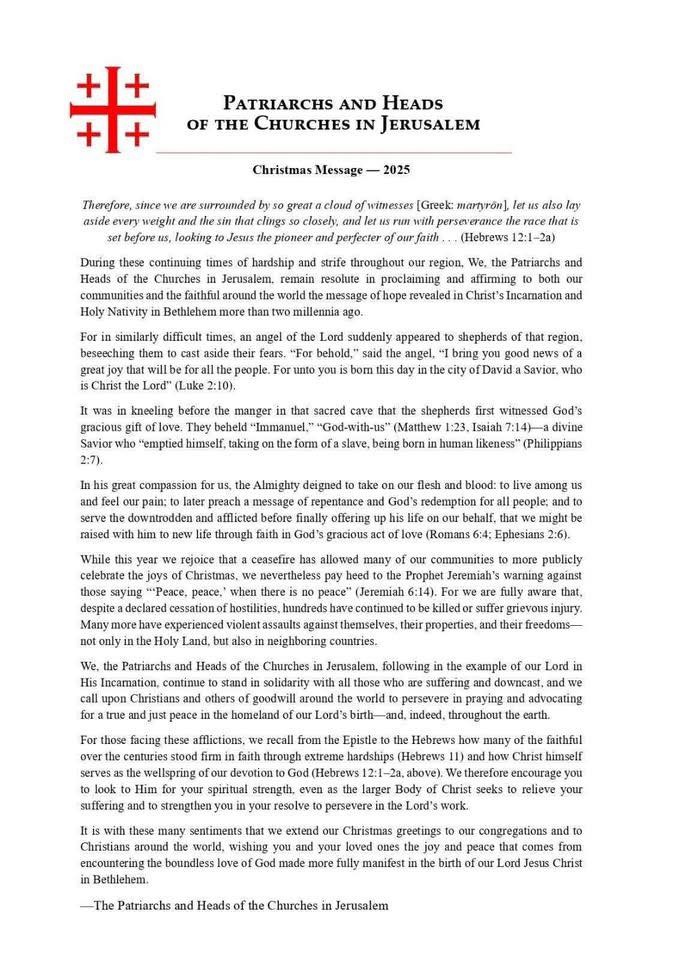
Therefore, since we are surrounded by so great a cloud of witnesses [Greek: martyrōn], let us also lay aside every weight and the sin that clings so closely, and let us run with perseverance the race that is set before us, looking to Jesus the pioneer and perfecter of our faith . . . (Hebrews 12:1–2a)
During these continuing times of hardship and strife throughout our region, We, the Patriarchs and Heads of the Churches in Jerusalem, remain resolute in proclaiming and affirming to both our communities and the faithful around the world the message of hope revealed in Christ’s Incarnation and Holy Nativity in Bethlehem more than two millennia ago.
For in similarly difficult times, an angel of the Lord suddenly appeared to shepherds of that region, beseeching them to cast aside their fears. “For behold,” said the angel, “I bring you good news of a great joy that will be for all the people. For unto you is born this day in the city of David a Savior, who is Christ the Lord” (Luke 2:10).
It was in kneeling before the manger in that sacred cave that the shepherds first witnessed God’s gracious gift of love. They beheld “Immanuel,” “God-with-us” (Matthew 1:23, Isaiah 7:14)—a divine Savior who “emptied himself, taking on the form of a slave, being born in human likeness” (Philippians 2:7).
In his great compassion for us, the Almighty deigned to take on our flesh and blood: to live among us and feel our pain; to later preach a message of repentance and God’s redemption for all people; and to serve the downtrodden and afflicted before finally offering up his life on our behalf, that we might be raised with him to new life through faith in God’s gracious act of love (Romans 6:4; Ephesians 2:6).
While this year we rejoice that a ceasefire has allowed many of our communities to more publicly celebrate the joys of Christmas, we nevertheless pay heed to the Prophet Jeremiah’s warning against those saying “‘Peace, peace,’ when there is no peace” (Jeremiah 6:14). For we are fully aware that, despite a declared cessation of hostilities, hundreds have continued to be killed or suffer grievous injury. Many more have experienced violent assaults against themselves, their properties, and their freedoms—not only in the Holy Land, but also in neighboring countries.
We, the Patriarchs and Heads of the Churches in Jerusalem, following in the example of our Lord in His Incarnation, continue to stand in solidarity with all those who are suffering and downcast, and we call upon Christians and others of goodwill around the world to persevere in praying and advocating for a true and just peace in the homeland of our Lord’s birth—and, indeed, throughout the earth.
For those facing these afflictions, we recall from the Epistle to the Hebrews how many of the faithful over the centuries stood firm in faith through extreme hardships (Hebrews 11) and how Christ himself serves as the wellspring of our devotion to God (Hebrews 12:1–2a, above). We therefore encourage you to look to Him for your spiritual strength, even as the larger Body of Christ seeks to relieve your suffering and to strengthen you in your resolve to persevere in the Lord’s work.
It is with these many sentiments that we extend our Christmas greetings to our congregations and to Christians around the world, wishing you and your loved ones the joy and peace that comes from encountering the boundless love of God made more fully manifest in the birth of our Lord Jesus Christ in Bethlehem.
—The Patriarchs and Heads of the Churches in Jerusalem
A Jerusalem Voice for Justice
An ecumenical witness for equality and a just peace in Palestine/Israel
Jerusalem, 20. Dezember 2025 | A Christmas Message – 2025
The cities of the Holy Land are adorned with lights and trees during this Christmas season, and markets and festivals abound, spreading a festive atmosphere. Many of us participate in these gatherings, as if we are thirsting for life after witnessing death and destruction over the past two years. Joy radiates from the faces of children and adults alike, in the carols and hymns, and in the markets and gifts.
We must ask: How can we celebrate while our people in Gaza are still suffering the effects of war, destruction, genocide and now face a harsh, rainy winter? Many are exposed to the elements, trying to survive without the most basic necessities. People are still dying: killed by the Israeli army, dying of starvation, disease and exposure to the cold.
How can we celebrate when, in the West Bank, terror reigns as the army imposes its regime of assassinations, mass arrests, house demolitions, land confiscation, while the settlers continue their rampage? Among those suffering under this regime of terror are our Christian brothers and sisters in Taybeh and Abboud. Their villages, like so many others, are attacked, their fields pillaged and their ancient churches desecrated.
We ask ourselves: How can we celebrate? Yet, celebrate we must!
We might indeed be powerless in the face of Israeli intransigence, which prevents life from entering Gaza, preventing law enforcement in the West Bank. However, the message from Bethlehem, Nazareth, and Jerusalem is that equality must come, injustice must end and light must triumph. Our Christmas celebration proclaims a message of life in the face of death and darkness.
Our celebrations are filled with Christmas carols and messages of hope, raised by faithful and pastors from the depths of our hearts, offering us a glimmer of hope after the horrors of the past two years. We revive hope by reliving the memory of Christmas, the birth of the Prince of Peace. Christmas is a holiday for everyone; it is a prayer, a celebration of humanity, and also a national holiday.
Some may ask: Have the celebrations and events become excessive? Have they burdened families already struggling with difficult economic circumstances? However, the number of participants in these celebrations gives the impression that they enrich the Christmas season, revitalize the economy, and bring joy and hope back to families who have waited so long.
This Christmas, we want to celebrate, but we continue, at the same time, to remain committed to our mission and our peaceful resistance, striving for equality, freedom, justice, and peace. Our hope is the hope of the shepherds at the coming of Christ. The angel told them: “I am bringing you good news of great joy for all the people: to you is born this day in the city of David a Savior, who is the Messiah, the Lord.” (Luke 2:10-11).
We rejoice and we celebrate, but with awareness and caution, for we are exposed every day to the danger of death and war in Gaza and throughout Palestine. We celebrate with our souls burdened by death in our land. Even in the heart of our city, Jerusalem, the City of God, at its so-called New Gate, there are attempts to deprive us of the serenity and sanctity of our feast, especially the municipality’s policy aimed at Judaizing the city and undermining the status quo that guarantees pluralism and the unique character of this neighborhood and the city as a whole.
Despite all this, we celebrate with our hearts lifted up to the sublimity of God, filled with the joy of the coming of the eternal Word of God, who became man and dwelt among us, our Savior and the Savior of all humanity. Through Him, we are free, witnesses and messengers of the message of love in our beloved Holy Land. Glory to God in the highest, and on all our land, peace from God, love, justice, and equality. Happy Feast!
Signatories:
Latin Patriarch of Jerusalem Michel Sabbah (emeritus)
Greek Orthodox Archbishop Attallah Hanna
Lutheran Bishop of the Holy Land Munib Younan (emeritus)
Mr. Yusef Daher
Ms. Sawsan Bitar
Mr. Samuel Munayer
Ms. Dina Nasser
Mr. John Munayer
Ms. Sandra Khoury
Rev. David Neuhaus SJ
Rev. Frans Bouwen MAfr
Rev. Firas Abdrabbo
Mr. Rafi Ghattas
Rev. Alessandro Barchi
and other members

For Gaza’s Chrildren …
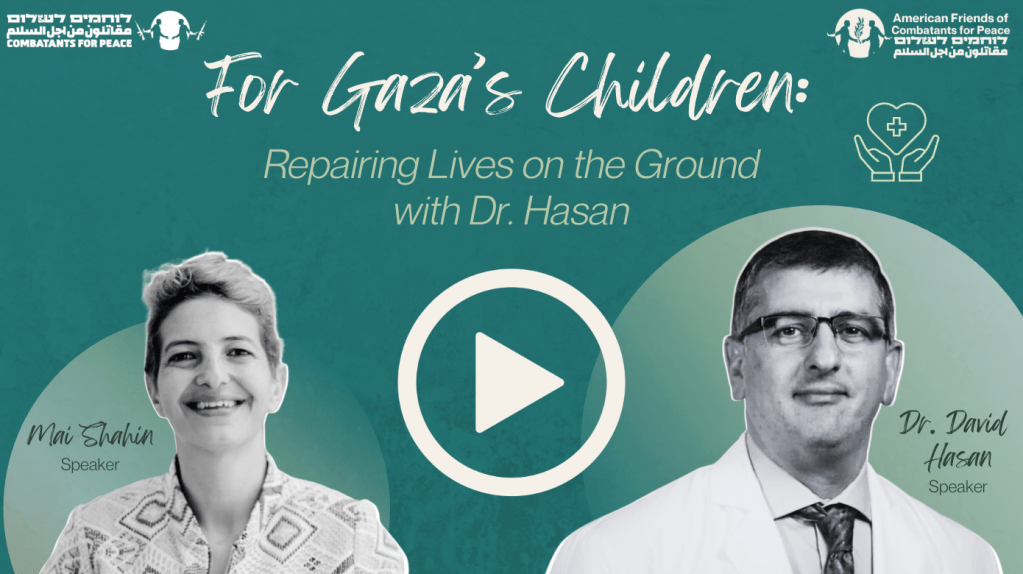
Aus dem Mailing der American Friends of Combatants for Peace
Yesterday, I was moved to my core as we gathered in shared witness: listening, reflecting, and holding what it means to respond to immense human need with compassion and responsibility.
We heard from Dr. David Hasan, a Palestinian-American neurosurgeon, Duke University professor, and the founder of the Gaza Children Village (GCV). Drawing on his frontline medical missions in Gaza, Dr. Hasan spoke about the collapse of critical systems and his decision to envision something more: a community-led model of care that protects children not only in moments of crisis, but also over the long term.
He also spoke of the urgent effort underway to convert an existing facility into what will become Gaza’s only tertiary children’s hospital, a lifeline for newborns, children with injuries, and families who have nowhere to turn.
Watch and share the recording of the talk: https://www.afcfp.org/past-events-data/for-gazas-children-repairing-lives-on-the-ground-with-dr-hasan
GCV has become a refuge for orphaned and highly vulnerable children across the Gaza Strip. Today, they serve more than 8,500 children, providing safe, structured daily environments where children can learn, heal, and grow, supported by education, nutrition, medical care, and psychosocial support.
As we close 2025, we invite you to join the work of repair in Gaza by supporting GCV directly. You can learn more about their mission and support their work here: 👉 https://www.thegazachildrenvillage.org/
Thank you for being a part of the collective movement of healing, humanity, and hope. Together, we can help build a future worthy of Gaza’s precious children.
Viele Augen sehen mehr
Wieder einmal ein Hinweis auf eine spannende Initiative

Aus der Selbstbeschreibung:
„Die Geschehnisse in Gaza tragen weltweit zu gesellschaftlichen Spaltungen bei. Auch das Verhalten der deutschen Bundesregierung befeuert Unmut in der Gesellschaft. Und wir finden die Situation schon seit einiger Zeit untragbar. Wir haben als private BürgerInnen daher den Verein „Don`t look away“ gegründet.
Wir stehen auf genau einer Seite: und zwar der der universellen Menschenrechte und des internationalen Rechts. Wir fordern besonders von der Bundesregierung und der Europäischen Union konsequente Handlungen bezüglich der in Gaza stattfindenden genozidalen Verbrechen.
Wir setzen uns schwerpunktmäßig dafür ein, dass die Bundesrepublik sich endlich für die Durchsetzung von Menschenrechten und internationalem Recht in ihrer Beziehung zu Israel einsetzt und die deutsche Außenpolitik danach ausrichtet sowie gemeinsam mit der EU-Kommission Konsequenzen folgen lässt.
Zudem fordern wir, dass Deutschland sich seinen vielen internationalen Partnerländern anschließt und den Staat Palästina anerkennt. Das Leiden und Sterben in Gaza geht uns sehr nahe. Insbesondere nach dem vermeintlichen Waffenstillstand nehmen wir eine abnehmende öffentliche Aufmerksamkeit wahr und möchten die durch Deutschland unterstützten Völkerrechtsverbrechen nicht akzeptieren. Wir sind eine Organisation aus der Mitte der Bevölkerung und sehen den Kampf gegen Antisemitismus und gegen Rassismus als gemeinsame Aufgabe an.
Unsere Forderungen werden – Umfragen zufolge – von einer Mehrheit der Deutschen getragen. Wir möchten den Menschen einen Raum für Trauer und politischen Unmut bieten, die zwar grundsätzlich politisch interessiert sind, sich aber bisher aus unterschiedlichen Gründen nicht öffentlich positioniert haben.
Seit August organisieren wir einmal monatlich Kundgebungen in München, Berlin und Köln (bald auch in Regensburg): hier verlesen wir die Namen der Kinder, die seit dem 7. Oktober in Gaza und Israel getötet wurden und stellen unsere politischen Forderungen. Uns ist symbolisch wichtig, dass getötete Kinder Sichtbarkeit erhalten, unterschiedliches Leid und Trauma gewürdigt wird und die unglaubliche Zahl der getöteten Kinder in Gaza (laut neuen Zahlen des Max-Planck Instituts bisher mindestens 30.000 direkt getötete Kinder) deutlich wird. Wir freuen uns, wenn Sie die Informationen zu diesen Kundgebungen mit uns zusammen verbreiten und selbst daran teilnehmen, etwa Namen verlesen oder eine Rede halten.
Die nächste Kundgebung in München findet statt am 27.12.2025 um 13.00 Uhr in der Sendlinger Straße.
Des Weiteren formulieren wir derzeit einen Offenen Brief, der sich an die Oberbürgermeister der Städte richtet, in denen wir Kundgebungen veranstalten. Wir fordern die Politiker:innen direkt auf, nach dem Vorbild Schweiz verletzte Kinder aus Gaza in unseren Krankenhäusern aufzunehmen und zu behandeln.

Ein Baum leuchtet
Auch in solchen Tagen, oder gerade in solchen Tagen vielleicht: Der Christbaum vor der Geburtskirche wird entzündet … es komme Licht…

Quelle: Ein Bild aus dem Facebook-Account von Mitri Raheb
Kurzer Film (mit Werbung) auf Youtube (DWS – Doha)
Bericht Deutsche Welle (Englisch)
29. November
Ein spezieller Tag für die Geschichte des „Heiligen Landes“ – 1947 wurde an diesem Tag das ehedem britische Mandat völkerrechtlich verbindlich geteilt, in einen jüdisch-zionistischen und einen arabisch-palästinensischen Staat – und ein Corpus Seperatum Jerusalem (-Bethlehem) … Die Verantwortung der Völkergemeinschaft dieses Beschluß umzusetzen, die Geschichte eines großes Scheiterns…
Der Tag wurde dann später von den Vereinten Nationen zum Tag der Solidarität mit den Palästinenser:innen erklärt … und trotz des noch immer fehlenden und nötigen Selbstbestimmungsrechtes der palästinensischen Seite, sollte dies ein Tag der Solidarität mit allen Menschen zwischen Mitterlmeer und Jordan sein. mit beiden „Völkern“ und mit allen drei Religionen und denen, die sich keiner Religion verpflichtet fühlen.
Zu diesem Tag paßt gut ein Gastbeitrag von Reimund Leicht (Judaist) und Florian Zemmin (Islamwisschaftler) von der Freien Universität Berlin:
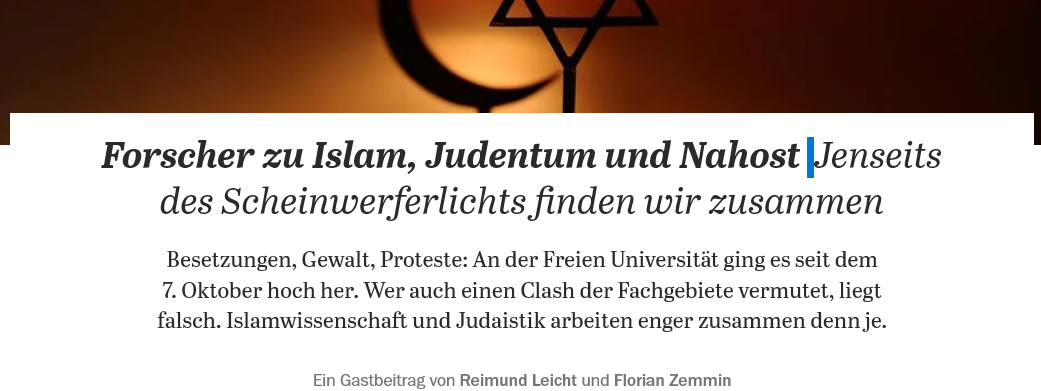
Von Professot Zemmin erscheint übrigens in der neuen Ausgabe des diAk-Zeitschrift israel & palästina (3-2025: Zwischen den Stühlen) ein längerer Beitrag zu den Narrativen der Region
Sebastia – wer kennt es noch ..
Besatzung und Enteignung macht vor nichts halt
Nachrichten zur antiken Stätte Sebastia (bei Nablus)
| November 24, 2025 |
| Aus dem Mailing vom Emek Shaveh vom 24. November 2025 In recent years, we have been closely monitoring Israel’s increasingly aggressive actions at archaeological sites across the West Bank – steps that violate international law, dramatically reshape realities on the ground and are tantamount to de facto annexation. One site we follow with particular concern is Sebastia, one of the most important archaeological sites in the West Bank and a candidate for inscription on UNESCO’s World Heritage List for the State of Palestine. Last week, the Israeli Civil Administration announced the expropriation of approximately 1,800 dunams (some 550 privately owned plots) belonging to residents of Sebastia and the neighbouring town of Burqa. Needless to say, the settlers’ plans have nothing to do with conserving the site – if that were the case, there would be no issue at all, as the entire archaeological mound lies in Area C. Despite the administrative division between Areas B and C, the town and the site form a single historical landscape. The town itself contains impressive antiquities and together, the site and the town, constitute the rich heritage of Sebastia. The settlers’ plan to separate the town from the site includes paving a new access road entirely within Area C, through which Israelis would reach the site; building a visitors’ center; fencing the site; and charging entry fees – similar to what has been done at Herodium. These steps would effectively sever the site from the town and from the community to which it has belonged for generations. Following the expropriation announcement, an emergency meeting was held yesterday in Sebastia. Residents reported that the expropriation will severely restrict access to agricultural lands and could lead to the loss of roughly 3,000 olive trees, some of them centuries old. This development comes on top of a sequence of measures that began in March 2023 with the government’s plan for the site, followed by the military seizure of the top of the mound – against which both residents and we submitted objections – and, of course, new excavations by the Staff Officer for Archaeology. All of these steps serve a clear objective: severing the community from the site and from its heritage. The emergency meeting on Saturday was attended by the Palestinian Minister of Tourism and Antiquities, the Governor of Nablus, and the Mayor of Sebastia. Participants discussed ways to oppose the expropriation and what actions might be taken to halt it. Our Executive Director, Alon Arad, also joined the meeting and presented our expertise and understanding of the situation, as well as potential avenues for action. Residents described increasing difficulties accessing their land – difficulties that resulted in nearly 60% of the olive trees not being harvested this year, an estimated loss of around 300 tons of olives. They also reported a dramatic decline in tourism, on which many families rely for their livelihood, due to movement restrictions and army harassment, including the use of tear gas and stun grenades near visitors, and demands to shut down local businesses around the site. The expropriation marks a dramatic escalation, and we are examining how we can effectively support the residents of Sebastia in resisting this plan. We will continue to update as developments unfold. For more information see the following press release: |
Emek Shaveh (Pressemitteilung vom 19. November 2025)
Ergänzung am 26. November 2025: Beitrag von David Neuhaus SJ auf Independent Catholic News, der mit diesen Zeilen endet:
„Religious leaders and people of faith and goodwill must urgently speak out to stop this action. If we remain silent in front of such an egregious decision, then more and more of the Palestinian heritage will be seized. We cannot allow the religious and cultural heritage of the Palestinians to be confiscated, violated and erased using religious texts and archaeological research. The entirety of the land we call holy is the home of Christians, Muslims, and Jews whose common heritage can be identified in the layers of history that stretch back to Biblical times. This heritage cannot be treated as the exclusive property of one group. Rather, in truly honouring this heritage, we might be able to open a future horizon of equality, justice and peace for all who treasure this heritage.“
UNESCO report: https://whc.unesco.org/en/tentativelists/5718/
Kairos Palästina II
Dis Stunde der Wahrheit: Glaube in Zeiten des Völkermords
Die Stunde der Wahrheit: Glaube in Zeiten des Völkermords Wir blicken auf den Tag, an dem wir frei in unserem Land leben werden, zusammen mit allen Bewohnern der Erde, in wahrem Frieden und Versöhnung – gegründet auf Gerechtigkeit und Gleichheit für alle Geschöpfe Gottes, wo „Gnade und Wahrheit sich begegnen und Gerechtigkeit und Friede sich küssen“ (Psalm 85,10).
Hier die deutsche Übersetzung des Textes, der versucht aus palästinensisch-christlicher Sicht eine konstruktive Perspektive zu entwickeln, ein Angebot, welches das Gespräch, auch das nicht einfache Gespräch, lohnt.

