Keeping hope alive

After a year of constant war, as the cycle of death continues unabated, we feel the need as Christians and as citizens to seek out the hope that comes from our faith. First, we must admit that we are exhausted, paralyzed by grief and fear. We are staring into the darkness. The entire region is in the grip of bloodshed that continues to escalate and spares no one. Before our eyes, our beloved Holy Land and the entire region are being reduced to ruins.

Daily, we mourn the tens of thousands of men, women and children who have been killed or wounded especially in Gaza, but also in the West Bank, Israel, Lebanon and beyond in Syria, Yemen, Iraq and Iran. We are outraged at the devastation wreaked on the area. In Gaza, homes, schools, hospitals, entire neighborhoods are now heaps of rubble. Disease, starvation and hopelessness reign. Is this the model for what our region will become?

Around us, the economy is in ruins, access to work is blocked and families have difficulty putting food on the table. In Israel too many are in mourning, living in anxiety and fear. There  must be another way!

Our catastrophe did not begin on October 7, 2023. The cycles of violence have been unending, beginning in 1917, peaking in 1948 and in 1967, continuing ever since, until today. And today has the Zionist dream of a safe home for Jews in a Jewish state called Israel brought security for Jews? And the Palestinians? They are caught up in the reality of death, exile and abandon for too long, waiting while persistently demanding the right to remain in their land, in their towns and villages.

Shockingly, the international community looks on almost impassively. Calls for ceasefire and an end to the devastation are repeated with no meaningful attempt to reign in those wreaking havoc. Weapons of mass destruction and the means to commit crimes against humanity flow into the region.

As this all continues, the questions resound: When is this going to end? For how long can we survive like this? What is the future of our children? Should we emigrate?

As Christians, we are faced with other dilemmas too: Is this a war in which we are simply passive bystanders?  Where do we stand in this conflict, presented too often as a struggle between Jews and Muslims, between Israel, on the one hand, and Hamas and Hezbollah supported by Iran, on the other? Is this a religious war? Should we isolate ourselves in the precarious safety of our Christian communities, cutting ourselves off from what is going on around us? Are we simply to watch and pray on the sidelines, hoping that this war will eventually pass?

The answer is a resounding no. This is not a religious war. And we must actively take sides, the side of justice and peace, freedom and equality. We must stand alongside all those, Muslims, Jews, and Christians, who seek to put an end to death and destruction.

We do so because of our faith in a living God and in our conviction that we must build a future together. Though our Christian community is small, Jesus reminds us that our presence is powerful. Confident in his resurrection, we have the vocation to be like yeast in the dough of society. With our prayers, our solidarity, our service and our living hope, we must encourage all of those around us, of all faiths and those with no faith, to find the strength to lift ourselves up from our collective exhaustion and find a path forward.

But none of us can do this alone. We look to our Christian religious leaders, our bishops and our priests for words of guidance. We need our shepherds to help us discern the strength that we have when we are together. Alone, each one of us is isolated and reduced to silence. Only together, can we find the resources to face the challenges.

In our exhaustion and despair, let us remember the paralytic man (Mark 2: 1-12) who could not get up. It was only when his friends carried him, when they used their imagination to create a hole in the roof and lower him down on his mat, that he was able to reach Jesus, who said to him: “Get up and walk.”

So it is with us. We must carry one another if we are to go forward. We must use our imaginations, rooted in Christ, to find openings where there appear to be none. When we have reached the limits of our hope, together we carry one another, as we turn to God and ask for help.

We need this help not to despair, not to fall into the trap of hatred. Our faith in the Resurrection teaches us that all human beings are to be loved, equal, created in the image of God, children of God and brothers and sisters of one another. Our belief in the dignity of every human person is manifest in our service to the wider community. Our schools, hospitals, social services are places where we care for all in need, indiscriminately.

It is also our faith that motivates us to speak the truth and oppose injustice. We are believers in a peace that Jesus has given us and that cannot be taken away. “He is our peace” (Ephesians 2:14). We must not be afraid to speak out against any form of violence, killing and dehumanization. Our faith makes us spokespeople for a land without walls, without discrimination,  spokespeople for a land of equality and freedom for all, for a future in which we live together.

We will only know peace when the tragedy of the Palestinian people is brought to an end. Only then will Israelis enjoy security. We need a definitive peace agreement between these two partners and not temporary ceasefires or interim solutions. Israel’s massive military force can destroy and bring death, it can wipe out political and military leaders and anyone who dares to stand up and oppose occupation and discrimination. However, it cannot bring the security that Israelis need. The international community must help us by recognizing that the root cause of this war is the negation of the right of the Palestinian people to live in its land, free and equal.

A peaceful future depends on a togetherness that extends beyond our own community. We are one people, Christians and Muslims. Together,  we must seek the way beyond the cycles of violence. Together with them we must engage with those Jewish Israelis who are also tired of the rhetoric, the lies, the ideologies of death and destruction.

Let us set forth, carrying one another. Let us keep hope alive, knowing that peace is possible. It will be difficult but we remember that we once lived together in this land as Muslims, Jews and Christians. There will be many moments when the way appears blocked. But together we will carve out a path forward, rooted in God’s hope, and “hope does not disappoint us.” (Romans 5:5). Our hope is in God, in ourselves and in every human being upon whom God bestows some of His goodness.

His Beatitude Patriarch Michel Sabbah and members of the Christian Reflection from Jerusalem

This Year at Crisis Group

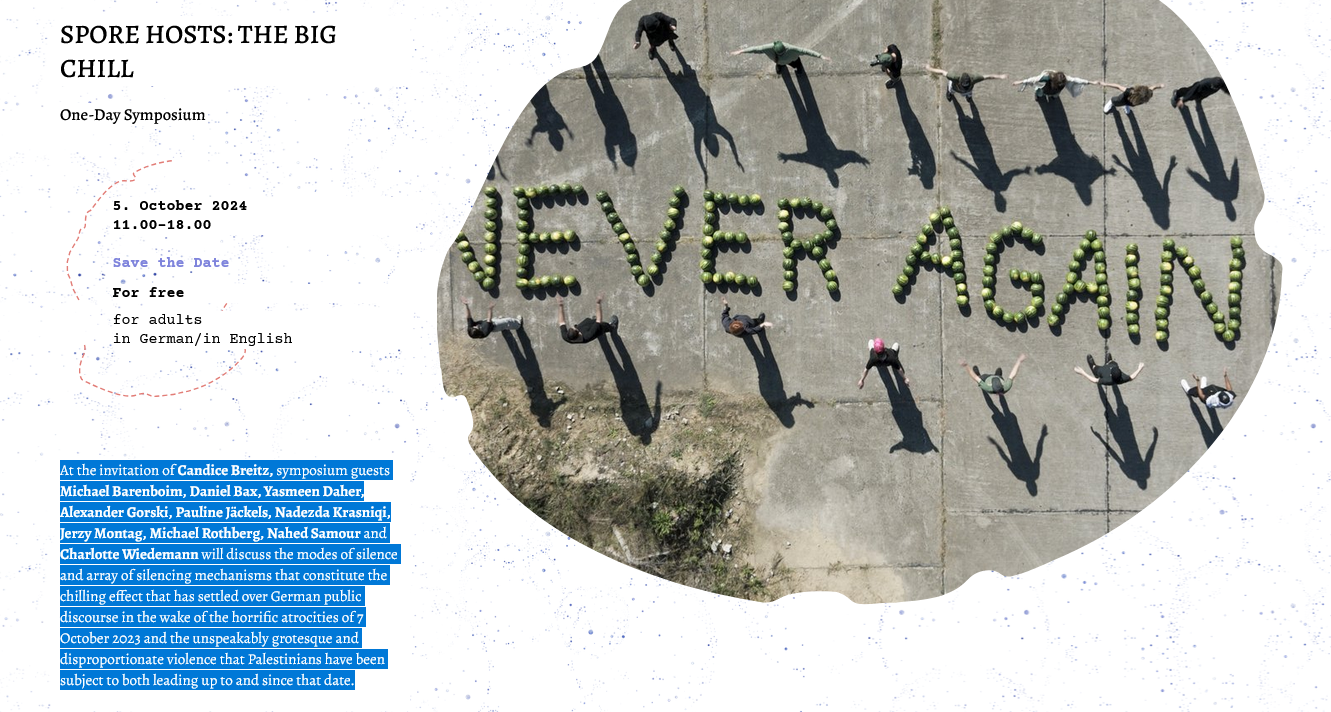
Spore: „The Big Chill“ – 5. Oktober 2024

At the invitation of Candice Breitz, symposium guests Michael Barenboim, Daniel Bax, Yasmeen Daher, Alexander Gorski, Pauline Jäckels, Nadezda Krasniqi, Jerzy Montag, Michael Rothberg, Nahed Samour and Charlotte Wiedemann will discuss the modes of silence and array of silencing mechanisms that constitute the chilling effect that has settled over German public discourse in the wake of the horrific atrocities of 7 October 2023 and the unspeakably grotesque and disproportionate violence that Palestinians have been subject to both leading up to and since that date.

5785 – das Neue Jahr MUß ein Besseres werden

Schon das vergangene Jahr war schrecklich, heute am Jüdischen Neujahr/Rosch Haschana 5785 nichts als der Wunsch, dieses Neue Jahr werde besser, friedlicher, freier, gerechter – für ALLE…

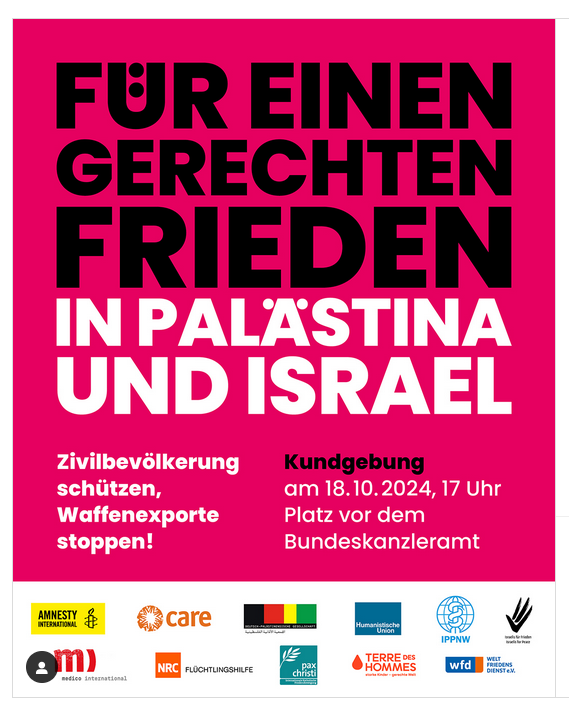
Aufruf zur Demo in Berlin

Gibt es wirklich nur den Weg der Gewalt und der Dominanz?

Das Editorial von Haaretz vom 2. Oktober 2024

The State of Israel is in the midst of the most difficult period in its history, under a reckless leadership headed by a man whose only promise he has made and kept to his people was to live by the sword. In remarks made at a new year’s cabinet meeting, Prime Minister Benjamin Netanyahu briefly mentioned the 101 hostages whom he has abandoned to suffering and death in Hamas‘ tunnels in the Gaza Strip, half of whom are no longer alive.

Under its thoughtless leadership, Israel is taking giant steps towards a regional war, while the world keeps asking itself: What does it want? Where is it heading?

Ayman Safadi, the Jordanian foreign minister, best captured those feelings in a speech that has gone viral across the globe but has been completely ignored by Israel. At a press conference following a joint celebration by Arab representatives during the UN General Assembly session, Safadi exercised his right to speak and say things all Israelis must hear.

„The Israeli prime minister came here today and said that Israel is surrounded by those who want to destroy it,“ he began. „We’re here — members of the Muslim-Arab committee, mandated by 57 Arab and Muslim countries — and I can tell you very unequivocally, all of us are willing to guarantee the security of Israel in the context of Israel ending the occupation and allowing for the emergence of a Palestinian state.“

This is not to say that Hamas did not seek to vanquish Israel, that Hezbollah is not a bitter and cruel enemy or that Iran is not seeking the worst for us, but Safadi has served to remind us of an undeniable truth: Under its long years of rule by Netanyahu, Israel has not lifted a finger for the sake of peace with the Palestinians, but the reverse.

„Do they have a narrative other than ‚I’m going to continue to go to war and kill this and kill that‘?“ he asked. „Ask any Israeli official what their plan is for peace, you’ll get nothing because they’re only thinking of the first step – we’re going to destroy Gaza, inflame the West Bank, destroy Lebanon. After that, they have no plan. We have a plan, we have no partner for peace in Israel.“

On the eve of Rosh Hashanah 5785, when the only horizon Israel’s leaders offer is war, we can only hope that in the coming year we will be blessed with a profound change in leadership and a new vision for the country. May this year and its troubles soon be over.

The above article is Haaretz’s lead editorial, as published in the Hebrew and English newspapers in Israel.

Mehr als ein Nachtrag zu: Heine-Preis 2024 an David Grossmann

David Grossman erhält auch den Marion Dönhoff-Preis 2024

24. September 2024

Für seinen unermüdlichen Einsatz im Nahostkonflikt für die Versöhnung zwischen Israelis und Palästinensern, wird der israelische Schriftsteller David Grossman mit dem Hauptpreis ausgezeichnet.

Erst vor kurzem erhielte er auch den den Ehrenpreis des Österreichischen Buchhandels für Toleranz in Denken und Handeln 2024

**

Heine Heine Preis

„Mit David Grossman ehrt die Landeshauptstadt Düsseldorf einen der bedeutendsten Vertreter der israelischen Gegenwartsliteratur, der sich für Verständigung und Toleranz nicht nur im Nahost-Friedensprozeß einsetzt“, sagte Oberbürgermeister Stephan Keller.

„Ich freue mich sehr über die Auszeichnung Grossmans, mit der ein Schaffen geehrt wird, das ganz in der Tradition Heinrich Heines Versöhnung und Dialog in den Mittelpunkt stellt.“

David Grossman wurde nach der Jury-Sitzung durch den Düsseldorfer Oberbürgermeister Stephan Keller telephonisch über die Auszeichnung informiert. „Ich freue mich sehr. Eine gute Nachricht in einer Zeit mit so vielen schlechten Nachrichten“, wird Grossman in der Mitteilung zur Auszeichnung zitiert. 

Die Jury begründet ihr Votum wie folgt:

„Den Heine-Preis der Landeshauptstadt Düsseldorf 2024 erhält David Grossman, eine der bedeutendsten Stimmen der Gegenwartsliteratur. Seine Prosa ist durchdrungen vom tiefen Verständnis und empathischer Nähe zu den Menschen mit ihren unauflöslich erscheinenden Konflikten. Ganz im Sinne Heinrich Heines tritt er klarsichtig für die Zusammengehörigkeit aller Menschen ein und setzt auf die verbindende Kraft der Literatur. In seinen intellektuell bestechenden, differenzierten Reden und Essays wirbt er unaufhörlich für Frieden und Aussöhnung im Nahen Osten. Er wird nicht müde, der Menschlichkeit eine Stimme zu geben.“

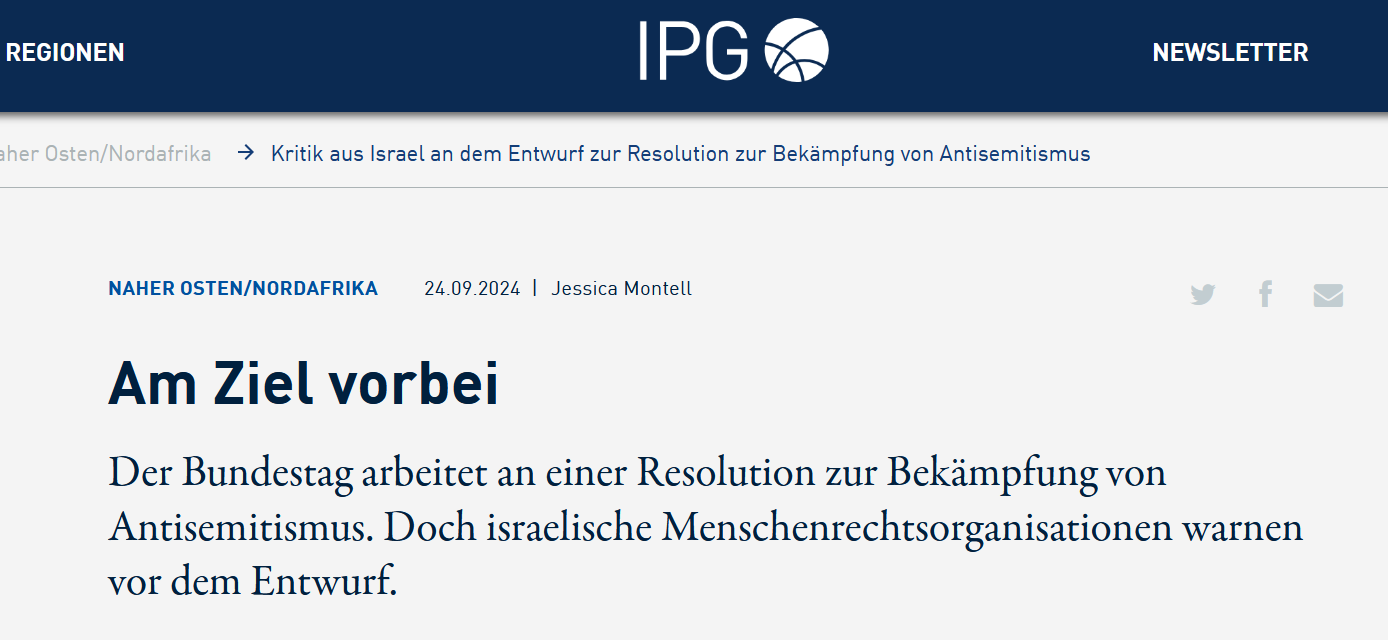
Israelische NGOs zur deutschen Debatte

Dazu ein Betrag (jpg-journal.de) von Jessica Montell (Hamoked, früher B’Tselem)

Blick auf die Feiertage….

Days of Awe: Rosh HaShana, Tashlich, Yom Kippur

October 2-12, 2024 • 1-10 Tishrei 5785 • Materialseite

From JVP Havurah Network, JVP BIJOCSM Network (Black, Indigenous, Jews of Color, Sephardi, Mizrahi), JVP Rabbinical Council, JVP Chapters, Members and Friends

KAYAN‐Projekt

Musik ersetzt nicht die harte Arbeit für den den Frieden, aber sie kann die Kraft dafür mobilisieren …

***

„Kayan“ ist das arabische Wort für „Existenz“. Als Kayan Projekt existieren Berliner Musiker aus Israel‐Palästina, Syrien und Polen als ein außergewöhnliches Ensemble, das sich um die Sängerin Eden Cami versammelt hat. Die junge Formation aus arabischer Ud, Kontrabaß und Percussion verbindet klassische und moderne Musik sowie Poesie aus der Levante mit Elementen des Jazz, die Eden Cami mit ihrem arabischen und hebräischen Gesang verwebt.

Der Lyriker Jan Wagner schreibt: „Die virtuos gezupfte Ud und das Gleiten und Schnippen und kunstvolle Stolpern des Kontrabasses treffen sich irgendwo an der Grenze zwischen Folk und Jazz, und der wunderbare Gesang der Singer‐Songwriterin Eden Cami läßt beides anklingen.

Besetzung / Stab

Eden Cami Gesang
Or Rozenfeld Kontrabass
Wassim Mukdad Oud
Borys Slowikowski Schlagzeug

Wann, wenn nicht jetzt

Noch einmal, und immer wieder: Eine andere Welt ist möglich, es gibt keinen unabänderlichen Lauf der Geschichte!

Ein Plakat und ein Mailing vom Israeli Palestinian Bereaved Family Forum // Parents Circle …