Die Stimme von CfP

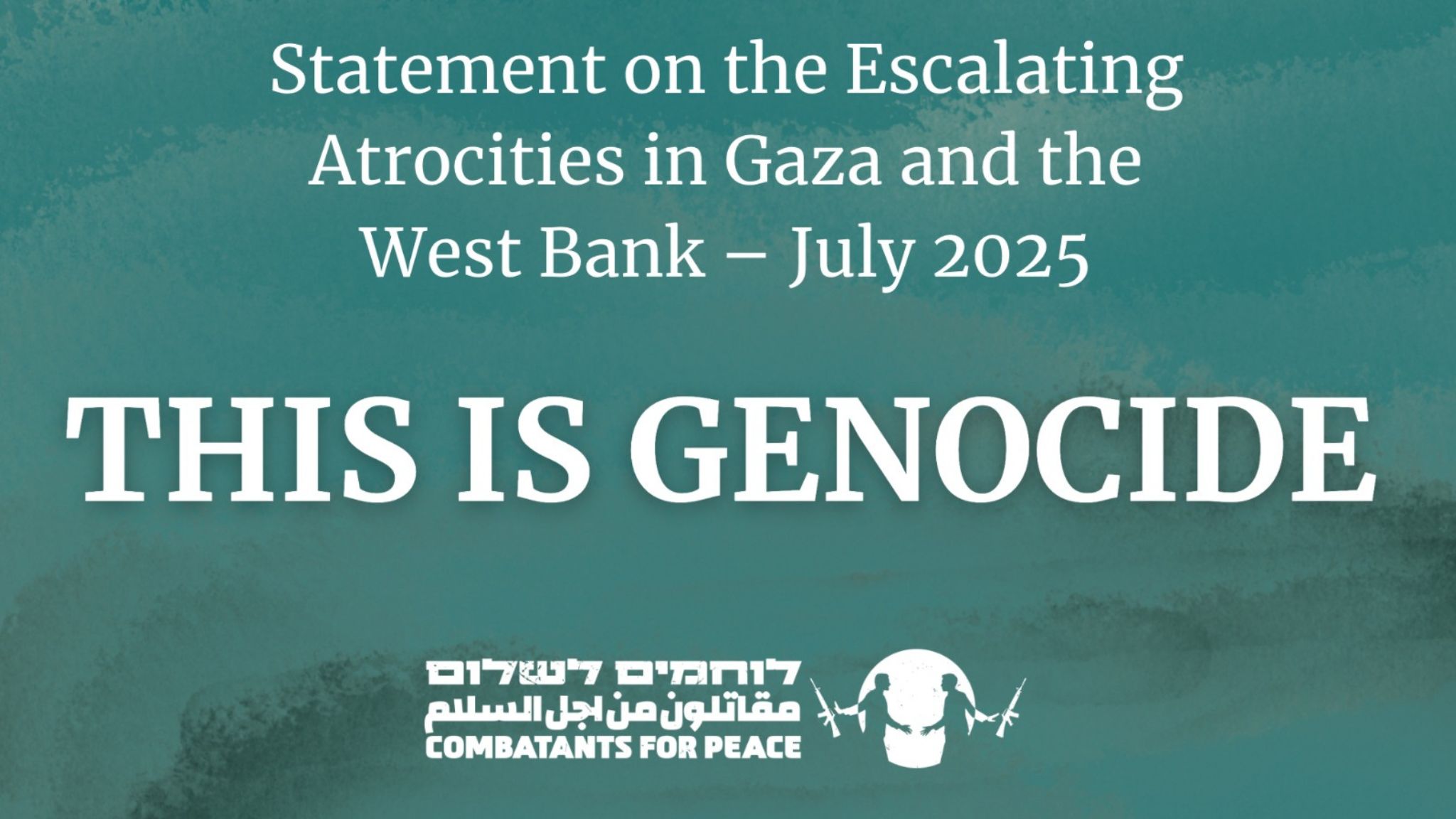
As a binational movement of Palestinians and Israelis committed to nonviolence and equality, Combatants for Peace issues this urgent statement in light of the deepening humanitarian and political crisis across Gaza and the West Bank:

In response to the continued policy of starvation in Gaza and the accelerating ethnic cleansing of Palestinian communities in the West Bank, we are compelled to speak clearly: this is genocide – and it must be stopped.

We do not use this word lightly. As outlined in B’Tselem’s recent report, Our Genocide  what we are witnessing is not simply a failure to protect civilian life – it is the deliberate, state-enabled destruction of it.

In Gaza, more than 60,000 people have been killed, including thousands of children. Families are dying of hunger, and entire neighborhoods have been reduced to rubble. Israel has systematically and deliberately destroyed over 70% of Gaza’s buildings, damaged or destroyed 94% of hospitals, and wiped out 89% of schools. Aid is obstructed, water is cut off, and civilians are being shot as they attempt to reach food. This is not a natural disaster – it is a deliberate policy choice aimed at destroying the conditions for civilian life.  

In the West Bank restrictions on movement have worsened dramatically, with checkpoints multiplying, roads closed without notice, and entire villages cut off from hospitals, schools and markets – all while entire rural Palestinian communities are being displaced by armed settlers and military units working in tandem. In the Jordan Valley, South Hebron Hills, and northern districts, homes have been torched, water sources poisoned, livestock killed, and people forced to flee. Just last night, Awdah Hathaleen – a well-known and loved community activist from Umm al-Khair – was shot and killed in yet another murderous settler attack. Weeks earlier, Sayfollah Musallet was beaten to death in the village of Sinjil while defending his family’s land from encroaching settlers. These are not isolated acts. They are part of a clear and documented strategy to remove Palestinians from their land – what international law recognizes as ethnic cleansing.

We also recognize the pain and anguish of Israeli families whose loved ones remain held hostage in Gaza. These hostages must be returned unharmed now – or, where necessary, given a respectful burial. Their immense suffering cannot be ignored. But it also cannot justify the starvation and mass killing of an entire civilian population. 

At the same time, thousands of Palestinian political prisoners remain imprisoned in Israeli jails, held in inhumane and degrading conditions. Many have endured years without trial, in solitary confinement, or denied access to legal recourse. Their release must be part of any just and lasting political resolution.

Any meaningful path toward peace must confront the full scope of human rights violations in this conflict – including the systemic use of unlawful detention and collective punishment against Palestinians, and the ongoing trauma, insecurity, and targeting of civilians experienced by Israelis. Justice must be extended to all who live here, without exception.

As Palestinians and Israelis who have chosen to walk the path of nonviolence – even in a time of war – we call on all people of conscience, within our societies and beyond them, to speak out. To act. To refuse complicity, and to reject the lies that tell us there is no other way.

We remain committed to peace, to nonviolence, and to each other. 

This commitment is rooted in the belief that the occupation must end, and that justice is not a dream – it is a requirement. Only then can we begin to repair what has been broken – and begin to build the future we know is possible: a future where Palestinians and Israelis live in freedom and equality, guided by a shared commitment to nonviolence and humanity.

In solidarity and hope,

Combatants for Peace

Halachic Left

Ein Beitrag von Yonat Shimron auf RNS

In diesen Minuten

Israelis für Frieden | Israelis for Peace

„Palästinensische Freiheit und israelische Sicherheit gehen Hand in Hand“

Ein Interview auf Kontrast.at mit der in Berlin lebenden, in West-Jerusalem aufgewachsenen Aktivistin Vered Berman.

Die andere Seite …

Während sich die Stimmen mehren, die Augen nicht länger vor dem Leid und dem Hunger der Palästinenser:innen im Gazastreifen zu verschließen (Etwa Crisis Group, Abraham Initiatives, Forward Ärzte ohne Grenzen etc.) …

Hier ein Blick auf das, was die Besatzung und die Militäreinsätze mit den Besatzern macht (… wem klingen hier nicht die Worte von Y. Leibowitz nach??)

Fiktive Grenzverletzungen

Gaza, nicht wegschauen!

Dem Horror, dem Hunger, dem Tod etwas entgegensetzen!

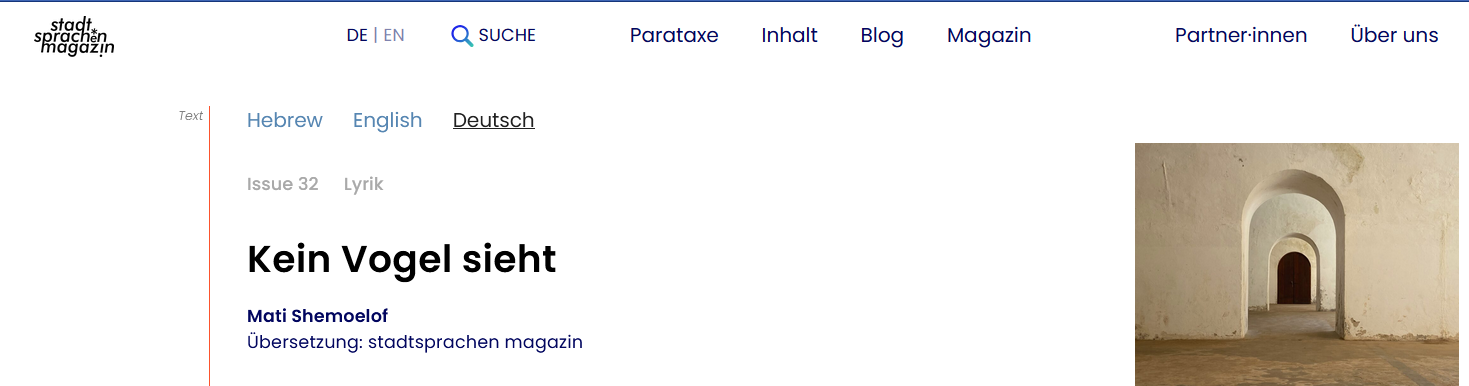
Mati Shemoelof hat im Stadtsprachenmagazin dieser Tage ein Gedicht veröffentlicht:

Anual Report 2024

Zum blättern

UNIVERSITÄT UND SCHOLASTIZID: VON KOMPLIZENSCHAFT ZU SOLIDARITÄT

Spore hosts: Erste Jahreskonferenz – Verein palästinensischer und jüdischer Akademiker*:innen (PJA)

Diese Konferenz möchte das Konzept des Scholastizids für ein Verständnis der aktuellen Situation in Palästina kritisch einsetzen und dadurch die Verantwortung von Universitäten und Bildungskräften, insbesondere in Deutschland, herausarbeiten. Seit Jahrzehnten und insbesondere seit Oktober 2023 wird der von Karma Nabulsi geprägte Begriff Scholastizid verwendet, um die absichtliche und systematische Zerstörung der Bildungsinfrastruktur in Palästina und die Unterdrückung des akademischen Lebens aufgrund der israelischen Militäraktionen im Gazastreifen zu beschreiben. Die intensiven Bombardierungen und Bodenoperationen werden gezielt gegen Schulen, Universitäten und akademische Einrichtungen eingesetzt und sind für Tod von Studierenden, Lehrenden und Verwaltungsangestellten sowie für die Zerstörung von Bibliotheken, Unterrichtsräumen und Forschungszentren verantwortlich.  

Die Verwendung des Begriffs Scholastizid neben verwandten Konzepten wie Educide und Epistemizid ermöglicht es, die Zusammenhänge zwischen Kausalität, Kontinuität und Interdependenz zwischen der Zerstörung eines Bildungssystems und der Auslöschung des palästinensischen Lebens, der palästinensischen Kultur und Erinnerung nachzuvollziehen. Er befasst sich auch mit der Unterdrückung, Marginalisierung und Ausgrenzung palästinensischer Wissenschaftler*innen in Europa. Darüber hinaus kann die Verwendung dieser Konzepte dazu beitragen, Probleme, wie den seit Jahrzehnten bestehenden erschwerten Zugang zu Bildung für Palästinenser*innen sowie die Zerstörung zukünftiger Bildungschancen zu beleuchten.

Angesichts dieser verheerenden Situation stellt diese Konferenz die Frage: Welche Verantwortung tragen Wissenschaftler*innen, Forscher*innen und Universitäten weltweit? Inwiefern sind bestimmte akademische Disziplinen und Bildungseinrichtungen explizit oder implizit an diesem anhaltenden Scholastizid beteiligt? Welche Formen nimmt diese Komplizenschaft an? Welche Strategien wenden Studierende, Lehrende und Forschende an, um über die Mittäterschaft hinaus Solidarität mit einem Volk zu entwickeln, dessen Zugang zu Bildung nicht nur gestört, sondern systematisch und gewaltsam zerstört wurde?  

Als Vereinigung palästinensischer und jüdischer Akademiker*innen (PJA), die sich für Gerechtigkeit, Wissenschaftsfreiheit und antikoloniale Wissenschaft einsetzen, veranstalten wir diese Konferenz, um kritisch zu untersuchen, wie die globale akademische Gemeinschaft auf die Zerstörung des palästinensischen Bildungswesens reagiert. Diese Auftaktveranstaltung spiegelt unsere gemeinsame Sorge um die Auslöschung der intellektuellen Zukunft Palästinas und die moralischen und rechtlichen Verpflichtungen wider, denen sich Wissenschaftler*innen und Institutionen weltweit, insbesondere in Deutschland, stellen müssen. Wir laden die Teilnehmenden ein, darüber nachzudenken, welche Handlungsmöglichkeiten angesichts institutioneller Komplizenschaft und epistemischer Gewalt bestehen. 

Organisiert vom Verein palästinensischer und jüdischer Akademiker*innen (PJA)

Teilnehmende 
  
Dana Abdel Fatah* (Berlin, DE), Najat Abdulhaq (Birzeit, PA), Alice von Bieberstein (Berlin, DE), Luis Cortés (Berlin, DE), Roser Garí Pérez (Berlin, DE), Aurélia Kalisky* (Berlin, DE), Feras Hammami (Göteborg, SE), Elad Lapidot* (Lille/Berlin, FR/DE), Nitzan Lebovic (Bethlehem, USA), Agata Lisiak (Berlin, DE), Rafaëlle Maison (Paris, FR), Mimo (Berlin, DE), Dirk Moses (New York, USA), Ben Ratskoff (Los Angeles, USA), Nahed Samour* (Nijmegen, NL), Sbeih Sbeih (Lyon, FR), Marc Siegel* (Mainz, DE), und Jorge Vega (Berlin, DE).

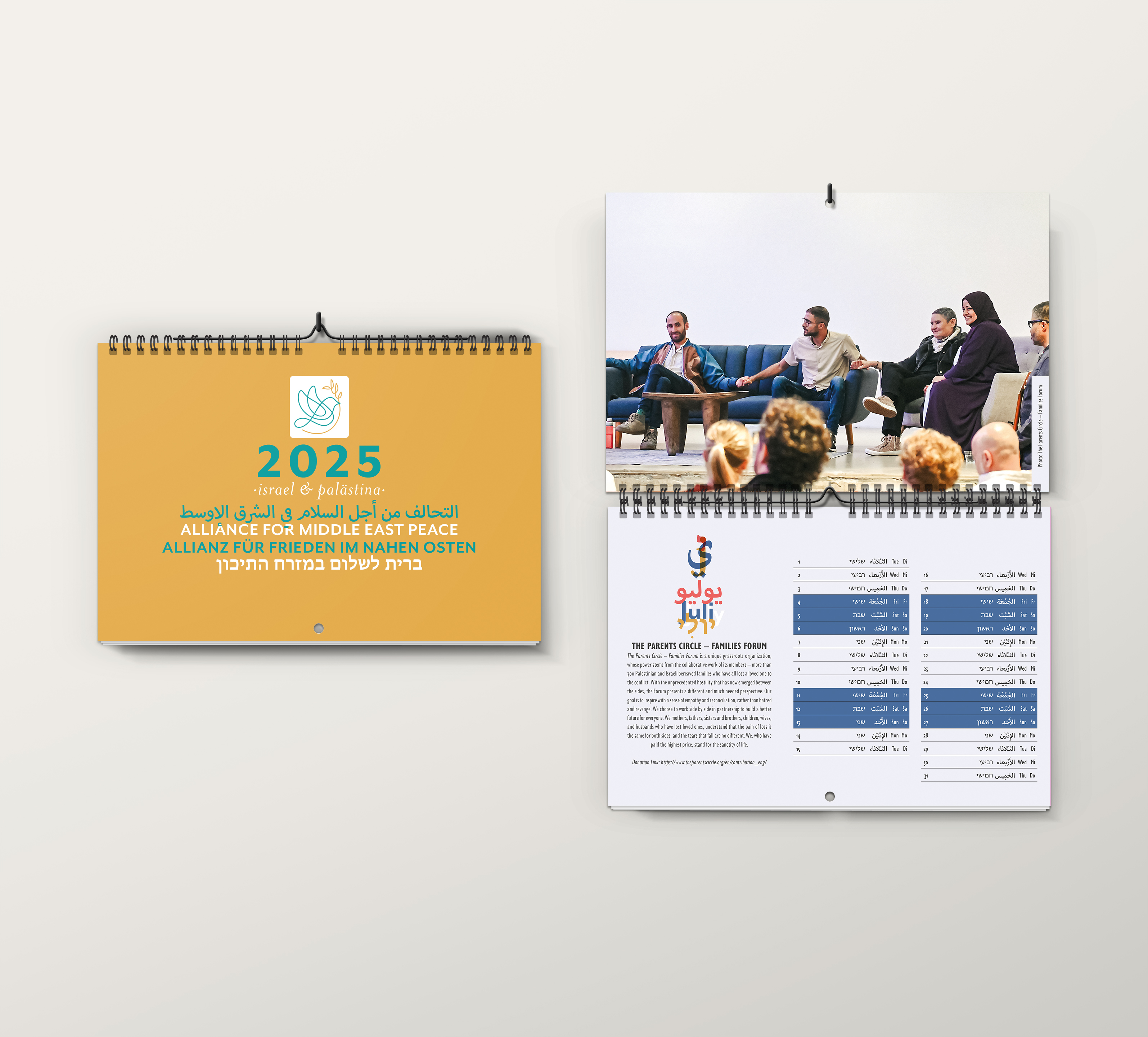
Kalender 2025 – Juli

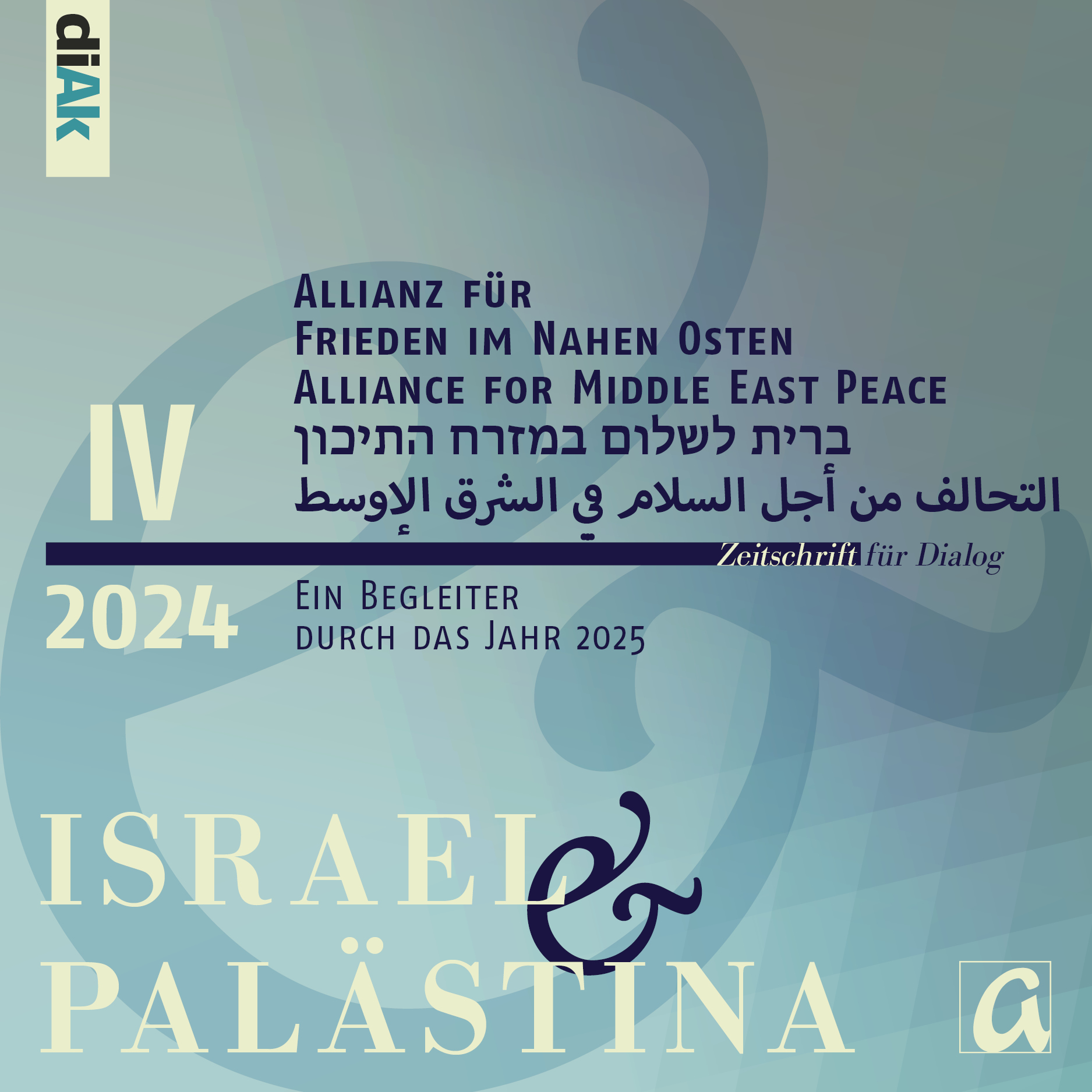
israel & palästina – Zeitschrift für Dialog | Ausgabe 4-2024

The Parents Circle – Families Forum is a unique grassroots organization, whose power stems from the collaborative work of its members – more than 700 Palestinian and Israeli bereaved families who have all lost a loved one to the conflict. With the unprecedented hostility that has now emerged between the sides, the Forum presents a different and much needed perspective. Our goal is to inspire with a sense of empathy and reconciliation, rather than hatred and revenge. We choose to work side by side in partnership to build a better future for everyone. We mothers, fathers, sisters and brothers, children, wives, and husbands who have lost loved ones, understand that the pain of loss is the same for both sides, and the tears that fall are no different. We, who have paid the highest price, stand for the sanctity of life. (Donation Link)

Es war das zehnte Mal, daß im Rahmen von israel & palästina | Zeitschrift für Dialog ein Photobegleiter in Kalenderform für das kommende Jahr erschienen ist:

Allianz für Frieden im Nahen Osten – Ein Begleiter durch das Jahr 2025

Erschienen in Zusammenarbeit mit allmep.org

Kalender 2025