Empathie als Aufgabe und Chance

Understanding the Pain of OthersThe Holocaust, the Nakba und German Memory Culture

Podiumsdiskussion vom Donnerstag, 2. Februar 2023, 19:00 h

Auf Youtube kann die Veranstaltung nachgehört/nachgeschaut werden.

Gesprächsleitung: Susan Neiman, Potsdam

 
In her book Understanding the Pain of Others, the author Charlotte Wiedemann pleads for a new inclusive memory culture that promotes solidarity instead of competition among victims. Doing justice to the victims of colonial crimes and their descendants does not call into question the specificity of the Shoah. On the contrary: the importance of human rights for all is a central lesson from the Holocaust. But tragically, Holocaust memory has not brought us much closer to such universal values.
In their co-edited volume The Holocaust and the Nakba: A New Grammar of Trauma and History Amos Goldberg, Bashir Bashir, and the contributors to the volume explore the possibility of creating a shared language for discussing the memories of two entangled, but entirely different historical events: the genocide of European Jews and the displacement of Palestinians. At the center of this new language is the concept of empathic unsettlement which challenges the mutual denial of the suffering of the Other, recognizes the political asymmetries in Israel-Palestine, and gives rise to an egalitarian binationalism.
This debate was originally scheduled to take place in the Goethe Institute Tel Aviv but was cancelled due to political pressure.


Charlotte Wiedemann
is a journalist and author. She has published numerous books on international topics, most recently Den Schmerz der Anderen begreifen. Holocaust und Weltgedächtnis (2022). Afflicted by silence in her own family, she has followed debates about German responsibility for National Socialism for four decades.

Bashir Bashir
is associate professor of political theory at the Open University of Israel and senior research fellow at the Van Leer Jerusalem Institute. His research interests are: democratic theory, nationalism and citizenship studies, liberalism, decolonization, and reconciliation. His most recent publication is The Arab and Jewish Questions: Geographies of Engagement in Palestine and Beyond (2020).
 
Amos Goldberg is associate professor of Jewish History and Contemporary Jewry at the Hebrew University of Jerusalem. For decades he has researched Holocaust memory at the intersection of history, critical theory, and literature. His publications include Trauma in First Person: Diary Writing during the Holocaust (2017) and his co-edited volume Marking Evil: Holocaust Memory in the Global Age (2015).
Eine palästinensische Stimme – aus Israel

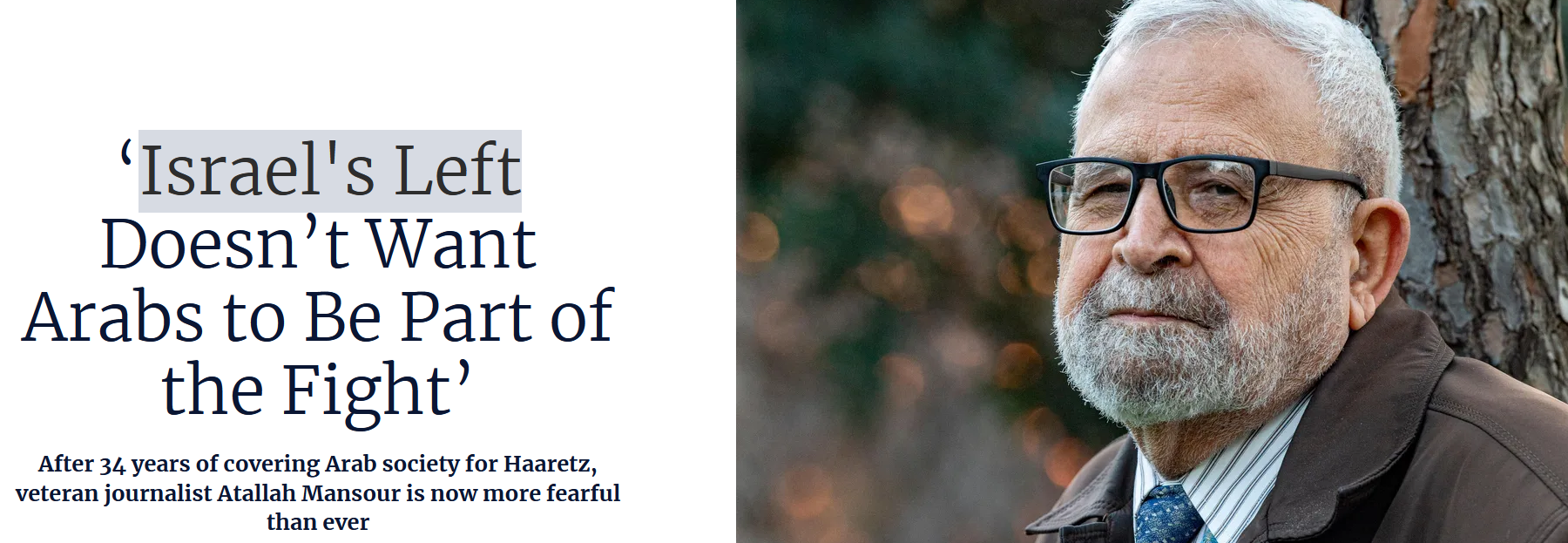
Der Journalist Atallah Mansour im Gespräch mit Sheren Falah Saab

Jahrzehntelang war Atallah Mansour eine bekannte Stimme der linksliberalen Tageszeitung Haaretz. Nun kommt der palästinensich-israelische Journalist (Jg. 1934) in einem ausführlichen Interview (9. Februar 2023: Israel’s Left Doesn’t Want Arabs to Be Part of the Fight’ – After 34 years of covering Arab society for Haaretz, veteran journalist Atallah Mansour is now more fearful than ever) zu dem Schluß, daß die Lage der arabisch-palästinensischen Israelis nie so gefährdet war wie heute. Das Nationalstaatgesetz von 2018 machte sie zu Bürgern zweiter Klasse. Die geplante ‚Revolution‘ der neuen Regierung hat nicht nur fatale Folgen für den rechtlichen Status aller Minderheiten in Israel, sie wird diese weiter sozial und politisch diskriminieren.

Hier Auszüge aus dem Gespräch:

”Mansour, the first Arab journalist to work in Israeli media, began his career at Haaretz in 1958 and covered Arab society over the next 34 years. “I wasn’t in anyone’s pocket nor was I a spokesman for any particular community. I did my work as a journalist,” he says. From the start, he understood the challenges involved in covering the Arab community for the Israeli media.”

My meeting with Mansour took place at his home in Nazareth several days after another round of protests against the judicial revolution planned by the Netanyahu government. Like many Arab Israelis, he expresses fear and uncertainty about the plan. He says that compared to all the other events of his long career, including the Second Lebanon War and the second intifada, “the situation this time is different from anything I’ve seen.”

“The changes this right-wing government is now proposing didn’t happen suddenly but have been taking place gradually and over an extended period of time,” he says. “In July 2018, they submitted the nation-state law [Basic Law on Israel as the Nation-State of the Jewish People, which critics say turns non-Jews in Israel into second-class citizens] – that was the first breaking point. … The Declaration of Independence takes into account minorities, among them Arabs, and recognizes the principle of equality, human dignity and freedom, even if it is only in theory. But the nation-state law doesn’t relate to equal rights for minorities – even the Druze who serve in the army aren’t mentioned. The nation-state law erases minorities – we’re no longer thought of as equals. That’s the worst thing that’s happened, not just on the level of the law. We’ve seen the consequences of it and they are far-reaching.”

Even the Joint List broke up.
“That happened as part of changes underway in Arab society. I voted for the Joint List – it’s the only choice left for me – but over the years we’ve seen support for Hadash [whose roots are in the Communist Party] weaken. Once they were as strong as the sun; today, they’re barely candlelight. Meanwhile, the Muslim tendencies have strengthened throughout the Arab world – the United Arab List and Mansour Abbas are part of that phenomenon.”

Do you still believe in the two-state solution? Do you think it’s a realistic scenario?

“There’s no other solution apart from two states. But if there really isn’t any readiness to compensate the families that were expelled from here, it will never happen. Peace has a price and Israel needs to make an effort. Annexation, if it happens, will ultimately harm the State of Israel – it will no longer be the same country. How long can the Palestinians remain without equality? The number of Arabs when the state was established was about 160,000. Today we are 2 million, and we are still fighting for full equality of rights.”

Fritz Bauers Erbe

Gerechtigkeit verjährt nicht – Deutschland 2022 – 98 min

Regie: Sabine Lamby, Cornelia Partmann, Isabel Gathof

Jahrzehnte nach Kriegsende finden derzeit die wahrscheinlich letzten Gerichtsverfahren wegen NS-Verbrechen statt. Wie kam es dazu, dass ehemalige SS-Wachleute nun als Greise vor dem Jugendgericht stehen, die bis dahin weitestgehend von Polizei und Justiz unbehelligt leben konnten? Lange konnte die deutsche Justiz nicht der historischen Tatsache gerecht werden, daß der systematische Massenmord in Konzentrationslagern nicht durch einzelne, wenige Täter, sondern nur durch die Unterstützung von tausenden Mittätern begangen werden konnte. Es galt der sogenannte Einzeltatnachweis, der insbesondere durch Zeugenaussagen der KZ-Überlebenden erbracht werden mußte. Dabei war der juristische Grundstein für einen Paradigmenwechsel längst durch den Generalstaatsanwalt Fritz Bauer gelegt, der im historischen Frankfurter Auschwitz Prozeß 1963 zum ersten Mal Angeklagte für Beihilfe zum Mord vor ein deutsches Gericht brachte. Doch schon damals kam es, trotz umfassender Erkenntnisse zum industrialisierten Massenmord, nicht zu einer Prozeßflut – im Gegenteil: die Strafverfolgung von NS-Verbrechern nahm sogar ab. Rund 60 Jahre später findet Fritz Bauers Erbe nun Anwendung.

Der Dokumentarfilm FRITZ BAUERS ERBE – GERECHTIGKEIT VERJÄHRT NICHT zeigt anhand der jüngsten NS-Prozesse zum „KZ Stutthof“ in Münster (2018/2019) und Hamburg (2020), wie sich Fritz Bauers Ansatz als neues Prinzip der Rechtsauffassung in Deutschland etablieren konnte. Mit bewegenden und aufrüttelnden Zeitzeugenberichten von Überlebenden, die in den Prozessen als Nebenklägerinnen auftreten, entfaltet der Film nicht nur eine faszinierende Geschichte darüber, wie die Gerechtigkeit ihren Weg in die deutschen Gerichte fand, sondern veranschaulicht auch die wegbereitende Bedeutung der heutigen Urteile als Mahnung für die Zukunft.

Vorführ-Termine:

Berlin, 23.02

Bochum, ab 09.02

Dresden, 12.02-14.02

Düsseldorf, 11.02, 12.02

Frankfurt, 19.02.23

Gera, 16.02

Hamburg, ab 09.02

Hannover, 18.02, 19.02, 25.02, 26.02

Hillesheim, ab 09.02

Karlsruhe, 12.02, 28.02

Kassel, 12.02

Ketsch, 16.03

Kiel, ab 09.02

Köln, ab 09.02

Lübeck, ab 09.02

Mannheim, 15.02

Marburg, 11.02, 12.02

München, 12.02, 01.03

Münster, 18.02, 22.02

Nürnberg, ab 09.02

Oldenburg, 12.02, 13.02

Pforzheim, 22.02

Speyer, 14.02

Stuttgart, 12.02

Quickborn, 09.03, 12.03

Hat die Zweistaatenlösung noch eine Chance?

Tagesspiegel (E-Paper) vom 8. Februat 2023

Drei Statements:
Muriel Asseburg ist Senior Fellow in der Forschungsgruppe Afrika und Mittlerer Osten der Stiftung Wissenschaft und Politik (SWP) in Berlin

Omri Boehm ist Associate Professor für Philosophie an der New School for Social Reseach in New York

Carsten Ovens ist Geschäftsführer von ELNET Deutschland e.V., einem Thinktank, der sich mit den deutsch-israelischen Beziehungen beschäftigt

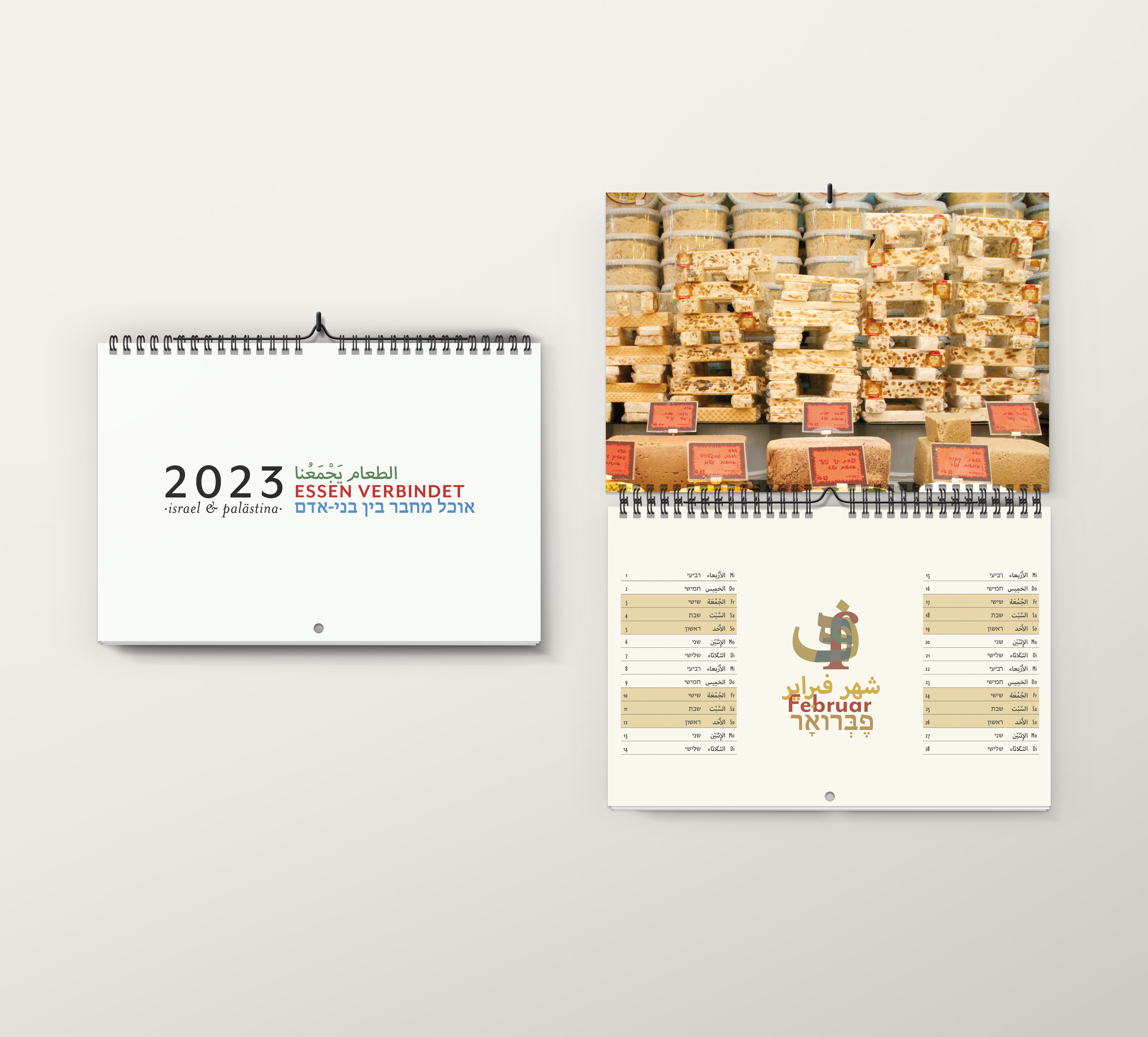
Kalender 2023 – Februar

Essen verbindet

Ein Begleiter durch das Jahr 2023 – Mit Photos von Bärbel Doering und aus dem AphorismA Verlagsarchiv

Der Wirklichkeit eine Vision entgegenhalten: Es gibt immer eine andere Zukunft!

Photo: Bärbel Doering

israel & palästina – Zeitschrift für Dialog | Ausgabe 4-2021


Multiperspective Holocaust Remebrance in Contemporary Europe

Insights from the Practice of European Holocaust Education and Exhibitions

Online Event – 7th February 2023, 3-5pm (CET)Link zu MuRem

How can the Holocaust be exhibited and educated alongside other historical and contemporary human rights and discrimination topics? What are the similarities in the challenges and approaches in different European contexts, and how do they differ? These are the questions we will discuss based on practical experiences from our European network at the online event. Representatives of Holocaust Education institutions in Poland, France, Belgium and Norway will give insights into their practical experiences with multiperspectivity. In dialogue with Hubert Strouk (Mémorial de la Shoah), Katarzyna Kulińska (POLIN museum) will explain, how the Holocaust Education at POLIN museum touches the contemporary refugee situation. Isabelle Diependaele (Kazerne Dossin) will address the question of multiperspectivity from the exhibition perspective in dialogue with Elise Grimsrud Christensen (Norwegian Center for Holocaust and Minority Studies). They will talk about their experiences in educational offers around special exhibitions on human rights and discrimination alongside main exhibitions on the Holocaust. We then present and launch a European survey on multiperspectivity in Holocaust education. The goal of the survey is to gain an insight into different approaches to addressing the various current challenges of Holocaust remembrance and education in Europe.

The survey is also supposed to give a better idea of what multiperspectivity could mean in different contexts and whether and how this approach is implemented. The event is part of the project „Multi-Perspective Holocaust Remembrance in Contemporary Europe“ (short: MuRem), coordinated by the Berlin-based NGO Minor. The goal is to build a network and strengthen multiperspectivity and interdisciplinarity in European Holocaust Education by taking into account the diversity of memory cultures and their consequences for the present.

Please find the full program attached and online, and register here.

Topographien von Flucht und Vertreibung

Narratives of Displacement with Prof. Dr. Yafa Shanneik – Zoomveranstaltung: 15.2.2023


Last fall‘s exhibition at the University of Würzburg, “Narratives of Displacement—Topographien von Flucht und Vertreibung“, presented art created by Iraqi and Syrian refugees in Germany, the United Kingdom and Jordan. Refugees shared their experiences of escaping war and settling into new countries. The exhibition included augmented and virtual reality technology to offer visitors an immersive and interactive experience.

The exhibition is part of the project ‘Negotiating Relationships and Redefining Traditions’ led by Prof. Dr. Yafa Shanneik who will be speaking about the project and its innovative techniques at the 25th DAFG Jour Fixe event.

Wednesday, 15 February 2023, 6 p.m. CET – Online Event via Zoom in English

Yafa Shanneik is Visiting Professor of Islamic Studies at the University of Lund/Sweden. She researches the dynamics and trajectories of gender in Islam within the context of contemporary diasporic and transnational Muslim women’s spaces. Currently, she is working on a project which explores women’s narratives of transnational marriage practices performed by Iraqi and Syrian women who have settled in Europe and other countries in the Middle East since the 1980s. She has published several articles and books on gender and Islam. Her monograph: The Art of Resistance in Islam. The Performance of Politics among Shi‘i Women in the Middle East and Beyond was published by Cambridge University Press in 2022.

More information on the exhibition is available here and more about the project here.

Please see also event invitation or visit the DAFG website.  

Please register online here: https://us02web.zoom.us/webinar/register/WN_IfUt3a4zSv6m-iNOvJ2Ajg

DAFG – Deutsch-Arabische Freundschaftsgesellschaft e.V. | Berlin

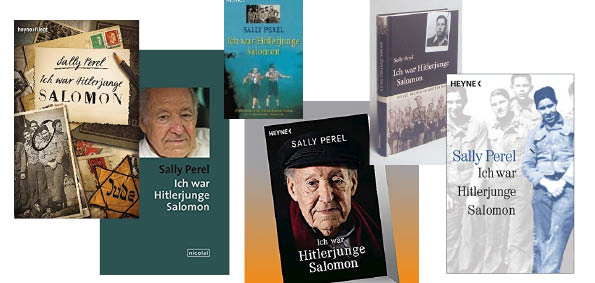
Hitlerjunge Salomon

Sally Perel z״l starb mit 97 Jahren in Israel

1925 in der niedersächsischen Stadt Peine geboren, starb er am 3. Februar in Tel Aviv.

Würdigungen (Auswahl): Deutsche WelleTagesspiegel

Auswahl aus den vielen Ausgaben seiner (auch verfilmten) Erinnerungen …

International Crisis Group

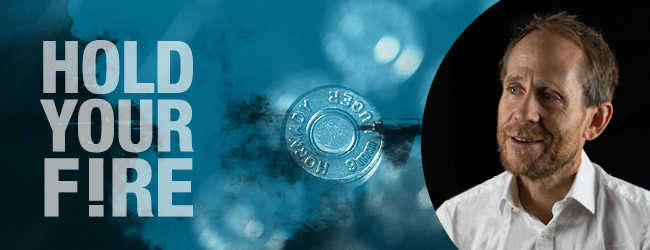
Der aktuelle Podcast zur Situation in Israel &Palästina

On Friday last week, a Palestinian gunman killed seven civilians in occupied East Jerusalem, the deadliest such attack for years. The shooting came the day after a raid by Israeli forces in a refugee camp in the West Bank city of Jenin, also the deadliest such operation for years. The week’s violence follows months in which more Palestinians died, according to human rights groups, than in the past almost two decades. More frequent Israeli raids, which Israel says aim to root out Palestinian militants behind an increasing number of attacks on Israelis, often provoke gun battles in West Bank cities. Militants have died, but also civilians, including many young Palestinians. In West Bank cities, new militias have formed, attracting young Palestinians angry not only at Israel but also at their own political leadership. Meanwhile, the new Israeli government of Prime Minister Benjamin Netanyahu, which is the most right-wing in Israeli history and comprises openly Jewish nationalist and anti-Palestinian ministers, promises an even tougher line on Palestinians. 

This week on Hold Your Fire!, Richard Atwood speaks with Mairav Zonszein and Tahani Mustafa, Crisis Group’s Israel/Palestine experts, about the latest spike in violence. They talk about Israel’s new government, its efforts to curb judicial power and what it might mean for policy toward the Palestinians. They also talk about Palestinian politics, many Palestinians’ disillusionment at their leadership, the emergence of new militias in West Bank cities and what might happen when ageing Palestinian President Mahmoud Abbas passes from the political scene. They ask whether there is any hope of change in policy from Washington and other Western capitals following U.S. Secretary of State Antony Blinken’s trip to the region this past week. They also talk about flashpoints in the months ahead.  

Wieder Vandalismus an christlicher Stätte in Jerusalem

Nachdem erst vor wenigen Tagen der protestantische Friedhof auf dem Zion Ziel der Zerstörungen war, brach am 2. Februar (Maria Lichtmeß) ein radikaler Jude in die Kirche der Flagellation (Geißelungskapelle am Beginn der Via Dolorosa) ein und zerstörte eine Christusfigur, bevor er von Wächtern überwältigt werden konnte.

Hier die Stellungnahme des Custos der Franziskaner, auf deren Gelände die Kapelle liegt, sowie ein kurzes Video.

Erst am Tag zuvor war es zu „violant attacks“ gekommen, wie es in Erklärung des Lateinischen Patriarchates heißt:

A STATEMENT ISSUED BY
THE JERUSALEM PATRIARCHATE
REGARDING THE RECENT RADICALS’ ATTACK ON THE CHRISTIANS OF THE NEW GATE AREA