The tribal societies of the Ottoman Middle East underwent significant transformations from the latter half of the nineteenth century onwards, shaped by a complex interplay of the global trends, Ottoman centralization, and the resulting urban-rural intertwinements. While the available scholarship has addressed these developments, it is difficult to claim that they provide adequate contextualization of the female tribal agency. This talk will argue that the women of the Arab tribes played remarkable roles in the adaptation of their communities to Ottoman modernization, using the example of three sheikhas (wives, sisters and mothers of tribal chiefs). They contributed to evolving imperial policies in a negotiating direction. It will focus on how these sheikhas emerged in the political, social, and judicial spheres of the urban and rural Middle East to defend their community’s interests. In addition, this talk will discuss how the tribal female leadership contributed to the development of the new political and social tools indicating how they actively participated in the tribal resistance against the Ottoman expansionism in early decades of the Tanzimat reformism and the processes of negotiations that followed and resulted with the integration of the tribal groups in the new system of the governance.
Talha Çiçek is an associate professor at the School of History, University College Dublin. Formerly, he was the British Academy Post-Doctoral Fellow at SOAS, England, and Humboldt Experienced Research Fellow at Leibniz-Zentrum Moderner Orient in Berlin. He is the author of the two books, War and State Formation in Syria: Cemal Pasha’s Governorate during World War I (Routledge, 2014) and Negotiating Empire in the Middle East: Ottomans and Arab Nomads in the Modern Era, 1840-1914 (Cambridge UP, 2021). Currently, he is working on the history of the Arabian horse in a global context and leading an ERC Consolidator Grant entitled „Global Capitalism and Rurality: Agency, Commodification and Socio-Ecological Transformation of the Middle Eastern Countryside, 1870-1945“.
Ein Beitrag von Fanny Oz-Salzberger auf Qantara.de (Zuerst: Ein neues Israel, Internationale Politik, Mai 2026)
Ein Zitat daraus:
„Ein neuer Naher Osten mag in der Entstehung begriffen sein. Die dringlichere Frage ist aber, ob damit auch ein neues Israel entsteht – und ob dieses Israel auf lange Sicht demokratisch bleiben wird. Sollte das nicht geschehen, dann wird es von keinem militärischen Sieg aufgewogen werden können.“
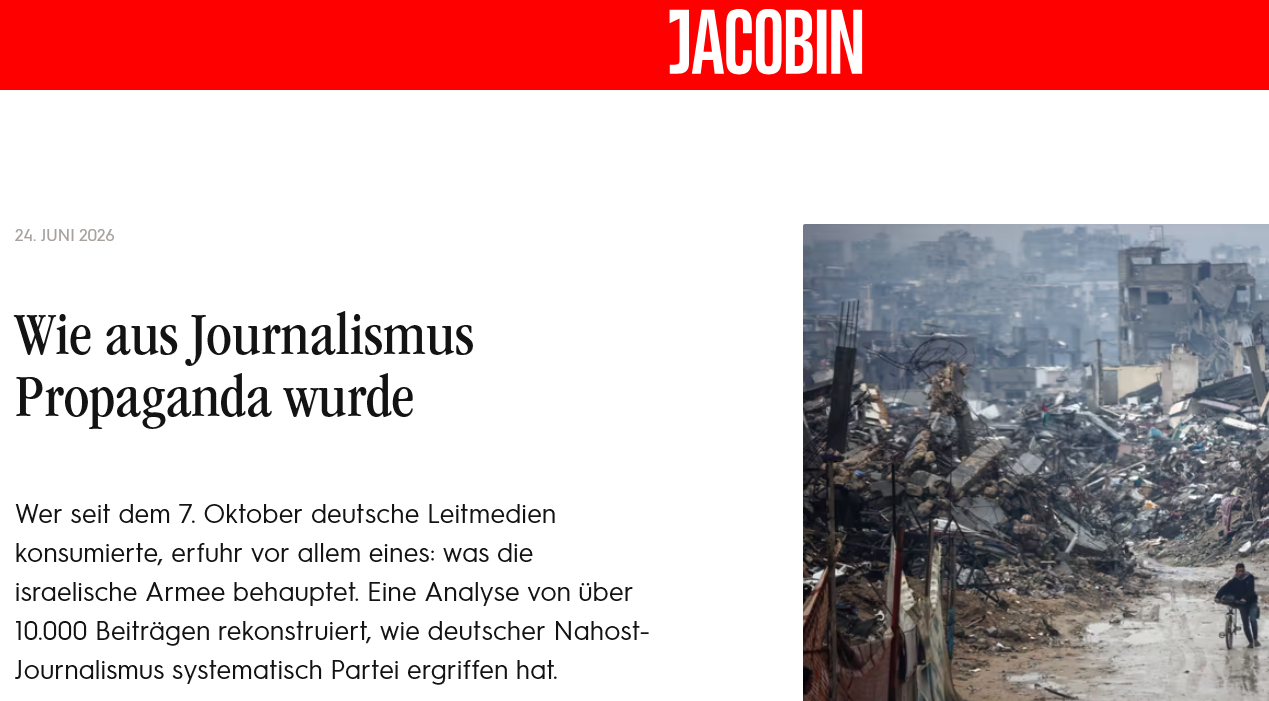
Zur Quelle die Selbstauskunft: „Jacobin ist eine führende Publikation der sozialistischen Linken. Wir bringen Euch scharfe und lesbare Analysen zu Politik, Wirtschaft und Kultur. 2011 in New York geboren, erscheint Jacobin auf Englisch, Spanisch, Italienisch, Portugiesisch, Griechisch und Niederländisch – und seit 2020 auch auf Deutsch.“
Im OS-Teil der Berliner Zeitung erschien gerade ein Beitrag zur Einschätzung des Wahlverhaltens der „russischen Community“ – in all ihrer Heterogenität – durch Lilly Galili (Tel Aviv), auch ein guter Einstieg für unseren nächsten DienstagZoom am 7. Juli zu den kommenden Knessetwahlen.
Entering the West Bank from Israel is like passing into a parallel universe, with a military checkpoint serving as portal. One overarching structure but two realities: in people, law and policing.
Israel has been steadily altering the West Bank’s human and physical landscape since it first occupied the territory in 1967. As Crisis Group expert Joost Hiltermann found, it now controls Palestinians’ freedom of movement to an unprecedented degree, with ruinous socio-economic effects.
I just stepped out of the room where civil society took its seat at the table.
This week began with renewed conflict in the region, as Israelis and Palestinians faced missiles, bombs, and terror. But the week ends with a powerful glimpse at a path to break out of this violent deadlock. As I write this, I am finishing up an intensive day in Paris, where I joined my ALLMEP colleagues and 150 peacebuilders from across our network, alongside foreign ministers and senior figures from more than 20 states from the G7 and beyond. Over the last 48 hours ALLMEP has marked two major milestones in a journey we’ve been on for two decades: the launch of an international fund, and the experience of Israeli and Palestinian civil society being integrated into the diplomatic plans of world leaders.
Building momentum step-by-step: The journey to the International Fund
Our momentum began with groundbreaking news out of the UK, originally published across major wire services (you can read the announcement on Reuters here). At a foreign ministerial meeting in Chevening, UK Foreign Secretary Yvette Cooper, Canadian Foreign Minister Anita Anand, and Australian Foreign Minister Penny Wong announced that their governments will launch and fund a new International Fund for Israeli-Palestinian Peace.
First conceived by ALLMEP in 2004 and inspired by the transformative success of the International Fund for Ireland, this new multilateral institution presents the chance to scale and institutionalize the reach and impact of civil society. Our field has learned how to create real impact, trust and partnerships on the ground — from humanitarian relief, environmental cooperation, and tech partnerships to economic development, educational programs, and inter-faith projects.
Now, this fund can radically scale the critical work of our 200+ member organizations (and counting — we welcomed 9 new members just this week). As Foreign Secretary Cooper noted in her announcement, while diplomats sign the agreements, there must be support for the civil society organizations building the dialogue, trust, and parallel constituencies required to make a two-state solution a reality.
This fund announcement is a major victory in the global campaign we first launched in 2009. It involved thousands of meetings and events, unheard-of coalitions of allies across the political spectrum, and six different bills in the U.S. Congress, leading Congress to pass MEPPA in 2020 with $250 million. We then enlisted Pope Francis, dozens of UK and European parliamentarians, and over 350 NGOs around the world in an appeal to the G7. Now, these three countries have delivered a new international fund, and are seeking others to help scale up.
Taking the stage in Paris as full partners
Following that historic announcement, our day in Paris began with a diplomatic breakfast, where I met, alongside leaders from our field, French Foreign Minister Jean-Noël Barrot, UK Foreign Secretary Cooper, and Canadian Foreign Minister Anand to discuss recommendations developed across civil society to deliver to the G7 leaders.
We then spent the day at a summit hosted by the French Ministry of Foreign Affairs. Leading experts and diplomats moderated five intensive working groups, each addressing a different aspect of the conflict. Our civil society representatives brought with them the ideas, input, and lived experiences of hundreds of leaders in our field, feeding them directly into this intensive policy conference.
Together, they generated concrete, actionable policy recommendations for a diplomatic community contending with a frozen political process. These ideas were presented in panels alongside remarks from ministers representing over a dozen countries, culminating in the official announcement of the 2026 Paris Call — a clear, united, and tangible roadmap delivered directly to the G7 Leaders’ Summit convening in France on Monday.
We are not starting from zero
This is a marathon, not a sprint. Hitting major milestones after years of work confirms the path we’re on. Getting here required building an entire network and organization. And now, through continuous, data-driven advocacy — from our AI Pulse research to last year’s New York Declaration and the inclusion of hundreds’ of civil society leaders’ voices in the Paris Call conversation — we are steadily bridging the gap between changemakers on the ground and the international community, making the people an indispensable part of the process.
As the day closed, a remarkable and all-too-rare scene unfolded in the streets of Paris. Hundreds of summit participants — Israelis and Palestinians — walked together along the Seine River to the Pont de la Tournelle bridge, sharing a resounding message: Peace is Possible.
After three years of devastating war, Israelis, Palestinians, and the international community are ready to pivot from war toward stabilization, recovery, and true conflict resolution. We are finally putting the infrastructure in place to offer a generational alternative to endless violence. With global diplomats now working hand-in-hand with an organized, resilient civil society network, we have the best fighting chance yet to ensure a secure, lasting future for both peoples.
We did not get here alone. This week’s achievements were only possible with your support, and building on them in the journey ahead will require even more from all of us. Thank you for standing with us and the Israeli and Palestinian peacebuilders. This week we saw just how much we can do together, step by step.
Joint statement from the Foreign Ministers of the UK, Australia and Canada on the launch of the International Peace Fund for Israelis and Palestinians
Today, we the Foreign Ministers of the United Kingdom, Australia and Canada are pleased to announce that we will establish a new International Peace Fund for Israelis and Palestinians, a multi-donor initiative to support peacebuilding efforts to establish the conditions for a lasting peace.
We are doing so at a moment of acute crisis in Israel and Palestine. The last three years have exacted a devastating and dehumanising toll on civilians and deepened mistrust and division between communities. At the same time, civil society has faced increasing restrictions and unprecedented pressure.
As prospects for a two-state solution remain challenging in the short term, there is an urgent need to invest in the conditions that can make future peace possible, through sustained dialogue and vital grassroots engagement.
We remain committed to a just and lasting resolution to the Israel-Palestine conflict, based on a negotiated two-state solution in which Israeli and Palestinian people can live in peace, security and dignity.
The fund will help strengthen the voices of moderates and marginalise the extremists, including Hamas.
As we have learned from other entrenched conflicts around the world, peace cannot be achieved through political and security measures alone. It also requires sustained effort to rebuild trust, to strengthen cooperation, and to highlight the shared humanity of people.
The Peace Fund will invest in programmes that advance a two-state solution, help reduce division, strengthen civil society, and support dialogue and cooperation within and between Israeli and Palestinian communities, building the foundations for peace.
The Fund will complement existing diplomatic, humanitarian and development efforts by helping to build the relationships, confidence and shared understanding needed for successful negotiations.
Funding contributions underscore strong international commitment to this initiative. As such, we will each be contributing initial seed funding equivalent to £1 million over three years. Once established, the Fund will be open to additional financial contributions from international partners committed to advancing peace.
Funding will be directed to trusted civil society organisations (CSOs) in both Israel and Palestine, with demonstrated expertise in peacebuilding and dialogue. Additional information on the fund, and its modalities will be announced shortly.
We call on our international partners to support this initiative and invest in the long-term foundations of peace. We also urge all parties to the conflict to take steps to reduce tensions, protect civilians, including humanitarian workers, and uphold international law.
The United Kingdom, Australia and Canada remain committed to working with partners to advance a two-state solution, as the only viable option for peace, security and dignity for Israelis and Palestinians.
****
Ergänzung: 12. Juni 2026 | Hier ein Bericht bei Reuters zum Thema!
Israel is one of the ten largest arms exporters in the world and is a leading exporter of surveillance technologies. Its arms exports have grown significantly in the past two years as European and Asian states rearm. Some commentators have linked Israeli arms exports to alleged human rights violations committed by the recipient countries. This, despite the establishment in 2007 of a domestic export licensing regime, and a growing array of international norms binding Israel and concerning state, individual and corporate responsibility. Professor Davidson will provide an overview of the history, economics and geopolitical aspects of Israeli arms exports, including the role of US assistance. She will then discuss Israel’s regulation of arms exports, highlighting weaknesses in human rights protection, including a lack of transparency, institutional concentration of powers, individualized risk assessment, and judicial deference to the executive. She will argue that the Israeli regulatory approach exemplifies the weaknesses of the dominant model of arms export regulation embodied in international law and in the domestic law of leading arms-exporting democracies.
About the Speakers
Natalie Davidson is an Associate Professor at Tel Aviv University’s Buchmann Faculty of Law, where she is also Vice-Dean for Teaching. She researches and teaches International Law, Constitutional Law, and Law and Society, focusing currently on the regulation of the global arms trade and authoritarian uses of law. She directs the team of Israel reporters for the Oxford Reports on International Law in Domestic Courts. She is a member of the Forum on the Arms Trade, an international network of experts on the humanitarian, economic and other implications of the global trade in arms.
Richard Steinberg (moderator) is the Jonathan D. Varat Endowed Professor of Law and Professor of Political Science at UCLA, where he writes and teaches in the areas of international law and international relations, with a focus on international economic law, international criminal law, and human rights. He is a Member of the Council on Foreign Relations, a Member of United States Trade Representative’s Trade and Environment Policy Advisory Committee, Chair of the International Trade Law Committee of the American Branch of the International Law Association, Director of Trade Policy Research at the Berkeley Roundtable on the International Economy (BRIE) at UC Berkeley, and Editor-in-Chief of the award-winning http://iccforum.com/.