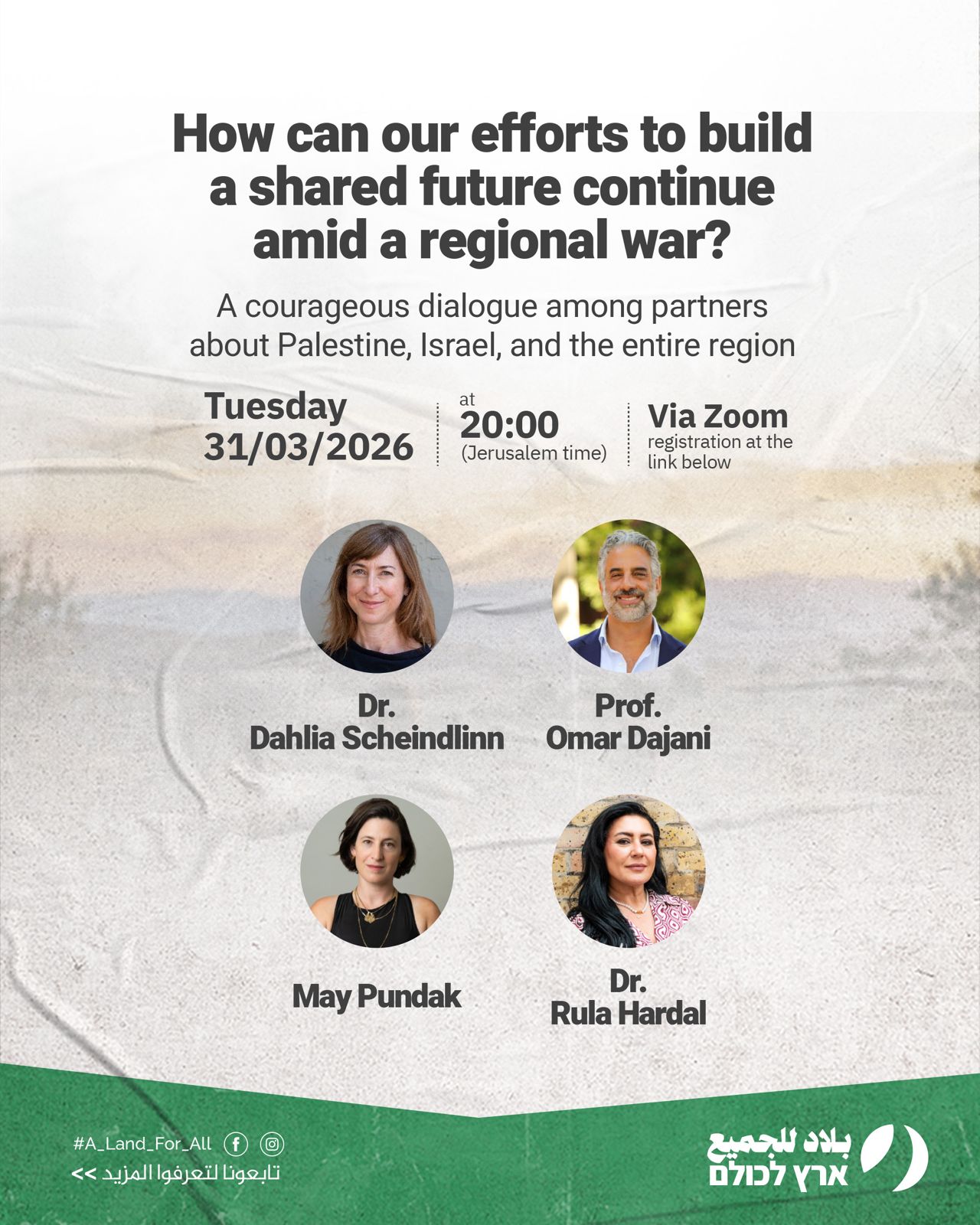
Webinar 31. März 2026 20.00 Uhr Jerusalem Time (19.00 MEZ) – Register here
In days meant to symbolize joy, celebration, and renewal, people across the region find themselves living through profound turmoil and deep uncertainty.
The war is expanding, instability is growing, and the stable future we all long for feels more distant than ever.
Yet even within this reality, we remain together—not because we have simple answers, but because it is clear to us that the fate of Palestinians, Israelis, and the entire region is intertwined. None of us is going anywhere.
The question is not whether we will live here together—but how we will live here together?
This is the question we seek to explore with international experts and key partners in the work of A Land For All.
Join an honest and important conversation where we will ask:
How can we understand the war from Palestinian, Israeli, regional, and international perspectives?
What changes lie ahead for the Middle East, and how will they impact Israelis and Palestinians?
How can we begin, even now, to shift from a paradigm of domination to partnership and build a truly just and thriving future?
With the participation of:
Prof. Omar Dajani — international jurist, expert in regional politics, and former advisor to Palestinian negotiation teams, and a member A Land for All, born into a family of Palestinian refugees from Jaffa-Yaffa.
Dr. Dahlia Scheindlin — expert on public opinion in Israel, political commentator, and member of the A Land for All.
Dr. Rula Hardal — Palestinian co-CEO of the A Land for All and expert in Palestinian nationalism
Moderated by – May Pundak, Israeli co-CEO of A Land for All
*The conversation will be held in English, with simultaneous translation into Arabic and Hebrew.
Christinnen und Christen im Nahen und Mittleren Osten bitten um Unterstützung
Der Ökumenische Rat der Kirchen (ÖRK/WCC) lädt am 26. März 2026, 15.00 Uhr zu einem weltweiten Friedensgebet für den Nahen Osten ein.
Nachtrag 28.3.2026:
For those who participated live: the prayer offered a profound space for lament, hope, comfort, and solidarity, woven together through Psalms, music, and the spoken word. Voices from across the globe —Including Prof. Dr Michel Abs of the Middle East Council of Churches, Bishop Prof. Dr Heinrich Bedford-Strohm, Patriarch Theophilos III of Jerusalem, and youth from the region — gave the prayer its breadth and depth. We are grateful for your presence.
If you were unable to join us this time, we warmly invite you to watch the full recording at your own pace:
Die Gebetsworte stammen von Christinnen und Christen aus der Region, die angesichts von Gewalt, Trauer und existenzieller Unsicherheit um Unterstützung bitten. Es besteht die Möglichkeit, online teilzunehmen und ein Zeichen für Frieden, Gerechtigkeit und Versöhnung zu setzen.
Angst vor neuen Angriffen, Trauer um getötete Angehörige und große Ungewissheit prägen das Leben vieler Menschen im Nahen Osten. Der anhaltende Konflikt erschüttert die Betroffenen zutiefst und belastet auch die christlichen Gemeinschaften in der Region, die dort zum Teil seit fast 2.000 Jahren leben.
Aufruf zum Friedensgebet am 26. März
Der Ökumenische Rat der Kirchen (ÖRK) ruft deshalb weltweit zu einem Gebet für Frieden im Nahen und Mittleren Osten auf – am 26. März um 15 Uhr MEZ. Die Gebetsworte stammen von Christinnen und Christen aus der Region selbst. Mit dem gemeinsamen Friedensgebet seien laut ÖRK alle Menschen guten Willens eingeladen, „Zeugnis abzulegen von der gemeinsamen Sehnsucht nach Frieden, Gerechtigkeit und Versöhnung ist in diesen bedrückenden und leidvollen Zeiten ein ganz wichtiges Zeichen der Verbundenheit und Solidarität“, so Pfarrer Andreas Goetze, Referent im Fachbereich Interreligiöser Dialog und Ansprechpartner für Christ:innen im Mittleren Osten im Zentrum Oekumene EKHN und EKKW.
Bitte der Christinnen und Christen aus Nahost-Region
Im Vorfeld hatte sich der ÖRK über die humanitäre, sicherheitspolitische und pastorale Lage der betroffenen Kirchen informiert. An einer Online‑Konsultation nahm auch Bischof i. R. Prof. Dr. Heinrich Bedford‑Strohm, Moderator des Zentralausschusses des ÖRK, teil. Er berichtete, dass Christinnen und Christen aus der Region den ÖRK ausdrücklich gebeten hätten, für sie zu beten. Bedford‑Strohm sagte: „Wir haben zugesagt, ihrem Gebetsaufruf zu folgen und werden alles in unserer Macht Stehende tun, um ein Ende der Eskalation zu fordern.“
Existenzielle Bedrohung
Viele Gemeinden im Nahen und Mittleren Osten stehen unter existenziellem Druck. In Teilen Syriens etwa fühlen sich Christinnen und Christen durch wiederkehrende Militäroperationen bedroht; auch die medizinische Versorgung ist eingeschränkt. Beispielsweise hat das Zentrum Oekumene von einer Frau erfahren, die ihr Kind unter schwierigen Umständen zur Welt brachte: Wegen Personalmangels und begrenzter Versorgung war die Situation kritisch, umso größer war die Erleichterung, dass Mutter und Kind überlebten. Der Nahost‑Experte Matthias Kopp, Sprecher der Deutschen Bischofskonferenz, warnt daher vor einem möglichen „schleichenden oder sogar eklatanten Christen‑Exodus“.
Sorge des ÖRK über zunehmende Instabilität in der Region und Appell
In einer gemeinsamen Erklärung betonte der ÖRK, dass sich humanitäre Risiken, Leid und Instabilität weiter verschärfen könnten, wenn die Gewalt anhält. Die Erklärung äußert tiefe Besorgnis über Berichte zu möglichen Verstößen gegen das humanitäre Völkerrecht und fordert alle beteiligten Akteure auf, Verantwortung für die Folgen ihres Handelns zu übernehmen. Abschließend heißt es: „Wir lehnen die brutale Logik von Krieg und Herrschaft ab. Wir bitten um Frieden.“
Im Gespräch mit Ahmad Shihabi: Journalismus nach dem 7. Oktober
Ahmad Shihabi wuchs in einem palästinensischen Flüchtlingslager südlich von Damaskus auf. Er absolvierte eine Ausbildung im Bereich Informatik, wurde dann Journalist. Während des syrischen Bürgerkriegs floh er nach Deutschland und arbeitet heute als Redakteur für die Neue Ruhr Zeitung (NRZ), vor allem zur politischen Situation im Nahen Osten, deren Auswirkungen auf Deutschland sowie zu Flucht und Migration.
In unserem diAk-Gespräch wollen wir mit ihm über seine Wahrnehmung der letzten zweieinhalb Jahre sprechen: Wie war es für ihn, als palästinensischer Journalist nach dem 7. Oktober in Deutschland zu berichten? Was ist seine Perspektive auf die deutsche Berichterstattung zu Israel/Palästina, Syrien oder Iran? Gemeinsam wollen wir über deutschen Journalismus, Debattenkultur und den Nahostkonflikt nachdenken.
Das Gespräch findet am 7. April 2026 von 19 bis 20 Uhr auf Zoom statt.
In recent years, a strategic approach has gained prominence in Israel’s regional policy: the idea that military strength and security superiority can serve as a foundation for normalization and cooperation with countries in the Middle East. According to this approach, often described as “normalization through power”, military deterrence, shared security interests, and advanced technological capabilities can position Israel as a central regional partner even without broader political progress vis-à-vis the Palestinians.
The war that began on October 7, and particularly the campaign against Iran, puts this paradigm to the test. While Israeli public attention is largely focused on the military aspects of the confrontation with Iran, a broader strategic question arises: what will the regional order look like on the day after the war, and can military achievements alone translate into a stable regional reality and sustainable cooperation?
This webinar will examine the future of relations between Israel and regional actors in light of the latest developments in the Middle East. The discussion will explore the opportunities and limitations of an approach based primarily on power and deterrence, alongside the role of political processes, regional diplomacy, and multilateral cooperation in shaping a more stable regional order.
The panel will bring together leading experts, who will offer diverse regional perspectives on the strategic implications of the war and on the possibilities for shaping a new regional reality in its aftermath.
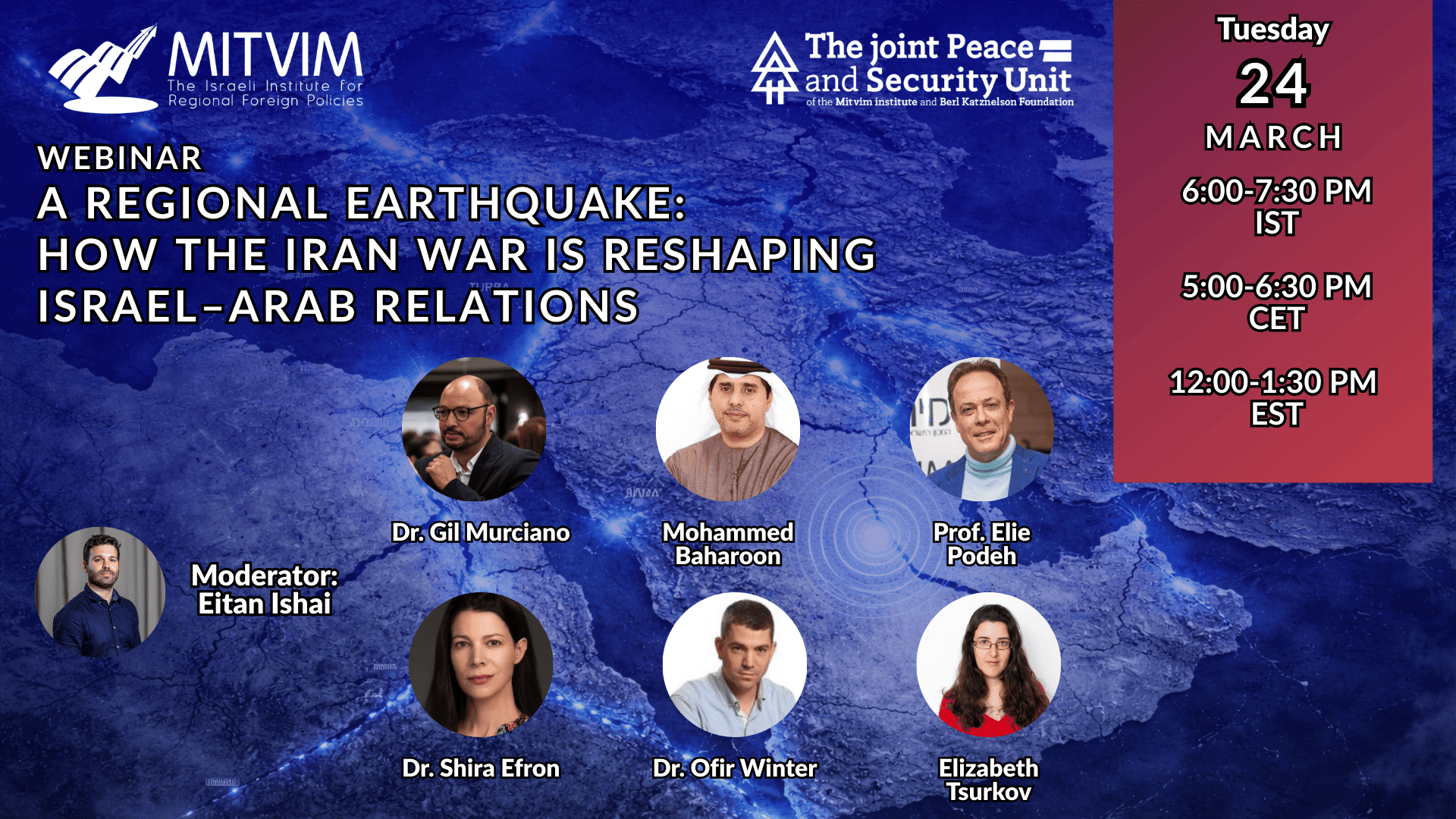
When: Tuesday, March 24, 6 PM (Israel time) ; 5 PM (CET); 11:00 AM (EST).
A Zoom link will be sent closer to the time of the webinar after the registration.
Moderator:
Eitan Ishai – Director of the MENA program, Mitvim
Speakers:
Dr. Gil Murciano – CEO, Mitvim
Mohammed Baharoon – Director General, B’huth Institute, United Arab Emirates
Prof. Eli Podeh – Lecturer, Department of Islamic and Middle Eastern Studies, Hebrew University of Jerusalem; Board Member, Mitvim; Member of the Regional Security Coalition
Dr. Shira Efron – RAND Corporation’s Distinguished Israel Policy Chair
Dr. Ofir Winter – Senior Researcher, Institute for National Security Studies; Lecturer, Department of Arabic and Islamic Studies, Tel Aviv University
Elizabeth Tsurkov – Fellow, Newlines Institute for Strategy and Policy; Research Fellow, Forum for Regional Thinking
A podcast episode punctuated with sirens and explosions on +972 with Meron Rapoport
Meron lives in Tel Aviv and, like most Israelis, has spent much of the past two weeks running to shelters. Yet this is just about the only thing he shares with the majority of his compatriots — not least because he is among the mere 4 percent of Israeli Jews who oppose this war that is setting the entire region ablaze.
But things don’t always go according to plan. When the dust settles, Meron says — reminding me that he’s often labeled an optimist — Israelis will realize, sooner or later, that they cannot escape the Palestinian question, and that a regime of apartheid and occupation will never have peace and quiet.
FR-Interview von Inge Günther mit Stefan Weidner, Autor, Islamwissenschaftler und Übersetzer, der bis vor wenigen Tagen in Beirut war und über den „kleinen“ Krieg im Schatten des „großen“ Krieges mit Iran berichtet. Ein Krieg zwischen Israel und Hisbollah, den weder der Zedernstaat noch die allermeisten Libanesen wollten und dem sie trotzdem nahezu wehrlos ausgeliefert sind.
Die Hisbollah steht im Libanon zunehmend isoliert da. Selbst unter Schiiten schwindet die Unterstützung für die Miliz dramatisch.