Union for the Mediterranean

Progress Report: Regional Integration in the Union for the Mediterranean 2025


From the Preface by the OECD
In 2021, the OECD published its first report monitoring regional integration in the Euro-Mediterranean region. This second edition of Regional Integration in the Union for the Mediterranean assesses progress made since 2021 – a period marked by the impacts of the COVID-19 pandemic, successive economic shocks, ongoing conflicts in the Middle East, and an increasingly complex geopolitical context.In this challenging environment, our report highlights the opportunities that economic integration offers for countries in the region to achieve stability, peace and prosperity

Silence is Complicity

Gemeinsame Erklärung der humanitären Beauftragten der Vereinten Nationen in der Nahostregion

Joint Statement by UN Resident and Humanitarian Coordinators in the Occupied Palestinian Territory (OPT), Syria, Yemen and Lebanon

One year ago, we called on those in power to end attacks against humanitarian workers and aid operations. Release all those arbitrarily detained. Safeguard the humanitarian space in the Middle East. That call remains unanswered.

Across the region, civilians, including humanitarian workers, have already endured an unbearable toll of decades of conflict and protracted crises. They are being killed, injured, and attacked in shocking numbers. Violations of international humanitarian law are at an unprecedented level, and impunity has become the norm.

The world is failing humanitarian workers and the people they serve. Since August 2024, at least 446 aid workers were killed, wounded, kidnapped or detained in the Occupied Palestinian Territory, Syria, Yemen and Lebanon. This brings the total number since August 2023 to at least 841 affected workers, including 584 killed, 215 wounded, 38 detained, and 4 kidnapped.

The assault on humanitarian space now includes moves to dismantle multilateral norms, undermine UN‑mandated bodies, and defund institutions tasked with protection and justice.

Even speaking out has become a liability, risking humanitarian access and triggering political retaliation.

Justice has failed for serious violations, whether committed by the same actors or by others emboldened by their impunity. The climate of permissiveness is politically indefensible and morally intolerable. There can be no exceptions to the rules of war. All parties must comply with international humanitarian law and be held accountable.

When we protect humanitarian workers, we are not only protecting the people they serve in the Middle East. We are protecting civilians everywhere, the international system, and the principles that underpin our collective dignity and humanity.

Humanitarians are not giving up, neither should the world.

This World Humanitarian Day, we renew our call—louder, sharper, uncompromising: Respect international humanitarian and human rights laws. Protect those who protect humanity. End impunity or be complicit. The world is watching. #ActForHumanity. Now.

Signatories

Dr. Ramiz Alakbarov, UN Resident and Humanitarian Coordinator for the Occupied Palestinian Territory (OPT), and Officer-In-Charge Special Coordinator for the Middle East Peace Process

Mr. Adam Abdelmoula, UN Resident and Humanitarian Coordinator for Syria

Mr. Julien Harneis, UN Resident and Humanitarian Coordinator for Yemen

Mr. Imran Riza, UN Resident and Humanitarian Coordinator for Lebanon

„Wir werden ihn besitzen“

So US-Präsident Donald Trump zum Gazastreifen.

Foreign Policy bat zehn Autoren, auf die Ankündigung des US-Präsidenten zu reagieren. Die Frankfurter Rundschau legt die Antworten erstmals in deutscher Sprache vor – zuerst veröffentlicht wurden sie am 6. Februar 2025 Magazin Foreign Policy.

Yousef Munayyer, einem palästinensischen Staatsbürger Israels und Leiter des Programms Palästina/Israel am Arab Center Washington DC

Robert A. Pape, Professor für Politikwissenschaft an der University of Chicago und Direktor des Chicago Project on Security and Threats.

Ahmed Fouad Alkhatib, einem in Gaza ansässigen Schriftsteller, Analyst und Senior Fellow beim Atlantic Council.

Dennis Ross, einem angesehenen Fellow am Washington Institute for Near East Policy.

Khaled Elgindy, Gastwissenschaftler am Center for Contemporary Arab Studies der Georgetown University.

Matthew Duss, dem geschäftsführenden Vizepräsidenten des Center for International Policy.

Dalia Hatuqa, Multimedia-Journalistin aus den USA und dem Westjordanland.

Sara Khorshid, Doktorandin an der Western University in Kanada.

Rala Rharrit, einer ehemaligen US-Diplomatin, die 18 Jahre lang im US-Außenministerium tätig war, bevor sie im April 2024 aus Protest gegen die Gaza-Politik der Biden-Regierung zurücktrat.

Aaron David Miller, Senior Fellow bei der Carnegie Endowment for International Peace.

Trumps Call …

Times of Israel:
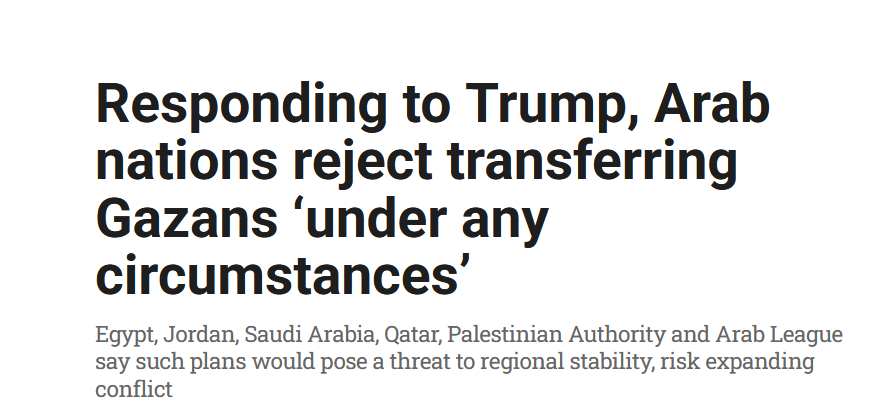
Responding to Trump, Arab nations reject transferring Gazans ‘under any circumstances’

Aljazeera:
Arab ministers reject Trump’s call to displace Palestinians from Gaza

Führt der Weg über „Abraham“?

Ein Essay über die Bedeutung, Möglichkeiten und Grenzen der sog. Abraham-Accords von Khaled Elgindy (Washington D.C., ehemaliger Senior Fellow und Direktor des Programms für Palästina und palästinensisch-israelische Angelegenheiten am Middle East Institute [MEI]) auf der Seite ipg-jounal.de

Mee(h)rwasser

Riesige Meerwasserentsalzungsanlage in Kooperation mit einem französischen Unternehmen in Jordanien auf den Weg gebracht, ursprünglich war ein solches Projekt mit Israel geplant, auch um den Wasserspiegel des Toten Meeres nicht weiter absinken zu lassen…

Bericht in der staatlichen jordanischen Nachrichtenagentur Petra

Amman, Jan 12 (Petra) — The Aqaba-Amman Water Desalination and Conveyance Project (National Carrier Project) moved from vision to reality Sunday with the signing of a historic contract between the Ministry of Water and Irrigation and the Meridiam-Suez investment alliance, setting in motion one of the region’s most ambitious water infrastructure ventures.

Eine Stimme aus Jordanien

A Horizon of Violence – so lautet der Titel eines längeres Essays von Ursula Lindsey (Amman), keine einfache Lektüre …

Er ist erschienen in einer Serie bei der Open Society Foundations.

Ursula Lindsey is a reporter, essayist and book reviewer who largely writes about North Africa and the Middle East, where she has lived for the last two decades. After living in Egypt and Morocco, she is now based in Amman, Jordan. She is a frequent contributor to The New York Review of Books and a co-host of the BULAQ podcast, which focuses on Arabic literature in translation.

Umm al-Jimal – Art Destination Jordanien

Umm al-Jimal ist eine spätantike Stadt mit beeindruckenden Ruinen von Gebäuden aus schwarzem Basalt, die auf nabatäischen und römischen Bauten errichtet wurden. Die archäologische Stätte befindet sich 80 km von Amman entfernt in der halbtrockenen Hauran-Region im Norden Jordaniens. Sie ist nicht nur wegen der Architektur und Geschichte einen Besuch wert, sondern auch, um eine engagierte Gemeinschaft kennenzulernen, die sich für den Erhalt ihres einzigartigen Erbes einsetzt und Dienstleistungen für Tourist:innen anbietet.

Die nabatäisch-frührömische Siedlung an einer Handelsroute von Karawanen (Mitte des 1. bis 3. Jahrhunderts n. Chr.) wurde im 4. bis 5. Jahrhundert zu einer römischen Militärstation. Als sich in byzantinisch-umayyadischer Zeit arabische Zivilisten aus der Region dort niederließen, entwickelte sich Umm al-Jimal zu einer wohlhabenden Agrar- und Handelsstadt. …

Der Kontext ist entscheidend

Der Nahosthistoriker Lorenzo Kamel im Gespräch auf Quantara.de (jetzt neu unter derm Dach des ifa – Institut für Auslandsbeziehungen, Stuttgart) über die Möglichkeiten der Europäischen Union (EU), die bislang keine nennenswerte Vermittlerrolle im Nahen Osten übernommen hat. Wie könnte sie wirksam zu einer dauerhaften Friedenslösung nach dem Gaza-Konflikt beitragen? Welchen Kurs sollte sie gegenüber autoritären Regimen in der Region einnehmen?

Abraham Accords, Normalisierung und die Perspektiven …

Die Vereinigten Arabischen Emirate und Bahrain waren nach Ägypten (1979) und Jordanien (1994) die ersten arabischen Länder, die ihre Beziehungen zu Israel normalisiert haben.

Eine Analyse von Dina Esfandiary und Dialla Jandali von der International Crisis Group zur aktuellen Einschätzung und den Perspektiven dieser Kooperationen.