Archivar der jüdischen Geisteswelt, so betitelt die FAZ den Nachruf von Thomas Meyer. Der besonders um die Aktualisierung des Werkes Martin Bubers verdiente Wissenschaftler (er war u.a. Mitherausgeber der Gesamtausgabe der Werke Bubers), war Zeit seines Lebens um jüdisch-arabische Verständigung bemüht.
Ein Nachruf von Benjamin Pollock (verlinkt auch über das Dubnow-Institut, Leipzig, dessen langjähriges Mitglied im Wissenschaftlichen Beirat und Redaktionsbeirat des Jahrbuchs des Dubnow-Instituts/Dubnow Institute Yearbook Mendes-Flohr war.
Paul Mendes-Flohr, bei der letzten Begegnung im April 2024 in West-Jerusalem am Eingang des Van Leer-Instituts, wo er im Lesesaal sein Arbeitsreich hatte … (Photo: B. Doering, im Bild mit R. Zimmer-Winkel)
Interdisziplinäre Ringvorlesungen für die breite Öffentlichkeit
Die Vielfalt Palästinas – eine kulturelle Zeitreise
Eine interdisziplinäre Ringvorlesung der Wissenschaftlichen Einheit Westasien, Nordafrika und Diaspora am Fachbereich Geschichts- und Kulturwissenschaften der Freien Universität Berlin
Beginn: 15.10.2024 18.00 Uhr
„Zwei Völker in einem Land“: Koexistenz und Konflikt in Palästina / Israel Vielfach verflochtene Identitäten, exklusive politische Ansprüche: eine historische Einordnung
Prof. Dr. Dr. h.c. i. R. Gudrun Krämer Institut für Islamwissenschaft, Freie Universität Berlin
Jede Woche Dienstags 18-20.00 Uhr bis zum 4.02. 2025
Regelmäßig schreibt Helga Baumgarten in der jungen Welt
21. September: »Wer schweigt, ist Mittäter« Der palästinensische Pfarrer Munther Isaac klagt die christliche Welt an
14. September »Christ und Palästinenser« Erzbischof »Abuna« kämpft für Gerechtigkeit jenseits religiöser Grenzen
Helga Baumgarten ist emeritierte Professorin für Politikwissenschaften an der Universität Birzeit nördlich von Jerusalem im Westjordanland und Autorin mehrerer Werke zum Nahostkonflikt.
Teil eins der Briefe erschien in der jungen Welt vom 29./30. Juni, die Folgebriefe wurden in den jW-Ausgaben vom 8., vom 13./14., vom 20./21., vom 27./28. Juli, vom 10., 17. und 24.8. sowie 7.9. veröffentlicht-
Für die Weltwoche für Frieden in Palästina und Israel vom 16. bis 22. September 2024 hat der Ökumenische Rat der Kirchen (ÖRK) neue Materialien veröffentlicht. In dieser Woche findet am 21. September auch der Weltfriedenstag der Vereinten Nationen statt, der zum 25. Mal begangen wird.
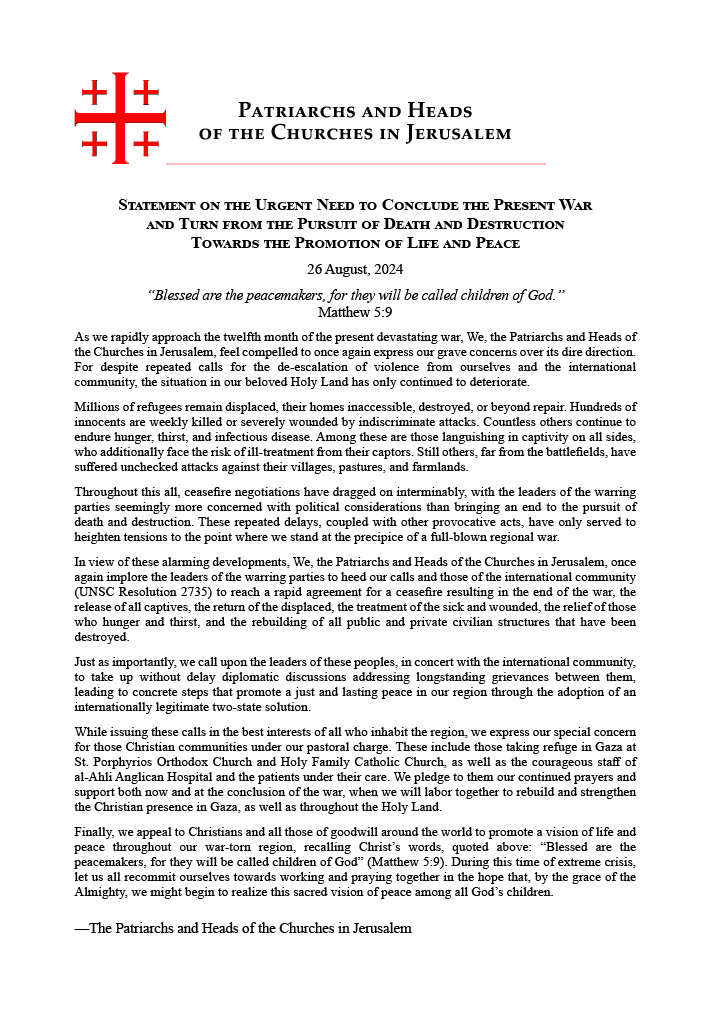
The Patriarchs and Heads of the Churches in Jerusalem have issued a statement, released on 26 August 2024
The statement says:
Blessed are the peacemakers, for they will be called children of God.” Matthew 5:9
As we rapidly approach the twelfth month of the present devastating war, We, the Patriarchs and Heads of the Churches in Jerusalem, feel compelled to once again express our grave concerns over its dire direction. For despite repeated calls for the de-escalation of violence from ourselves and the international community, the situation in our beloved Holy Land has only continued to deteriorate.
Millions of refugees remain displaced, their homes inaccessible, destroyed, or beyond repair. Hundreds of innocents are weekly killed or severely wounded by indiscriminate attacks. Countless others continue to endure hunger, thirst, and infectious disease. Among these are those languishing in captivity on all sides, who additionally face the risk of ill-treatment from their captors. Still others, far from the battlefields, have suffered unchecked attacks against their villages, pastures, and farmlands.
Throughout this all, ceasefire negotiations have dragged on interminably, with the leaders of the warring parties seemingly more concerned with political considerations than bringing an end to the pursuit of death and destruction. These repeated delays, coupled with other provocative acts, have only served to heighten tensions to the point where we stand at the precipice of a full-blown regional war.
In view of these alarming developments, We, the Patriarchs and Heads of the Churches in Jerusalem, once again implore the leaders of the warring parties to heed our calls and those of the international community (UNSC Resolution 2735) to reach a rapid agreement for a ceasefire resulting in the end of the war, the release of all captives, the return of the displaced, the treatment of the sick and wounded, the relief of those who hunger and thirst, and the rebuilding of all public and private civilian structures that have been destroyed.
Just as importantly, we call upon the leaders of these peoples, in concert with the international community, to take up without delay diplomatic discussions addressing longstanding grievances between them, leading to concrete steps that promote a just and lasting peace in our region through the adoption of an internationally legitimate two-state solution.
While issuing these calls in the best interests of all who inhabit the region, we express our special concern for those Christian communities under our pastoral charge. These include those taking refuge in Gaza at St. Porphyrios Orthodox Church and Holy Family Catholic Church, as well as the courageous staff of al-Ahli Anglican Hospital and the patients under their care. We pledge to them our continued prayers and support both now and at the conclusion of the war, when we will labor together to rebuild and strengthen the Christian presence in Gaza, as well as throughout the Holy Land.
Finally, we appeal to Christians and all those of goodwill around the world to promote a vision of life and peace throughout our war-torn region, recalling Christ’s words, quoted above: “Blessed are the peacemakers, for they will be called children of God” (Matthew 5:9). During this time of extreme crisis, let us all recommit ourselves towards working and praying together in the hope that, by the grace of the Almighty, we might begin to realize this sacred vision of peace among all God’s children.
— The Patriarchs and Heads of the Churches in Jerusalem
Aus der musikalischen Tradition der Judentums in Marokko hat der israelische Künster Amit Hai Cohen zusammen mit dem Piyut Ensemble und weiteren Künstler:innen eine beeindruckende Performance geschaffen… [wer ein wenig gedanklich in West-Jerusalem unterwegs ist, wird die Brücke über die Derek Hebron/Tareek al-Khalil in Talpioth, nahe der britischen Pill-Box erkennen, über die hier u.a. getanzt wird…]
Erklärung: Just war? Justice and Peace Commission of the Holy Land (30. Juni 2024)
Aus der aktuellen Erklärung (PDF) hier zwei Zitate:
“As Catholics in the Holy Land, who share .. (the) vision for a peaceful world, we are outraged that political actors in Israel and abroad are mobilizing the theory of “just war” in order to perpetuate and legitimate the ongoing war in Gaza. … Though we are a small community in the Holy Land as Catholics we are an integral part of this land’s identity. We wish to make it clear that we, and our theological tradition, must not be used in order to justify this violence. The witness that we bring is not one of war, but one of transformational love, one of freedom and equality, one of justice and peace, one of dialogue and reconciliation”.