Zum Jahresausklang ein Hinweis auf ein längere Geschichte… voller „spirit“ für das Kommende.
Mit guten Wünschen für ein besseres 2026 und Dank für das Interesse am täglichen Blog des diAk.
Empfehlt uns / empfehlen Sie uns weiter – diAk-Vorstand
…
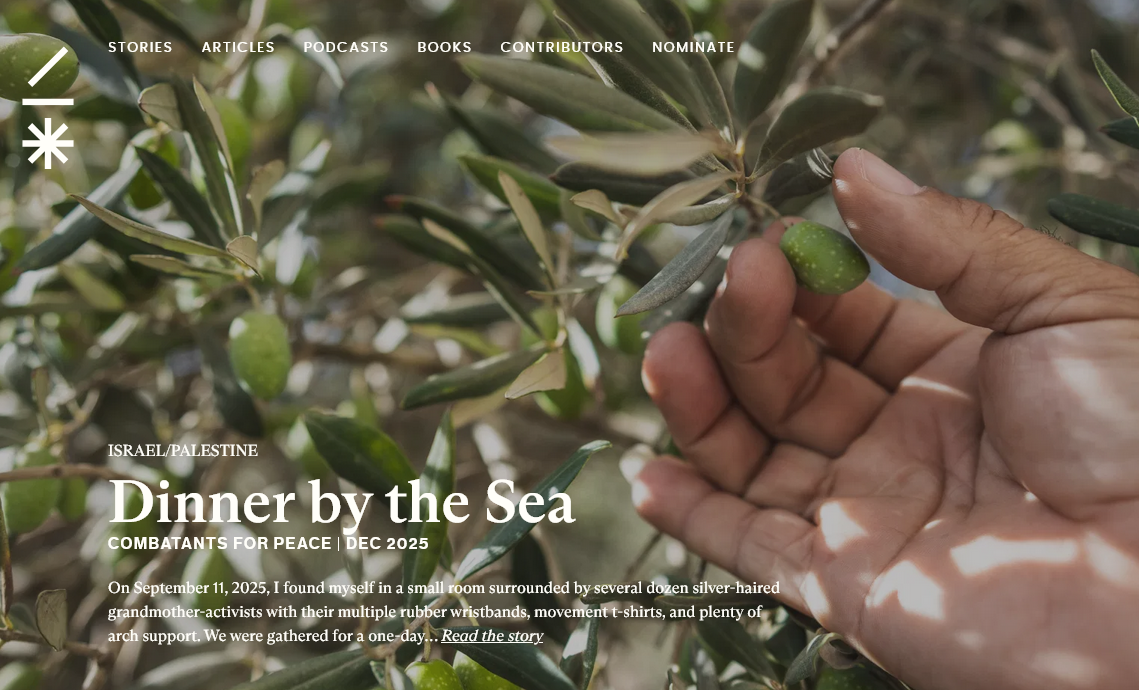
„Ceasefire is a step in a journey of a thousand steps, but it is not peace. As I write, the last of the living hostages are reunited with their families while thousands of former prisoners are bussed from life sentences in sunless dungeons to the wreckage and rubble of Gaza. They, too, might reunite with their families—starved, emaciated, evicted, but breathing—all praise to God. I watched one former prisoner reunite with his young children whom he’d been tortured to believe were dead, and another rock back and forth on his knees with a bracelet he’d woven for his daughter clutched in his hands as he wailed, “My family is dead, my family is dead… my home, my children, everything is gone… my family is dead.”
Über die Herausgeber: At BitterSweet we look to tell stories of hope, of good at work in the world. And while Combatants for Peace is certainly that, we are also committed to telling counternarratives. As the story of a conquering „peace“ gains traction, trumpeted by those who personally stand to gain power, prestige, and payment, let the courage of activists such as Sulaiman and Avner, Rana and Eszter remind us not to look away. “Don’t talk about us without us,” Rana reminds us. “If you want to be part of the solution, you need to hear all the voices of people involved and affected by that conflict. And we need to be part of the discussion whether you agree or not. Everybody who lives here needs to be involved in the peace process.” „Peace“ is not dictated into being, but grown, a fragile seed planted in hope of a future safe enough for it to flourish. Thank you to Elie and Kai, Fatima and Ahmed, Koren and Orí, and the many courageous activists committed to true peace, to a more excellent way. – Avery Marks, Features Editor
In this episode of Nullpunkt, Hanno Hauenstein speaks with Mouin Rabbani, an incisive Palestinian analysts of Israel-Palestine. We examine the so-called ceasefire in Gaza – and why the killing has continued. Rabbani dissects Germany’s role and Friedrich Merz’s claim that Israel is “doing the dirty work” for Germany.The conversation moves from the repression of debate in Germany to the collapse of the two-state framework in Israel-Palestine. Rabbani explains why he, himself once a proponent of the two-state-solution, now no longer believes in it. Video & Editing: Tom WillsLogo: Laura Selma KoeranYou can find Rabbani’s writing & analysis here:– https://mouinrabbani.substack.com–https://www.jadaliyya.com
Timestamps0:00 – Intro1:45 – Has Israel’s Global Image Changed?4:00 – Silencing Debate on Israel–Palestine5:15 – “Israel Is Doing the Dirty Work”10:00 – How Germany Looks from the Outside13:30 – The Palestinian National Movement: Where To Now?19:30 – Ceasefire: Temporary Pause / Turning Point?25:00 – Gaza’s “Westbank-ification”28:00 – Fragile Western Consensus on Israel32:20 – Two States vs. One State39:30 – Who Can Pressure Israel?42:45 – The Israeli Opposition48:00 – Media Failure & Distortions
Die größten Herausforderungen für ein friedliches Miteinander in Nahost liegen nicht in den Beziehungen der Staaten, sondern auf der Ebene der gesellschaftlichen Versöhnung. Vier Neuerscheinungen vermitteln ein Gefühl für eine mögliche Zukunft der Region.
Muriel Asseburg: Der 7. Oktober und der Krieg in Gaza. Hintergrund, Eskalation, Folgen. München: C. H. Beck 2025. 286 Seiten, 20,00 Euro
Sabine Adler: Israel. Fragen an ein Land. Berlin: Ch. Links 2025. 270 Seiten, 24,00 Euro
Natalie Amiri: Der Nahost-Komplex. Von Menschen, Träumen und Zerstörung. München: Penguin 2025. 416 Seiten, 25,00 Euro
Daniel Gerlach: Die Kunst des Friedens. Eine andere Geschichte des Nahen Ostens – Deals, Friedensverhandlungen & Geheimdiplomatie. München: C. Bertelsmann 2025. 351 Seiten, 25,00 Euro
Am ersten Dienstag im neuen Jahr, am 6. Januar 2026, wird unser nächster Gesprächsabend auf Zoom stattfinden. Zu Gast haben wir diesmal den Soziologen und Kulturwissenschaftler Dr. Dr. Peter Ullrich, Fellow am Zentrum für Antisemitismusforschung und Senior Researcher im Zentrum Technik und Gesellschaft der TU Berlin. Zuletzt erschien im Wallstein-Verlag der von ihm herausgegebene Sammelband „Was ist Antisemitismus?“. Im Januar wird er mit uns über Antisemitismus im deutschen Nahost-Diskurs und dessen politische Instrumentalisierung sprechen – insbesondere über das Phänomen des „autoritären Anti-Antisemitismus“. Die Veranstaltung beginnt um 19 Uhr und dauert etwa eine Stunde.
Zoom-Link für die Veranstaltung im Blog am 6. Januar
Nächste Veranstaltung:
3. Februar 2026 – Marina Klimchuk, freie Journalistin
Vergangene Veranstaltungen:
7. Oktober 2025 – Sally Azar (Jerusalem), Evangelisch-Lutherische Kirche in Jordanien und im Heiligen Land: Die Situation palästinensischer Christ*innen nach dem 7. Oktober 2023
4. November 2025 – Prof. Dr. Markus Dreßler (Leipzig), Religionswissenschaftler und Türkeiexperte: Türkische Perspektiven auf den Nahostkonflikt und die Antisemitismusdebatte
2. Dezember 2025 – Dr. Maya Rosenfeld (Jerusalem), Soziologin an der Hebräischen Universität in Jerusalem: The Anthropology of Occupation – The Case of Dheheishe Refugee Camp
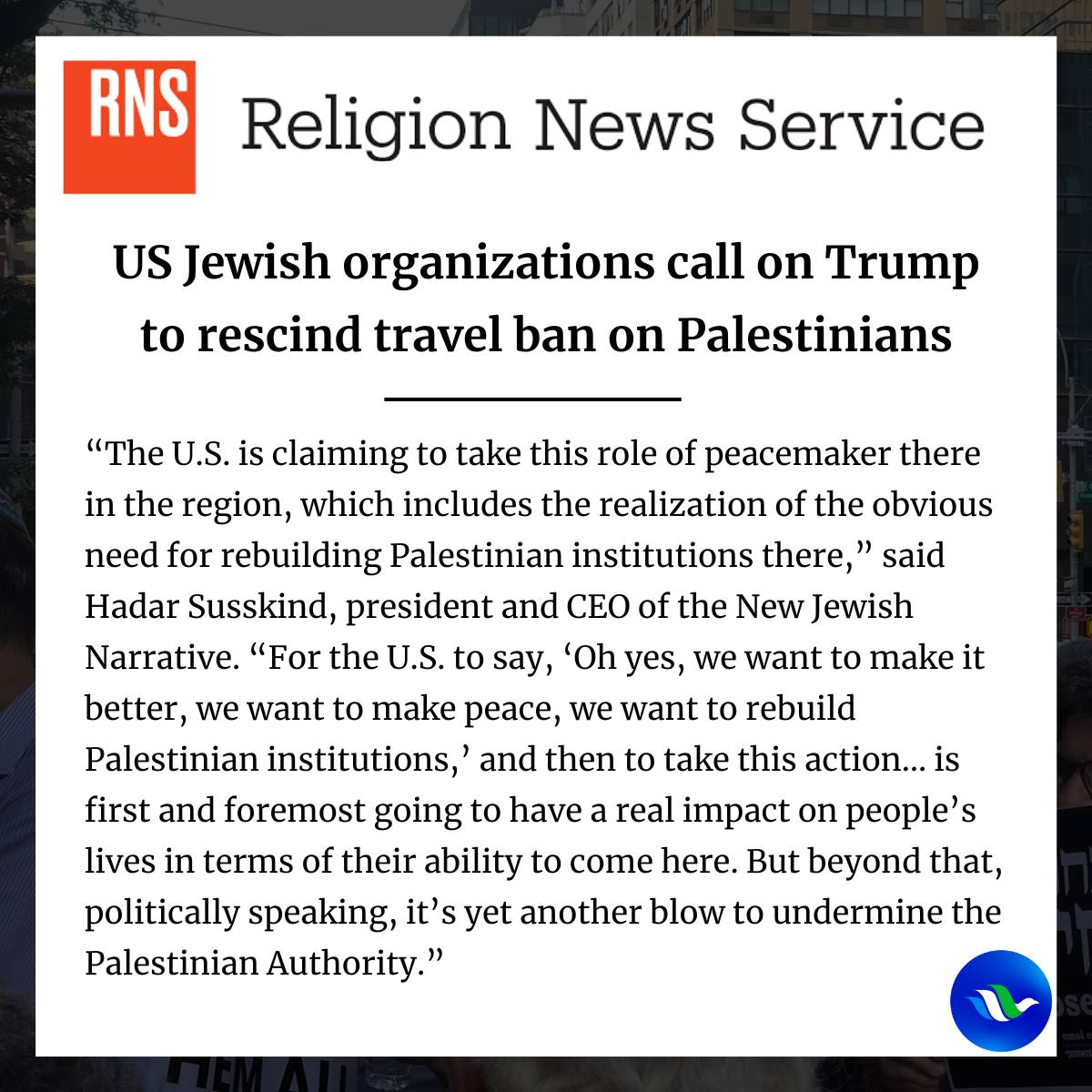
A coalition of eight Jewish organizations sent a letter this morning to President Donald Trump and Secretary of State Marco Rubio expressing alarm over the Trump administration’s expanded Travel Ban.
The letter sharply criticizes the decision to target Palestinians, noting that the Travel Ban further weakens the Palestinian Authority in a manner that will make stabilizing Gaza more difficult. Here the full text of the letter, signed by
New Jewish Narrative Bend the Arc: Jewish Action J Street National Council of Jewish Women New York Jewish Agenda (NYJA) Partners for Progressive Israel T’ruah: The Rabbinic Call for Human Rights The Workers Circle
Ein Meinungsbild – German Institute for Global and Area Studies (GIGA),Dezember.2025
Eine im August 2025 durchgeführte Umfrage zeigt, daß die Mehrheit der in Deutschland lebenden Menschen eine Außenpolitik gegenüber Gaza und Israel befürwortet, die sich am Völkerrecht orientiert und auf die Wahrung der Menschenrechte abzielt. Eine kritische Reflexion über die Gründe und Konsequenzen der Kluft zwischen öffentlichem Meinungsbild und außenpolitischem Handeln ist daher dringend geboten. Prof. Dr. Thomas Richter (GIGA) und Prof. Dr. Christine Binzel (Friedrich-Alexander Universität Erlangen-Nürnberg) haben die wichtigsten Studienergebnisse jetzt veröffentlicht.
Über die Ansichten der in Deutschland lebenden Bevölkerung zum Angriff der Hamas auf Israel am 7. Oktober 2023 und Israels anschließender militärischer Offensive in Gaza ist wenig bekannt. Eine im August 2025 durchgeführte quotierte, repräsentative Online-Umfrage mit 1.050 Befragten gibt Einblicke in die Meinungen darüber sowie in die Bewertung der Medienberichterstattung, das Verständnis von Antisemitismus und die Haltung zur Erinnerungskultur.
Es stimmen 68 Prozent der Befragten der Aussage zu, daß die Hamas am 7. Oktober 2023 Kriegsverbrechen begangen hat. Ähnlich viele (65 Prozent) sind der Ansicht, daß die israelische Armee Kriegsverbrechen sowie Verbrechen gegen die Menschlichkeit in Gaza begehe. Es stimmen 59 Prozent zu, daß Israels militärisches Vorgehen als Völkermord an der palästinensischen Bevölkerung zu bewerten sei.
Nur zehn Prozent stehen uneingeschränkt hinter der Aussage, daß die Sicherheit Israels deutsche Staatsräson sein sollte. Mehr als zwei Drittel sind der Meinung, daß sich die deutsche Außenpolitik vom Völkerrecht und den universellen Menschenrechten leiten lassen soll.
Über 60 Prozent hätten sich bereits von der Ampelregierung gewünscht, israelische Kriegsverbrechen in Gaza zu benennen und zu verurteilen. Es sprechen sich 68 Prozent dafür aus, daß die aktuelle Bundesregierung die israelische Regierung zu einem Ende der Blockade Gazas und einer permanenten Waffenruhe drängt. Nur 18 Prozent wünschen sich eine stärkere militärische Unterstützung Israels.
Es sind 61 Prozent der Befragten der Ansicht, daß Kritik an Israel von Antisemitismus zu trennen sei. Schließlich sind 56 Prozent der Meinung, dass Deutschlands historische Verantwortung Jüdinnen und Juden gelten solle und nicht dem israelischen Staat.
Insgesamt kann festgehalten werden, daß sich weite Teile der in Deutschland lebenden Bevölkerung für eine Neuausrichtung der deutschen Außenpolitik mit Blick auf Gaza und Israel aussprechen. Die Mehrheit der Befragten wünscht sich eine Außenpolitik, die sich klar am Völkerrecht orientiert. Eine daraus resultierende Konsequenz ist das Vermeiden von Doppelstandards – ein Anliegen, welches ebenfalls mehrheitlich befürwortet wird. Eine kritische Reflexion über die Gründe und Konsequenzen der Kluft zwischen öffentlichem Meinungsbild und außenpolitischem Handeln ist dringend geboten. Eine fortgesetzte Neigung, völkerrechtliche Prinzipien nicht universell anzuwenden, hat das Potenzial, die bestehenden Unterschiede weiter zu vertiefen.
Die Studie wurde von der Friedrich-Ebert-Stiftung finanziert und ist in Kooperation zwischen Prof. Dr. Thomas Richter (GIGA), Prof. Dr. Christine Binzel (Friedrich-Alexander Universität Erlangen-Nürnberg) und Prof. Dr. Peter Wetzels (Universität Hamburg) umgesetzt worden.
Im ORF heißt es dazu: „Mehr als zwei Jahre nach dem beispiellosen Massaker der Terrororganisation Hamas und anderer Extremistengruppen in Israel verweigert Ministerpräsident Benjamin Netanjahu weiterhin eine unabhängige Untersuchung der Vorfälle. Statt der Einrichtung einer staatlichen Untersuchungskommission befürwortet der 76-Jährige die Ernennung einer Regierungskommission.“
Times of Israel: „Lawmakers advance bill for politically appointed Oct. 7 probe in place of state inquiry“
Haaretz: Netanyahu Ministers Approve Government-controlled Oct. 7 Probe, Push Judicial Overhaul Bills – A committee of Israeli ministers has approved on Monday to advance a bill establishing an investigation into Hamas‘ October 7 attack, a Likud-sponsored proposal that would give Prime Minister Benjamin Netanyahu’s government influence over the inquiry’s composition and mandate.
An ecumenical witness for equality and a just peace in Palestine/Israel
Jerusalem, 20. Dezember 2025 | A Christmas Message – 2025
The cities of the Holy Land are adorned with lights and trees during this Christmas season, and markets and festivals abound, spreading a festive atmosphere. Many of us participate in these gatherings, as if we are thirsting for life after witnessing death and destruction over the past two years. Joy radiates from the faces of children and adults alike, in the carols and hymns, and in the markets and gifts.
We must ask: How can we celebrate while our people in Gaza are still suffering the effects of war, destruction, genocide and now face a harsh, rainy winter? Many are exposed to the elements, trying to survive without the most basic necessities. People are still dying: killed by the Israeli army, dying of starvation, disease and exposure to the cold.
How can we celebrate when, in the West Bank, terror reigns as the army imposes its regime of assassinations, mass arrests, house demolitions, land confiscation, while the settlers continue their rampage? Among those suffering under this regime of terror are our Christian brothers and sisters in Taybeh and Abboud. Their villages, like so many others, are attacked, their fields pillaged and their ancient churches desecrated.
We ask ourselves: How can we celebrate? Yet, celebrate we must!
We might indeed be powerless in the face of Israeli intransigence, which prevents life from entering Gaza, preventing law enforcement in the West Bank. However, the message from Bethlehem, Nazareth, and Jerusalem is that equality must come, injustice must end and light must triumph. Our Christmas celebration proclaims a message of life in the face of death and darkness.
Our celebrations are filled with Christmas carols and messages of hope, raised by faithful and pastors from the depths of our hearts, offering us a glimmer of hope after the horrors of the past two years. We revive hope by reliving the memory of Christmas, the birth of the Prince of Peace. Christmas is a holiday for everyone; it is a prayer, a celebration of humanity, and also a national holiday.
Some may ask: Have the celebrations and events become excessive? Have they burdened families already struggling with difficult economic circumstances? However, the number of participants in these celebrations gives the impression that they enrich the Christmas season, revitalize the economy, and bring joy and hope back to families who have waited so long.
This Christmas, we want to celebrate, but we continue, at the same time, to remain committed to our mission and our peaceful resistance, striving for equality, freedom, justice, and peace. Our hope is the hope of the shepherds at the coming of Christ. The angel told them: “I am bringing you good news of great joy for all the people: to you is born this day in the city of David a Savior, who is the Messiah, the Lord.” (Luke 2:10-11).
We rejoice and we celebrate, but with awareness and caution, for we are exposed every day to the danger of death and war in Gaza and throughout Palestine. We celebrate with our souls burdened by death in our land. Even in the heart of our city, Jerusalem, the City of God, at its so-called New Gate, there are attempts to deprive us of the serenity and sanctity of our feast, especially the municipality’s policy aimed at Judaizing the city and undermining the status quo that guarantees pluralism and the unique character of this neighborhood and the city as a whole.
Despite all this, we celebrate with our hearts lifted up to the sublimity of God, filled with the joy of the coming of the eternal Word of God, who became man and dwelt among us, our Savior and the Savior of all humanity. Through Him, we are free, witnesses and messengers of the message of love in our beloved Holy Land. Glory to God in the highest, and on all our land, peace from God, love, justice, and equality. Happy Feast!
Signatories: Latin Patriarch of Jerusalem Michel Sabbah (emeritus) Greek Orthodox Archbishop Attallah Hanna Lutheran Bishop of the Holy Land Munib Younan (emeritus) Mr. Yusef Daher Ms. Sawsan Bitar Mr. Samuel Munayer Ms. Dina Nasser Mr. John Munayer Ms. Sandra Khoury Rev. David Neuhaus SJ Rev. Frans Bouwen MAfr Rev. Firas Abdrabbo Mr. Rafi Ghattas Rev. Alessandro Barchi and other members
Auch solche Nachrichten gibt es (noch nicht genug…)
London to Host the World’s First Summit for the International Fund for Israeli-Palestinian Peace
In a landmark move backed by overwhelming public support, Foreign Secretary Yvette Cooper announces she will host an inaugural meeting of the International Fund for Israeli-Palestinian Peace in March 2026 in London, at Lancaster House.
Announced on December 8th, the government confirmed its goal to “bring together international peacebuilding expertise and civil society organisations from the Middle East, to map existing peace-building work and support the establishment of an International Peace Fund for Israel and Palestine”, highlighting the important role that civil society organisations can play.
Foreign Secretary Cooper stated that “this conference will be a crucial step in that journey, bringing together representatives of Palestinian and Israeli civil society to build common ground between their communities, challenge entrenched divisions, and work towards a future where both states can live side-by-side in peace and security”
Yvette Cooper stated that the UK is “well placed to host and facilitate these talks, and the new International Peace Fund we are helping to create will provide the practical support to drive this work forward.”
Later that day, ChancellorRachel Reeves re-iterated her government’s support for this initiative at LFI’s annual lunch, stating: “I can confirm today that Foreign Secretary Yvette Cooper will host representatives from Israeli and Palestinian civil society in March at Lancaster House to support the establishment of an International Fund, and ensure civil society groups are at the forefront of our efforts to advance long-term peace, and a two-state solution”
The announcement coincides with new UK polling showing that among respondents who expressed an opinion 84% of the UK public support creating the Fund, and 73% want the UK to contribute at least £10 million towards it. Global polling shows the same appetite: 88% of respondents support their country joining international peace efforts, and a majority back participation in the Fund.
The announcement fulfills a pledge made last year by Prime Minister Sir Keir Starmer, following a private meeting with peacebuilders Ibrahim Abu Ahmed and Barak Talmor, alongside ALLMEP’s Executive Director John Lyndon and UK Advocacy Manager Rachael Liss. There, the Prime Minister heard first-hand how grassroots initiatives are reducing violence, building trust, and creating the conditions for a lasting and just peace.
The UK’s decision comes at a decisive moment. A fragile ceasefire was secured in October, yet progress toward subsequent stages remains limited. Experience from other successfully resolved conflicts suggests that turning a temporary truce into lasting peace requires sustained engagement with the communities directly affected by the conflict—support that can help generate the trust, ideas, policies, and future leadership essential for long-term conflict resolution.
The International Fund for Israeli-Palestinian Peace is designed to meet this need by providing robust, multi-year support for civil society initiatives that promote relationship-building, shift public attitudes, and catalyse the societal change that political agreements alone cannot achieve.
The UK’s decision reflects a recognition that transforming a ceasefire into a durable peace will require integrating civil society as a central component of the process. The announcement also positions the UK as a leader in advancing commitments made in the 2024 G7 Leaders’ Communiqué to “coordinate and institutionalise support for civil society peacebuilders as part of a wider diplomatic strategy.” The approach also aligns with the New York Declaration and with the Trump 20 Point Plan, each of which articulate a role for civil society recognising that peace cannot be secured solely through political negotiation.
Aus dem Mailing der American Friends of Combatants for Peace
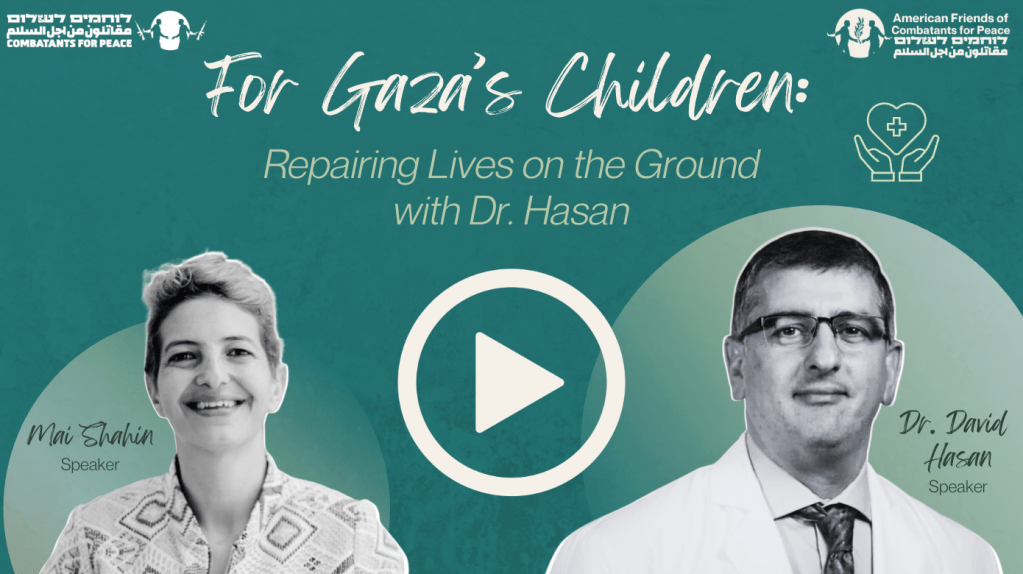
Yesterday, I was moved to my core as we gathered in shared witness: listening, reflecting, and holding what it means to respond to immense human need with compassion and responsibility.
We heard from Dr. David Hasan, a Palestinian-American neurosurgeon, Duke University professor, and the founder of the Gaza Children Village (GCV). Drawing on his frontline medical missions in Gaza, Dr. Hasan spoke about the collapse of critical systems and his decision to envision something more: a community-led model of care that protects children not only in moments of crisis, but also over the long term.
He also spoke of the urgent effort underway to convert an existing facility into what will become Gaza’s only tertiary children’s hospital, a lifeline for newborns, children with injuries, and families who have nowhere to turn.
GCV has become a refuge for orphaned and highly vulnerable children across the Gaza Strip. Today, they serve more than 8,500 children, providing safe, structured daily environments where children can learn, heal, and grow, supported by education, nutrition, medical care, and psychosocial support.
As we close 2025, we invite you to join the work of repair in Gaza by supporting GCV directly. You can learn more about their mission and support their work here: 👉 https://www.thegazachildrenvillage.org/
Thank you for being a part of the collective movement of healing, humanity, and hope. Together, we can help build a future worthy of Gaza’s precious children.