Eine andere Sicht

Hoffen wir, daß es nicht nur ein Pfeifen im Wald ist, die politischen Mehrheiten gibt es jedenfalls (noch?) nicht …

The Palestinian economy is in collapse. Hamas is regaining control over the limited existing resources and assets in the Gaza Strip, after the war destroyed Gaza’s economic system. In the West Bank, the Palestinian Authority (PA) is struggling to survive amid deliberate Israeli government policy that is exploiting the former’s dependence and advancing unilateral coercive measures to cripple the Palestinian economy and the PA itself.

This policy reflects a dangerous escalation of the Israeli approach that viewed Hamas as an asset and the PA as a burden, an approach whose beginnings predated October 7, 2023. The collapse of the PA and the Palestinian economy are openly touted by Israeli ministers as elements of a strategy designed to advance annexation and prevent the establishment of a Palestinian state, even at the cost of a stronger Hamas and critical damage to Israeli security.

This paper, written by Yitzhak Gal, proposes a new policy and includes pragmatic recommendations for action that will mend Israeli-Palestinian economic relations while supporting progress on a phased process toward two states and stable, long-term security. The proposed strategy is based on reform and socioeconomic stabilization of the PA within regional collaborative arrangements.

The paper illustrates the strong link between Palestinian economic growth and the security relations between Israel and the Palestinians. On this foundation, the paper proposes a three-stage road map whose goal is gradual building of a strong Palestinian economy; which will function as an independent system, while maintaining close cooperation with Israel and other countries in the region. That will contribute both to Palestinian and Israeli stability and prosperity.

A necessary condition for implementation of this roadmap is a political will in Israel to change its approach toward the Palestinians and to make strides in a process directed at socioeconomic and political stabilization. Therefore, the plan can only be implemented under an Israeli government that is willing to adopt a policy that is entirely different from the current government’s policy.

Nevertheless, even under the current government, there are several critical steps that can be performed almost immediately. These steps are proposed in the first stage of the road map, concurrently with Stage 2 of President Trumps’ 20- point peace plan. These steps will be part of US-led measures to implement UN Security Council Resolution 2803 with respect to Gaza.

The concrete measures proposed for the first stage are: Resolution of the PA’s protracted fiscal crisis in order to allow full and timely wage payments and orderly delivery of public services; gradual re-entry of Palestinian workers into Israel for employment while implementing agreed changes to improve security arrangements; suspension of measures that impair the Palestinian banking system and application of new arrangements that will stabilize this critical system; as well as measures that would leverage the rebuilding of Gaza to jump-start the Palestinian economy, with emphasis on trade and logistics. The execution of these steps will be contingent on a comprehensive, effective reform of the PA, cessation of payments to prisoners and “martyrs” (shaheeds), and tight security coordination that ensures demilitarization in Gaza and the marginalization of Hamas.

In the second stage, additional set of measures that can be promoted under the umbrella of the Oslo Accords and the Paris Protocol. These measures will include: convening of the joint Israeli-Palestinian economic committee and the additional joint subcommittees defined in the Paris Protocol and accompanying agreements, for development of agreed future plans; phased promotion of economic links between Gaza and the West Bank, contingent on accepted security arrangements; establishment of special-economic-status industrial zones and free trade areas; signing of preferential trade arrangements with the UAE and Saudi Arabia, the EU, and the US; promotion of Palestinian and Israeli integration into regional economic projects, primarily the reconstruction of Gaza and the India–Middle East–Europe Economic Corridor (IMEC).

The third stage will focus on a new Israeli-Palestinian economic agreement, under US-international-regional aegis. The new economic agreement will be negotiated as part of an agreed path to the future establishment of a demilitarized Palestinian state, and as an integral element of a regional settlement. This economic agreement will replace the Paris Protocol and its accompanying set of agreements as well as the multiple unliteral arrangements that have evolved over the past 30 years. This stage, which is proposed to take place over a longer term (3–4 years), will include issues such as a permanent trade regime, the currency of the PA, and other significant changes in the structure of the Palestinian economy.

Implementation of the proposed plan will drive the Palestinian economy forward, strengthen the moderate actors in the Palestinian arena, and support the socioeconomic stability that is a necessary condition for a stable settlement and long-term security.

The proposed plan also offers a set of additional significant benefits for Israel: The plan will lead to a strong and stable PA that maintains effective rule in the West Bank, that constitutes an effective alternative to Hamas in the Gaza Strip, is committed to peace with Israel, and is a partner in effective anti-terror measures. Implementation of the plan will dilute the power of Hamas and other extremist groups in Gaza and the West Bank.

The gradual nature of the process, which is directed toward a clear political horizon and its progress based on the achievement of clear milestones, will build confidence and trust and create a system with long-lasting stability.

Israel’s integration as an important actor in comprehensive regional initiatives, such as IMEC, is expected to be an important growth engine for Israel’s economy for decades to come.

Strukturmuster deutscher Israelpolitik

Ein Beitrag auf dem Blog der Deutsche JuristInnen für das Völkerrecht.

Kurze Erinnerung: DienstagsZoom – 3. März 2026

Der diAk – Ein Blick zurück und nach vorn

Der deutsch-israelische Arbeitskreis für Frieden im Nahen Osten: Ein Blick zurück und nach vorn

Ulrich Kusche wurde 1944 in Breslau (heute Wrocław) geboren. Später studierte er evangelische Theologie, promovierte in Heidelberg zum „Judentum im Urteil deutscher Alttestamentler“ und wurde Vertreter des Bundesverbands Deutsch-Israelischer Studiengruppen (BDIS) in Jerusalem. Danach sammelte er 45 Jahre lang Erfahrung als Pastor in der Seelsorge und Bildungsarbeit. 1977 gehörte Kusche zu den Gründungsmitgliedern des Deutsch-israelischen Arbeitskreises für Frieden im Nahen Osten (diAk); später war er für einige Jahre Vorsitzender des Vereins. 

Bei unserem nächsten Vortrags- und Diskussionsabend wollen wir mit Ulrich Kusche über die deutsch-israelische Beziehungsarbeit in den 1970er Jahren, die Entwicklung der DIG, die Entstehung des diAk und dessen frühe Vereinsgeschichte, aber auch über die Rolle des diAk heute sprechen.

Das Gespräch findet am Dienstag, dem 3. März 2026, von 19 bis 20 Uhr auf Zoom statt. Eine Anmeldung ist nicht erforderlich. Der Link für den Zoom-Room ist:

Nächste Veranstaltung: 3. März 2026

Vergangene Veranstaltungen:

7. Oktober 2025 – Sally Azar (Jerusalem), Evangelisch-Lutherische Kirche in Jordanien und im Heiligen Land: Die Situation palästinensischer Christ*innen nach dem 7. Oktober 2023

4. November 2025 – Prof. Dr. Markus Dreßler (Leipzig), Religionswissenschaftler und Türkeiexperte: Türkische Perspektiven auf den Nahostkonflikt und die Antisemitismusdebatte

2. Dezember 2025 – Dr. Maya Rosenfeld (Jerusalem), Soziologin an der Hebräischen Universität in Jerusalem: The Anthropology of Occupation – The Case of Dheheishe Refugee Camp

6. Januar 2026 – Dr. Dr. Peter Ullrich (Berlin), Soziologe und Kulturwissenschaftler, Zentrum für Antisemitismusforschung: Autoritärer Anti-Antisemitismus

3. Februar 2026 – Marina Klimchuk (Graz), freie Journalistin: Postsowjetische Identität im deutschen Judentum und der Genozid in Gaza

Ethnische Säuberung?

Wenige Begriffe spalten so sehr in der Debatte um Isarel / Palästina – Palästina/Israel:

Hier drei aktuelle Berichte zu Situation:

Vereinten Nationen (OCHR)

Radio Vatikan:

Deutsche Welle

Gazas Zukunft?

European Council on Foreign Relations – Ein Beitrag von Muhammad Shehada (Visiting Fellow)

Israelis for Peace

Open Letter for German Action Against Human Rights Violations in the West Bank & More Updates

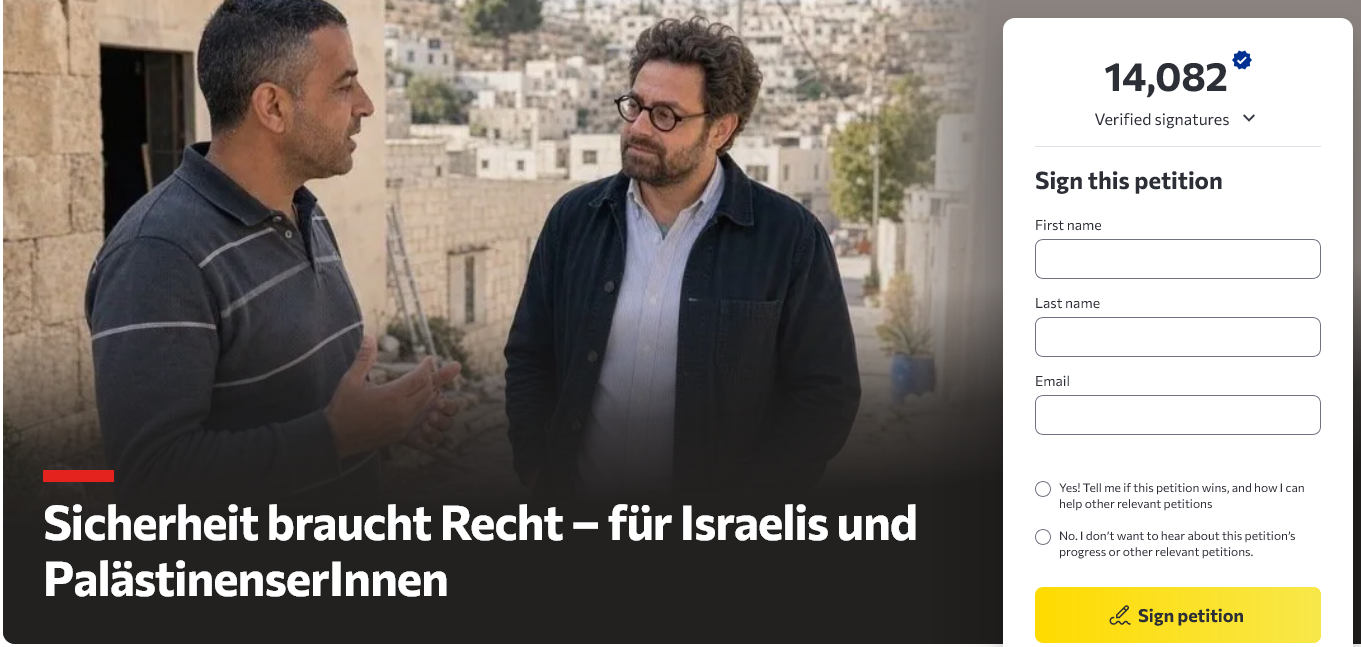
In the last days, we’ve been collecting signatures for an open letter against the atrocities in the West Bank. Here is a part of it:

“Since the announcement of a fragile ceasefire in Gaza in October 2025, international attention has largely shifted away from the region. However, the Israeli government has continued to severely violate the ceasefire and its human rights obligations, in Gaza and in the occupied West Bank. We call upon Germany, one of Israel’s closest allies, to fulfill its own obligations under international law and its commitment to human rights by acting decisively against these ongoing atrocities.

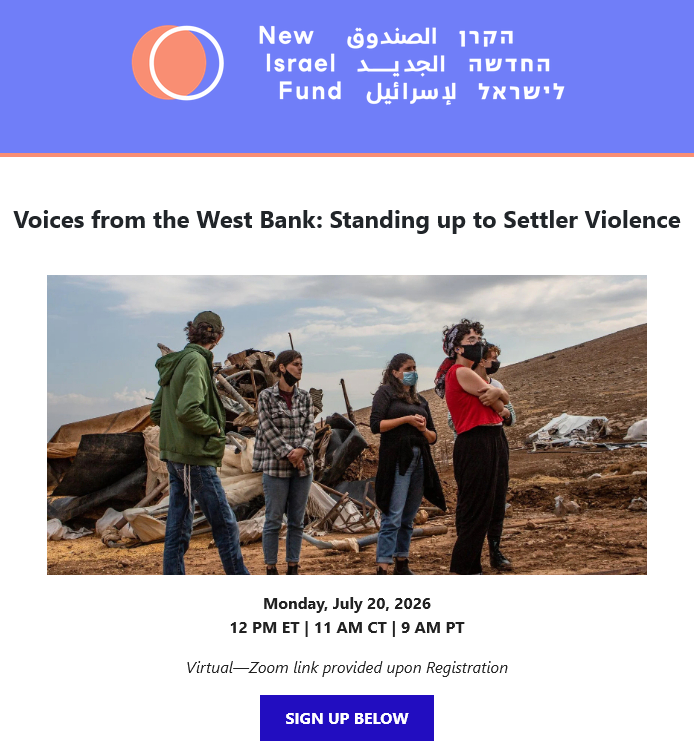
The situation in the West Bank is deteriorating rapidly. In recent months, there has been a surge in settler violence against Palestinians, particularly targeting herding communities in Area C. These attacks – which include the daily harassment of farmers, targeting of humanitarian activists – Israelis and internationals – and organized raids on Palestinian villages – often occur with the tacit agreement or active assistance of the Israeli military. According to the Israeli human rights organization B’Tselem, more than 44 communities have been displaced since October 2023.

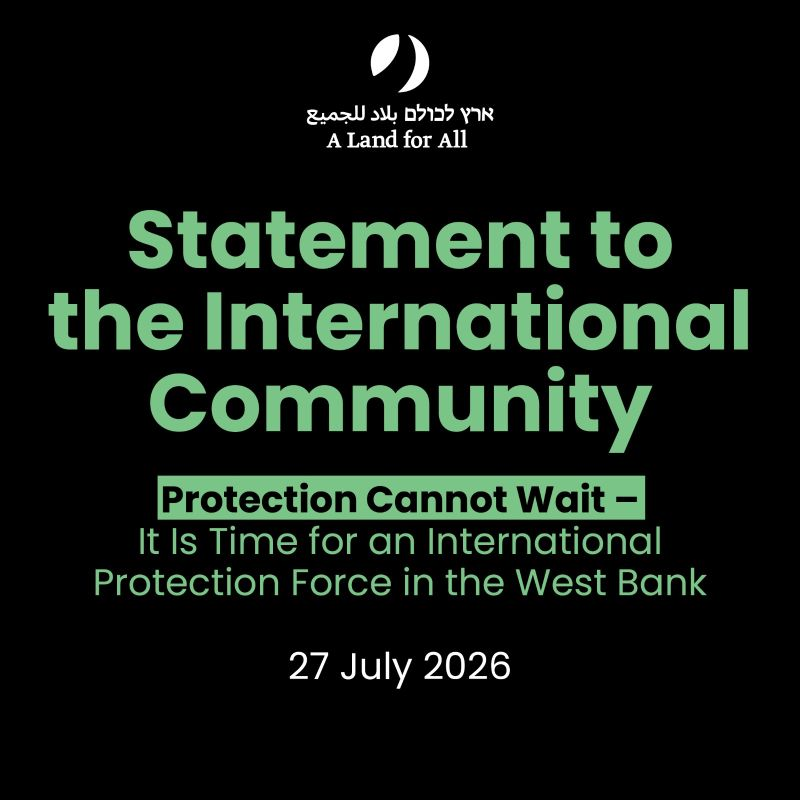
Germany holds a unique position of influence in the West Bank as a primary financial supporter of both the Palestinian Authority and local civil society. While the U.S. has turned a blind eye to the escalation of extremist violence and ethnic cleansing in the West Bank, the many military raids on cities and villages in the region must not enjoy tacit international approval. We urge Germany to shift its policy and pressure Israel to cease the annexation and human rights violations.

Mehr

Zu Berlinale Zeiten …

***

Und „passend“ dazu ein Beitrag von Hanno Hauenstein auf seinem Blug null.punkt

How the Berlinale Jury’s Turn to “Neutrality” Exposed the Limits of Solidarity in Germany’s Cultural Sphere

Sag mir wie Du es nennst und ich sage Dir …

Ein Beitrag von Joseph Croitoru auf Zeit-Online über die Auseinandersezuimg um die Deutungshoheit in den aktuellen politischen Auseinandersetzung in Israel / Palästina

Jüdisch, postsowjetisch, besatzungskritisch sucht …

Im Nachgang zu unserem DienstagsZoom am 3. Februar, hier ein Beitrag der Autorin in der taz vom 15. Februar 2026

Überleben – und (weiter) leben

Sophie von der Tann für den Weltspiegel:

Ein Jahr nach seiner Freilassung aus der Geiselhaft der Hamas spricht Eli Sharabi aus dem Kibbutz Be’eri erstmals ausführlich über seine 491 Tage als Geisel der Hamas im Gazastreifen.

Bettina Meier, ARD Tel Aviv für die Tagesschau:

491 Tage war Eli Sharabi in Geiselhaft in Gaza – und hat darüber ein Buch geschrieben. Darin schildert der Familienvater, wie er auch in den dunkelsten Stunden durchgehalten hat, um zu überleben.