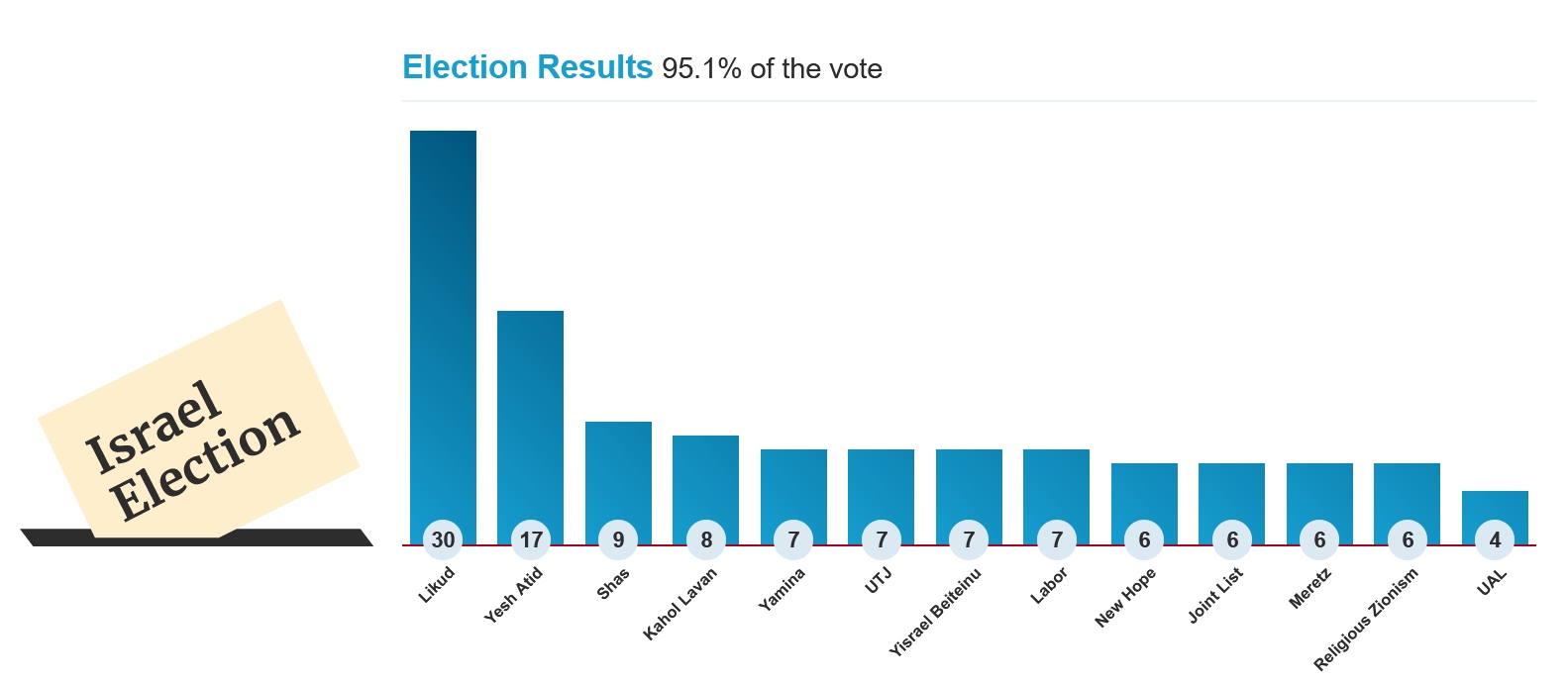
So sieht die neue (24.) Knesset aus (… zu 99,5%)
Noch immer steht das endgültige Ergebnis der Knessetwaheln nicht fest und kleine Verschiebungen könn(t)en noch große Wirkungen haben, wie dieser lange „Wahlabend“ gezeigt haben: Ein Durchmarsch für Netanyahu ist es jedenfalls nicht geworden und noch ein paar mehr kleine „Wunder“ – dazu mehr, wenn das Endergebnis bekannt gegeben worden ist. Hier die Graphik von Haaretz am Donnerstagmittag.
Anders als bei den letzten Wahlen treten die arabisch-israelischen Parteien nicht mehr geschlossen in einer gemeinsamen Liste an. Die Islamische Bewegung Ra´am hat sich abgespalten und signalisiert, daß sie gewillt ist, von einer grundsätzlichen Oppositionshaltung Abstand zu nehmen und auf zionistische Parteien aller Couleur zuzugehen. Das öffnet den Weg für jüdisch-arabische Koalitionen, wie sie bereits in den Kommunen seit einiger Zeit praktiziert werden. Inwieweit dieser politische Pragmatismus der Zusammenarbeit bereits die nationalen Wahlen und die danach folgenden Koalitionsverhandlungen beeinflussen wird, ist fraglich. Lidia Averbukh analysiert diese Entwicklung in diesem Beitrag für die SWP.
Welche Koalitionen sind möglich? Welche wahrscheinlich?
Nicht nur die israelische Linke ist so weit reduziert, dass sie parlamentarisch am Abgrund steht, durch die Schwächung des zentristischen Bündnisses Blau-Weiß ist auch die Mitte zerbrochen. Netanyahu wird wiederum versuchen, mit allen Mitteln eine Koalition zustande zu bringen, die ihn vor weiteren gerichtlichen Verfahren bewahrt. Wie sich die einzelnen Fraktionen zu den entscheidenden Fragen wie die Bewältigung der Coronakrise, das Verhältnis zwischen Staat und Religion, die Behandlung des Konflikts und der Unabhängigkeit der Justiz, besonders des Obersten Gerichtshofs, verhalten werden, wird auch die Koalitionsbildung nach den Wahlen beeinflussen.
In seinem Kurzbeitrag über die vierte Wahl in Israel innerhalb von zwei Jahren stellt Peter Lintl drei der wahrscheinlichsten Szenarien vor.
Eine der wichtigsten Zukunftsfragen in Israel beleuchtet am Donnerstag, 11. März 2021 ein Online-Gespräch der Rosa Luxemburg.Stiftung in Tel Aviv. Das Zoom-Event um 20 Uhr (19 CET), statt.
Die Sprecher:innen sind:
– David Enoch, member of The Joint Democratic Initiative
– Rami Younis, Palestinian journalist, filmmaker, and activist
– Ghada Majadle, Human rights activist, team member of Physician for Human Rights-Israel
Modaration: Orly Noy, editor at Local Call and political activist
Einladungslink: https://us02web.zoom.us/j/83232146624

Was ist das Ergebnis der Zerbrechens der „Gemeinsamen Liste“?
Abgezeichnet/angedeutet hatte sich das Zerbrechen dieses Projektes schon einige Zeit – Was bedeutet das für die inner-israelischen Machtverhältnisse, was für die palästinensisch-politische Szene, diesseits und jenseits der Mauer? Ein israelischer Ministerpräsident, der seine mögliche erneute Wahl islamischen Kräften im eigenen Land verdanken könnte, ist jedenfalls noch einmal ein fast bizzar zu nennende Wendung. Einen ausführlichen Beitrag dazu von Joshua Leifer auf dem Blog von Jewish Currents.
Die Wahllisten stehen fest | 39 Parteien bei der Wahlkommission registriert
In der ersten Umfrage (Channel 13) nach der Schließung des Bewerbeverfahren für die Wahlisten zeigen sich die Prognosen, die zumindest eine gewisse Tendenz anzeigen:
Likud 30
Yesh Atid 17
New Hope 13
Yamina 11
Labor 7
Joint List 7
Shas 7
United Torah Judaism 6
Religious Zionists 5
Yisrael Beytenu 5
Blue and White 4
Meretz 4
Ra’am 4.
Bei Chanel 12 ergeben sich diese Zahlen:
Likud 29
Yesh Atid 17
The New Hope 14
Yamina 11
Joint List 9
Shas 8
United Torah Judaism 7
Yisrael Beytenu 7
Labor 6
Meretz 4
Blue and White 4.
Mit dem Blick ihres großartigen Mottos:
‚A past to be shared not owned‘
schaut Emek Shaveh auf das vergangene Jahr. Regelmäßig (auf Deutsch) informiert die Facebookseite der Organisation.
***
Zum Appetit machen hier einmal der aktuelle Mailtext.

Dear friends, 2020 has kept many of us indoors but has not slowed down development in and around archaeological sites in East Jerusalem and the West Bank. In Jerusalem, our efforts to prevent the construction of a cable car in the Historic Basin have reached the final phase in court. Following July’s hearing, the State and the petitioners, including Emek Shaveh, submitted additional materials. While the court has asked the State to provide further proof that the venture is indeed a transportation plan in the service of tourism as the developers claim, the petitioners claim that the State has been unable to prove the cable car would aid in the transport of tourists to the Old City or solve the problem of congestion in the area. At the time of writing the High Court has yet to announce its decision.

In October, Emek Shaveh learned that the Jerusalem Development Authority had initiated preliminary works for the construction of the cable car even though the case against the cable car was still open in the High Court. Emek Shaveh brought the issue to the attention of city council members who refused to approve confiscation of Palestinian land for the project prior to a decision by the court. The cause was aided by ultra-orthodox council members who were concerned the construction of the cable car may involve the desecration of Jewish graves. Also in October, Emek Shaveh learned about orders to uproot trees from the planned route of the cable car. In response to our objections, the Forest Administrator at the Ministry of Agriculture accepted our objection and decided to suspend the works.

In the City of David/Silwan, the excavation of the Roman road (known as the “Pilgrim’s Road”) continued throughout the pandemic pretty much uninterrupted. Earlier this year, we published a summary of a government plan called the “Shalem Plan” (Shalem=whole) for the ancient sites of the Historic Basin. The report describes the vision to excavate and link together multiple sites to create a tourist route dominated by a Judeo-centric historical narrative. The Pilgrim’s Road is a central feature of this plan. The Elad Foundation claims the route served the Jewish pilgrims en-route to the Temple during the 1st century CE although there is no hard archaeological evidence to support this. As you may recall, earlier this year we published a report documenting claims by the Palestinians of Wadi Hilweh in Silwan that the excavations are the cause of severe damage and subsidence in homes situated above the excavation route.
In the City of David/Silwan, the excavation of the Roman road (known as the “Pilgrim’s Road”) continued throughout the pandemic pretty much uninterrupted. Earlier this year, we published a summary of a government plan called the “Shalem Plan” (Shalem=whole) for the ancient sites of the Historic Basin. The report describes the vision to excavate and link together multiple sites to create a tourist route dominated by a Judeo-centric historical narrative. The Pilgrim’s Road is a central feature of this plan. The Elad Foundation claims the route served the Jewish pilgrims en-route to the Temple during the 1st century CE although there is no hard archaeological evidence to support this. As you may recall, earlier this year we published a report documenting claims by the Palestinians of Wadi Hilweh in Silwan that the excavations are the cause of severe damage and subsidence in homes situated above the excavation route.

2020 has seen a substantial increase in settler activity at sites in the West Bank. Following the publication of President Trump’s „Peace to Prosperity“ plan we have witnessed a coordinated campaign by the settlers to take control over and develop sites in area C of the West Bank. The focus on sites in area C stems from a strategic decision to use the sites to stave what they claim are attempts by the Palestinian Authority to take over sections of Area C. Tensions between the PA and the Civil Administration have increased at major sites such as Sebastia where the PA held a ceremony in November or at the village of Tuqu‘ near Bethlehem where the archaeology unit at the civil administration confiscated a Byzantine era baptismal font in the summer. In late July, the Knesset’s foreign affairs and defense committee met to discuss Area C with archaeology as one of the topics at the behest of a right-wing think tank called the Shiloh Forum. Materials presented to the committee by the forum were based on an unpublished report by a settlers group called “Preserving Eternity” who had previously made unfounded claims about Palestinian acts of destruction. In response, Emek Shaveh submitted an opinion demonstrating how the sites are used as a pretext for an increased destruction of dwellings in and around archaeological sites (a rise of 162% in number of decrees) and reminded the committee of Israel’s duty to safeguard the sites for the benefit of the local population under international law.
In September, for the first time in 35 years, the Civil Administration issued expropriation orders for two antiquity sites: Deir Sam’an and Deir Kala’, northwest of Ramallah which are situated on privately owned Palestinian land. The sites feature impressive Byzantine remains. In the last decades, the Civil Administration has refrained from confiscating private lands containing antiquities. The expropriations represent a new level in efforts to take control of antiquity sites as part of the unofficial process of annexation underway in area C. Emek Shaveh has approached the Chief Military Advocate demanding he suspend the expropriation orders and remind the area commander of his obligations under international law.
In Hebron, a plan by the settlers to build a lift for the disabled in a process that contravenes the Oslo Accords was approved by the Judea and Samaria Central Planning Committee after petitions by the Hebron Municipality and Emek Shaveh were rejected. The plan has been promoted by the settlers for twenty years and was approved in a process that did not involve conservation professionals or thorough oversight by the Civil Administration’s Staff Officer for Archaeology. The planned lift is incongruous with the historic structure and will mostly serve Jews, not Muslims, coming to pray at the holy site.

Inside the Green Line, we launched a joint project with the Arab Culture Association on preserving and promoting sites which embody the heritage of minority groups. Our report Selective Conservation: Policy and Funding for Minority Heritage Sites in Israel outlines the mechanisms and policies shaping heritage preservation in Israel while flagging up discrimination against heritage sites of non-Jewish societal groups. In the report we call for a reevaluation of Israel’s heritage policy including a revamping of the system of allocations which has enabled the uneven distribution of funding for conservation and development. A series of zoom tours in Hebrew was kicked off last month with a tour of Lod and discussion of heritage challenges with a local councilwoman.

Our work on amendments to the Antiquities Law and the Antiquities Authority Law which we began three years ago is entering the final phase. Last month the proposed amendment was submitted to the Knesset for an initial vote. This followed a year of lobbying with MKs from across the political spectrum and officials in various ministries. The amendments, which have been formulated in consultation with archaeologists and preservation experts seek to resolve the conflict of interest which makes the Antiquities Authority’s excavations and conservation policies vulnerable to political and economic considerations. Our work on amendments to the conservation law is in the advocacy phase. We believe that legislation is key to safeguarding the multifaceted heritage of the Historic Basin and of sites within the Green Line.

2020 has posed new challenges. Like many others we had to adapt the way we work to comply with the restrictions posed by the Covid-19 pandemic. Adapting our tours to an online format took time, but ultimately through the zoom events which combined filmed tours with discussion with participants we managed to reach a much wider audience. People who had never participated in our tours where able to do so from far and wide both in Israel and abroad. With the vaccine on the horizon, we look forward to resuming some of our tours in the physical world, but also intend to keep offering many of our events on zoom.
2021 is going to be interesting. With the High Court expected to make the final decision on the cable car, one of the most critical battles over the identity of Jerusalem’s Historic Basin will be decided. As for the West Bank, we remain hopeful that the change of administration in the United States (and perhaps in Israel as well) could temper the pace of appropriation of sites and lands. We are excited about our new public campaign to promote the preservation and development of minority heritage sites across the country. If you are on facebook, please like our page and follow our weekly column #neighbours which tell the stories of the multilayered sites across the country. Thank you for your support for our work.
Es gibt in Israel doch noch Publizisten, die an Wunder zu glauben scheinen. Ori Wertmann schreibt in der Times of Israel über die israelische Labour-Party, die Avoda. Er glaubt (wirklich), daß mit einem anderen Vorsitzenden und dem Rauswurf von Peretz die Partei noch einmal an Bedeutung im Land gewinnen könne.
Ob die nächste Knesset nicht viel eher die erste sein wird, in der die Arbeitspartei nicht mehr vertreten sein wird?