
Thema: Israels Premier Netanjahu will den Gazastreifen vollständig besetzen. Das Militär ist dagegen.
Kategorie: Friedens- und Versöhnungsarbeit
Yalla
Jüdisch-arabische Berührungen – Herausgegeben von Anika Reichwald
im Namen des Jüdischen Museums Hohenems (Online-Katalog)

Redaktion: Dinah Ehrenfreund, Hanno Loewy
Übersetzungen: Kirsten Lehmann, Lilian Dombrowski
Gestaltung: Thomas Matt
Fotos: Dietmar Walser, Thomas Matt / ISBN 978-3-200-10568-3
Die Geschichte arabisch-jüdischer Lebenswelten reicht Jahr- hunderte zurück, bis in die präislamischen Stammesgesell-schaften Arabiens. Eine lange und widersprüchliche Beziehungsgeschichte – mal romantisiert, mal vergessen, verdrängt und dämonisiert – gibt es zu entdecken: jüdisches Leben unter islamischer Herrschaft über die heutigen arabischen Länder und die Iberische Halbinsel (al-Andalus), im Osmanischen Reich oder unter dem Einfluß europäischer Kolonialinteressen.
Yalla. Arabisch-jüdische Berührungen lädt ein zur Erkundung unvertrauter, widersprüchlicher Identitäten. Und leistet einen bescheidenen Beitrag dazu, auf das Begehren nach Eindeutigkeit mit Ironie und Offenheit zu reagieren – sei es in den Auseinandersetzungen um Zugehörigkeit und Abgrenzung in Europa, sei es im Blick auf den scheinbar so unlösbaren Konflikt an der Schnittstelle zwischen Europa, Asien und Afrika, dessen tragische Radikalisierung der Gewalt und der gegenseitigen Auslöschungsfantasien uns jeden Tag mehr beunruhigt. (Hanno Loewy im Vorwort)
Einleitung: Hanno Loewy
Texte zur Ausstellung: Anika Reichwald
Mit Essays von:
Lital Levy „Arabische Juden im Maschrek. Zur Historisierung eines Konzepts“
Emily Benichou „Gottreich Arabische Juden im Maghreb. Zur Historisierung eines Konzepts“
Mati Shemoelof „Fragen (nach) einer arabisch-jüdischen Diaspora“
Online-Katalog zur gleichnamigen Ausstellung im Jüdischen Museum Hohenems, 29. September 2024 bis 05. Oktober 2025. Dank großzügiger Förderung durch die Stiftung Irène Bollag-Herzheimer, Basel.
Eine bittere Lektüre …
New York Declaration on the Peaceful Settlement …
Bemerkenswertes Abschlußpapier der von Frankreich und Saudi-Arabien organisierten VN-Konferenz zur Zwei-Staaten-Lösung „New York Declaration on the Peaceful Settlement of the Question of Palestine and the Implementaton of the Two-State Solution„:
Aus dem Kommentar des Berliner Tagesspiegel dazu:

Bericht auf Radio Vatikan zur Konferenz Ende Juli (interessant wer als Initiator nicht genannt wird)
Auch hier haben die Opfer Gesichter
„Der palästinensische Aktivist Odeh Hadalin wurde Augenzeugen und Medienberichten zufolge von einem israelischen Siedler angeschossen und schwer am Oberkörper verletzt. Im Krankenhaus im israelischen Beersheva erlag er seinen Verletzungen.“
Ein Bericht von Judith Poppe in der taz und ein Beitrag von Yuval Abraham (Regisseur von No other Land, an dessen Entstehung Odeh Hadalin beteiligt war).
Nachtrag 2. August 2025: Ein Nachruf auf Holy Land Trust:

Die Stimme von CfP
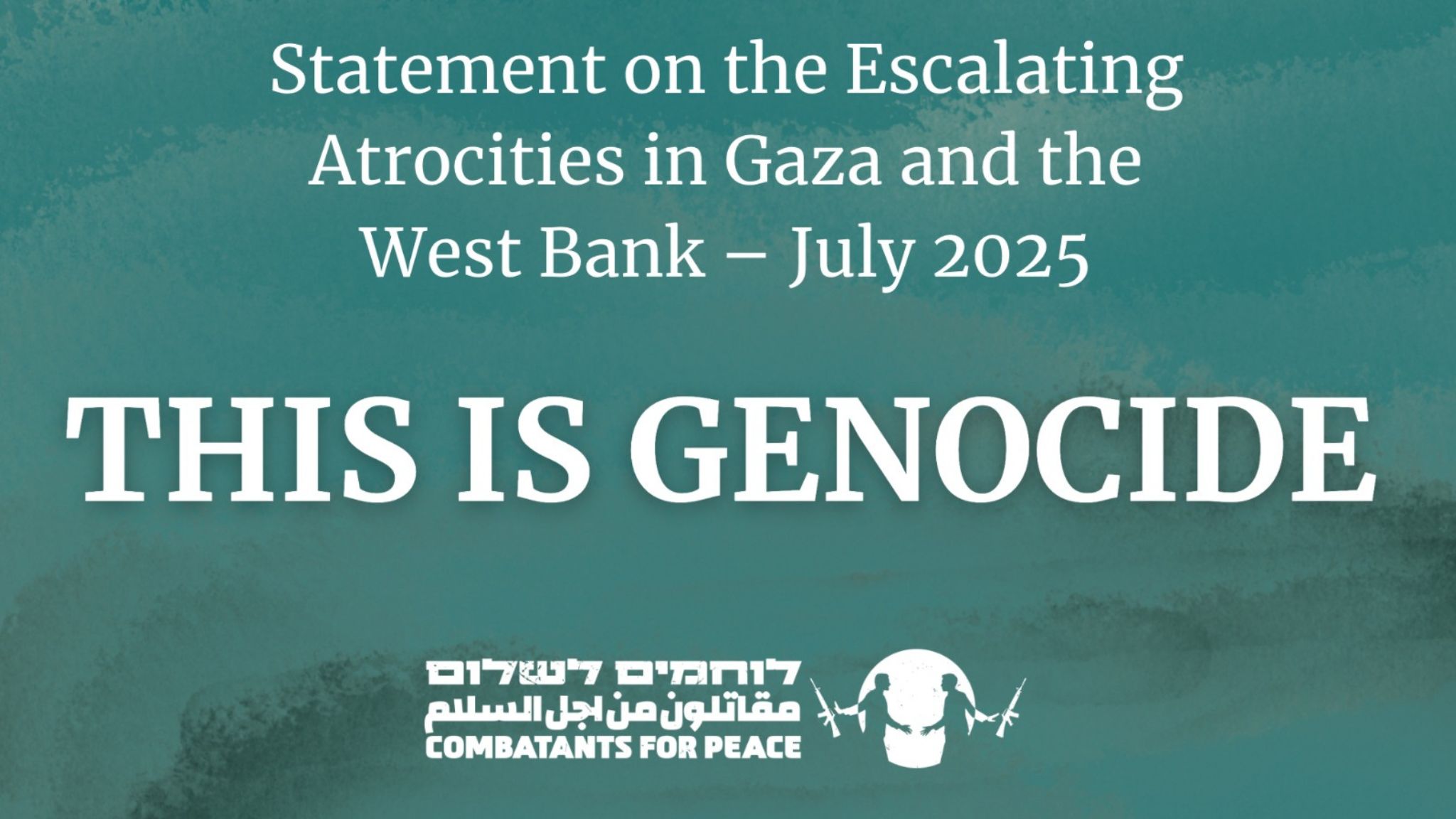
As a binational movement of Palestinians and Israelis committed to nonviolence and equality, Combatants for Peace issues this urgent statement in light of the deepening humanitarian and political crisis across Gaza and the West Bank:
In response to the continued policy of starvation in Gaza and the accelerating ethnic cleansing of Palestinian communities in the West Bank, we are compelled to speak clearly: this is genocide – and it must be stopped.
We do not use this word lightly. As outlined in B’Tselem’s recent report, “Our Genocide” what we are witnessing is not simply a failure to protect civilian life – it is the deliberate, state-enabled destruction of it.
In Gaza, more than 60,000 people have been killed, including thousands of children. Families are dying of hunger, and entire neighborhoods have been reduced to rubble. Israel has systematically and deliberately destroyed over 70% of Gaza’s buildings, damaged or destroyed 94% of hospitals, and wiped out 89% of schools. Aid is obstructed, water is cut off, and civilians are being shot as they attempt to reach food. This is not a natural disaster – it is a deliberate policy choice aimed at destroying the conditions for civilian life.
In the West Bank restrictions on movement have worsened dramatically, with checkpoints multiplying, roads closed without notice, and entire villages cut off from hospitals, schools and markets – all while entire rural Palestinian communities are being displaced by armed settlers and military units working in tandem. In the Jordan Valley, South Hebron Hills, and northern districts, homes have been torched, water sources poisoned, livestock killed, and people forced to flee. Just last night, Awdah Hathaleen – a well-known and loved community activist from Umm al-Khair – was shot and killed in yet another murderous settler attack. Weeks earlier, Sayfollah Musallet was beaten to death in the village of Sinjil while defending his family’s land from encroaching settlers. These are not isolated acts. They are part of a clear and documented strategy to remove Palestinians from their land – what international law recognizes as ethnic cleansing.
We also recognize the pain and anguish of Israeli families whose loved ones remain held hostage in Gaza. These hostages must be returned unharmed now – or, where necessary, given a respectful burial. Their immense suffering cannot be ignored. But it also cannot justify the starvation and mass killing of an entire civilian population.
At the same time, thousands of Palestinian political prisoners remain imprisoned in Israeli jails, held in inhumane and degrading conditions. Many have endured years without trial, in solitary confinement, or denied access to legal recourse. Their release must be part of any just and lasting political resolution.
Any meaningful path toward peace must confront the full scope of human rights violations in this conflict – including the systemic use of unlawful detention and collective punishment against Palestinians, and the ongoing trauma, insecurity, and targeting of civilians experienced by Israelis. Justice must be extended to all who live here, without exception.
As Palestinians and Israelis who have chosen to walk the path of nonviolence – even in a time of war – we call on all people of conscience, within our societies and beyond them, to speak out. To act. To refuse complicity, and to reject the lies that tell us there is no other way.
We remain committed to peace, to nonviolence, and to each other.
This commitment is rooted in the belief that the occupation must end, and that justice is not a dream – it is a requirement. Only then can we begin to repair what has been broken – and begin to build the future we know is possible: a future where Palestinians and Israelis live in freedom and equality, guided by a shared commitment to nonviolence and humanity.
In solidarity and hope,
Combatants for Peace
Halachic Left
Auch andere als ethnisch.nationale Interpretationen sind möglich …

Ein Beitrag von Yonat Shimron auf RNS

In diesen Minuten
Auch wer gleich nicht in Berlin sein kann, der „höre“ die Stimme der

Israelis für Frieden | Israelis for Peace

„Palästinensische Freiheit und israelische Sicherheit gehen Hand in Hand“
Ein Interview auf Kontrast.at mit der in Berlin lebenden, in West-Jerusalem aufgewachsenen Aktivistin Vered Berman.

Die andere Seite …
Während sich die Stimmen mehren, die Augen nicht länger vor dem Leid und dem Hunger der Palästinenser:innen im Gazastreifen zu verschließen (Etwa Crisis Group, Abraham Initiatives, Forward Ärzte ohne Grenzen etc.) …
Hier ein Blick auf das, was die Besatzung und die Militäreinsätze mit den Besatzern macht (… wem klingen hier nicht die Worte von Y. Leibowitz nach??)

