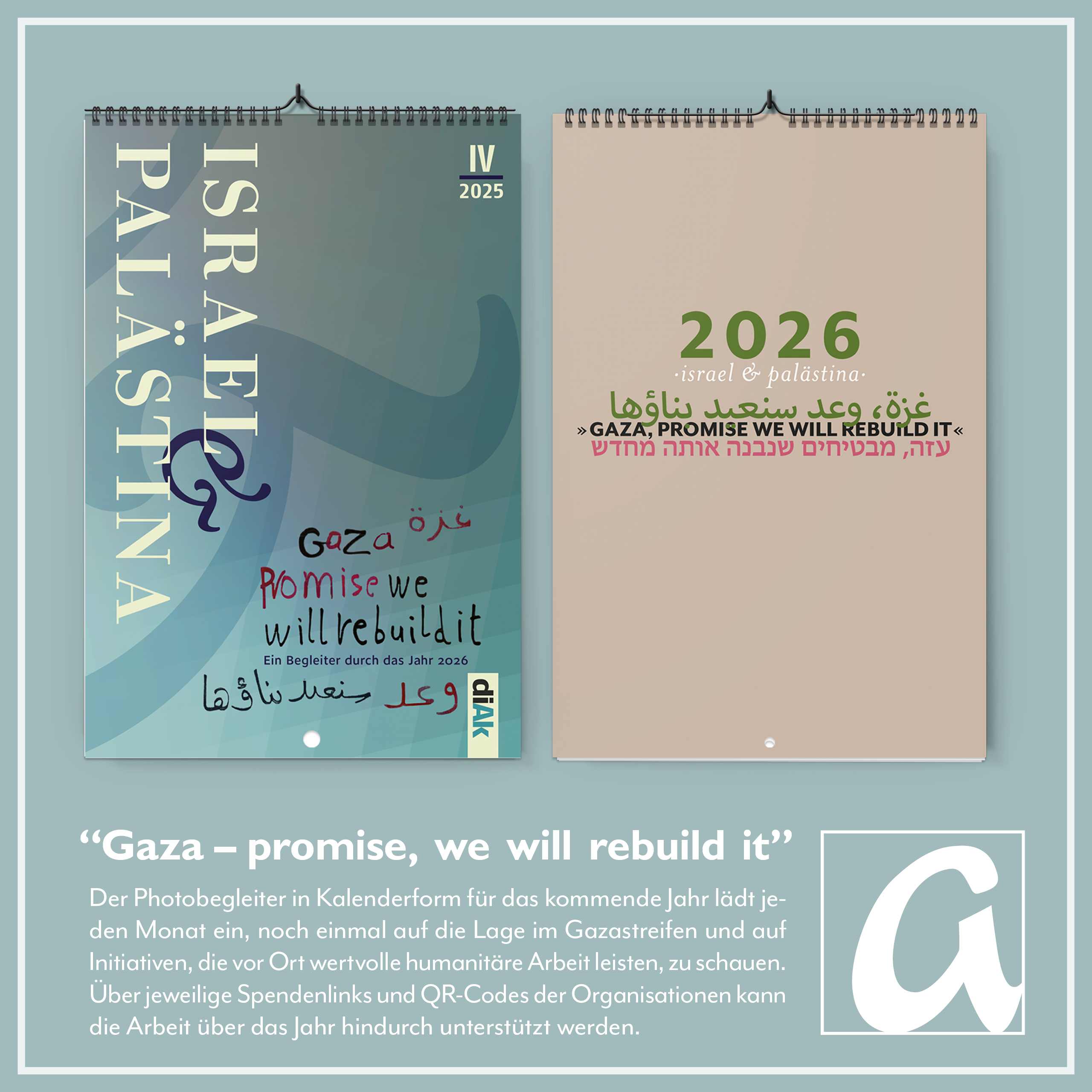
Der 11. Kalender im Rahmen von israel & palästina | Zeitschrift für Dialog!
Dieser Kalender ging in den Druck zu einem Zeitpunkt, an dem es einen fragilen Waffenstillstand im Gazastreifen gab, von dem auch heute niemand weiß, ob er auch 2026 halten wird.
In der Westbank verschärft sich die Lage zugleich weiter und in Israel finden wir eine tiefgespaltene Gesellschaft vor, bei der noch nicht klar ist, ob sich die Kräfte der Dominanz oder der Kooperation durchsetzen werden.
Der Photobegleiter in Kalenderform für das Jahr lädt jeden Monat ein, noch einmal auf die Lage im Gazastreifen zu schauen. Die wenigen Quadratkilometer sind versehrt und zerstört, wie es kaum denkbar schien. Aber es sind nicht nur die zerbombten Häuser, auch die Menschen haben Schaden genommen und der Weg der Heilung wird lang.
Die Wunden sind auf beiden Seiten tief und es gilt, sie nicht gegeneinander aufzurechnen, sondern mit Empathie und Zuwendung nach Möglichkeiten zu suchen, wie eine andere Zukunft aussehen kann und was (man:frau:wir) dafür tun können. Eine Möglichkeit gibt es über die jeweiligen Spendenlinks und QR-Codes der Organisationen.
israel & palästina – Zeitschrift für Dialog | Ausgabe 4-2025
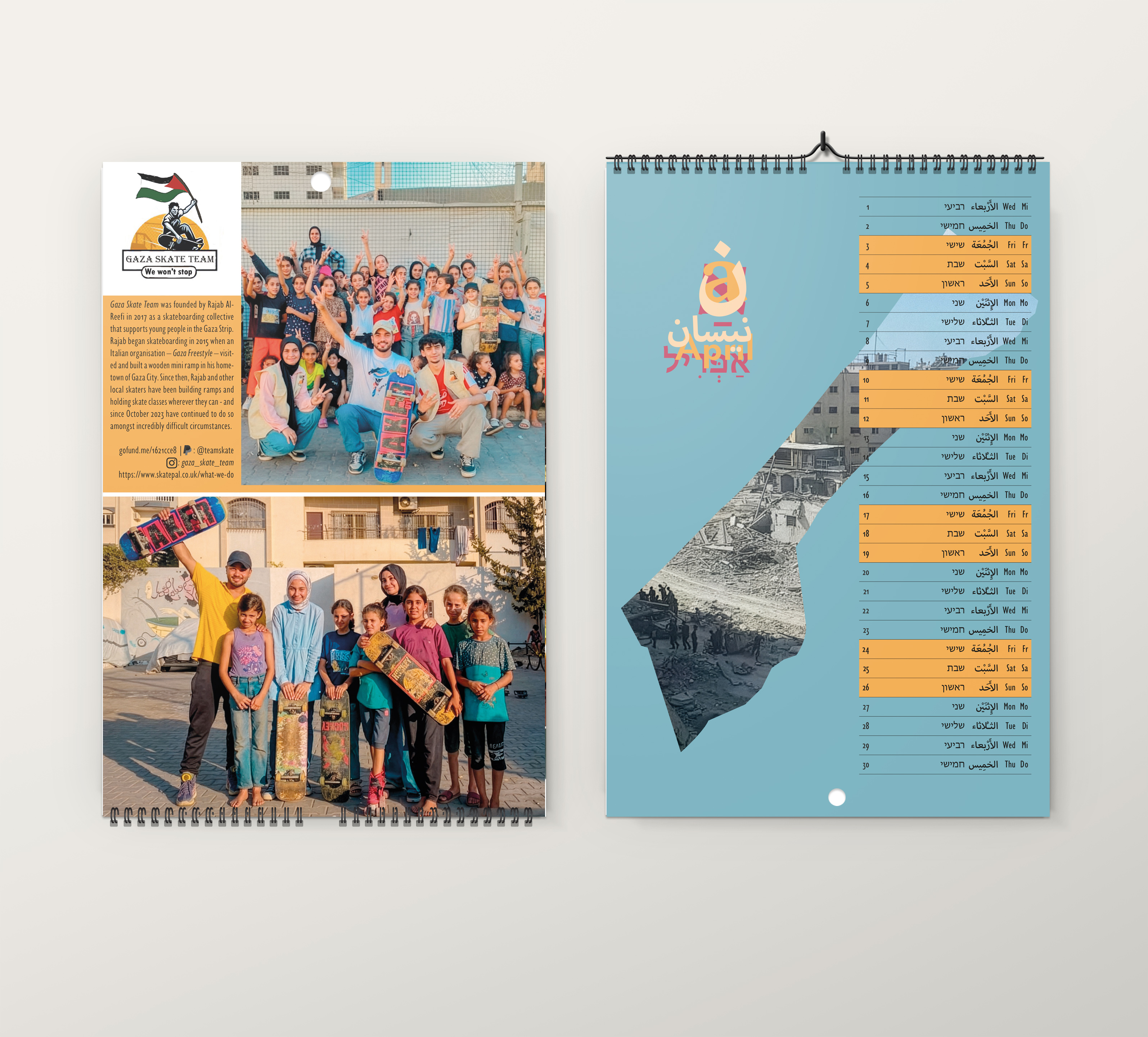
Gaza Skate Team was founded by Rajab Al-Reefi in 2017 as a skateboarding collective that supports young people in the Gaza Strip.
Rajab began skateboarding in 2015 when an Italian organisation – Gaza Freestyle – visited and built a wooden mini ramp in his hometown of Gaza City. Since then, Rajab and other local skaters have been building ramps and holding skate classes wherever they can – and since October 2023 have continued to do so amongst incredibly difficult circumstances.
Es war das elfte Mal, daß im Rahmen von israel & palästina | Zeitschrift für Dialog ein Photobegleiter in Kalenderform für das kommende Jahr erschienen ist:
Gaza – promise, we will rebuild it – Ein Begleiter durch das Jahr 2026
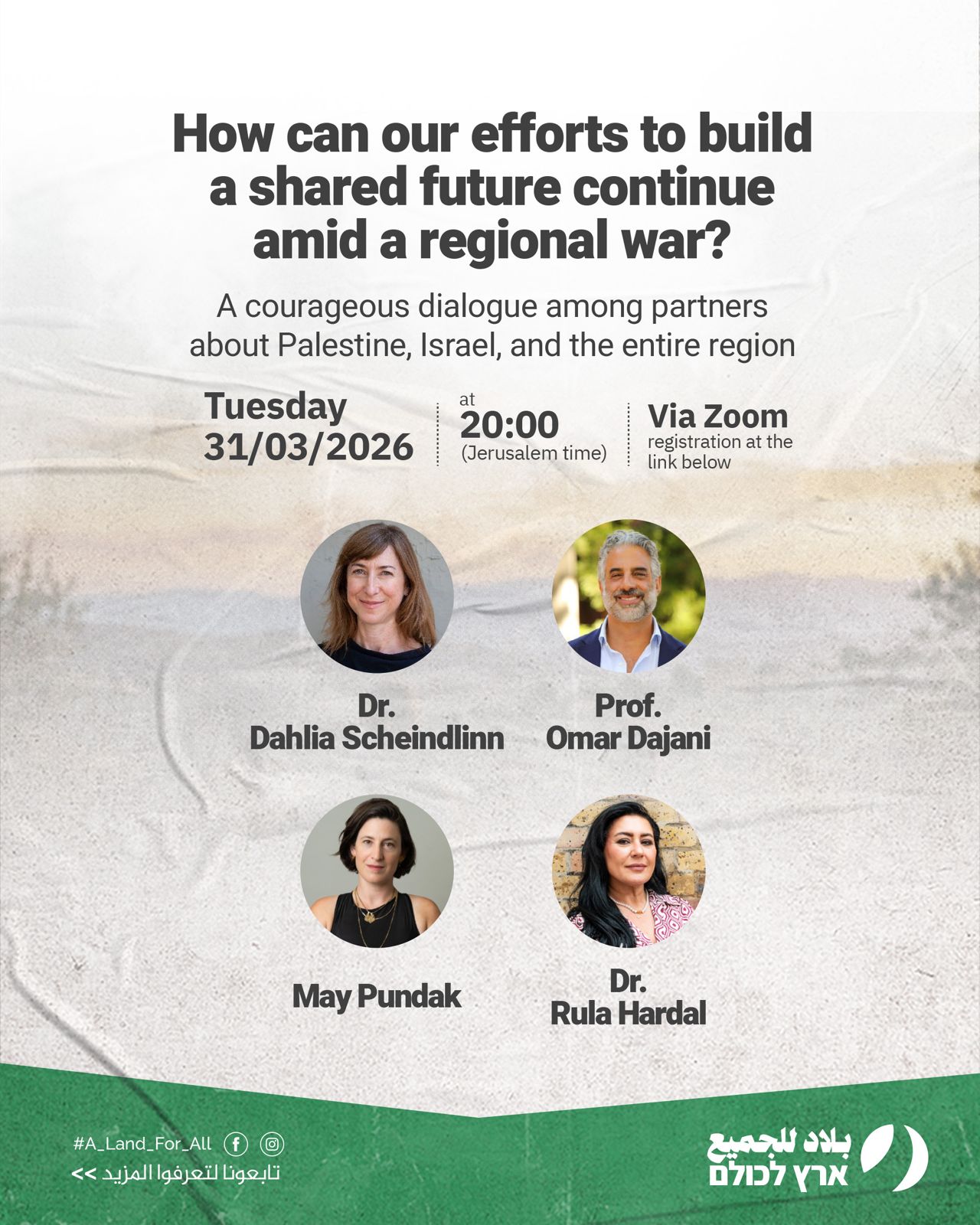
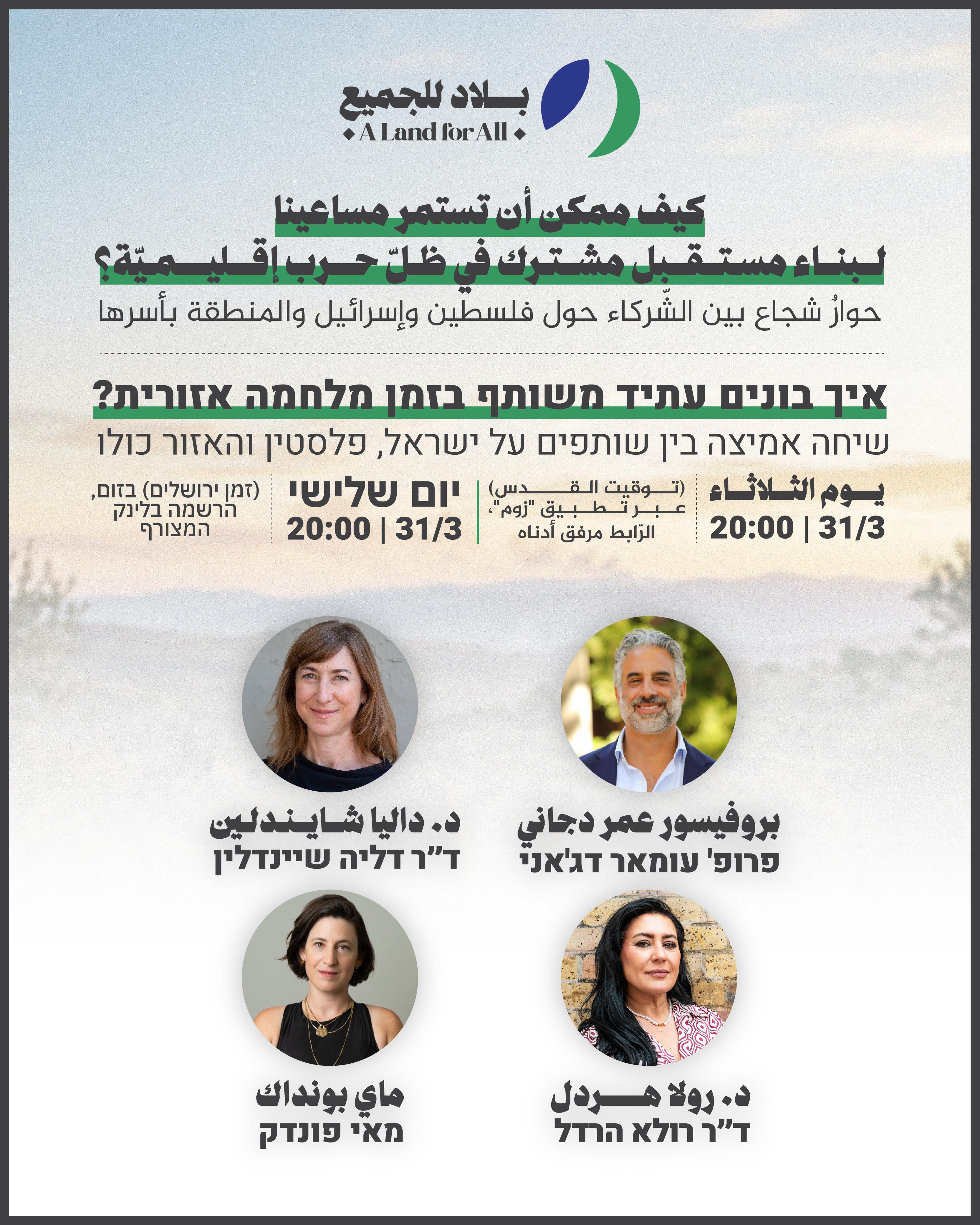
Webinar 31. März 2026 20.00 Uhr Jerusalem Time (19.00 MEZ) – Register here
In days meant to symbolize joy, celebration, and renewal, people across the region find themselves living through profound turmoil and deep uncertainty.
The war is expanding, instability is growing, and the stable future we all long for feels more distant than ever.
Yet even within this reality, we remain together—not because we have simple answers, but because it is clear to us that the fate of Palestinians, Israelis, and the entire region is intertwined. None of us is going anywhere.
The question is not whether we will live here together—but how we will live here together?
This is the question we seek to explore with international experts and key partners in the work of A Land For All.
Join an honest and important conversation where we will ask:
How can we understand the war from Palestinian, Israeli, regional, and international perspectives?
What changes lie ahead for the Middle East, and how will they impact Israelis and Palestinians?
How can we begin, even now, to shift from a paradigm of domination to partnership and build a truly just and thriving future?
With the participation of:
Prof. Omar Dajani — international jurist, expert in regional politics, and former advisor to Palestinian negotiation teams, and a member A Land for All, born into a family of Palestinian refugees from Jaffa-Yaffa.
Dr. Dahlia Scheindlin — expert on public opinion in Israel, political commentator, and member of the A Land for All.
Dr. Rula Hardal — Palestinian co-CEO of the A Land for All and expert in Palestinian nationalism
Moderated by – May Pundak, Israeli co-CEO of A Land for All
*The conversation will be held in English, with simultaneous translation into Arabic and Hebrew.
Christinnen und Christen im Nahen und Mittleren Osten bitten um Unterstützung
Der Ökumenische Rat der Kirchen (ÖRK/WCC) lädt am 26. März 2026, 15.00 Uhr zu einem weltweiten Friedensgebet für den Nahen Osten ein.
Nachtrag 28.3.2026:
For those who participated live: the prayer offered a profound space for lament, hope, comfort, and solidarity, woven together through Psalms, music, and the spoken word. Voices from across the globe —Including Prof. Dr Michel Abs of the Middle East Council of Churches, Bishop Prof. Dr Heinrich Bedford-Strohm, Patriarch Theophilos III of Jerusalem, and youth from the region — gave the prayer its breadth and depth. We are grateful for your presence.
If you were unable to join us this time, we warmly invite you to watch the full recording at your own pace:
Die Gebetsworte stammen von Christinnen und Christen aus der Region, die angesichts von Gewalt, Trauer und existenzieller Unsicherheit um Unterstützung bitten. Es besteht die Möglichkeit, online teilzunehmen und ein Zeichen für Frieden, Gerechtigkeit und Versöhnung zu setzen.
Angst vor neuen Angriffen, Trauer um getötete Angehörige und große Ungewissheit prägen das Leben vieler Menschen im Nahen Osten. Der anhaltende Konflikt erschüttert die Betroffenen zutiefst und belastet auch die christlichen Gemeinschaften in der Region, die dort zum Teil seit fast 2.000 Jahren leben.
Aufruf zum Friedensgebet am 26. März
Der Ökumenische Rat der Kirchen (ÖRK) ruft deshalb weltweit zu einem Gebet für Frieden im Nahen und Mittleren Osten auf – am 26. März um 15 Uhr MEZ. Die Gebetsworte stammen von Christinnen und Christen aus der Region selbst. Mit dem gemeinsamen Friedensgebet seien laut ÖRK alle Menschen guten Willens eingeladen, „Zeugnis abzulegen von der gemeinsamen Sehnsucht nach Frieden, Gerechtigkeit und Versöhnung ist in diesen bedrückenden und leidvollen Zeiten ein ganz wichtiges Zeichen der Verbundenheit und Solidarität“, so Pfarrer Andreas Goetze, Referent im Fachbereich Interreligiöser Dialog und Ansprechpartner für Christ:innen im Mittleren Osten im Zentrum Oekumene EKHN und EKKW.
Bitte der Christinnen und Christen aus Nahost-Region
Im Vorfeld hatte sich der ÖRK über die humanitäre, sicherheitspolitische und pastorale Lage der betroffenen Kirchen informiert. An einer Online‑Konsultation nahm auch Bischof i. R. Prof. Dr. Heinrich Bedford‑Strohm, Moderator des Zentralausschusses des ÖRK, teil. Er berichtete, dass Christinnen und Christen aus der Region den ÖRK ausdrücklich gebeten hätten, für sie zu beten. Bedford‑Strohm sagte: „Wir haben zugesagt, ihrem Gebetsaufruf zu folgen und werden alles in unserer Macht Stehende tun, um ein Ende der Eskalation zu fordern.“
Existenzielle Bedrohung
Viele Gemeinden im Nahen und Mittleren Osten stehen unter existenziellem Druck. In Teilen Syriens etwa fühlen sich Christinnen und Christen durch wiederkehrende Militäroperationen bedroht; auch die medizinische Versorgung ist eingeschränkt. Beispielsweise hat das Zentrum Oekumene von einer Frau erfahren, die ihr Kind unter schwierigen Umständen zur Welt brachte: Wegen Personalmangels und begrenzter Versorgung war die Situation kritisch, umso größer war die Erleichterung, dass Mutter und Kind überlebten. Der Nahost‑Experte Matthias Kopp, Sprecher der Deutschen Bischofskonferenz, warnt daher vor einem möglichen „schleichenden oder sogar eklatanten Christen‑Exodus“.
Sorge des ÖRK über zunehmende Instabilität in der Region und Appell
In einer gemeinsamen Erklärung betonte der ÖRK, dass sich humanitäre Risiken, Leid und Instabilität weiter verschärfen könnten, wenn die Gewalt anhält. Die Erklärung äußert tiefe Besorgnis über Berichte zu möglichen Verstößen gegen das humanitäre Völkerrecht und fordert alle beteiligten Akteure auf, Verantwortung für die Folgen ihres Handelns zu übernehmen. Abschließend heißt es: „Wir lehnen die brutale Logik von Krieg und Herrschaft ab. Wir bitten um Frieden.“
REPORT OF THE SECRETARY-GENERAL ON THE IMPLEMENTATION OF UN SECURITY COUNCIL RESOLUTION 2334 (2016)
delivered by
RAMIZ ALAKBAROV
DEPUTY SPECIAL COORDINATOR FOR THE MIDDLE EAST PEACE PROCESS
24 March 2026 [As Delivered]
Mister President,
Excellencies,
Today’s briefing is devoted to the thirty-seventh report of the Secretary-General on the implementation of Security Council resolution 2334 (2016). It covers the period from 3 December 2025 to 13 March 2026.
Security Council resolution 2334 (2016) calls on Israel to “immediately and completely cease all settlement activity in the occupied Palestinian territory, including East Jerusalem” and to “fully respect all of its legal obligations in this regard.” Settlement activity has, nevertheless, continued at high levels. During the reporting period, Israeli planning authorities advanced or approved over 6,000 housing units in the occupied West Bank, including approximately 3,160 housing units in Area C, and 2,850 housing units inEast Jerusalem. The Israeli Housing Ministry published tenders for 5,375 housing units in Area C, out of which 3,401 are located in the area of E1. On 8 February, the Israeli cabinet approved a series of measures that would expand Israeli civil authority in the occupied West Bank and further consolidate Israeli planning, enforcement and administrative control, including in parts of Areas A and B. These measures include transfer of Hebron municipal authorities, such as construction permits in the Ibrahimi Mosque/Tomb of the Patriarchs, to Israeli authorities. The measures, which mostly require implementation via military orders, would also remove regulatory barriers on land acquisition and construction by Israelis and purport to shift certain authorities from the Palestinian Authority to the Israeli Civil Administration.
On 15 February, the Israeli Government approved a plan to resume land registration processes in Area C of the occupied West Bank and allocated some 244 million shekels [approximately 78 million USD] for this purpose. Demolitions and seizures of Palestinian-owned structures also accelerated. Citing the lack of Israeli-issued building permits, which are almost impossible for Palestinians to obtain, Israeli authorities demolished, seized or forced people to demolish 429 structures in the occupied West Bank, including East Jerusalem, displacing 575 persons, including 290 children and 150 women. 28 of these structures were donor funded. Evictions of Palestinians from their homes in occupied East Jerusalem also continued. On 4 January, the Israeli police forcibly evicted two Palestinian families from their apartments in the Batn Al Hawa area of Silwan, in occupied East Jerusalem, displacing eight people. Settlers took over the building shortly thereafter. This is the sixth eviction Incident in Batn al Hawa since February 2024. On 10 February 2026, Israeli authorities issued eviction notices against 11 Palestinian families in the same neighbourhood, affecting approximately 80 individuals, including children. Mister President,
Security Council resolution 2334 (2016) calls for “immediate steps to prevent all acts of violence against civilians, including acts of terror, as well as all acts of provocation and destruction.” Acts of violence against civilians continued, with the high number of fatal incidents, precluding me from detailing all. The ceasefire in Gaza remained highly fragile as Israel Défense Forces (IDF) military operations continued with airstrikes, shelling and gunfire across the Strip, including in the vicinity of the so-called Yellow Line, while Hamas and other Palestinian armed groups engaged in armed exchanges with IDF personnel. During the reporting period, according to the Gaza Ministry of Health, 292 Palestinians were killed in IDF airstrikes, shelling and gunfire in Gaza, and 1,741 were injured. A total of 651 Palestinians have been killed since the ceasefire went into effect. On 30-31 January, the IDF carried out a series of airstrikes across Gaza, killing 33 Palestinians, including 7 women and 7 children. The IDF said it targeted Hamas and Islamic Jihad commanders and sites throughout Gaza after eight militants emerged from a tunnel in Rafah on 30 January, three of whom were killed and one captured.
On 26 January, the body of the final Israeli hostage held in Gaza was found and identified by the IDF following a search in Gaza City and returned to his family. Israeli forces reportedly exhumed and removed Palestinian bodies from burial sites in Gaza. Meanwhile, the high levels of violence in the occupied West Bank, including East Jerusalem, continued at an alarming rate.
Overall, in the occupied West Bank, 32 Palestinians, including seven children, were killed during large scale Israeli Security Forces operations, armed exchanges, settler attacks, and other incidents. 833 Palestinians, including 138 children, were injured, including 172 by Israel Security Forces due to tear gas inhalation and 141 by live ammunition, and 322 by Israeli settlers and other civilians. According to Israeli sources, two Israeli civilians, including one woman, were killed by armed Palestinians and another 49 Israelis, including five children and five women, and four Israeli security forces personnel were injured by Palestinians in shooting, stabbing and ramming attacks and other incidents. The Israeli Security Forces arrested more than 1,600 Palestinians during raids and operations in the occupied West Bank. Israel currently holds at least 9,245 Palestinians, 3,358 of whom in administrative detention. On 1 February, Israeli forces extended a military order designating Jenin, Tulkarm and Nur Shams refugee camps and surrounding areas “closed military zones” until 31 March, prohibiting access without military-issued permits, extending the ongoing displacement of some 33,000 of their residents, while continuing with the extensive destruction of homes an infrastructure in the camps. Daily settler-related attacks escalated, often in the presence of Israeli forces, resulting in casualties, property damage and displacement in Palestinian communities across the occupied West Bank. On 16 December, an Israeli settler reportedly shot and killed an 18-year-old Palestinian near Tuqu’, Bethlehem during the funeral procession for a 16-year-old Palestinian boy shot and killed by Israeli forces on 15 December. On 26 January, following repeated attacks and threats by Israeli settlers from four surrounding settlement outposts, the remaining 100 residents of Ras Ein al ‘Auja Bedouin community were forced to leave their community. This follows the forced displacement of 98 Palestinian households comprising 485 people on 8 and 19 January. On 27 January, around 100 Israeli settlers raided four communities in Masafer Yatta, south of Hebron, injuring six Palestinians, including two women and one child. Subsequently, on 7 March an Israeli settler shot and killed a 27‑year‑old Palestinian man in Masafer Yatta, reportedly during an altercation after settlers trespassed near Palestinian homes in Area B. Including this incident, between 2 and 8 March, six Palestinians were killed in settler violence. Palestinian attacks against Israelis continued both in the occupied West Bank and Israel. On 26 December, a Palestinian man killed two Israelis, including a woman, and injured another two, including one boy, in ramming and stabbing attacks near the Israeli cities of Bet She’an and Afula. During the Holy month of Ramadan, as in previous years, the Israeli authorities-imposed restrictions on Palestinians from the West Bank visiting the Al Aqsa compound, limiting the number of additional permits issued for worshippers entering Jerusalem for Friday prayers and allowing access only for certain age and gender categories. From 28 February, as part of broader security measures and limits on gatherings imposed due to military escalation in the Middle East, Israeli authorities severely restricted access to Jerusalem’s Old City, including to the Holy Sites.
Mister President, The Security Council, in its resolution 2334 (2016), called upon both parties to refrain from provocative actions, incitement and inflammatory rhetoric. Unfortunately, such acts continued. Hamas and Palestinian Islamic Jihad continued to praise terror attacks and to call for additional violence against Israelis. A senior Fatah Official called Israel “neo-Nazis,” while another said “Israel is doomed to perish.” Israeli ministers and Members of the Knesset continued to call for the re-establishment of settlements in Gaza, the annexation of the West Bank, the “emigration” of Palestinians from the OPT and for continuing to “kill the idea of a Palestinian state”. On 20 February, an Israeli Knesset member alongside dozens of activists crossed into the Gaza Strip, stating "Gaza will always be ours". On 20 January, a Jerusalem municipal official expressed hope that Israel would “throw out and annihilate” all UNRWA personnel shortly after the UNRWA Sheikh Jarrah compound was seized and almost completely demolished by Israeli authorities in complete disregard for the legal framework applicable to these inviolable premises of the United Nations. On 25 January, the compound was set alight by unknown assailants. The Secretary-General brought this issue to the attention of the President of the General Assembly and of the President of the Security Council on 28 January 2026.
Mister President, Resolution 2334 (2016) reiterated calls by the Middle East Quartet for “affirmative steps to be taken immediately to reverse negative trends on the ground that are imperilling the two-State solution.” On 24 January, President Abbas issued a decree amending the Local Elections Law to require candidates to commit to the PLO as the sole legitimate representative of the Palestinian people and to its program. On 2 February, he issued a decree authorizing direct elections to the Palestinian National Council on 1 November 2026. On 13 February, the Palestinian Authority published the draft interim constitution of the State of Palestine for a 60-day public review period. Following a request from the Central Elections Commission, the United Nations deployed an electoral needs assessment mission from 16 to 24 February. Israel continued its unilateral withholding of Palestinian clearance revenues. The PA estimates that Israel is currently withholding more than 8 billion NIS, deepening the PA’s fiscal crisis. Correspondent banking agreements, essential for the Palestinian economy, continue to be renewed on a short-term basis, with the most recent extension set to expire on 28 March. In Gaza, about 1.4 million people remain displaced across 1,200 sites, many in overcrowded and unsafe conditions. Since the start of the military escalation in the Middle East and as of mid-March, only limited fuel and humanitarian aid have entered Gaza through Kerem Shalom. On 30 December, Israel announced that it plans to suspend the operations of some international NGOs. The Government also notified 37 INGOs that their registrations would expire at the end of 2025. On 27 February, Israel’s High Court of Justice issued a temporary injunction blocking the deregistration.
Mister President, In resolution 2334 (2016), the Security Council also called upon all States “to distinguish, in their relevant dealings, between the territory of the State of Israel and the territories occupied since 1967.” Resolution 2334 also called upon “all parties to continue, inter alia, to exert collective efforts to launch credible negotiations on all final status issues in the Middle East peace process.” On 14 January, the United States announced the start of Phase II of the Comprehensive Plan to End the Gaza Conflict, endorsed in Security Council Resolution 2803 (2025). On 16 January, the United States announced the formation of a transitional Palestinian government for Gaza, the National Committee for the Administration of Gaza (NCAG), as well as the appointment of the High Representative for Gaza. The Committee convened in Cairo on 16 January and continues its preparations to assume transitional governance responsibilities. The Board of Peace held meetings on 22 January and 19 February, during which member states pledged some USD 17 billion towards the reconstruction of Gaza. On 20 February, a Liaison Office was established between the Office of the High Representative and the PA. On 1 February, Israel reopened the Rafah crossing between Gaza and Egypt, allowing limited pedestrian movement in and out of the Strip. To date, 848 people have left Gaza through Rafah, while 844 have returned. Following the military escalation in the Middle East on 28 February, the crossing was closed, reopening on 19 March.
Mister President, In closing, allow me to share the Secretary-General’s observations on the implementation of Security Council Resolution 2334 (2016) in the Occupied Palestinian Territory – the West Bank, including East Jerusalem, and the Gaza Strip. 1. Israeli settlement expansion continues at a rapid pace, alongside the proliferation of outposts and steps promoting the annexation of the West Bank. I condemn the relentless Israeli settlement expansion in the West Bank, which continues to fuel tensions, impede access by Palestinians to their land, and threaten the viability of a fully independent and contiguous Palestinian State. The rapidly expanding settlement footprint, including the expansion of settlement outposts, is taking place in conjunction with a rise in settler-related attacks. These developments are in breach of international law, further entrenching the unlawful Israeli occupation and undermining the right of the Palestinian people to self-determination. I reiterate that all Israeli settlements and related infrastructure have no legal validity and are in flagrant violation of international law, including applicable UN resolutions, recalling in this regard the findings by the International Court of Justice in its Advisory Opinion of 19 July 2024 which affirmed, inter alia, that the State of Israel is under an obligation to bring to an end its unlawful presence in the Occupied Palestinian Territory as rapidly as possible. The Government of Israel must abide by its obligations under international law.
2. These unilateral Israeli steps steadily transform the landscape. I am deeply concerned by the Government’s decisions to deepen Israeli administrative and territorial control of the West Bank. These measures are likely to increase Israeli control over the land and contribute to settlement expansion and could lead to the dispossession of Palestinians of their property. They would also further undermine the Palestinian Authority, contravene existing agreements, breach relevant obligations under international law, and risk further destabilizing the situation on the ground, as well as seriously eroding the prospects for a negotiated two-State solution.
3. In addition to settlement activities, Palestinians face displacement, demolitions, evictions and crippling movement and access restrictions that stifle the economy and severely limit access to employment, hospitals, schools, and agricultural land. Residents continue to be denied the right to return home. The demolition and seizure of Palestinian structures entail numerous human rights violations and raise concerns about the risk of forcible transfer. I call on Israel to cease the demolition of Palestinian-owned structures in accordance with its international obligations. I also note with deep concern the recent report of the Office of the High Commissioner for Human Rights detailing Israel’s discriminatory administration of the West Bank, including East Jerusalem – with evidence-based findings on entrenched racial discrimination.
4. The heightened level of violence in the West Bank is deeply alarming. I condemn all acts of violence against civilians. I am deeply concerned that persistent and intensifying settler attacks, sometimes in the proximity and with the support of Israeli security forces, are further displacing Palestinian communities. I call on Israel, as the occupying power, to protect the Palestinian population against attacks and intimidation. Palestinian attacks against Israelis must also cease. All perpetrators of violent attacks must be held accountable.
5. I remain concerned about large numbers of Palestinians, including children, held by Israel, including in administrative detention without charge or trial. Reports of torture, ill-treatment, including sexual violence, and deaths in custody are deeply disturbing. Israel must use detention as a last resort, prevent ill-treatment, and end administrative detention of children. All detainees must be treated humanely and those arbitrarily detained must be released.
6. I am disturbed by the multiple instances in which officials on all sides have glorified violence and engaged in dangerous provocations, incitement, and inflammatory language, which must be rejected by all.
7. Israel’s implementation of punitive economic and fiscal measures is destabilizing Palestinian institutions and threatening the viability of the Palestinian Authority. I urge Israel to immediately cease all such unilateral steps.
8. I encourage continued reforms by the Palestinian Authority and urge international partners to provide the necessary support to these efforts. I welcome ongoing electoral preparations, which are key to the reform process.
9. I reiterate my call to the parties to respect and uphold the status quo at the Holy Sites in Jerusalem, taking into account the special and historic role of Jordan.
10. The launch of Phase Two of the Comprehensive Plan to End the Gaza Conflict, including the establishment of the National Committee for the Administration of Gaza, is an important step. It is crucial that all parties fully abide by their commitments so that recovery can proceed in Gaza while advancing a credible political horizon towards a two-State solution. In coordination with the Palestinian Authority, the UN stands ready to support the Committee’s efforts to provide critical public services, facilitate humanitarian aid, and lay the groundwork for reconstruction.
11. I welcome the recovery of the body of the last hostage in Gaza. I am deeply relieved that all hostages have been reunited with their families or brought home for burial. As released hostages continue to publicly share chilling details of their captivity, including accounts of sexual violence, I again strongly condemn the abhorrent terror attacks by Hamas and other Palestinian armed groups on 7 October 2023, and their prolonged holding of hostages in inhumane conditions.
12. I condemn the continued killing and injury of civilians in Gaza, including women and children. Despite the ceasefire, Israeli airstrikes, exchanges of gunfire between both sides and shelling particularly near the so-called Yellow Line, and attacks on civilians attempting to return home or access land have resulted in further loss of life. I condemn the continued destruction by the Israeli Security Forces of large areas in the Gaza Strip. Such incidents must immediately cease. The protection of civilians is paramount in any armed conflict. Parties to a conflict have an obligation to respect international humanitarian law.
13. I am deeply concerned by the dire humanitarian situation in Gaza. While food security has improved due to increased aid and commercial deliveries, infrastructure damage is catastrophic, and there are severe shortages of clean water, medical care, and shelter. Humanitarian access remains restricted, with aid convoys facing logistical and security obstacles. I call on all parties to comply with their obligations under international humanitarian law, including to facilitate the full, rapid, and unimpeded passage of humanitarian assistance.
14. I strongly condemn the Israeli authorities' continued steps against UNRWA. These actions are inconsistent with Israel’s clear obligations under international law. I again urge the Government of Israel to immediately return and restore the UNRWA Sheikh Jarrah compound and other UNRWA premises to the United Nations without delay, along with any assets seized from them. I welcome the Advisory Opinion issued by the International Court of Justice on 22 October, which reaffirmed several fundamental obligations of Israel under international law, such as the obligation to cooperate with the United Nations, including UNRWA. I urge Member States to continue to politically support and financially sustain UNRWA.
15. I remain committed to supporting Palestinians and Israelis in ending the unlawful occupation and resolving the conflict in line with international law, UN resolutions, and bilateral agreements, pursuing a two-State vision: Israel and a fully independent, democratic, contiguous, viable, sovereign Palestinian State, including both Gaza and the West Bank, living side by side in peace and security, based on pre-1967 lines, with Jerusalem as the capital of both States.
Der Vatikan ruft zu Spenden für die Christ:innen im Heiligen Land auf. In einem am Montag, 16.3.26, veröffentlichten Brief an die Bischöfe weltweit erinnert der Leiter der vatikanischen Ostkirchenbehörde, Claudio Kardinal Gugerotti, an die Folgen des Krieges.
Lieber Mitbruder,
wie sehr haben wir gehofft, dass der Frieden endlich Leben und Hoffnung ins Heilige Land zurückbringen möge! Sogenannte Dialoge und Vereinbarungen haben sich vervielfacht, doch die Waffen schweigen nicht. Man hat gesagt, dass Frieden erreicht worden sei, aber auch wenn die Medien weniger berichten als früher, geschieht es weiterhin: die Waffen feuern, die Menschen sterben, Gebiete sind umkämpft, Christen wandern aus, um ihr Leben zu retten. Sogar in den Schulen fehlen oft die Lehrer, weil ihnen die Einreise verweigert wird.
Ich weiß, dass es immer schwieriger wird, mich an Dich und an die christliche Gemeinde, für die Du Verantwortung trägst, zu wenden, und die Worte, die ich von Jahr zu Jahr an Dich richte, wiederholen sich. Ich weiß, dass es schwieriger wird, sich vorzustellen, die Wunden dieser so grausam zerrissenen Welt zu verbinden und zu desinfizieren, solange dies noch möglich ist. Doch wir Christen können nicht anders als hoffen, weil Gott unsere Hoffnung ist und Gott keinen Verrat begeht. Das in unseren Räumen und an unseren heiligen Orten aufgehängte Kreuz ist das Zeichen eines Lebens, das stärker ist als der Tod, ja den Tod überwunden hat. Wir müssen Vieles ändern: die Mentalität, die Sensibilität, die Prioritäten im täglichen Leben, weil uns diese Welt immer mehr entmenschlicht und wir es nicht merken.
Gott ist unsere Hoffnung
Vergessen wir nie zu beten, denn Gott ist unsere Hoffnung. Nun aber möchte ich Dir eine kleine Geste vorschlagen, genau im Sinne dieser Umkehr, dieser Veränderung: ein wenig von unserem Geld zu geben, um unseren Brüdern und Schwestern in äußerster Gefahr zu helfen, damit sie einen weiteren Tag leben können und die Möglichkeit haben, zu hoffen und neu anzufangen. Eine wichtige Geste für sie und auch zentral für die Kustodie des Heiligen Landes, die seit langer Zeit über die Orte wacht, die das Leben Jesu, unseres Herrn, geprägt haben. Es handelt sich auch für uns um eine wichtige Geste, da sie uns verstehen lässt, dass wir ohne ein Opfer, ohne eine Veränderung unseres Lebens in dieser in Flammen stehenden Welt untätig bleiben und damit zu Komplizen derer werden, die sie in Brand stecken.
Eine Geste, die fast überall auf der Welt (weil manche Gemeinschaften ein anderes Datum gewählt haben) am Karfreitag Wirklichkeit wird, an dem Tag, an dem wir an Jenen denken, der kein Almosen, sondern sein Leben gegeben hat, seinen letzten Atemzug, den Heiligen Geist, damit diese Welt heil werde und wieder Ungeahntes erhoffe. Die Päpste haben diese Geste gewollt und befürworten sie weiterhin, weil sie überzeugt sind, dass man nur in der Väterlichkeit, im Teilen und in solidarischer Freundschaft eine Wirklichkeit aufbauen kann, die wieder menschliche Züge trägt und die den Plan einer Menschheit aufgreift, wie Gott sie beim Schöpfungsakt wollte. Notwendiger Beitrag
Für das Überleben ist auch Euer Beitrag notwendig. Sehr viele Christen im Heiligen Land haben alles verloren, auch die Arbeit im Dienst an den Pilgern, denn aus Angst wagt sich jetzt kaum jemand mehr in diese Gebiete. Unsere Brüder und Schwestern im Glauben, die an den heiligen Stätten leben, wissen, dass mit Eurem Beitrag, und vielleicht nur mit diesem, ihre Sicherheit zwar nicht gewährleistet werden kann, aber doch wenigstens ihre Schulen wieder funktionieren, neue Häuser gebaut werden können und, wo die Zerstörung total ist, eine gewisse Versorgung gesichert ist. Zuerst haben Bomben, dann Naturkatastrophen ihr Land verwüstet und unbewohnbar gemacht, ganz zu schweigen von den immer zahlreicheren Trauerfällen, ohne dass es einen Tag gibt, an dem man ruhig durchatmen könnte.
Bitte bringe mit den Worten, die Deine Gläubigen am besten verstehen, unsere Pflicht zum Ausdruck, für das Heilige Land sowie für viele andere verwüstete Orte Sorge zu tragen. Zeige Bilder, sensibilisiere das Bewusstsein durch die vielfältigen Informationsquellen, die die täglichen Mühen der wenigen Christen verständlich machen, denen es gelingt, in ihrer Heimat zu bleiben. Es gibt viele Mittel, angefangen bei den Appellen der Päpste sowie der opferbereiten Hirten vor Ort. Versuchen wir, unseren Gläubigen bewusst zu machen, dass das Geben bei der Kollekte für das Heilige Land ein starkes Zeichen des Glaubens ist, dass ein Heiliges Land ohne Gläubige ein verlorenes Land ist, weil die lebendige Erinnerung verloren ginge, die die Kontinuität mit der Quelle der Erlösung sichert, die uns in Christus erneuert hat. Ermahne, überzeuge, rüttle die Gewissen auf, rufe auf zur Solidarität mit dem einen Leib Christi, der die Kirche ist und sich über alle Länder der Welt erstreckt. Ein Frevel ist nicht nur eine Tat gegen die Eucharistie; Frevel ist auch die Tat gegen den Leib Christi, der die Kirche ist. Der heilige Augustinus betont dies eindringlich: Wenn du den Leib Christi am Altar empfängst, sei dir bewusst, dass du empfängst, was du bist. „Werdet, was ihr seht, und empfangt, was ihr seid“ (Serm. 272).
Ich bin überzeugt, dass unsere Gläubigen, Deine Gläubigen, für diesen Apell empfänglich sein werden, denn die tiefsten Kräfte – die durch die Taufe fester Teil der universalen Sehnsucht nach dem Guten geworden sind, die uns auf die Begegnung mit Gott vorbereitet – warten nur darauf, gestärkt oder geübt zu werden. Unermüdlich appelliert Papst Leo XIV. an Herz und Verstand und erinnert an die Verpflichtung, eins zu sein, damit es Frieden gebe, keinen vorläufigen Waffenstillstand, keinen endlosen Hass, keine ungeheuren Ausgaben für Waffen, sondern ein Beitrag zu einem gemeinsamen Neubeginn: „Ich danke Gott für jene Christen, die vor allem im Nahen Osten ausharren und, in ihrer Heimat bleiben und der Versuchung widerstehen, sie zu verlassen. Den Christen muss die Möglichkeit gegeben werden, mit allen Rechten, die ihnen ein sicheres Leben garantieren, in ihrer Heimat zu bleiben, und das nicht nur mit Worten. Ich bitte euch: setzen wir uns dafür ein!“ (Audienz für die Teilnehmer am Jubiläum der Ostkirchen, 14. Mai 2025).
Wie oft habe ich diese christlichen Minderheiten persönlich besucht, die jeden Morgen mit dem Risiko aufwachen, dass sie keinen Platz mehr zum Leben finden. Helft uns, ihnen konkrete Hoffnung und nicht nur Worte des Trostes zu schenken, weil wir, die wir sie besuchen, wissen, dass wir wieder gehen werden, während sie mit ihren Ängsten zurückbleiben, ja sogar mit der großen Furcht, ausgelöscht zu werden, gerade weil sie Christen sind. Die Kollekte für das Heilige Land wird, zusammen mit der unschätzbaren täglichen Hilfe unserer Franziskaner und all jener, die in den Gemeinden vor Ort leben und arbeiten, ein Tropfen im Ozean sein, doch ohne diesen Tropfen wird der Ozean zur Wüste.
Der Herr möge all jenen seinen reichen Segen schenken, die sich auch an diesem Karfreitag bewusst sind, dass sie Schuldner sind angesichts des unverdiente Geschenks des Lebens und die sich als Mitarbeiter an einer Schöpfung verstehen, die das irdische Jerusalem dem himmlischen Jerusalem ähnlicher macht. Danke, lieber Mitbruder, dass Du mir zugehört hast. Der himmlische Vater stärke Deine Bemühungen um Frieden und Deinen Einsatz für das Leben jener, die unschuldige Opfer des Krieges sind. Kain und Abel gibt es auch heute. Und doch hat der Sohn Gottes uns gezeigt: Wenn man sich entscheiden muss, dann nimmt man dem anderen das Leben nicht, sondern gibt das eigene Leben für ihn hin.
Leon Weintraub nahm 1946 sein Medizinstudium in Göttingen auf. Zuvor hatte er mehrere Konzentrationslager überlebt. Seitdem setzt sich der Auschwitz-Überlebende für die Menschlichkeit ein. Im März 2026 erhielt er die Ehrendoktorwürde und den Friedenspreis.
A podcast episode punctuated with sirens and explosions on +972 with Meron Rapoport
Meron lives in Tel Aviv and, like most Israelis, has spent much of the past two weeks running to shelters. Yet this is just about the only thing he shares with the majority of his compatriots — not least because he is among the mere 4 percent of Israeli Jews who oppose this war that is setting the entire region ablaze.
But things don’t always go according to plan. When the dust settles, Meron says — reminding me that he’s often labeled an optimist — Israelis will realize, sooner or later, that they cannot escape the Palestinian question, and that a regime of apartheid and occupation will never have peace and quiet.