Ein kleiner Ausschnitt aus der Dankesrede des israelischen Regisseurs Yuval Abraham:
Our film “No Other Land” on occupied Masafer Yatta’s brutal expulsion won best documentary in Berlinale. Israel’s channel 11 aired this 30 second segment from my speech, insanely called it “anti semitic” – and I’ve been receiving death threats since. I stand behind every word. pic.twitter.com/2burPfZeKO
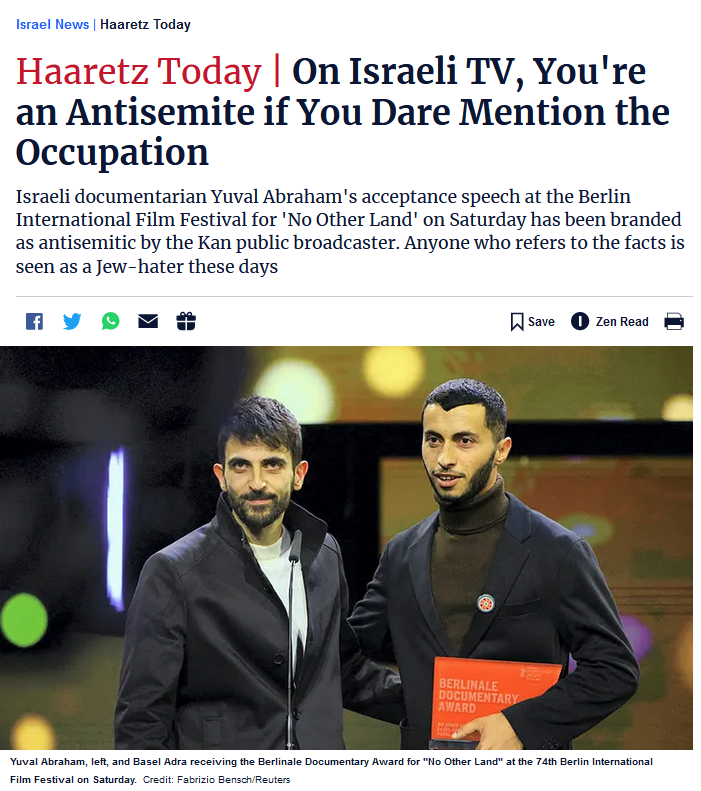
Und die Wahrnehmung, die einer solche Rede in manchen israelischen Medien hervorruft, hier ein Beitrag aus der Haaretz (Sheren Falah Saab) über die Berlinale-Berichterstattung des Kan Public Broadcaster.
Die Wellen der deutschen Politik kochen hoch, wie schön wäre es, wenn bei der nächste Berlinale Menschen mit zwei Schals auf die Bühne träten, … noch ein weiter Weg.
„A right-wing Israeli mob came to my family’s home yesterday to search for me, threatening close family members who fled to another town in the middle of the night. I am still getting death threats and had to cancel my flight home. This happened after Israeli media and German politicians absurdly labeled my Berlinale award speech – where I called for equality between Israelis and Palestinians, a ceasefire and an end to apartheid – as ‘antisemitic’. The appalling misuse of this word by Germans, not only to silence Palestinian critics of Israel, but also to silence Israelis like me who support a ceasefire that will end the killing in Gaza and allow the release of the Israeli hostages – empties the word antisemitism of meaning and thus endangers Jews all over the world. As my grandmother was born in a concentration camp in Libya and most of my grandfather’s family was murdered by Germans in the holocaust, I find it particularly outraging that German politicians in 2024 have the audacity to weaponize this term against me in a way that endangered my family. But above all else, this behavior puts Palestinian co-director Basel Adra’s life in danger, who lives under a military occupation surrounded by violent settlements in Masafer Yatta. He is in far greater danger than I am. I’m happy our award winning film, No Other Land, is sparking an important international debate on this issue – and I hope that millions of people watch it when it comes out this year. Sparking a conversation is why we made it. You can have harsh criticism of what me and Basel said on stage without demonizing us. If this is what you’re doing with your guilt for the holocaust – I don’t want your guilt.“
Vortrag mit Viola Shafik – Donnerstag 29. Februar – 19.00 Uhr @ B.L.O. Ateliers – Kaskelstraße 55, 10317 Berlin / S-Bhf Nöldnerplatz Eintritt Frei / englische Sprache
Die deutsch-ägyptische Filmemacherin, Kuratorin und Filmwissenschaftlerin Viola Shafik stellt ihr neues Buch „Resistance, Dissidence, Revolution. Ästhetik des Dokumentarfilms im Nahen Osten und Nordafrika“ vor. Inspiriert von Deleuze und Guattaris Bild des „Rhizoms“ verfolgt die Autorin einen deterritorialisierten Ansatz revolutionären Filmschaffens, der die Vielfalt und Fluidität revolutionärer Werke in der Region berücksichtigt, einschließlich des revolutionären Potenzials und der Reichweite historischer und zeitgenössischer Filmkollektive in Palästina, Algerien, Ägypten, Syrien und Marokko.
Vor dem Hintergrund seines eigenen Engagements im ägyptischen Filmkollektiv Mosireen wird sich der ägyptische Künstler und Filmemacher Ziyad Hawwas mit der Autorin über ihre Perspektive des kollektiven revolutionären Filmemachens austauschen. Es werden kurze Filmausschnitte gezeigt.
Wie bleibt frau HumanistIn?“ – Renata Schmidtkunz im Gespräch mit der Autorin Maya Arad Yasur, dem Wissenschaftler Gal Hertz und dem Politiker Jules El-Khatib
Die israelische Autorin Maya Arad Yasur, geboren 1976 in Israel, hat kurz nach dem Massaker der Hamas einen Theatertext verfaßt. Der Titel: „Wie man (frau) nach einem Massaker humanistisch bleibt in 17 Schritten.“
Der Text der studierten Dramaturgin dreht sich um das Ringen um eine humanistische Haltung gegenüber den zivilen Opfern. Wie schafft man:frau es nach allem, was geschah und geschieht, nicht der blinden Rachsucht zu verfallen.
Die in München lebende israelische Regisseurin Sapir Heller hat zu dem Text ein Konzept für eine Bühnenperformance entwickelt, die an mehreren deutschen Theatern in unterschiedlicher Besetzung zu sehen war.
Das Theater Nestroyhof Hamakom im 2. Wiener Gemeindebezirk zeigt diese Performance, die nach Menschlichkeit, Empathie und Zukunft fragt von 31. Jänner bis 2. Februar 2024. Es spielt die in Wien lebende deutsch-israelische Schauspielerin Lena Kalisch. In einer Kooperation mit dem Theater Hamakom, kuratiert von Martina Schmidt, spricht Renata Schmidtkunz mit der Autorin Maya Arad Yasur, dem israelischen Germanisten Gal Hertz und dem palästinensisch-deutschen Hochschul-Dozenten für Soziale Arbeit, Jules El-Khatib darüber, wie es nach derartig viel Gewalt im Nahen Osten weitergehen kann.
Auf der Online-Plattform qantara.dereflektiert Jannis Julien Grimm, Leiter der Forschungsgruppe „Radical Spaces“ am Zentrum für interdisziplinäre Friedens- und Konfliktforschung, sehr nachdenkenswert über die Herausforderungen der aktuellen Debatten.
„Diskussionen um den Nahost-Konflikt werden seit je her durch Lagerdenken erschwert. Insbesondere in Deutschland erweist es sich mitunter als ein heikler Balanceakt, Empathie für Opfer politischer Gewalt in Israel zu zeigen und gleichzeitig auf das Leid der Menschen in Gaza und im Westjordanland hinzuweisen, die bei weitem die Hauptlast aller Konfrontationen zwischen israelischen Truppen und palästinensischen Milizen tragen.“
In einem Land im Krieg erfordert es viel Mut, das Schweigen der Waffen zu fordern; die Logik von Gewalt führt immer nur zu mehr Gewalt – 37 Organisationen der israelischen Zivilgesellschaft haben diesen Aufruf unterzeichnet:
We, the undersigned Israel-based civil society and human rights organizations, call for an immediate ceasefire in the Gaza Strip and demand the immediate release of hostages held in the Gaza Strip. An immediate ceasefire will prevent further loss of civilian lives and facilitate access to vital aid for Gaza to address the unprecedented humanitarian catastrophe there.
In more than 120 days of war in Gaza, following Hamas’s egregious attack on October 7 which killed some 1,200 Israelis and internationals, we have witnessed Israeli bombardments and siege policy causing unfathomable death and destruction in the Gaza Strip.
According to the Palestinian Ministry of Health, some 27,000 people have been killed, over 66,000 people have been injured, and thousands more are still buried under the rubble. The healthcare system has been almost totally decimated by military assaults, electricity blackouts, the enormous number of medical staff killed or displaced, and shortages of medications and medical equipment. Only 14 out of 36 hospitals are partially operational and are on the verge of collapse due to extreme overload and lack of supplies. Food supply and clean drinking water are lacking throughout Gaza, with the entire population at imminent risk of famine and dehydration.
Some 1.7 million people – about 75% of the population – have been displaced. IDP shelters are overcrowded and lack basic conditions, with extreme shortages of food, water, and other necessities. Large areas in the Strip are no longer habitable. Thousands of homes have been heavily damaged or destroyed by Israeli bombardments, while critical civil infrastructure, public buildings, cultural institutions, places of worship, and heritage sites lie in ruins.
The shortage in supplies and the active hostilities prevent an effective humanitarian response. Some necessary humanitarian items and medical equipment are being blocked from entry by Israel. Heavy rains, cold weather, and extreme overcrowding in tent encampments and shelters, have significantly increased the incidence of illness and disease. The distribution of what little aid is entering is significantly hindered by the lack of safe access within the Strip. Nowhere in Gaza is safe for civilians.
We thus call on all parties to reach an immediate ceasefire and we call upon Israel to allow unfettered entry and delivery of humanitarian aid and goods into and throughout Gaza, as directed to do by the International Court of Justice. Hamas must unconditionally release all people taken hostage on October 7. We call on the international community to uphold its legal obligation to restore respect for international humanitarian law and protect civilians. The international community must ensure that all those responsible for grave violations of international humanitarian and human rights law be held accountable. These steps are vital for ensuring human rights and security for Israelis and Palestinians alike.
Signed by:
Akevot Institute for Israeli-Palestinian Conflict Research | Amnesty International Israel | The Association for Civil Rights Israel (ACRI) | Bimkom – Planners for Planning Rights | Breaking the Silence | B’Tselem – The Israeli Information Center for Human Rights in the Occupied Territories | Combatants for Peace | Emek Shaveh | Gisha – Legal Center for Freedom of Movement | Green Olive Collective | HaMoked: Center for the Defence of the Individual | Haqel – In Defense of Human Rights | Ir Amim | Isha L’isha Haifa Feminist Center | Israeli Palestinain Bereved Families for Peace | Jordan Valley Activists | Looking the Occupation in the Eye | Machsom Watch | Mothers Against Violence Israel | Negev Coexistence Forum for Civil Equality | New Profile – The Movement to Demilitarize Israeli Society | Parents Against Child Detention | Peace Now | Physicians for Human Rights Israel | Policy Working Group | PsychoActive – Mental Health Professionals for Human Rights | Rabbis for Human Rights | The School for Peace | Social Workers for Peace and Welfare | Solidarity of Nations – Achvat Amim | Standing Together | This Is Not An Ulpan | Torat Tzedek | Yesh Din | Yesh Gvul | Your Neighbor As Yourself | Zazim – Community Action |
Für die einen überholt, wenn je eine wirkliche Option, für die anderen ein Weg / der Weg aus der Sackgasse… Moshe Zimmermann im Gespräch mit Michael Hesse von der FR über sein mit Moshe Zuckermann veröffentlichtes Buch und dessen Umfeld: „Denk ich an Deutschland …“ Frankfurt a. M. (Westend) 2023. 304 S., 25 Euro.
Wer Deutscher werden möchte, soll sich zum Existenzrecht Israels bekennen. Die Regeln für die Einbürgerung sollen entsprechend verschärft werden. Das Land Sachsen-Anhalt ist mit einem besonderen Erlass zum Staatsangehörigkeitsrecht vorangeprescht. …
Über die Ereignisse, die der aktuelle Krieg zwischen Israel und der Hamas tagtäglich zeitigt, kann man:frau unterschiedliche Positionen vertreten, sogar darüber, ob ein Waffenstillstand in diesen Tagen geboten, möglich, sinnvoll oder unbedingt nötig sein müsse …
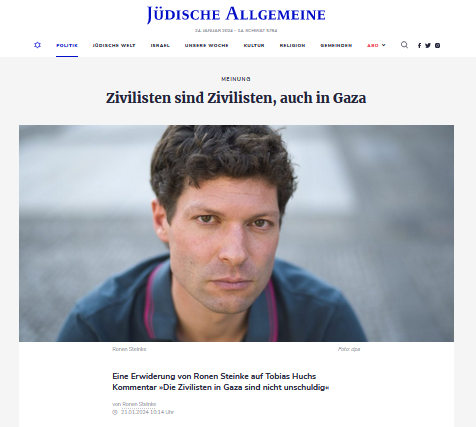
Die Jüdische Allgemeine hat dieser Tage allerdings einen Kommentar von Tobias Huch veröffentlicht, der für einige Irritationen gesorgt und auf den Ronen Steincke, rechtspolitischer Korrespondent bei der »Süddeutschen Zeitung«, geantwortet hat:
Die JA hat inzwischen Titel des Kommentars von T. Huch verändert und auch den Text und dies online auch kommuniziert.