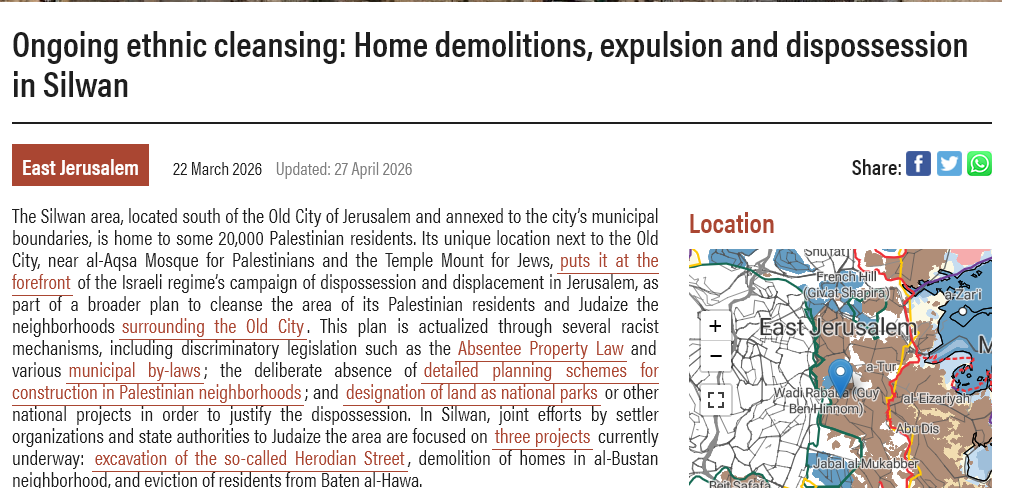
Ein Beitrag von James Smith auf der Seite von Middle Eats Eye

„Dr Abu Safiya must be immediately released. So too should all Palestinian detainees, including the 82 other healthcare workers still in Israeli prisons“
Ein Beitrag von James Smith auf der Seite von Middle Eats Eye
„Dr Abu Safiya must be immediately released. So too should all Palestinian detainees, including the 82 other healthcare workers still in Israeli prisons“
June 30, 2026
Crisis Appeal for Health, Emergency Support, and Survival Essentials in Gaza
As part of its Emergency Appeal: Crisis Appeal for Health, Emergency Support, and Survival Essentials in Gaza, Caritas Jerusalem continues to respond to one of the most urgent humanitarian needs facing displaced communities: access to safe drinking water.
Across Gaza, the ongoing crisis has severely damaged water infrastructure, leaving countless families without reliable access to clean water. Today, 91% of households experience water insecurity, while many people survive on less than six liters of water per person per day—far below the minimum amount required to meet basic daily needs. The lack of safe water, combined with overcrowded living conditions, damaged sanitation systems, and limited healthcare services, has significantly increased the risk of disease and has further worsened an already devastating humanitarian situation.
To help address this critical need, Caritas Jerusalem has launched a water trucking intervention, delivering potable drinking water directly to shelters, displacement camps, and communities where access to safe water has been cut off. The intervention is implemented in close coordination with local authorities and community representatives to ensure that the most vulnerable families are reached safely and equitably.
One of the communities currently benefiting from this intervention is the Al-Abraj area, where residents have endured prolonged shortages of clean drinking water.
„We have been suffering from a shortage of clean water in this area,“ says Yehia Abdo, Regional Director for Al-Abraj. „Caritas Jerusalem has now provided us with clean water, and we are grateful for your kind efforts. This is the best-quality water we have received in a long time. We truly appreciate your support.“
He explains that the community’s access to water became increasingly difficult after routes were cut off, forcing residents to travel long distances in search of safe drinking water. „This camp has an urgent need for water due to the long distances people must travel after access routes were cut off. We issued an emergency appeal, and Caritas Jerusalem responded. The water quality is excellent. Thank you, Caritas Jerusalem.“
For families living through prolonged displacement, access to clean water is more than a basic necessity—it is essential for survival, health, and dignity.
Beyond water trucking, the intervention also includes the distribution of emergency WASH (Water, Sanitation and Hygiene) kits containing essential hygiene and dignity items, helping families maintain basic hygiene standards despite the challenging conditions. Together, these interventions aim to reduce the spread of waterborne diseases, protect public health, and preserve the dignity of vulnerable households.
Through its Emergency Appeal, Caritas Jerusalem remains committed to standing alongside the people of Gaza, delivering life-saving assistance where it is needed most and ensuring that families continue to have access to one of life’s most fundamental necessities: safe, clean drinking water.
Ein Beitrag von Fanny Oz-Salzberger auf Qantara.de (Zuerst: Ein neues Israel, Internationale Politik, Mai 2026)
Ein Zitat daraus:
„Ein neuer Naher Osten mag in der Entstehung begriffen sein.
Qantara
Die dringlichere Frage ist aber, ob damit auch ein neues Israel entsteht – und ob dieses Israel auf lange Sicht demokratisch bleiben wird.
Sollte das nicht geschehen, dann wird es von keinem
militärischen Sieg aufgewogen werden können.“
Ein Bericht von Ir Amim zum Download
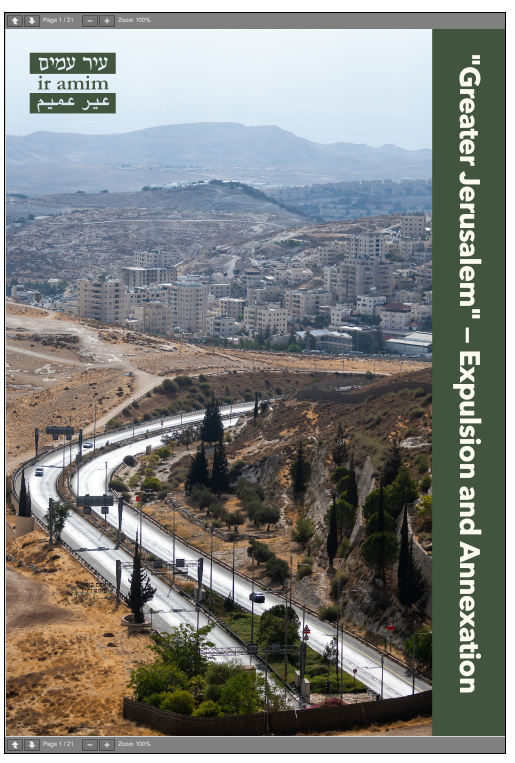
Download Full Report // Download Executive Summary
Over the past three years, Israel has dramatically reshaped the West Bank area around Jerusalem, often referred to in Israeli political discourse as “Greater Jerusalem.” Through accelerated settlement expansion, the establishment of outposts and related infrastructure, and escalating state and settler violence against Palestinian communities, annexation of this area is advancing at full force.
While annexation has largely been understood as the deepening of Israeli control over the space, application of Israeli sovereignty, and the obstruction of a future Palestinian state, Ir Amim’s new report underscores how the forcible transfer of Palestinian communities is central to the annexation paradigm. Expulsion and displacement are not side effects of annexation, but rather inextricable components of it.
These developments are part of a broader Israeli government agenda across the West Bank: expanding Israeli territorial contiguity while pushing Palestinians into disconnected enclaves within an increasingly fragmented Palestinian space. This strategy is unfolding throughout the West Bank, but it is especially visible around Jerusalem.
The report details the cumulative system of pressure being used to make life unsustainable for Palestinian communities, including land confiscation, settlement and outpost expansion, demolition orders and denial of building permits, military closure orders, new permit regimes, settler and military violence, severe restrictions on movement, and the closure of entire areas to Palestinian access.
International Crisis Group Journeys (Text)
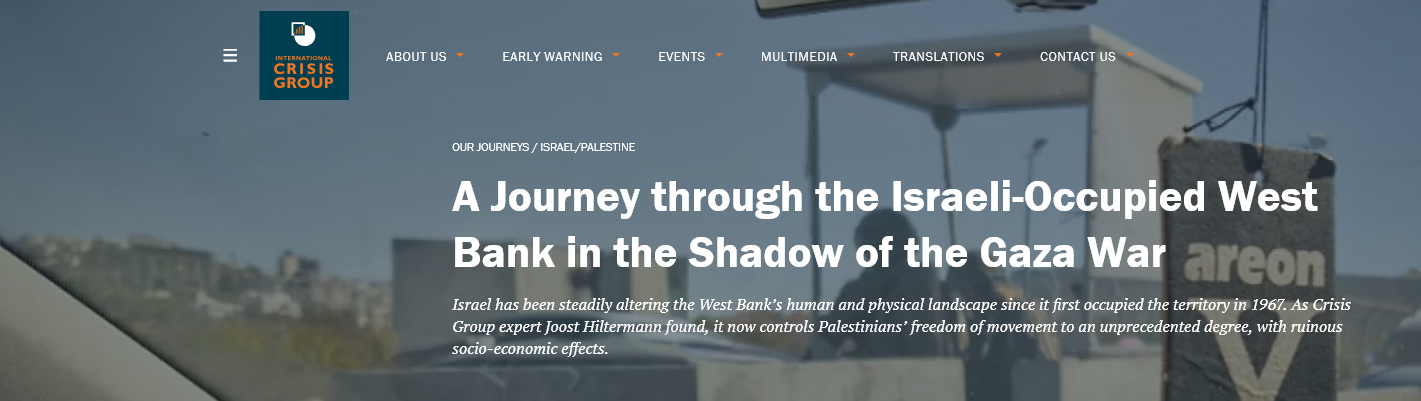
| Entering the West Bank from Israel is like passing into a parallel universe, with a military checkpoint serving as portal. One overarching structure but two realities: in people, law and policing. Israel has been steadily altering the West Bank’s human and physical landscape since it first occupied the territory in 1967. As Crisis Group expert Joost Hiltermann found, it now controls Palestinians’ freedom of movement to an unprecedented degree, with ruinous socio-economic effects. |

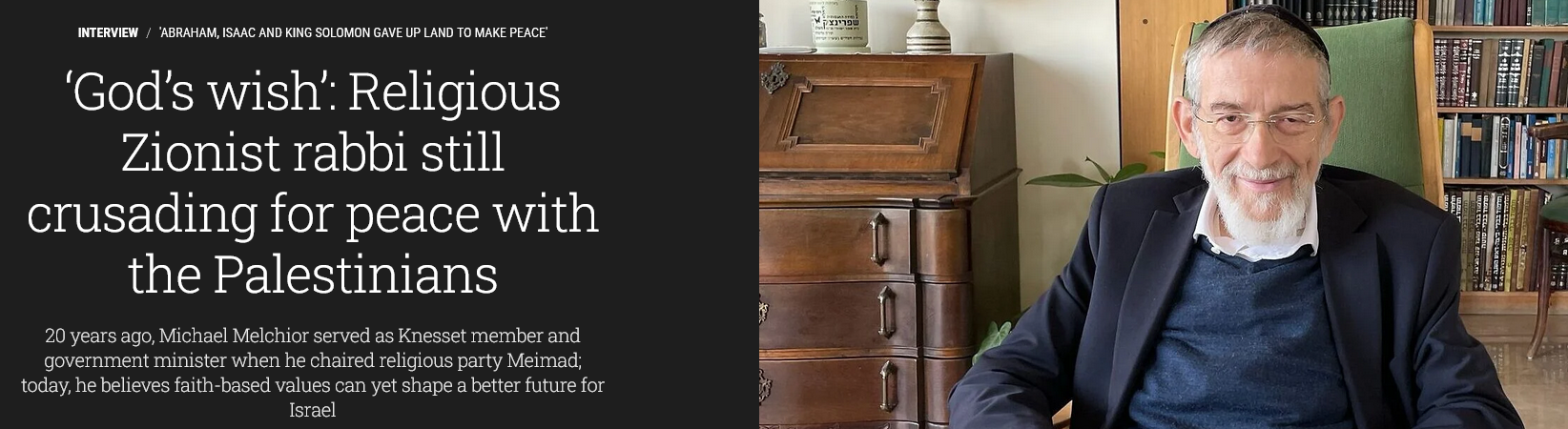
Ein lesenswerter Beitrag in der Times of Israel über die Arbeit von Rabbi Michael Melchior (72)
Sanitation conditions in Gaza continue to deteriorate and remain critical. After months and years in displacement camps without adequate infrastructure, families face increasing health risks linked to inadequate waste management, sewage overflows, and accumulating rubble. Clean Shelter continues to work across these interconnected challenges, focusing on practical, mid-term measures to mitigate risks in waste management, sewage containment, and rubble clearance, and is committed to delivering water for multiple uses to remote areas that lack access.
House-Warming: 25 Additional Families Return Home
Through our Shelter Program, Clean Shelter has restored safer and more dignified living conditions for 25 families by repairing damaged homes and making them habitable and weather-resistant once again. These interventions help families move out of tents and return to more stable shelter, improving safety, dignity, and protection for vulnerable households.
In addition, we carried out essential sewage repairs in a residential building in Gaza, housing 28 families. The work helped address environmental contamination and significantly improved sanitation conditions for all residents.

Sewage Control
Sewage management remains one of our most urgent priorities. As part of an ongoing project providing bathroom panels and septic tanks, we delivered essential infrastructure across multiple displacement sites: five bathroom panels installed in five camps and seven septic tanks installed in seven camps.
These interventions improve hygiene conditions, help prevent sewage overflow, and reduce health risks for displaced families living under increasingly difficult circumstances.

Water Access Expanded to a New Area
In addition to our continuous provision of safe drinking water to 60,000 people per day, Clean Shelter has successfully extended water access to a community residing at a higher elevation in Tal Elamal. This community previously had to walk long distances to obtain water. The problem is now solved for 140 families, who no longer face this daily burden.
Looking Ahead
Clean Shelter remains committed to scaling our response as needs grow. With sanitation conditions deteriorating and funding remaining unpredictable, your support is essential to keep these vital services running and to reach more families in urgent need. Thank you for standing with displaced families in Gaza.
We are now fundraising for the continuation of our operations in the second half of 2026 – we need your help and support! Please feel free to share our newsletter and social media posts and donate today to ensure safer living conditions for the most vulnerable individuals and families in Gaza!
With gratitude, The Clean Shelter Team.
To stay informed, follow us on Facebook, Instagram, LinkedIn, and X for real-time updates and
Gemeinsame Erklärung der Staats- und Regierungschefs des Vereinigten Königreichs, Italiens, Frankreichs und Deutschlands zur Lage im Westjordanland
In den letzten Monaten hat sich die Lage im Westjordanland erheblich verschlechtert.
Die Gewalt durch Siedler hat ein noch nie dagewesenes Ausmaß erreicht. Die Politik und Vorgehensweise der israelischen Regierung, einschließlich einer weiteren Verfestigung der israelischen Kontrolle, untergraben die Stabilität und die Aussichten auf eine Zwei-Staaten-Lösung.
Das Völkerrecht ist unmißverständlich: israelische Siedlungen im Westjordanland sind illegal. Bauprojekte im Gebiet E1 wären keine Ausnahme.
Die Siedlungserschließung im Gebiet E1 würde das Westjordanland zweiteilen und wäre ein schwerwiegender Bruch internationalen Rechts.
Wirtschaftsunternehmen sollten sich nicht an Bauausschreibungen für das Gebiet E1 oder an anderen Projekten zur Siedlungserschließung beteiligen. Sie sollten sich der rechtlichen und auch der rufschädigenden Folgen bewußt sein, die ihre Beteiligung am Siedlungsbau hätte, einschließlich des Risikos, an schweren Verstößen gegen das Völkerrecht beteiligt zu sein.
Wir fordern die Regierung Israels auf, die Ausweitung der Siedlungen und ihrer administrativen Kompetenzen zu beenden, die Rechenschaftspflicht für Gewalttaten durch Siedler sicherzustellen und Anschuldigungen gegen israelische Streitkräfte nachzugehen, die haschemitische Obhut über die heiligen Stätten Jerusalems und die historischen Status-Quo-Regelungen zu respektieren sowie die der Palästinensischen Behörde und der palästinensischen Wirtschaft auferlegten finanziellen Beschränkungen aufzuheben. Wir stellen uns entschieden denjenigen entgegen, einschließlich Mitgliedern der israelischen Regierung, die sich für eine Annexion des Westjordanlandes sowie die gewaltsame Vertreibung der palästinensischen Bevölkerung aussprechen.
Wir bekräftigen unser unerschütterliches Bekenntnis zu einem umfassenden, gerechten und dauerhaften Frieden auf der Grundlage einer verhandelten Zwei-Staaten-Lösung im Einklang mit den einschlägigen Resolutionen des VN-Sicherheitsrats, eine Lösung, nach der zwei demokratische Staaten, Israel und Palästina, in Frieden und Sicherheit innerhalb sicherer und anerkannter Grenzen nebeneinander existieren.
Freitag, 22. Mai 2026