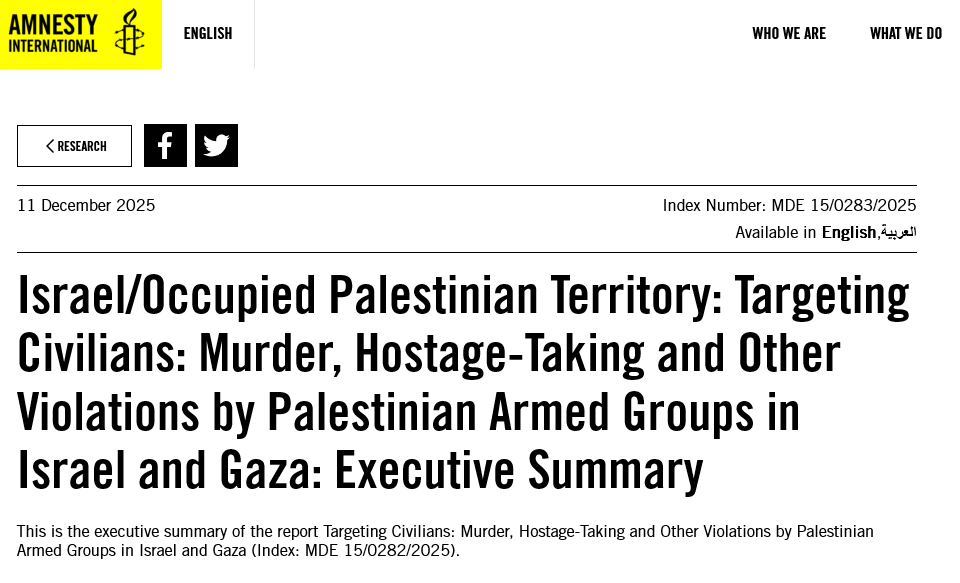
Amnesty International hat einen Bericht zum Angriff der Hamas und vier weiterer bewaffneter Gruppen auf Israel am 7. Oktober 2023 veröffentlicht. Aktuell (11.12.25) liegt der Bericht auf Englisch und Arabisch vor (Executive Summary) (Bericht dazu auf orf.at) (Nachtrag am Abend des 11.12.25: Bericht auf Deutsch bei Amnesty Deutschland)
CONCLUSION AND RECOMMENDATIONS
Through its research findings and legal analysis, Amnesty International has concluded that Palestinian armed groups committed violations of international humanitarian law, war crimes and crimes against humanity during their attacks in southern Israel that started on 7 October 2023 and continued to commit violations and crimes under international law in their holding and mistreatment of hostages and the withholding of bodies seized. It considers that Hamas, including its military wing, the Al-Qassam Brigades, was chiefly responsible for these violations and crimes. Other Palestinian armed groups, notably Palestinian Islamic Jihad, including its military wing, the Al-Quds Brigades, and the Al-Aqsa Martyrs’ Brigades, formerly the military wing of the Fatah political movement, were responsible to a lesser extent, as were unaffiliated Palestinian civilians from Gaza in some instances.
In light of these conclusions, Amnesty International makes a number of recommendations to secure justice and reparation for victims and survivors of crimes committed. Amnesty International has presented its recommendations in relation to the genocide and other crimes under international law committed by Israel in Gaza, specifically, and in Israel and the OPT, more generally, in other publications.
Hamas and other Palestinian armed groups must unconditionally return the body of Ran Gvili, seized from Israel on 7 October 2023, as soon as it is located. They should seek international assistance if needed to locate it. They must investigate serious violations of international humanitarian law, including crimes under international law, committed by their forces during the 7 October 2023 attacks and since, including with respect to hostages. They must publicly acknowledge, denounce and halt the serious violations of international humanitarian law, including crimes under international law, that have been and continue to be perpetrated, and commit to non-repetition of such violations. Amnesty International also calls on Hamas, as the de facto authority in Gaza, to ensure that all those responsible for serious violations of international humanitarian law and crimes under international law committed during the 7 October 2023 attacks and since then, including with respect to hostages, are brought to justice in fair proceedings conducted by an independent and impartial judicial mechanism.
Amnesty International calls on the Israeli authorities to end violations of international law against Palestinians in the OPT and Palestinian citizens of Israel. The authorities should continue criminal investigations into the 7 October 2023 attacks, hostage-taking and seizure and holding of bodies. Where there is sufficient admissible evidence, the authorities must bring those reasonably suspected of responsibility for crimes under international law to justice. The accused should be tried in civilian courts, in open proceedings that respect international human rights law and do not apply the death penalty. The Israeli authorities should take a survivor-centred approach to pursuing justice and accountability.
Israel, Hamas – as the de facto authority in Gaza – and the authorities of the State of Palestine should all engage with, cooperate fully with and provide access to all international justice institutions and UN human rights mechanisms investigating or monitoring violations of international law in Israel and the OPT, including the ICC, the UN Commission of Inquiry, the Office of the UN High Commissioner for Human Rights and the UN Special Rapporteur on the Situation of Human Rights in the Palestinian Territory Occupied Since 1967.
All parties should share with these international justice institutions and UN human rights mechanisms all evidence they have collected that is relevant to the investigation of such violations, including those committed by Palestinian armed groups, for the purpose of pursuing accountability and redress.