
Nimrod Sheffer war der Vizechef der israelischen Luftwaffe. Heute kritisiert er den Krieg in Gaza als sinnlos und gefährlich – für Geiseln, Soldaten und Palästinenser.- Ein Interview mit Thomas Krumenacker in DIE ZEIT
Aus Instagram
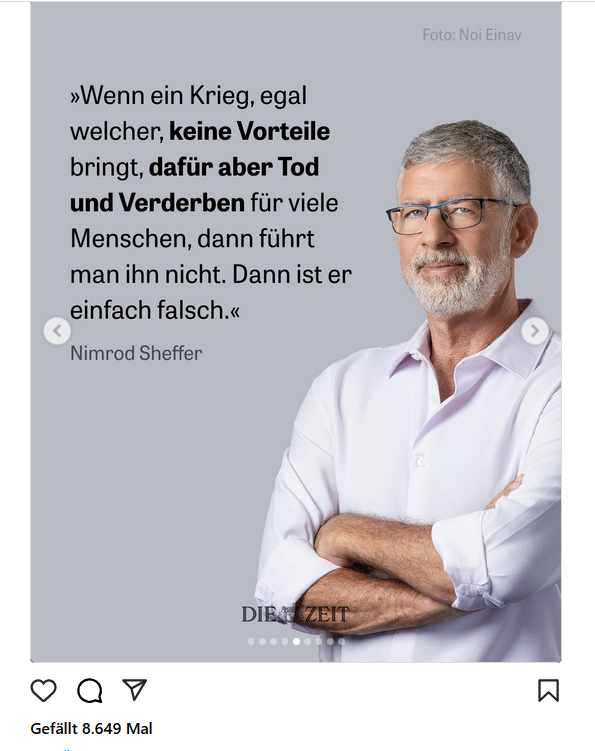
Nimrod Sheffer war der Vizechef der israelischen Luftwaffe. Heute kritisiert er den Krieg in Gaza als sinnlos und gefährlich – für Geiseln, Soldaten und Palästinenser.- Ein Interview mit Thomas Krumenacker in DIE ZEIT
Aus Instagram
Der Streit zwischen den Kirchen und der (West-)Jerusalemer Stadtverwaltung hat einen neuen Höhepunkt erreicht:
„The city of Jerusalem earlier this month froze the bank accounts of the Greek Orthodox Patriarchate of Jerusalem, the church body that represents around half of all Palestinian Christians and is a major landholder in Israel.
Ein Bericht David I. Klein auf dem Portal RNS | Religion News Service.

Photo: B. Doering
Gemeinsame Erklärung der humanitären Beauftragten der Vereinten Nationen in der Nahostregion
Stand Up, Speak Out, Protect the Humanitarian Space
Joint Statement by UN Resident and Humanitarian Coordinators in the Occupied Palestinian Territory (OPT), Syria, Yemen and Lebanon
One year ago, we called on those in power to end attacks against humanitarian workers and aid operations. Release all those arbitrarily detained. Safeguard the humanitarian space in the Middle East. That call remains unanswered.
Across the region, civilians, including humanitarian workers, have already endured an unbearable toll of decades of conflict and protracted crises. They are being killed, injured, and attacked in shocking numbers. Violations of international humanitarian law are at an unprecedented level, and impunity has become the norm.
The world is failing humanitarian workers and the people they serve. Since August 2024, at least 446 aid workers were killed, wounded, kidnapped or detained in the Occupied Palestinian Territory, Syria, Yemen and Lebanon. This brings the total number since August 2023 to at least 841 affected workers, including 584 killed, 215 wounded, 38 detained, and 4 kidnapped.
The assault on humanitarian space now includes moves to dismantle multilateral norms, undermine UN‑mandated bodies, and defund institutions tasked with protection and justice.
Even speaking out has become a liability, risking humanitarian access and triggering political retaliation.
Justice has failed for serious violations, whether committed by the same actors or by others emboldened by their impunity. The climate of permissiveness is politically indefensible and morally intolerable. There can be no exceptions to the rules of war. All parties must comply with international humanitarian law and be held accountable.
When we protect humanitarian workers, we are not only protecting the people they serve in the Middle East. We are protecting civilians everywhere, the international system, and the principles that underpin our collective dignity and humanity.
Humanitarians are not giving up, neither should the world.
This World Humanitarian Day, we renew our call—louder, sharper, uncompromising: Respect international humanitarian and human rights laws. Protect those who protect humanity. End impunity or be complicit. The world is watching. #ActForHumanity. Now.
Signatories
Dr. Ramiz Alakbarov, UN Resident and Humanitarian Coordinator for the Occupied Palestinian Territory (OPT), and Officer-In-Charge Special Coordinator for the Middle East Peace Process
Mr. Adam Abdelmoula, UN Resident and Humanitarian Coordinator for Syria
Mr. Julien Harneis, UN Resident and Humanitarian Coordinator for Yemen
Mr. Imran Riza, UN Resident and Humanitarian Coordinator for Lebanon
Der Historiker Adam Raz über das „Lexikon der Brutalität“ und wie sich die israelische Mehrheitsgesellschaft nach dem 7. Oktober von Netanjahu vereinnahmen ließ.
Ein Interview von Inge Günther

Jüdisch-arabische Berührungen – Herausgegeben von Anika Reichwald
im Namen des Jüdischen Museums Hohenems (Online-Katalog)

Redaktion: Dinah Ehrenfreund, Hanno Loewy
Übersetzungen: Kirsten Lehmann, Lilian Dombrowski
Gestaltung: Thomas Matt
Fotos: Dietmar Walser, Thomas Matt / ISBN 978-3-200-10568-3
Die Geschichte arabisch-jüdischer Lebenswelten reicht Jahr- hunderte zurück, bis in die präislamischen Stammesgesell-schaften Arabiens. Eine lange und widersprüchliche Beziehungsgeschichte – mal romantisiert, mal vergessen, verdrängt und dämonisiert – gibt es zu entdecken: jüdisches Leben unter islamischer Herrschaft über die heutigen arabischen Länder und die Iberische Halbinsel (al-Andalus), im Osmanischen Reich oder unter dem Einfluß europäischer Kolonialinteressen.
Yalla. Arabisch-jüdische Berührungen lädt ein zur Erkundung unvertrauter, widersprüchlicher Identitäten. Und leistet einen bescheidenen Beitrag dazu, auf das Begehren nach Eindeutigkeit mit Ironie und Offenheit zu reagieren – sei es in den Auseinandersetzungen um Zugehörigkeit und Abgrenzung in Europa, sei es im Blick auf den scheinbar so unlösbaren Konflikt an der Schnittstelle zwischen Europa, Asien und Afrika, dessen tragische Radikalisierung der Gewalt und der gegenseitigen Auslöschungsfantasien uns jeden Tag mehr beunruhigt. (Hanno Loewy im Vorwort)
Einleitung: Hanno Loewy
Texte zur Ausstellung: Anika Reichwald
Mit Essays von:
Lital Levy „Arabische Juden im Maschrek. Zur Historisierung eines Konzepts“
Emily Benichou „Gottreich Arabische Juden im Maghreb. Zur Historisierung eines Konzepts“
Mati Shemoelof „Fragen (nach) einer arabisch-jüdischen Diaspora“
Online-Katalog zur gleichnamigen Ausstellung im Jüdischen Museum Hohenems, 29. September 2024 bis 05. Oktober 2025. Dank großzügiger Förderung durch die Stiftung Irène Bollag-Herzheimer, Basel.
Bemerkenswertes Abschlußpapier der von Frankreich und Saudi-Arabien organisierten VN-Konferenz zur Zwei-Staaten-Lösung „New York Declaration on the Peaceful Settlement of the Question of Palestine and the Implementaton of the Two-State Solution„:
Aus dem Kommentar des Berliner Tagesspiegel dazu:

Bericht auf Radio Vatikan zur Konferenz Ende Juli (interessant wer als Initiator nicht genannt wird)
Dem Horror, dem Hunger, dem Tod etwas entgegensetzen!
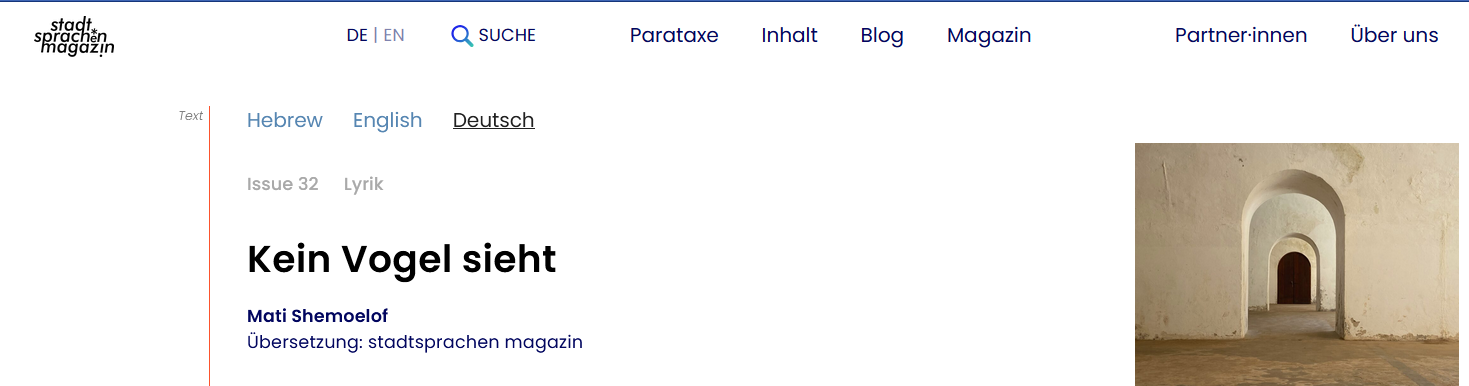
Mati Shemoelof hat im Stadtsprachenmagazin dieser Tage ein Gedicht veröffentlicht:
(Ergänzung 22.7: 29, statt 25 Unterzeichnerstaaten)
Nicht einmal das glaubt die Bundesregierung unterschreiben zu können.
[Und es ist keine Erklärung des Iran, Rußlands, Nordkoreas und …]
sondern ein Joint statement by:
EU Commissioner for Equality, Preparedness and Crisis Management and
Foreign ministers of
Australia,
Austria,
Belgium,
Canada,
Cyprus,
Denmark,
Estonia,
Finland,
France,
Iceland,
Ireland,
Italy,
Greece,
Japan,
Latvia,
Lithuania,
Luxembourg,
Malta,
The Netherlands,
New Zealand,
Norway, (da hat der Kanzler noch mal am selben Tag die großen Gemeinsamkeiten betont, als der PM in Berlin zu Gast war …)
Poland,
Portugal,
Slovenia,
Spain,
Sweden,
Switzerland and the
UK
We, the signatories listed below, come together with a simple, urgent message: the war in Gaza must end now.
The suffering of civilians in Gaza has reached new depths. The Israeli government’s aid delivery model is dangerous, fuels instability and deprives Gazans of human dignity. We condemn the drip feeding of aid and the inhumane killing of civilians, including children, seeking to meet their most basic needs of water and food. It is horrifying that over 800 Palestinians have been killed while seeking aid. The Israeli Government’s denial of essential humanitarian assistance to the civilian population is unacceptable. Israel must comply with its obligations under international humanitarian law.
The hostages cruelly held captive by Hamas since 7 October 2023 continue to suffer terribly. We condemn their continued detention and call for their immediate and unconditional release. A negotiated ceasefire offers the best hope of bringing them home and ending the agony of their families.
We call on the Israeli government to immediately lift restrictions on the flow of aid and to urgently enable the UN and humanitarian NGOs to do their life saving work safely and effectively.
We call on all parties to protect civilians and uphold the obligations of international humanitarian law. Proposals to remove the Palestinian population into a “humanitarian city” are completely unacceptable. Permanent forced displacement is a violation of international humanitarian law.
We strongly oppose any steps towards territorial or demographic change in the Occupied Palestinian Territories. The E1 settlement plan announced by Israel’s Civil Administration, if implemented, would divide a Palestinian state in two, marking a flagrant breach of international law and critically undermine the two-state solution. Meanwhile, settlement building across the West Bank including East Jerusalem has accelerated while settler violence against Palestinians has soared. This must stop.
We urge the parties and the international community to unite in a common effort to bring this terrible conflict to an end, through an immediate, unconditional and permanent ceasefire. Further bloodshed serves no purpose. We reaffirm our complete support to the efforts of the US, Qatar and Egypt to achieve this.
We are prepared to take further action to support an immediate ceasefire and a political pathway to security and peace for Israelis, Palestinians and the entire region.
…. soll es, soll was richten? Es fehlen einem die Worte …
Die Bombadierungen, die Tötungen, die Gewalt geht weiter im Gazastreifen. Und die deutsche Ministerin für Entwicklungszusammenarbeit redet in Kairo mit palästinensischen Flüchtlingen, dafür auf Arabisch…

