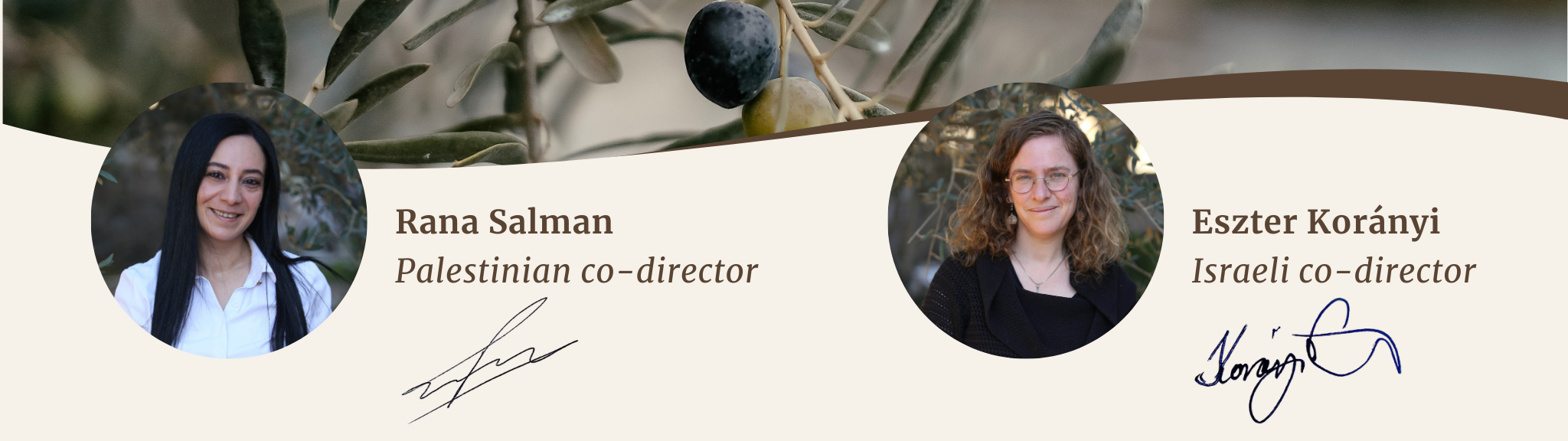
Below is message of CfP that they shared on the social media to with their International allies
The Palestinian and Israeli members of Combatants for Peace are united in our profound alarm at the current military escalation between the United States, Israel, and Iran.
As a joint movement committed to nonviolence and to ending the occupation through political means, we firmly reject the belief that expanded military force will bring safety or stability to our region.But why do we feel like this?
A few days ago in the West Bank, two Palestinian brothers were shot and killed by settlers in the village of Qaryut, part of a documented rise in settler violence and displacement that human rights organizations and UN monitors have repeatedly warned the world about. Such attacks are not isolated eruptions of chaos; they unfold within a system of occupation that fragments Palestinian life, weakens accountability, and entrenches a reality of unequal rights that corrodes any genuine prospect for peace.
In Israel, civilians have been killed and injured by Iranian missile strikes on residential areas, a stark reminder that when confrontation escalates between states, it is ordinary people who absorb the consequences. International humanitarian law is unequivocal: civilians must never be targeted, and indiscriminate attacks on populated areas are unlawful. As governments invoke deterrence and security to justify their actions, Israeli and Iranian families mourn loved ones as the confrontation spreads. Official statements speak in strategic terms; on the ground, it is grief that endures.
We refuse the hierarchy of grief that measures one life against another, and we reject the logic that treats civilian deaths as currency in a wider struggle. What binds these realities together is not only escalation between states, but the political structures that normalize and perpetuate harm – occupation, annexation, collective punishment, and regional brinkmanship that treats civilian lives as leverage rather than as equal human beings entitled to protection and dignity.
Moral clarity at this moment requires holding these truths together: opposing attacks on civilians everywhere while confronting the underlying reality of occupation, oppression and entrenched injustice that makes repeated escalation inevitable. Expanding war will not resolve either; it will only prologue the suffering.
If we are serious about protecting civilian life, we must be serious about ending the systems that endanger it. In hope,
Hoffen wir, daß es nicht nur ein Pfeifen im Wald ist, die politischen Mehrheiten gibt es jedenfalls (noch?) nicht …
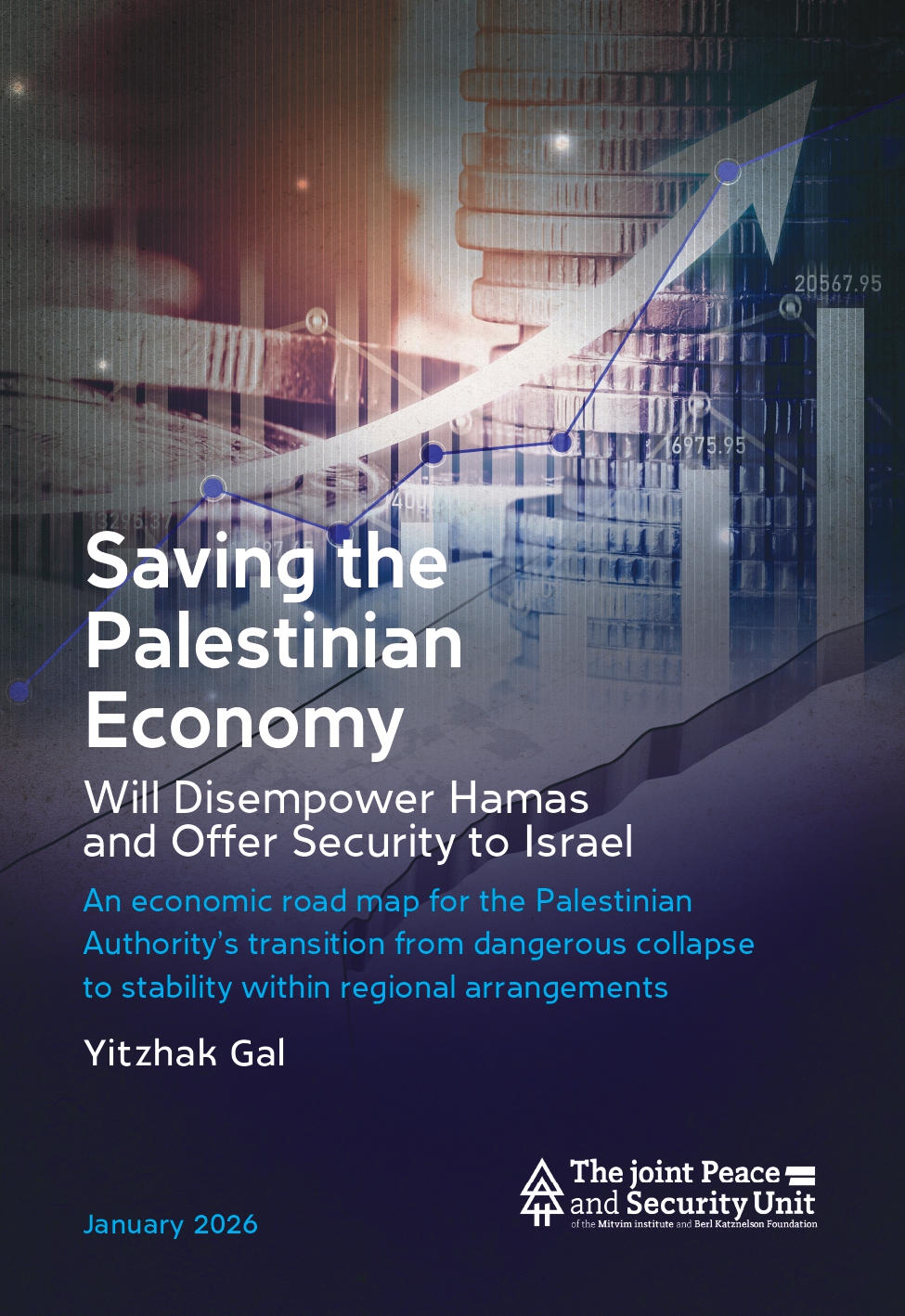
The Palestinian economy is in collapse. Hamas is regaining control over the limited existing resources and assets in the Gaza Strip, after the war destroyed Gaza’s economic system. In the West Bank, the Palestinian Authority (PA) is struggling to survive amid deliberate Israeli government policy that is exploiting the former’s dependence and advancing unilateral coercive measures to cripple the Palestinian economy and the PA itself.
This policy reflects a dangerous escalation of the Israeli approach that viewed Hamas as an asset and the PA as a burden, an approach whose beginnings predated October 7, 2023. The collapse of the PA and the Palestinian economy are openly touted by Israeli ministers as elements of a strategy designed to advance annexation and prevent the establishment of a Palestinian state, even at the cost of a stronger Hamas and critical damage to Israeli security.
This paper, written by Yitzhak Gal, proposes a new policy and includes pragmatic recommendations for action that will mend Israeli-Palestinian economic relations while supporting progress on a phased process toward two states and stable, long-term security. The proposed strategy is based on reform and socioeconomic stabilization of the PA within regional collaborative arrangements.
The paper illustrates the strong link between Palestinian economic growth and the security relations between Israel and the Palestinians. On this foundation, the paper proposes a three-stage road map whose goal is gradual building of a strong Palestinian economy; which will function as an independent system, while maintaining close cooperation with Israel and other countries in the region. That will contribute both to Palestinian and Israeli stability and prosperity.
A necessary condition for implementation of this roadmap is a political will in Israel to change its approach toward the Palestinians and to make strides in a process directed at socioeconomic and political stabilization. Therefore, the plan can only be implemented under an Israeli government that is willing to adopt a policy that is entirely different from the current government’s policy.
Nevertheless, even under the current government, there are several critical steps that can be performed almost immediately. These steps are proposed in the first stage of the road map, concurrently with Stage 2 of President Trumps’ 20- point peace plan. These steps will be part of US-led measures to implement UN Security Council Resolution 2803 with respect to Gaza.
The concrete measures proposed for the first stage are: Resolution of the PA’s protracted fiscal crisis in order to allow full and timely wage payments and orderly delivery of public services; gradual re-entry of Palestinian workers into Israel for employment while implementing agreed changes to improve security arrangements; suspension of measures that impair the Palestinian banking system and application of new arrangements that will stabilize this critical system; as well as measures that would leverage the rebuilding of Gaza to jump-start the Palestinian economy, with emphasis on trade and logistics. The execution of these steps will be contingent on a comprehensive, effective reform of the PA, cessation of payments to prisoners and “martyrs” (shaheeds), and tight security coordination that ensures demilitarization in Gaza and the marginalization of Hamas.
In the second stage, additional set of measures that can be promoted under the umbrella of the Oslo Accords and the Paris Protocol. These measures will include: convening of the joint Israeli-Palestinian economic committee and the additional joint subcommittees defined in the Paris Protocol and accompanying agreements, for development of agreed future plans; phased promotion of economic links between Gaza and the West Bank, contingent on accepted security arrangements; establishment of special-economic-status industrial zones and free trade areas; signing of preferential trade arrangements with the UAE and Saudi Arabia, the EU, and the US; promotion of Palestinian and Israeli integration into regional economic projects, primarily the reconstruction of Gaza and the India–Middle East–Europe Economic Corridor (IMEC).
The third stage will focus on a new Israeli-Palestinian economic agreement, under US-international-regional aegis. The new economic agreement will be negotiated as part of an agreed path to the future establishment of a demilitarized Palestinian state, and as an integral element of a regional settlement. This economic agreement will replace the Paris Protocol and its accompanying set of agreements as well as the multiple unliteral arrangements that have evolved over the past 30 years. This stage, which is proposed to take place over a longer term (3–4 years), will include issues such as a permanent trade regime, the currency of the PA, and other significant changes in the structure of the Palestinian economy.
Implementation of the proposed plan will drive the Palestinian economy forward,strengthen the moderate actors in the Palestinian arena, and support the socioeconomic stability that is a necessary condition for a stable settlement and long-term security.
The proposed plan also offers a set of additional significant benefits for Israel: The plan will lead to a strong and stable PA that maintains effective rule in the West Bank, that constitutes an effective alternative to Hamas in the Gaza Strip, is committed to peace with Israel, and is a partner in effective anti-terror measures. Implementation of the plan will dilute the power of Hamas and other extremist groups in Gaza and the West Bank.
The gradual nature of the process, which is directed toward a clear political horizon and its progress based on the achievement of clear milestones, will build confidence and trust and create a system with long-lasting stability.
Israel’s integration as an important actor in comprehensive regional initiatives, such as IMEC, is expected to be an important growth engine for Israel’s economy for decades to come.
Im Nachgang zu unserem DienstagsZoom am 3. Februar, hier ein Beitrag der Autorin in der taz vom 15. Februar 2026
Marina Klimchuk – Für die Autorin war Israel das gelobte Land, heute schämt sie sich für ihren Paß. Eine Geschichte von Entfremdung – und der Suche nach Verbündeten.
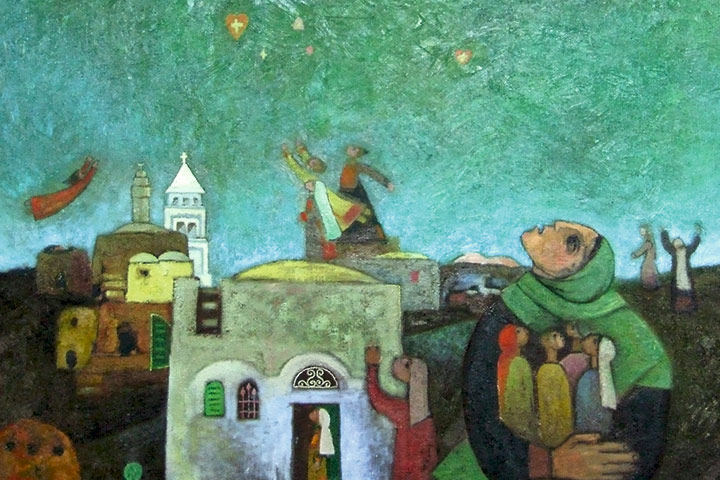
11 Uhr: Festgottesdienst in der Französischen Friedrichstadtkirche, Berlin-Mitte Predigt: Dr. Imad Haddad, Bischof der Evangelisch-Lutherischen Kirche in Jordanien und im Heiligen Land (ELCJHL)
13 Uhr: Empfang im Kaiserin-Friedrich-Haus, Berlin-Mitte, anschließender Imbiß
14 bis 16.30 Uhr: Festnachmittag im Kaiserin-Friedrich-Haus, Berlin-Mitte Vorträge und Gespräche zum Thema „Zwischen Verzweiflung und Hoffnung – Zur Situation der palästinensischen Christinnen und Christen“ mit:
Bischof Dr. Imad Haddad (ELCJHL)
Daoud Nassar (Tent of Nations)
Marc Frings (Generalsekretär des Zentralkomitees der deutschen Katholiken, ehemaliger Leiter der Konrad Adenauer Stiftung Ramallah)
NEW EPISODE Hold the Fire FROM THE INTERNATIONAL CRISIS GROUP
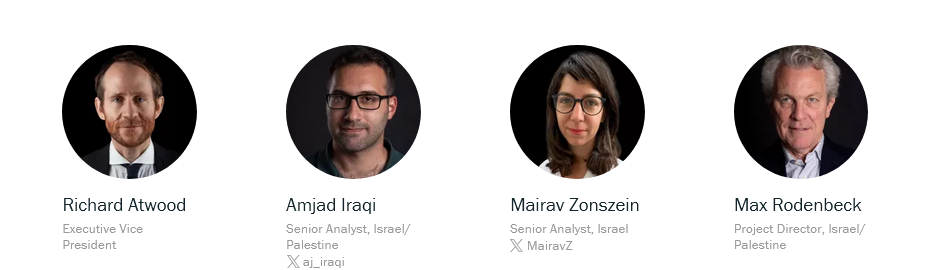
In this episode of Hold Your Fire!, Richard Atwood speaks with Crisis Group experts Amjad Iraqi, Mairav Zonszein and Max Rodenbeck about President Donald Trump’s Board of Peace and its implications for Gaza. They unpack the structure of the board’s different layers, how Palestinians are reacting to the new Palestinian technocratic Gaza committee and what that committee will do. They look at conditions on the ground in Gaza amid frequent ceasefire violations and Hamas’s continued hold of parts of the strip. They also assess the obstacles to moving the peace plan forward, including working out agreement on the sequencing of Hamas decommissioning weapons, on one hand, and Israeli withdrawing troops and letting in reconstruction aid on the other, as well as the still-uncertain prospects for an international stabilisation force in the strip.