Seit längerem wieder einmal ein Hinweis zu den Möglichkeiten des Netzes: 1914-1918-online.net – Ein Projekt der Freien Universität Berlin / Friedrich-Meinecke-Institut (FMI)- hier ein Hinweis auf das Osmanische Reich …
„This article traces some of the uses of photography on the Ottoman fronts during the Great War. It explores images by native photographers from the empire’s various national communities and by European photographers at the front. It highlights three different types of photography: studio portrait images of soldiers and of social life at the time – a neglected theme of particular importance to social historians of war; the work of official, press, and resident photographers, often hired by the Ottoman armies to document notable events (e.g. visits of dignitaries); and, on the British side of the Egyptian-Palestinian front, images taken by soldier-photographers that documented war preparations and the activities of the officers.“
As we approach October 7th and the one-year anniversary of the massacre in Israel and the war on Gaza, we invite you to join us for a time of reflection and action. This moment calls us to honor the sacredness of every life lost to the ongoing violence, to acknowledge our deep sorrow, and to renew our commitment to peace, freedom, and safety for all.
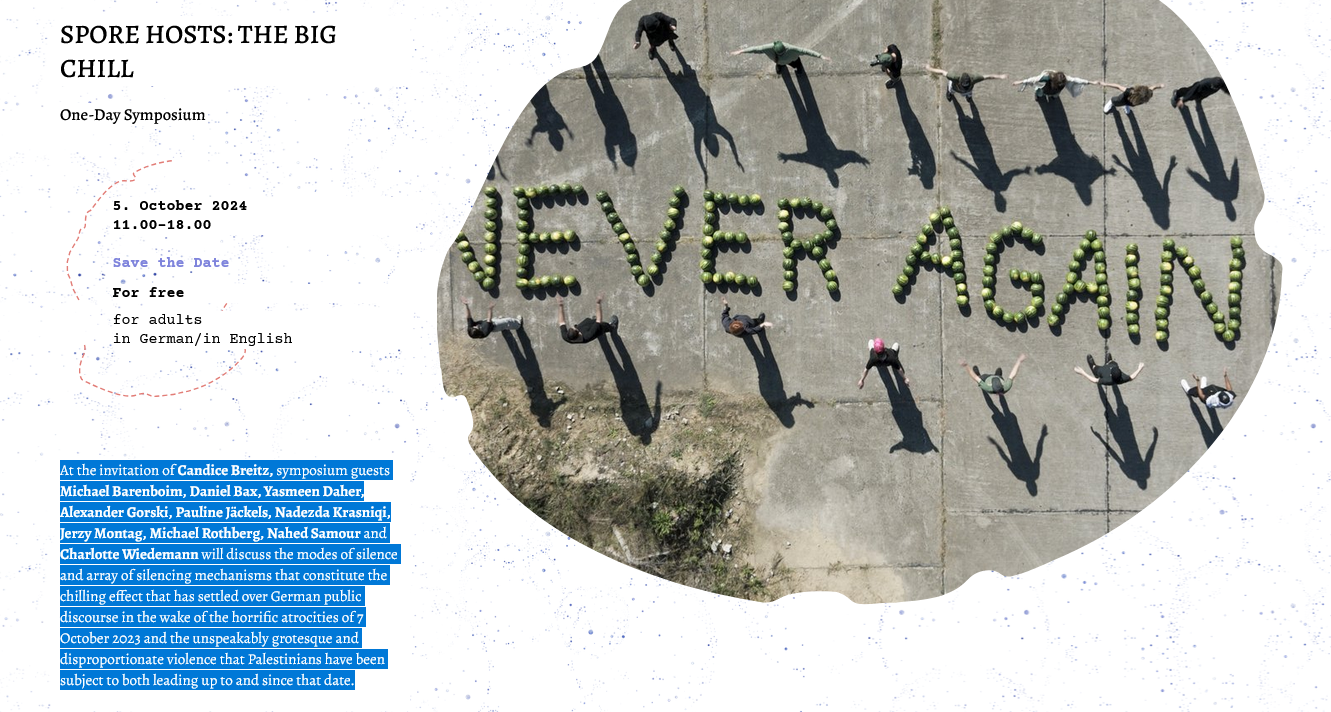
At the invitation of Candice Breitz, symposium guests Michael Barenboim,Daniel Bax, Yasmeen Daher,Alexander Gorski,Pauline Jäckels,Nadezda Krasniqi,Jerzy Montag,Michael Rothberg,Nahed Samour and Charlotte Wiedemann will discuss the modes of silence and array of silencing mechanisms that constitute the chilling effect that has settled over German public discourse in the wake of the horrific atrocities of 7 October 2023 and the unspeakably grotesque and disproportionate violence that Palestinians have been subject to both leading up to and since that date.
Schon das vergangene Jahr war schrecklich, heute am Jüdischen Neujahr/Rosch Haschana 5785 nichts als der Wunsch, dieses Neue Jahr werde besser, friedlicher, freier, gerechter – für ALLE…
The State of Israel is in the midst of the most difficult period in its history, under a reckless leadership headed by a man whose only promise he has made and kept to his people was to live by the sword. In remarks made at a new year’s cabinet meeting, Prime Minister Benjamin Netanyahu briefly mentioned the 101 hostages whom he has abandoned to suffering and death in Hamas‘ tunnels in the Gaza Strip, half of whom are no longer alive.
Under its thoughtless leadership, Israel is taking giant steps towards a regional war, while the world keeps asking itself: What does it want? Where is it heading?
Ayman Safadi, the Jordanian foreign minister, best captured those feelings in a speech that has gone viral across the globe but has been completely ignored by Israel. At a press conference following a joint celebration by Arab representatives during the UN General Assembly session, Safadi exercised his right to speak and say things all Israelis must hear.
„The Israeli prime minister came here today and said that Israel is surrounded by those who want to destroy it,“ he began. „We’re here — members of the Muslim-Arab committee, mandated by 57 Arab and Muslim countries — and I can tell you very unequivocally, all of us are willing to guarantee the security of Israel in the context of Israel ending the occupation and allowing for the emergence of a Palestinian state.“
This is not to say that Hamas did not seek to vanquish Israel, that Hezbollah is not a bitter and cruel enemy or that Iran is not seeking the worst for us, but Safadi has served to remind us of an undeniable truth: Under its long years of rule by Netanyahu, Israel has not lifted a finger for the sake of peace with the Palestinians, but the reverse.
„Do they have a narrative other than ‚I’m going to continue to go to war and kill this and kill that‘?“ he asked. „Ask any Israeli official what their plan is for peace, you’ll get nothing because they’re only thinking of the first step – we’re going to destroy Gaza, inflame the West Bank, destroy Lebanon. After that, they have no plan. We have a plan, we have no partner for peace in Israel.“
On the eve of Rosh Hashanah 5785, when the only horizon Israel’s leaders offer is war, we can only hope that in the coming year we will be blessed with a profound change in leadership and a new vision for the country. May this year and its troubles soon be over.
The above article is Haaretz’s lead editorial, as published in the Hebrew and English newspapers in Israel.
Eine Analyse von Steven A. Cook der Unterschiede bzw. Gemeinsamkeiten der beiden aussichtsreichen Kandidierenden für die US-Präsidentenwahl im November auf dem Portal The Liberal Patriot. Auch wenn nur eine Stimme, ist sie doch interessant und scheint hilfreich dabei zu verstehen, warum der amtierende israelische Ministerpräsident in den den letzten Monaten immer wieder (öffentlich) die US-Politik und -Interessen mit seinen Aktionen vorführt / vorführen kann.
Friedenskonzert in der Passionskirche Berlin | Sa 26. Okt 2024, 20:00 Uhr (Marheinekeplatz 1‐2)
Musik ersetzt nicht die harte Arbeit für den den Frieden, aber sie kann die Kraft dafür mobilisieren …
***
„Kayan“ ist das arabische Wort für „Existenz“. Als Kayan Projekt existieren Berliner Musiker aus Israel‐Palästina, Syrien und Polen als ein außergewöhnliches Ensemble, das sich um die Sängerin Eden Cami versammelt hat. Die junge Formation aus arabischer Ud, Kontrabaß und Percussion verbindet klassische und moderne Musik sowie Poesie aus der Levante mit Elementen des Jazz, die Eden Cami mit ihrem arabischen und hebräischen Gesang verwebt.
Der Lyriker Jan Wagner schreibt: „Die virtuos gezupfte Ud und das Gleiten und Schnippen und kunstvolle Stolpern des Kontrabasses treffen sich irgendwo an der Grenze zwischen Folk und Jazz, und der wunderbare Gesang der Singer‐Songwriterin Eden Cami läßt beides anklingen.
Besetzung / Stab
Eden Cami Gesang Or Rozenfeld Kontrabass Wassim Mukdad Oud Borys Slowikowski Schlagzeug