Pessach geht zu Ende, heute ist Karfreitag. Es geht um Befreiung, um den Weg zu einem neuen Leben, dazu gehört auch ein wahrhaftige Blick auf das, was geschieht – Zwei aktuelle Beiträge dazu in deutschen Medien.
Ein Beitrag von Jan-Christoph Kitzler auf der Seite des Deutschlandfunks
***
Offener Brief: Ende des Militäreinsatzes
Interview bei Deutschlandfunk Kultur: Autor Ofer Waldman hofft auf Signalwirkung von Protest | Mehr dazu: Wenig Wirkung vor Ort
Ein Bericht von Jan-Christoph Kitzler (ARD Tel Aviv) auf tagesschau.de –
‚eine laute Minderheit, um Anarchisten, die von ausländischen Nichtregierungsorganisationen unterstützt würden‘, so der israelsiche Ministerpräsident, einfache Antworten auf komplexe Situationen, das macht ja weltweit Schule ….
„Israels Armee ist auf ihre Reservisten angewiesen, und seit dem Überfall der Hamas am 7. Oktober 2023 hat sich gezeigt, wie wichtig sie sind. Frauen und Männer können in Israel nach Ihrem Militärdienst noch bis zum 40. Lebensjahr zum Reservedienst eingezogen werden, Offiziere auch darüber hinaus. Fast 300.000 Reservisten wurden nach dem 7. Oktober nach Angaben der Armee eingezogen, viele über Monate, auch mehrfach.
Doch inzwischen wird die Weigerung vieler Reservisten, in den Krieg zu ziehen, zum Problem. Die genauen Zahlen sind unter Verschluss – doch israelische Medien berichten über die größte Verweigerungswelle seit Jahrzehnten.
Von mehr als 100.000 Verweigerern ist die Rede. Überprüfen lässt sich das nicht. Was man weiß, ist, dass einige Soldaten Briefe veröffentlicht haben – darunter Reservisten der Luftwaffe, der Marine und von Spezialeinheiten der Aufklärung. … „
16. April 2025 | 19.30 Uhr | Lettrétage in der Veteranenstraße 21
Photo: (c) Bashir Bashir
Kilmé is a monthly talk series dedicated to Palestinian artists, intellectuals, and academics; a platform to present their work and speak about subjects that are important to them. Kilmé means word in Arabic. The organizers are dedicated to presenting palestinian voices in all of their diversity and creativity, thus contributing to the cultural landscape of Berlin, a city with the largest Palestinian population in Europe.
In the April issue of kilmé talks, Bashir Bashir will be the guest. The evening will be moderated by Tyme Khleifi and Michael Barenboim.
Bashir Bashir is associate professor in the department of sociology, political science and communication at the Open University of Israel and a senior research fellow at the Van Leer Jerusalem Institute. Currently, he is a fellow at the Wissenschaftskolleg zu Berlin. His primary research interests are nationalism and citizenship studies, liberalism, democratic theory, decolonization, the politics of reconciliation, and alternatives to partition in Palestine/Israel. Among other numerous publications, he is the co-editor of „The Holocaust and Nakba: A New Grammar of Trauma and History“ (Columbia University Press, 2018); and „The Arab and Jewish Questions: Geographies of Engagement in Palestine and Beyond“ (Columbia University Press, 2020). His writings have appeared in English, Hebrew, Arabic, Italian, German, and Japanese.
***
Ergänzung: 11. April 2025: Hybrid-Veranstaltung im ZMO | 24. April 2025, 17.00 Uhr
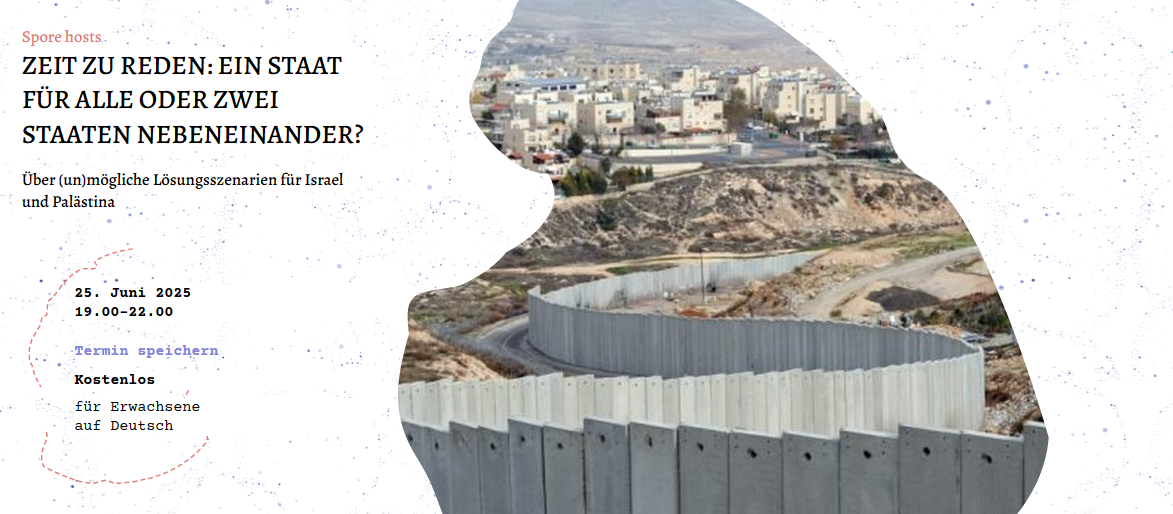
Egalitarian Bi-nationalism for Israel/Palestine
There is a growing agreement among scholars, politicians and experts that the oppressive realities and colonial policies in Palestine/Israel are politically unacceptable and morally indefensible. Leading human rights organizations like Human Rights Watch, Amnesty International and B’Tselem have published extensive reports that identify these colonial policies and their disastrous impacts on the lives and rights of the Palestinians. The question of putting an end to these wretched and segregationist realities and policies and moving to more transformative and inclusive solutions has preoccupied several scholars and politicians in Israel/Palestine and beyond. Liberal and national principles in the forms of one-person one-vote or territorial and ethnic partition have been at the center of debates on these transformative solutions.
This talk argues that egalitarian bi-nationalism is better equipped to address the underlying issues of the conflict in Israel/Palestine than the liberal and secessionist national frames. Egalitarian binationalism, the talk goes on to argue, better satisfies the urge for self-determination of Palestinian Arabs and Israeli Jews than the benign neglect majoritarianism of the liberal state or ethnic secession and the partition of the two-state solution. The talk concludes that egalitarian bi-nationalism’s insistence on envisioning affective relations of co-belonging based on an ethics of equality, parity, mutual legitimacy, and cohabitation offers rich resources for historical reconciliation and decolonization in Israel/Palestine.
Die Nachwirkungen des Zweiten Weltkriegs sind bis heute spürbar. In einer dreiteiligen Miniserie beleuchten Wissenschaftler*innen der Max Weber Stiftung verschiedene regionale Aspekte des Endes des Zweiten Weltkriegs: Welche Flucht- und Migrationsbewegungen prägten die Nachkriegszeit? Wie wird in Ägypten oder in Japan an das Kriegsende erinnert? Und welche verschlungenen Wege nahmen jüdische Ritualobjekte während und nach dem Krieg?
Mit der dreiteiligen Miniserie The Ends of War widmet sich die Max Weber Stiftung (MWS) dem Ende des Zweiten Weltkriegs aus transnationaler Perspektive. Wissenschaftsjournalistin Janine Funke bringt internationale Wissenschaftler:innen zusammen, die über ihre Forschungen zur Kriegs- und Erinnerungsgeschichte an den Auslandsinstituten der MWS sprechen. Mit Experteninterviews und eindringlichen Erzählungen beleuchtet die Serie, was das Kriegsende für verschiedene Weltregionen bedeutete.
Die drei Folgen sind ab sofort und auf allen gängigen Plattformen verfügbar und haben folgende Schwerpunkte:
#1: Erinnerung an den Holocaust – wie an Orte von Massenerschießungen erinnert wird und welche Rolle jüdische Ritualobjekte für das Kulturerbe spielen. #2: Emigration und Kriegsflüchtlinge – wie das Kriegsende Millionen von Menschen zu Flüchtlingen machte und geopolitische Neuordnungen anstieß. #3: Ostasien und der Nahe Osten – vom deutschen Afrikafeldzug in Ägypten bis zur japanischen Kapitulation und den umstrittenen Erinnerungskulturen in Ostasien.
In einem Interview in der Frankfurter Rundschau befragt Inge Günther den israelischen Shoa-Forscher Amos Goldberg über die Beziehungen seines Landes zu Ultrarechten aus aller Welt und warum er Genozid-Vorwürfe für stichhaltig hält, auch wenn Gaza nicht Auschwitz ist.
Beiträge unter anderem von Profin. Drin. Drin . Aleida Assmann (Anglistik und Allgemeine Literaturwissenschaft, Uni Konstanz, Mitglied der Steuerungsgruppe der Jerusalem Erklärung zum Antisemitismus), Prof. Michael Barenboim (Barenboim-Said-Akademie, Association of Palestinian and Jewish Academics), Hanno Hauenstein (Journalist, Berlin), Prof. Dr. Werner Ruf (Politikwissenscha
Panels:
The Destruction of Gaza’s Educational Infrastructure & Sustaining Higher Education
Akademische Freiheit in der autoritären Wende
Wissenschaft in der „Zeitenwende”: Militarisierung oder zivile Entwicklung?
Freedom of the Press? How German media have been covering the Gaza War
Wissenschaftliche Zusammenarbeit für Konfliktlösung und gerechten Frieden
Join for an upcoming webinar discussing „The Present Day: Peacemaking Alternatives for Israeli Policy,“ a policy document developed by the Forum for Regional Thinking in collaboration with the Van Leer Jerusalem Institute. The document analyzes the events leading up to October 7 and the subsequent war, criticizes Israel’s immediate and long-term policy, and offers recommendations for recognizing Palestinian national rights and achieving a historic reconciliation. Dr. Shmuel Lederman and Dr. Eli Osheroff, two of the document’s authors, share their key insights and discuss paths for action. The online event would be held in English.
In January 2025, the Forum for Regional Thinking, in collaboration with the “Israel in the Middle East” research cluster at the Van Leer Jerusalem Institute, published an extensive analytic paper on the road to the Gaza war, including recommendations for a way out of the war towards historic reconciliation between Israelis and Palestinians.
Jack Omer-Jackaman, Editor des US-amerikanischen Blogs Fathon – nach eigenem Verständnis „For a deeper understanding of Israel, the region, and global antisemitism“, reflektiert über Tranp und alles was damit zusammenhängt …:Opinion | An Elementary Truth: Gaza is Palestinian
Jack Omer-Jackaman is the author of Caught Somewhere Between Zion and Galut: Israel, Zionism and Anglo-Jewish identity 1948-1982 (2017). In his lengthy and passionate Zionist critique (on Fathon) he argues that Trump’s peace plan is duplicitous and self-interested in intent, irrational in execution, and will be dangerous and cruel in consequence for Palestinians and Israelis alike.