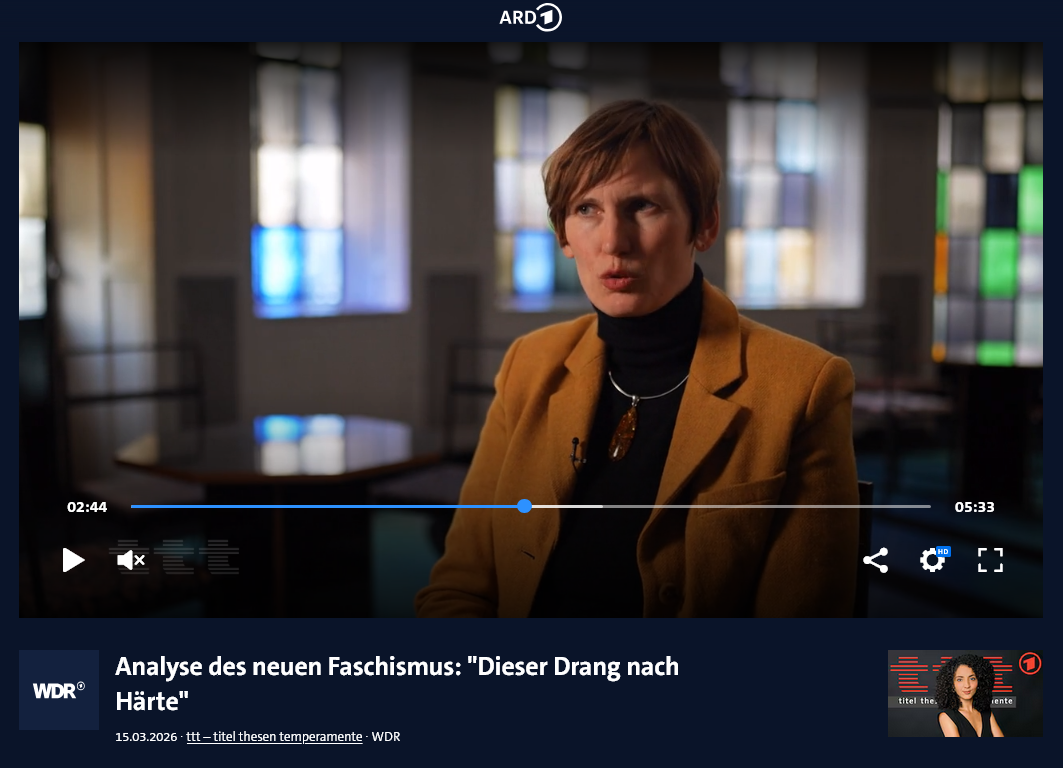
Ein Beitrag in der ARD Mediathek aus dem Magazin ttt.
Die Philosophin Eva von Redecker definiert und erklärt den Rechtsruck unserer Gegenwart.
Ein Rechtsruck geht um die Welt – überall gewinnen autoritäre Kräfte an Macht und Einfluss. In der Folge werden Minderheiten ausgegrenzt oder körperlich angegriffen. Aber welche Entwicklungen in der Gesellschaft begünstigen dies? Der Faschismus der Gegenwart ist nicht mit dem der Vergangenheit zu vergleichen, er hat eine neue Gestalt, die nicht leicht zu erkennen und noch schwerer zu erklären ist. Mit „Dieser Drang nach Härte“ hat die Philosophin Eva von Redecker eine Analyse des neuen Faschismus vorgelegt, der hilft, ihn zu entschlüsseln und Strategien der Gegenwehr zu entwickeln.
“Gidi & Mati” will be presenting their album, “The Strangers Are the Friends”, with a live performance on 13 February at Lettrétage in Berlin.
Here quotes form the mailing of Mati Shemoelof
„I would like to elaborate on it from an artistic point of view – Two years ago, we started jamming in Gidi’s Berlin living room. We didn’t know what would come of this project. I approached my art without fear, embracing insecurity in a new field, and so I started this musical journey, which, truth be told, I had never taken before. But to start down the path to a fruitful artistic career, one must be blind. We never said that we would have an album, but after performing in Potsdam, Berlin and Zürich, we realized that the time was right to record for future generations. I remember the thrill of entering the studio; for me, it was as if I was becoming a session musician with the Beatles. Gidi controlled the whole session and played all the instruments, but sometimes we jammed with the guitar. I learned so much and remember not even eating my sandwich on the way to the studio because I was so concentrated. Now, having reached one of the pivotal moments of my artistic career, we will celebrate with an album where I wrote the lyrics and Gidi composed the music, which we sing together. „
Thomas Schütt will read the English translation and friends will join us. Please listen to the two magical singles that we have just released to all the music channels.
We hope to see you all at our special event in Berlin, celebrating this unforgettable moment with us.
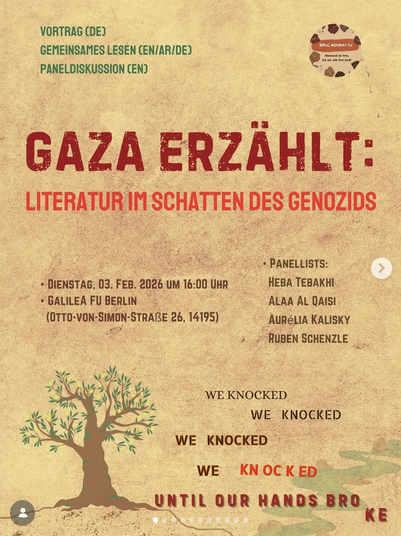
„Gaza erzählt: Literatur im Schatten des Genozids“.
BIPoC Referat des AStA FU lädt ein zu einer Literaturveranstaltung „Gaza erzählt: Literatur im Schatten des Genozids“. Gemeinsam mit Autor*innen und Literaturwissenschaftler*innen soll folgenden Fragen nachgegangen werden:
– Was schreiben die Autor*innen — oder können sie überhaupt schreiben —, während ihre Wohngegend, ihr Zuhause und ihre Familien bombardiert werden und Hunger bis hin zum Verhungern erleiden? – Warum schreiben Autro*innen inmitten des Elends? Um zu überleben? Um zu erinnern? Damit die Welt sie hört und auf ihr Leid aufmerksam wird? – Ist es sinnvoll, diese Texte als Literatur des Genozids zu bezeichnen und einzuordnen? – Wie beeinflußt die schnelle Übersetzung die Rezeption dieser Literatur? Verliert sie dadurch ihren Kontext — oder gewinnt sie notwendige Sichtbarkeit?
Dienstag, 03. Februar 2026, 16 Uhr 📍 GalileA @galileafuberlin (über Mensa 2 FU Berlin; Otto-von-Simson-Str. 26)
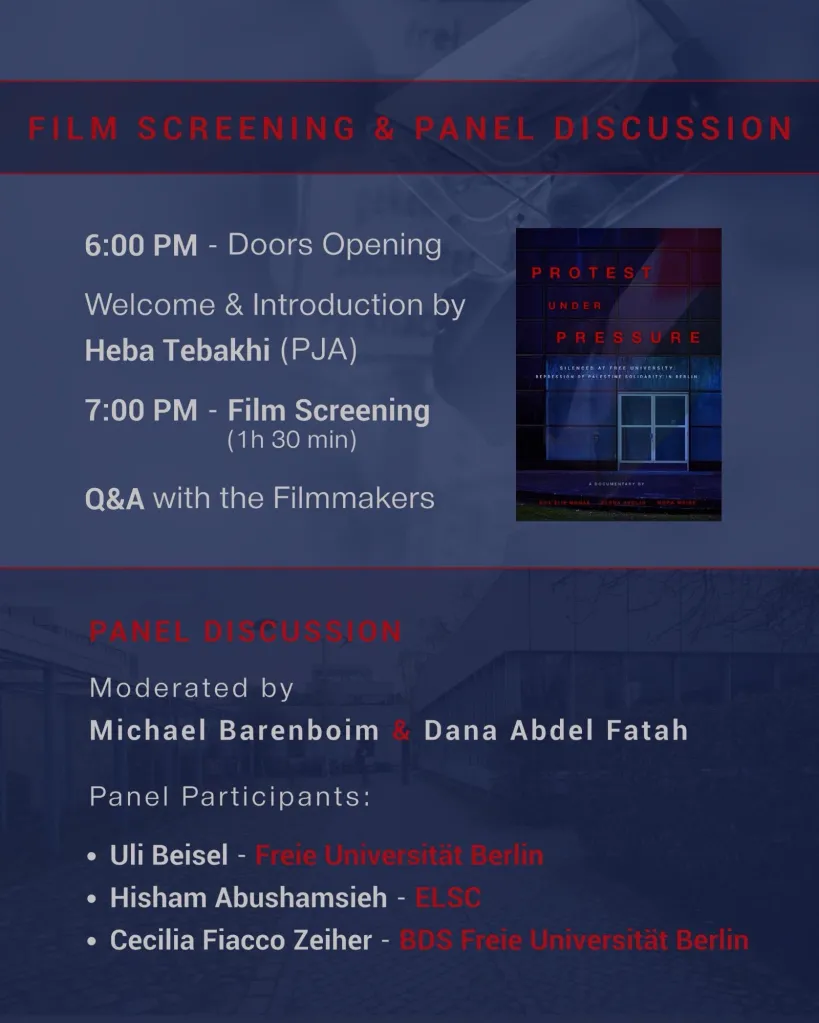
The Association of Palestinian and Jewish Academics (PJA) invites you to the public screening of the documentary Protest under Pressure.
We are very thrilled to announce the screening of “Protest under Pressure”. After a year of dedicated work by student filmmakers, involving interviews, protest coverage, rigorous research, and editing, the film will be screened on January 17th at 6pm at Spore Initiative Berlin.
The screening will be followed by a panel discussion on academic complicity featuring Uli Beisel – Freie Universität Berlin), Hisham Abushamsieh (European Legal Support Center), and Cecilia Fiacco Zeiher (BDS Freie Universität Berlin), moderated by PJA members Michael Barenboim & Dana Abdel Fatah Entrance is free.https://spore-initiative.org/de/programm-in-berlin/besuchen-und-mitmachen/protest-under-pressure
Veranstaltung der Deutschen Nationalbibliothek Leipzig – 22./23. Januar 2026
Die Tagung „Subversive Klänge“ widmet sich historischen und zeitgenössischen Beispielen musikalischen Protests und zeigt, wie Klang zum Medium politischer Artikulation werden kann. An zwei Tagen präsentieren die Vortragenden ihre aktuellen Arbeiten zu musikalischen Strategien des Widerstands: von szenischer Kammermusik in der DDR über Free Jazz, Punk und New Wave, kirchenmusikalische Praktiken im Sozialismus bis hin zu jüdischer Musik im Stalinismus, Umgehung von politischer Zensur im 19. Jahrhundert oder widerständigen Kompositionen im „Dritten Reich“ und im Exil. Die Veranstaltung richtet sich an ein breites Publikum mit Interesse an Musik, Politik und Zeitgeschichte.
Eine Kooperationsveranstaltung des Deutschen Buch- und Schriftmuseums, des Deutschen Musikarchivs und des Instituts für Musikwissenschaft der Universität Leipzig.
Organisation: Linus Hartmann-Enke, Stefan Keym und Ruprecht Langer
Key Words for the Study of the Arabic Literary and Manuscript Tradition
Logo created by Nadia El Obaidi, FUB-IT, 2025
kalimatin Arabic means ‚words‘; the Acronym stands for “Key Words for the Study of the Arabic Literary and Manuscript Tradition” (in Arabic: كلمات مفتاحية لدراسات المخطوطات والنصوص الأدبية في التراث العربي).
kalimat is the first online handbook of Arabic literature from the pre-modern and early modern periods. The new publication format promotes Arabic and English as the two languages of academic research and learning in the field.
Thus, all articles are to be published in both Arabic and English, just as the platform is bilingual in all its functionalities. Both the editorial workflows, the editing and incremental publication of the articles will be facilitated by the open source software Open Encyclopedia System (OES)engineered by the project partner FUB-IT at the Freie Universität Berlin directed by Brigitte Grote. The entire platform is published in open access.
kalimatconsists of short articles that translate Arabic literary concepts into modern usage, as well as analyze and contextualize them in specified corpora. The main goal of kalimat is to emphasize the complexity and multi-layered semantic nature of literature as a meta-concept. Another goal is to account for the polysemy and mutability of the rich repertoire of Arabic literary concepts. The terms and concepts to be included in our living handbook will bring together research in philology and literary and intellectual history as well as cultural studies and are drawn from the fields of literary genres and institutions, literary theory including poetics, rhetoric, and linguistics, literary ethics (adab), as well as textual practices.
The kalimat project and editorial team at Freie Universität Berlin under the academic lead of Johannes Stephan are hosting a pilot project in Arabic Digital Humanities to facilitate access to the latest academic research in the field, promote young academics and their contributions and to open the floor for new readings of literary concepts in the Arabic tradition.
Freie Universität Berlin, Department of History and Cultural Studies, Arabic Studies, Fabeckstraße 23/25, 14195 Berlin-Dahlem
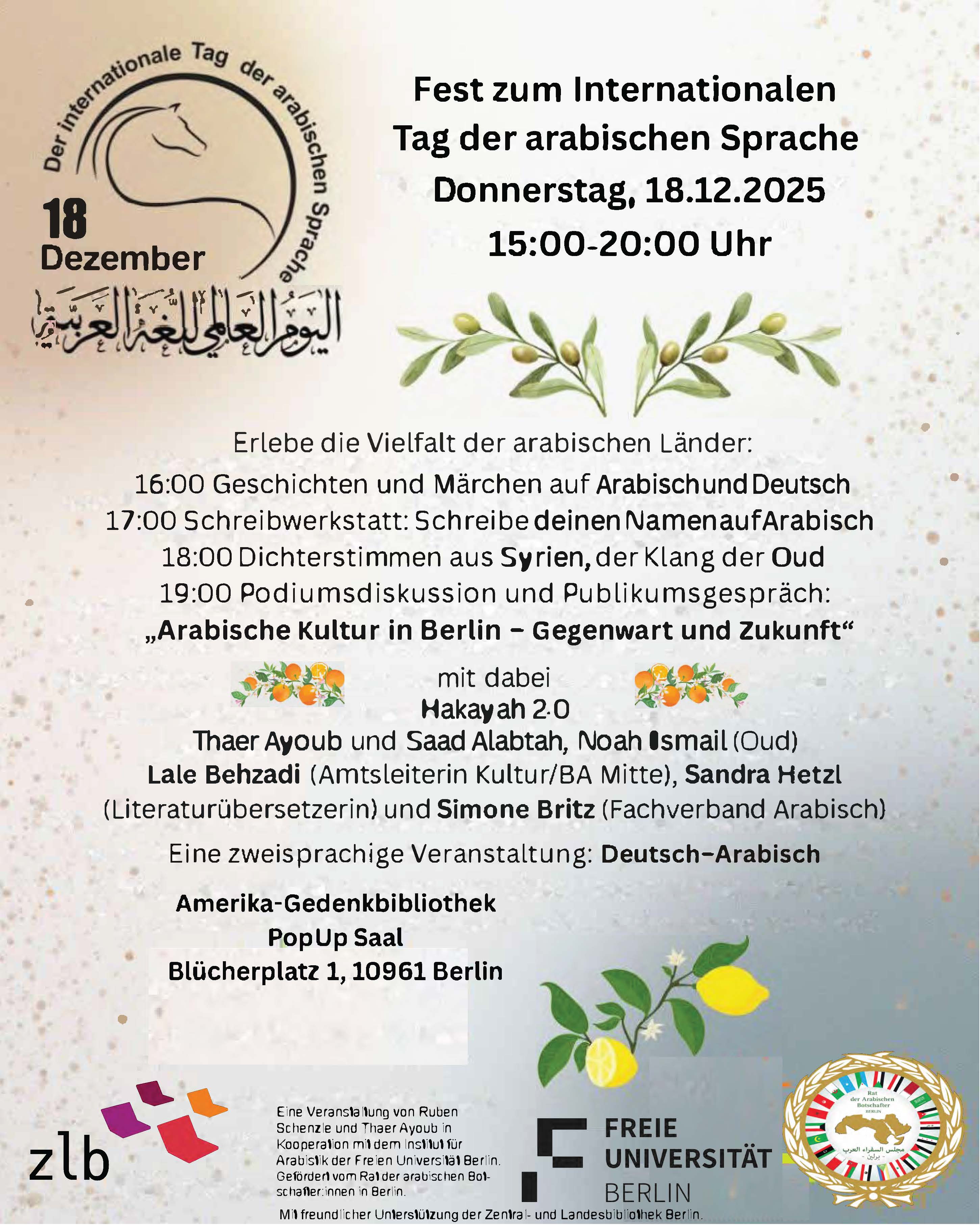
Mit Kunst und Kultur wird in Berlin (und anderenorts?) ein Fest der arabischen Sprache gefeiert: Am 18. Dezember 1973 wurde Arabisch als eine der sechs offiziellen Amtssprachen der Vereinten Nationen anerkannt.