Der Historiker Ilan Pappe widmet sich in seinem neuen Buch den »vergessenen« Palästinenser:innen in Israel. Wie sich die staatliche Politik ihnen gegenüber seit 1948 verändert hat und warum sie eine Schlüsselrolle für eine gerechtere Zukunft spielen, erklärt er im Gespräch.
Ein Interview mit Ilan Pappe geführt von Magdalena Berger auf Jacobin.de
Kommentar dazu in der Frankfurter Allgemeinen Sonntagszeitung (Tania Martini)
To the Association of University Heads in Israel, the Board of Academic Public Colleges, the Israel Academy of Sciences and Humanities, and Academics for Israeli Democracy
We, members of the academic and administrative staff in institutions of higher education in Israel, call on you to act immediately to mobilize the full weight of Israeli academia to stop the Israeli war in Gaza.
Israeli higher education institutions play a central role in the struggle against the judicial overhaul. It is precisely against this backdrop that their silence in the face of the killing, starvation, and destruction in Gaza, and in the face of the complete elimination of the educational system there, its people, and its structures, is so striking. Since Israel violated the ceasefire on March 18, almost 3,000 people have been killed in Gaza. The vast majority of them were civilians. Since the start of the war, at least 53,000 people have been killed in Gaza, including at least 15,000 children and at least 41 Israeli hostages. At the same time, many international bodies are warning of acute starvation – the result of intentional and openly declared Israeli government policy – as well as of the rendering of Gaza into an area unfit for human habitation. Israel continues to bomb hospitals, schools, and other institutions. Among the war’s declared goals, as defined in the orders for the current military operation “Gideon’s Chariots,” is the “concentration and displacement of the population.” This is a horrifying litany of war crimes and even crimes against humanity, all of our own doing.
As academics, we recognize our own role in these crimes. It is human societies, not just governments, that commit crimes against humanity. Some do so by means of direct violence. Others do so by sanctioning the crimes and justifying them, before and after the fact, and by keeping quiet and silencing voices in the halls of learning. It is this bond of silence that allows clearly evident crimes to continue unabated without penetrating the barriers of recognition.
We cannot claim that we did not know. We have been silent for too long. For the sake of the lives of innocents and the safety of all the people of this land, Palestinians and Jews; for the sake of the return of the hostages; if we do not call to halt the war immediately, history will not forgive us. We will not forgive ourselves. It is our duty to act to stop the slaughter; it is our duty to save lives. It is our duty to save what can still be saved of this land’s future. The institutions of higher education in Israel must raise their voices, address their students and the public at large, look at reality directly and call things what they are – unspeakable actions being done in our name, with our own hands, that will ultimately result in destroying higher education in Israel and the entire society from within.
For the online version of the letter in Hebrew, Arabic, and English with the full list of signatories, click here [Googledoc].
→ CURRENT NUMBER OF FASTERS: 598 (updated May 28) ←
You’re invited to a 40-day fast for Gaza, organized by Veterans For Peace. On May 22, we begin our fasting across the country while demanding: 1) a resumption of humanitarian aid, under UN authority, to Gaza 2) that the U.S. stop arming Israel NOW!
Join us in our work! We imagine two fasting options: a centralized fasting location in NYC where fasters will commit to 250 calories a day, in line with the general caloric intake of Gazans under the ongoing Israeli military blockade, and a dispersed fasting option for folks to join the work from their local context. This action is open to all Gaza allies and people of good conscience who want an end to the genocide in Gaza, veteran or not. Our fast launches as the UN warns the death of 15000 infants is imminent. Join us as we resist this genocide!
Lesenswerte Überlegungen von Rida Abu Rass auf dem Portal +972mag über „What can the Joint List teach us about building Palestinian political power?“ – Ten years after its formation, this experiment in Palestinian unity inside Israel — and its ultimate collapse — shows the need for carefully cultivated alliances.
Auf der Seite von 972mag reflektiert Fadi Shabita über eine alte Frage, die nichts an Aktualität und auch nichts an Sprengkraft verloren hat: Kann es einen gemeinsamen Kampf von Israelis und Palästinenser.innen (nur?) geben – wenn die Basis echte Gleichheit und Gerechtigkeit ist? Und wie sähe / sieht das dann aus?
Der britische Guardian berichtet in einem bewegenden Beitrag von Hannah Ellis-Petersen und Quique Kierszenbaum (Tel Aviv) über den Protest von Überlebenden der Shoa in Israel, die das Leiden der Palästinenser:innen nicht aus den Augen verlieren …
Auch in Deutschland wächst die Unruhe, ob die verfassungsmäßige Ordnung, in deren Kern die Gewaltenteilung steht, die Stürme der kommenden (wie schon der aktuellen) Zeit überstehen wird.
In Israel zeigt sich gerade eine neue Drehung in der politischen Spirale, wenn der Chef des (resp. eines) Geheimdienstes ein explosives Memorandum an den Oberste Gerichtshof richtet.
… „No citadel has fallen,“ former Supreme Court President Esther Hayut said during the court hearings that ultimately produced an 11-0 ruling authorizing someone charged with serious crimes to serve as prime minister. Since then, Israelis have seen the fortress in the process of being brought down on its inhabitants‘ heads. The court must prevent Netanyahu from getting rid of someone who is trying to prevent him from finishing the job.
Ein Bericht von Jan-Christoph Kitzler (ARD Tel Aviv) auf tagesschau.de –
‚eine laute Minderheit, um Anarchisten, die von ausländischen Nichtregierungsorganisationen unterstützt würden‘, so der israelsiche Ministerpräsident, einfache Antworten auf komplexe Situationen, das macht ja weltweit Schule ….
„Israels Armee ist auf ihre Reservisten angewiesen, und seit dem Überfall der Hamas am 7. Oktober 2023 hat sich gezeigt, wie wichtig sie sind. Frauen und Männer können in Israel nach Ihrem Militärdienst noch bis zum 40. Lebensjahr zum Reservedienst eingezogen werden, Offiziere auch darüber hinaus. Fast 300.000 Reservisten wurden nach dem 7. Oktober nach Angaben der Armee eingezogen, viele über Monate, auch mehrfach.
Doch inzwischen wird die Weigerung vieler Reservisten, in den Krieg zu ziehen, zum Problem. Die genauen Zahlen sind unter Verschluss – doch israelische Medien berichten über die größte Verweigerungswelle seit Jahrzehnten.
Von mehr als 100.000 Verweigerern ist die Rede. Überprüfen lässt sich das nicht. Was man weiß, ist, dass einige Soldaten Briefe veröffentlicht haben – darunter Reservisten der Luftwaffe, der Marine und von Spezialeinheiten der Aufklärung. … „
Muriel Asseburg und Peter Lintl zu den Entwicklungen in Israel
Israels Regierung baut in rasantem Tempo die Gewaltenteilung ab und weitet ihre Kontrolle über den Staatsapparat aus. Die militärische Reaktion auf den Angriff der Hamas und anderer bewaffneter Gruppierungen am 7. Oktober 2023 scheint in eine dauerhafte Wiederbesetzung des Gazastreifens zu münden. Die »freiwillige« Auswanderung der palästinensischen Bevölkerung des Küstengebiets wird als Option der Konfliktlösung gesehen. Gleichzeitig treibt die Netanjahu-Regierung das Siedlungsprojekt im Westjordanland mit neuer Verve voran. In ihren Ansätzen – sei es in der Innenpolitik, gegenüber den Palästinenser:innen oder gegenüber den Nachbarstaaten – sieht sie sich durch die Trump-Administration ermutigt. Damit entfernt sich Israel weiter von einer liberalen Demokratie. Eine Regelung der Palästina-Frage wird so konterkariert, die Region destabilisiert. Deutsche Politik darf diese Entwicklungen nicht ignorieren.
Muriel Asseburg / Peter Lintl Israels radikale Regierung. Abbau der Gewaltenteilung, Übernahme des Staatsapparates und beschleunigte Annexion SWP-Aktuell 2025/A 16 (April 2025) – 8 Seiten
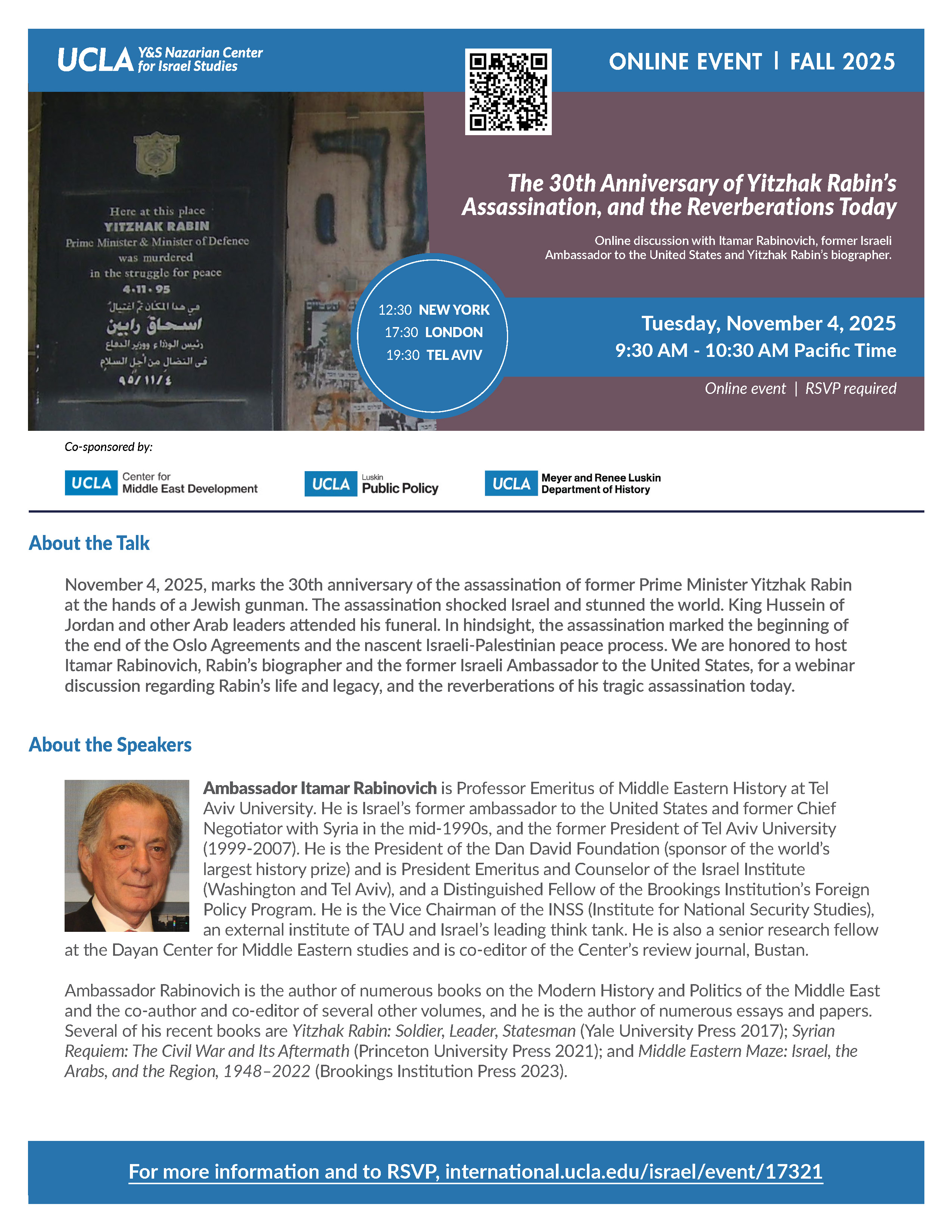
16. April 2025 | 19.30 Uhr | Lettrétage in der Veteranenstraße 21
Photo: (c) Bashir Bashir
Kilmé is a monthly talk series dedicated to Palestinian artists, intellectuals, and academics; a platform to present their work and speak about subjects that are important to them. Kilmé means word in Arabic. The organizers are dedicated to presenting palestinian voices in all of their diversity and creativity, thus contributing to the cultural landscape of Berlin, a city with the largest Palestinian population in Europe.
In the April issue of kilmé talks, Bashir Bashir will be the guest. The evening will be moderated by Tyme Khleifi and Michael Barenboim.
Bashir Bashir is associate professor in the department of sociology, political science and communication at the Open University of Israel and a senior research fellow at the Van Leer Jerusalem Institute. Currently, he is a fellow at the Wissenschaftskolleg zu Berlin. His primary research interests are nationalism and citizenship studies, liberalism, democratic theory, decolonization, the politics of reconciliation, and alternatives to partition in Palestine/Israel. Among other numerous publications, he is the co-editor of „The Holocaust and Nakba: A New Grammar of Trauma and History“ (Columbia University Press, 2018); and „The Arab and Jewish Questions: Geographies of Engagement in Palestine and Beyond“ (Columbia University Press, 2020). His writings have appeared in English, Hebrew, Arabic, Italian, German, and Japanese.
***
Ergänzung: 11. April 2025: Hybrid-Veranstaltung im ZMO | 24. April 2025, 17.00 Uhr
Egalitarian Bi-nationalism for Israel/Palestine
There is a growing agreement among scholars, politicians and experts that the oppressive realities and colonial policies in Palestine/Israel are politically unacceptable and morally indefensible. Leading human rights organizations like Human Rights Watch, Amnesty International and B’Tselem have published extensive reports that identify these colonial policies and their disastrous impacts on the lives and rights of the Palestinians. The question of putting an end to these wretched and segregationist realities and policies and moving to more transformative and inclusive solutions has preoccupied several scholars and politicians in Israel/Palestine and beyond. Liberal and national principles in the forms of one-person one-vote or territorial and ethnic partition have been at the center of debates on these transformative solutions.
This talk argues that egalitarian bi-nationalism is better equipped to address the underlying issues of the conflict in Israel/Palestine than the liberal and secessionist national frames. Egalitarian binationalism, the talk goes on to argue, better satisfies the urge for self-determination of Palestinian Arabs and Israeli Jews than the benign neglect majoritarianism of the liberal state or ethnic secession and the partition of the two-state solution. The talk concludes that egalitarian bi-nationalism’s insistence on envisioning affective relations of co-belonging based on an ethics of equality, parity, mutual legitimacy, and cohabitation offers rich resources for historical reconciliation and decolonization in Israel/Palestine.