Über 600 Israelis aus dem akademischen Leben protestieren in einer Petition an die internationale Gemeinschaft und Zivllgesellschaft gegen nochmals angestiegenen Siedlerterror. Hier ein Link zu einem kurzen FR-Stück von Inge Günther.
Und dazu ein Gespräch mit Yuli Novak, der Chefin der NGO B’Tselem, geführt von Judith Poppe auf https://qantara.de
Akiva Eldar schreibt in der Haaretz über Netanyahus (und Trumps) Rede, der ganze Text steht (leider) hinter der Bezahlschranke, wir zitieren hier einige zentrale Passagen:
In the declarations of Prime Minister Benjamin Netanyahu and his friend U.S. President Donald Trump, the word „freedom“ has been used repeatedly since the start of the attack against Iran. In an (emotional) address to the Iranian people, Netanyahu promised „a historic war for freedom.“ Netanyahu knows that the „The Iranian people deserve a better future.“ In other words, he is encouraging the citizens of Iran to rebel in order to win their freedom.
With his considerable obtuseness, Netanyahu legitimized the next intifada and the two that preceded it. Are the rights of the women and children in the occupied territories in better shape than those of the women and children in Tehran? The Iranian security forces fire at citizens who demonstrate against a despotic government. The residents of the West Bank don’t dare to go out into the streets. They’ve learned that even a video on TikTok can lead to arrest.
A boy who throws a stone at a command car is considered a terrorist whose punishment is death. And as is customary in benighted regimes, our secret service terrifies civilians, encourages informers and nurtures collaborators. That’s the only way to rule over a foreign nation for six decades. […]
An Israeli who calls on the residents of the territories to demonstrate against the occupation will end the day at the police station. Foreign peace activists who want to help Palestinian shepherds are expelled from the country. Israeli human rights organizations are subject to incitement and hostile legislation. Any request by Palestinians for help from international organizations is considered „political terrorism“ here, and is accompanied by economic sanctions.
[…]
Yet for almost 60 years Israeli governments have been making a mockery of international law when it comes to settlement across the Green Line and responsibility for the welfare of the population under occupation. Israel defies United National decisions that support the establishment of a Palestinian state, and we’re paying a miniscule price.
Even worse. The government and the security forces operating in the territories are scorning Israeli law. They’re violating the rulings handed down by the High Court of Justice. For example, that the military commander is obligated to invoke his authority while finding a balance between security needs and the welfare of the local population. In another ruling, the High Court judges decided that the laws of belligerent occupation, which apply in the territories, require seeing to the needs of the local population.
At the end of the week, it was reported that 11 Palestinians were wounded in 20 Jewish terrorism incidents. Settlers threw stones at Palestinians, sprayed graffiti, shot fireworks in Palestinian villages and blocked roads.
These reports, which have become as routine as the sirens in Kiryat Shmona, bore Netanyahu. He’s busy fulfilling God’s mission of saving the world from the Iranian bomb. Human dignity and freedom in Iran, and here too, aren’t and never were his main interest. And suddenly he’s calling for a popular uprising against a despotic government. I wonder how it sounds in Palestinian Arabic.
A podcast episode punctuated with sirens and explosions on +972 with Meron Rapoport
Meron lives in Tel Aviv and, like most Israelis, has spent much of the past two weeks running to shelters. Yet this is just about the only thing he shares with the majority of his compatriots — not least because he is among the mere 4 percent of Israeli Jews who oppose this war that is setting the entire region ablaze.
But things don’t always go according to plan. When the dust settles, Meron says — reminding me that he’s often labeled an optimist — Israelis will realize, sooner or later, that they cannot escape the Palestinian question, and that a regime of apartheid and occupation will never have peace and quiet.
Hoffen wir, daß es nicht nur ein Pfeifen im Wald ist, die politischen Mehrheiten gibt es jedenfalls (noch?) nicht …
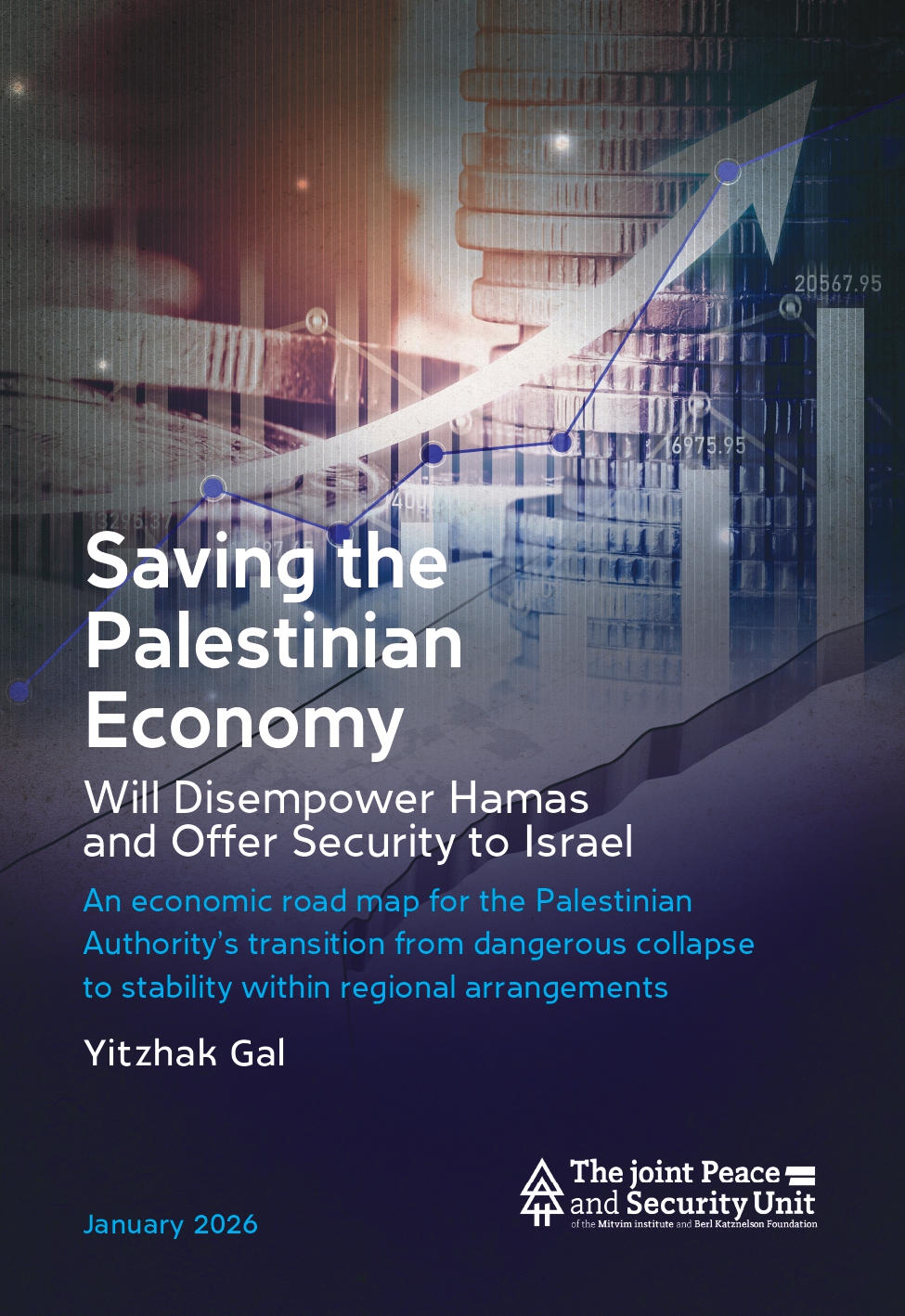
The Palestinian economy is in collapse. Hamas is regaining control over the limited existing resources and assets in the Gaza Strip, after the war destroyed Gaza’s economic system. In the West Bank, the Palestinian Authority (PA) is struggling to survive amid deliberate Israeli government policy that is exploiting the former’s dependence and advancing unilateral coercive measures to cripple the Palestinian economy and the PA itself.
This policy reflects a dangerous escalation of the Israeli approach that viewed Hamas as an asset and the PA as a burden, an approach whose beginnings predated October 7, 2023. The collapse of the PA and the Palestinian economy are openly touted by Israeli ministers as elements of a strategy designed to advance annexation and prevent the establishment of a Palestinian state, even at the cost of a stronger Hamas and critical damage to Israeli security.
This paper, written by Yitzhak Gal, proposes a new policy and includes pragmatic recommendations for action that will mend Israeli-Palestinian economic relations while supporting progress on a phased process toward two states and stable, long-term security. The proposed strategy is based on reform and socioeconomic stabilization of the PA within regional collaborative arrangements.
The paper illustrates the strong link between Palestinian economic growth and the security relations between Israel and the Palestinians. On this foundation, the paper proposes a three-stage road map whose goal is gradual building of a strong Palestinian economy; which will function as an independent system, while maintaining close cooperation with Israel and other countries in the region. That will contribute both to Palestinian and Israeli stability and prosperity.
A necessary condition for implementation of this roadmap is a political will in Israel to change its approach toward the Palestinians and to make strides in a process directed at socioeconomic and political stabilization. Therefore, the plan can only be implemented under an Israeli government that is willing to adopt a policy that is entirely different from the current government’s policy.
Nevertheless, even under the current government, there are several critical steps that can be performed almost immediately. These steps are proposed in the first stage of the road map, concurrently with Stage 2 of President Trumps’ 20- point peace plan. These steps will be part of US-led measures to implement UN Security Council Resolution 2803 with respect to Gaza.
The concrete measures proposed for the first stage are: Resolution of the PA’s protracted fiscal crisis in order to allow full and timely wage payments and orderly delivery of public services; gradual re-entry of Palestinian workers into Israel for employment while implementing agreed changes to improve security arrangements; suspension of measures that impair the Palestinian banking system and application of new arrangements that will stabilize this critical system; as well as measures that would leverage the rebuilding of Gaza to jump-start the Palestinian economy, with emphasis on trade and logistics. The execution of these steps will be contingent on a comprehensive, effective reform of the PA, cessation of payments to prisoners and “martyrs” (shaheeds), and tight security coordination that ensures demilitarization in Gaza and the marginalization of Hamas.
In the second stage, additional set of measures that can be promoted under the umbrella of the Oslo Accords and the Paris Protocol. These measures will include: convening of the joint Israeli-Palestinian economic committee and the additional joint subcommittees defined in the Paris Protocol and accompanying agreements, for development of agreed future plans; phased promotion of economic links between Gaza and the West Bank, contingent on accepted security arrangements; establishment of special-economic-status industrial zones and free trade areas; signing of preferential trade arrangements with the UAE and Saudi Arabia, the EU, and the US; promotion of Palestinian and Israeli integration into regional economic projects, primarily the reconstruction of Gaza and the India–Middle East–Europe Economic Corridor (IMEC).
The third stage will focus on a new Israeli-Palestinian economic agreement, under US-international-regional aegis. The new economic agreement will be negotiated as part of an agreed path to the future establishment of a demilitarized Palestinian state, and as an integral element of a regional settlement. This economic agreement will replace the Paris Protocol and its accompanying set of agreements as well as the multiple unliteral arrangements that have evolved over the past 30 years. This stage, which is proposed to take place over a longer term (3–4 years), will include issues such as a permanent trade regime, the currency of the PA, and other significant changes in the structure of the Palestinian economy.
Implementation of the proposed plan will drive the Palestinian economy forward,strengthen the moderate actors in the Palestinian arena, and support the socioeconomic stability that is a necessary condition for a stable settlement and long-term security.
The proposed plan also offers a set of additional significant benefits for Israel: The plan will lead to a strong and stable PA that maintains effective rule in the West Bank, that constitutes an effective alternative to Hamas in the Gaza Strip, is committed to peace with Israel, and is a partner in effective anti-terror measures. Implementation of the plan will dilute the power of Hamas and other extremist groups in Gaza and the West Bank.
The gradual nature of the process, which is directed toward a clear political horizon and its progress based on the achievement of clear milestones, will build confidence and trust and create a system with long-lasting stability.
Israel’s integration as an important actor in comprehensive regional initiatives, such as IMEC, is expected to be an important growth engine for Israel’s economy for decades to come.
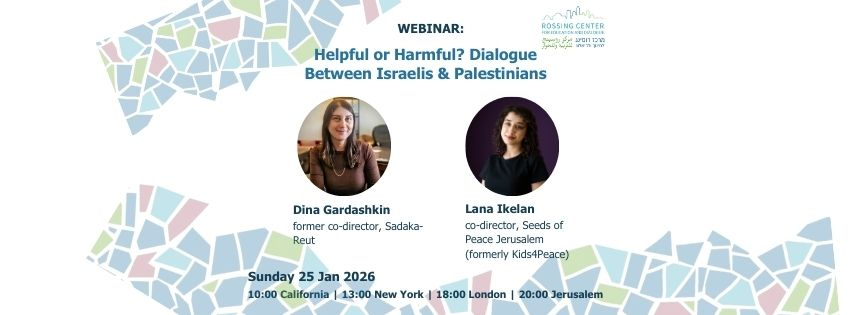
We’re starting from a shared premise: contact alone is not enough. If dialogue is meant to encourage participants to critically examine reality and imagine change, it must be intentionally designed and carefully facilitated. But that raises a central dilemma: Is dialogue most effective when it happens together or separately?
Both having begun their own journeys as participants in dialogue groups and working their way up to leadership positions, our speakers bring deep, lived experience from the field:
Lana Ikelan, Co-Director of Seeds of Peace Jerusalem (formerly Kids4Peace), engages young people across deep asymmetries of power and narrative. Dina Gardashkin, former Co-Director of Sadaka-Reut, confronts inequality, education, and political responsibility.
Together with Lana and Dina, questions such as will be explored: • How does the group setting impact the process participants undergo? • What kinds of transformation are possible only in mixed groups or only in separate groups? • What are the risks and limitations of each framework?
Sunday, January 25, 2026 | 8 pm Jerusalem time (19.00 Uhr MEZ)
This conversation is for educators, facilitators, activists, donors, and anyone grappling seriously with what dialogue can — and cannot — do in our current reality.
Auf der Plattform +972 analysiert Hila Amit warum über „Over 150,000 citizens have left the country in the past two years alone — many of them with a one-way ticket and no plans of returning“
Klaus Hillenbrand bricht in der taz noch einmal eine Lanze für eine differenzierte Betrachtung und Analyse dessen, was ‚der‘ Zionismus als politischen Projekt wollte und welche Realitäten sich heute vorfinden.
Moshe Sharett – Leadership, Diplomacy, Legacy: A Reevaluation [Konferenz Ankündigung für September 2026]
The Jacob Robinson Institute for the History of Individual and Collective Rights (The Hebrew University of Jerusalem) and the Azrieli Center for Israel Studies (Ben-Gurion University of the Negev) invite proposals for an international conference on “Moshe Sharett – Leadership, Diplomacy, Legacy: A Reevaluation”. The event will be held at the Mount Scopus campus in (West-)Jerusalem, from Monday, 7 September to Wednesday, 9 September 2026.
Moshe Sharett (1894-1965) was among the foremost leaders of the Yishuv and the early State of Israel. A complex and thought-provoking figure, Sharett served as the country’s first Foreign Minister (1948-1956) and its second Prime Minister (1954-1955). Yet, the founder of Israel’s diplomatic service still remains to be fully leaned and studied. Marking sixty years since his death, this conference aims to bring together an interdisciplinary group of scholars for a renewed critical examination of Sharett’s leadership, diplomacy and legacy. Special attention will be given to the moral realism that characterized the statesmanship he shaped and embodied.
Weitere Informationen / Further information on H/Soz/Kult
Im ORF heißt es dazu: „Mehr als zwei Jahre nach dem beispiellosen Massaker der Terrororganisation Hamas und anderer Extremistengruppen in Israel verweigert Ministerpräsident Benjamin Netanjahu weiterhin eine unabhängige Untersuchung der Vorfälle. Statt der Einrichtung einer staatlichen Untersuchungskommission befürwortet der 76-Jährige die Ernennung einer Regierungskommission.“
Times of Israel: „Lawmakers advance bill for politically appointed Oct. 7 probe in place of state inquiry“
Haaretz: Netanyahu Ministers Approve Government-controlled Oct. 7 Probe, Push Judicial Overhaul Bills – A committee of Israeli ministers has approved on Monday to advance a bill establishing an investigation into Hamas‘ October 7 attack, a Likud-sponsored proposal that would give Prime Minister Benjamin Netanyahu’s government influence over the inquiry’s composition and mandate.





 Sunday, January 25, 2026 | 8 pm Jerusalem time (19.00 Uhr MEZ)


