Der Offene Hörsaal der Freien Universität Berlin

Die Vielfalt Palästinas – eine kulturelle Zeitreise

Eine interdisziplinäre Ringvorlesung der Wissenschaftlichen Einheit Westasien, Nordafrika und Diaspora am Fachbereich Geschichts- und Kulturwissenschaften der Freien Universität Berlin

„Zwei Völker in einem Land“: Koexistenz und Konflikt in Palästina / Israel
Vielfach verflochtene Identitäten, exklusive politische Ansprüche: eine historische Einordnung

  • Prof. Dr. Dr. h.c. i. R. Gudrun Krämer
    Institut für Islamwissenschaft, Freie Universität Berlin

Jede Woche Dienstags 18-20.00 Uhr bis zum 4.02. 2025

Übersicht

An der Hoffnung festhalten

Ein kleiner Auszug:

Aus der ganzen Welt werden sie zu uns kommen, um zu sehen, wie wir Frieden von unten schaffen

Und dann werden wir entscheiden müssen, wie wir reagieren. Ob wir ihren Geschichten zuhören? Ob es uns gelingt, Tränen zuzulassen und mit ihnen zu fühlen? Ob wir vielleicht sogar irgendwann mit ihnen werden lachen können?

Werden wir gemeinsame Geschichten des Leids entdecken können – wohl ein bißchen unterschiedlich und doch einander ähnelnd, Geschichten darüber, was jenseits des Zauns geschehen ist und was hier bei uns? Wohin wird unsere Scham uns tragen und wohin vor allem die Verantwortung? Werden wir ihnen Empathie entgegenbringen können, so wie sie sie uns gegenüber zeigen werden? Und muß man überhaupt erst darauf warten, daß die andere Seite damit beginnt?

Keeping hope alive

After a year of constant war, as the cycle of death continues unabated, we feel the need as Christians and as citizens to seek out the hope that comes from our faith. First, we must admit that we are exhausted, paralyzed by grief and fear. We are staring into the darkness. The entire region is in the grip of bloodshed that continues to escalate and spares no one. Before our eyes, our beloved Holy Land and the entire region are being reduced to ruins.

Daily, we mourn the tens of thousands of men, women and children who have been killed or wounded especially in Gaza, but also in the West Bank, Israel, Lebanon and beyond in Syria, Yemen, Iraq and Iran. We are outraged at the devastation wreaked on the area. In Gaza, homes, schools, hospitals, entire neighborhoods are now heaps of rubble. Disease, starvation and hopelessness reign. Is this the model for what our region will become?

Around us, the economy is in ruins, access to work is blocked and families have difficulty putting food on the table. In Israel too many are in mourning, living in anxiety and fear. There  must be another way!

Our catastrophe did not begin on October 7, 2023. The cycles of violence have been unending, beginning in 1917, peaking in 1948 and in 1967, continuing ever since, until today. And today has the Zionist dream of a safe home for Jews in a Jewish state called Israel brought security for Jews? And the Palestinians? They are caught up in the reality of death, exile and abandon for too long, waiting while persistently demanding the right to remain in their land, in their towns and villages.

Shockingly, the international community looks on almost impassively. Calls for ceasefire and an end to the devastation are repeated with no meaningful attempt to reign in those wreaking havoc. Weapons of mass destruction and the means to commit crimes against humanity flow into the region.

As this all continues, the questions resound: When is this going to end? For how long can we survive like this? What is the future of our children? Should we emigrate?

As Christians, we are faced with other dilemmas too: Is this a war in which we are simply passive bystanders?  Where do we stand in this conflict, presented too often as a struggle between Jews and Muslims, between Israel, on the one hand, and Hamas and Hezbollah supported by Iran, on the other? Is this a religious war? Should we isolate ourselves in the precarious safety of our Christian communities, cutting ourselves off from what is going on around us? Are we simply to watch and pray on the sidelines, hoping that this war will eventually pass?

The answer is a resounding no. This is not a religious war. And we must actively take sides, the side of justice and peace, freedom and equality. We must stand alongside all those, Muslims, Jews, and Christians, who seek to put an end to death and destruction.

We do so because of our faith in a living God and in our conviction that we must build a future together. Though our Christian community is small, Jesus reminds us that our presence is powerful. Confident in his resurrection, we have the vocation to be like yeast in the dough of society. With our prayers, our solidarity, our service and our living hope, we must encourage all of those around us, of all faiths and those with no faith, to find the strength to lift ourselves up from our collective exhaustion and find a path forward.

But none of us can do this alone. We look to our Christian religious leaders, our bishops and our priests for words of guidance. We need our shepherds to help us discern the strength that we have when we are together. Alone, each one of us is isolated and reduced to silence. Only together, can we find the resources to face the challenges.

In our exhaustion and despair, let us remember the paralytic man (Mark 2: 1-12) who could not get up. It was only when his friends carried him, when they used their imagination to create a hole in the roof and lower him down on his mat, that he was able to reach Jesus, who said to him: “Get up and walk.”

So it is with us. We must carry one another if we are to go forward. We must use our imaginations, rooted in Christ, to find openings where there appear to be none. When we have reached the limits of our hope, together we carry one another, as we turn to God and ask for help.

We need this help not to despair, not to fall into the trap of hatred. Our faith in the Resurrection teaches us that all human beings are to be loved, equal, created in the image of God, children of God and brothers and sisters of one another. Our belief in the dignity of every human person is manifest in our service to the wider community. Our schools, hospitals, social services are places where we care for all in need, indiscriminately.

It is also our faith that motivates us to speak the truth and oppose injustice. We are believers in a peace that Jesus has given us and that cannot be taken away. “He is our peace” (Ephesians 2:14). We must not be afraid to speak out against any form of violence, killing and dehumanization. Our faith makes us spokespeople for a land without walls, without discrimination,  spokespeople for a land of equality and freedom for all, for a future in which we live together.

We will only know peace when the tragedy of the Palestinian people is brought to an end. Only then will Israelis enjoy security. We need a definitive peace agreement between these two partners and not temporary ceasefires or interim solutions. Israel’s massive military force can destroy and bring death, it can wipe out political and military leaders and anyone who dares to stand up and oppose occupation and discrimination. However, it cannot bring the security that Israelis need. The international community must help us by recognizing that the root cause of this war is the negation of the right of the Palestinian people to live in its land, free and equal.

A peaceful future depends on a togetherness that extends beyond our own community. We are one people, Christians and Muslims. Together,  we must seek the way beyond the cycles of violence. Together with them we must engage with those Jewish Israelis who are also tired of the rhetoric, the lies, the ideologies of death and destruction.

Let us set forth, carrying one another. Let us keep hope alive, knowing that peace is possible. It will be difficult but we remember that we once lived together in this land as Muslims, Jews and Christians. There will be many moments when the way appears blocked. But together we will carve out a path forward, rooted in God’s hope, and “hope does not disappoint us.” (Romans 5:5). Our hope is in God, in ourselves and in every human being upon whom God bestows some of His goodness.

His Beatitude Patriarch Michel Sabbah and members of the Christian Reflection from Jerusalem

5785 – das Neue Jahr MUß ein Besseres werden

Schon das vergangene Jahr war schrecklich, heute am Jüdischen Neujahr/Rosch Haschana 5785 nichts als der Wunsch, dieses Neue Jahr werde besser, friedlicher, freier, gerechter – für ALLE…

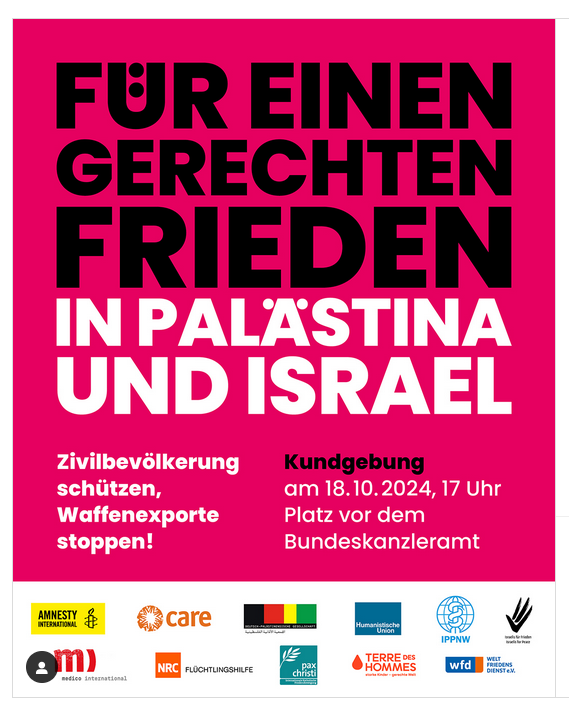
Aufruf zur Demo in Berlin

Brief(e) aus Jerusalem

21. September: »Wer schweigt, ist Mittäter«
Der palästinensische Pfarrer Munther Isaac klagt die christliche Welt an

14. September »Christ und Palästinenser«
Erzbischof »Abuna« kämpft für Gerechtigkeit jenseits religiöser Grenzen

Helga Baumgarten ist emeritierte Professorin für Politikwissenschaften an der Universität Birzeit nördlich von Jerusalem im Westjordanland und Autorin mehrerer Werke zum Nahostkonflikt.

Teil eins der Briefe erschien in der jungen Welt vom 29./30. Juni, die Folgebriefe wurden in den jW-Ausgaben vom 8., vom 13./14., vom 20./21., vom 27./28. Juli, vom 10., 17. und 24.8. sowie 7.9. veröffentlicht-

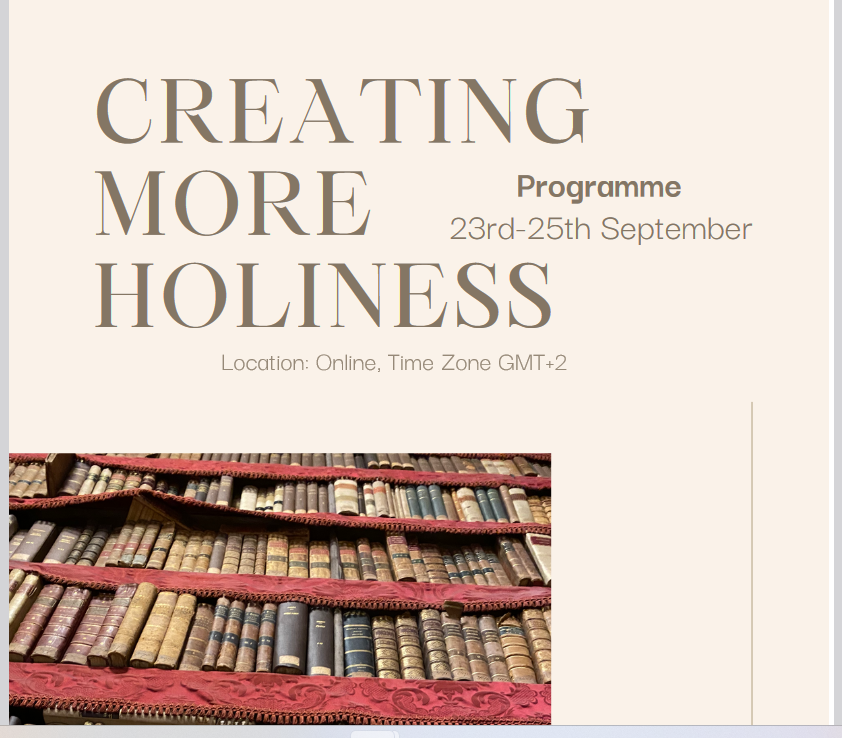
CREATING MORE HOLINESS

Auch wenn die Zeiten und Nachrichten nicht recht zu diesem Titel zu passen scheinen…

Ein spannendes Online-Programm 23-25- September 2024

Programmheft

ToRoll: Materialized holiness is a collaborative research project to examine the production of ritually pure Torah scrolls as an extraordinary codicological, theological, and sociological phenomenon of Jewish scribal culture. The project includes the digital edition of selected scribe literature from antiquity until the
modern era, paleographical analyses of the letter crownlets and particular forms of lettering, analyses of the inks and the materials used for writing medieval Torah scrolls of European provenance, and qualitative interviews with contemporary scribes.

A primary objective of the project is to further integrate central research fields of Jewish Studies into the inter- and transdisciplinary research discourses, and to open them up for methodological approaches with the help of the Digital Humanities. For processing new research Questions, the project combines the academic expertise from Jewish Studies with the methods of material research, the social sciences, and art history, as well as with the future-oriented approaches of information technology.

Annett Martini in Bologna Materialized Holiness

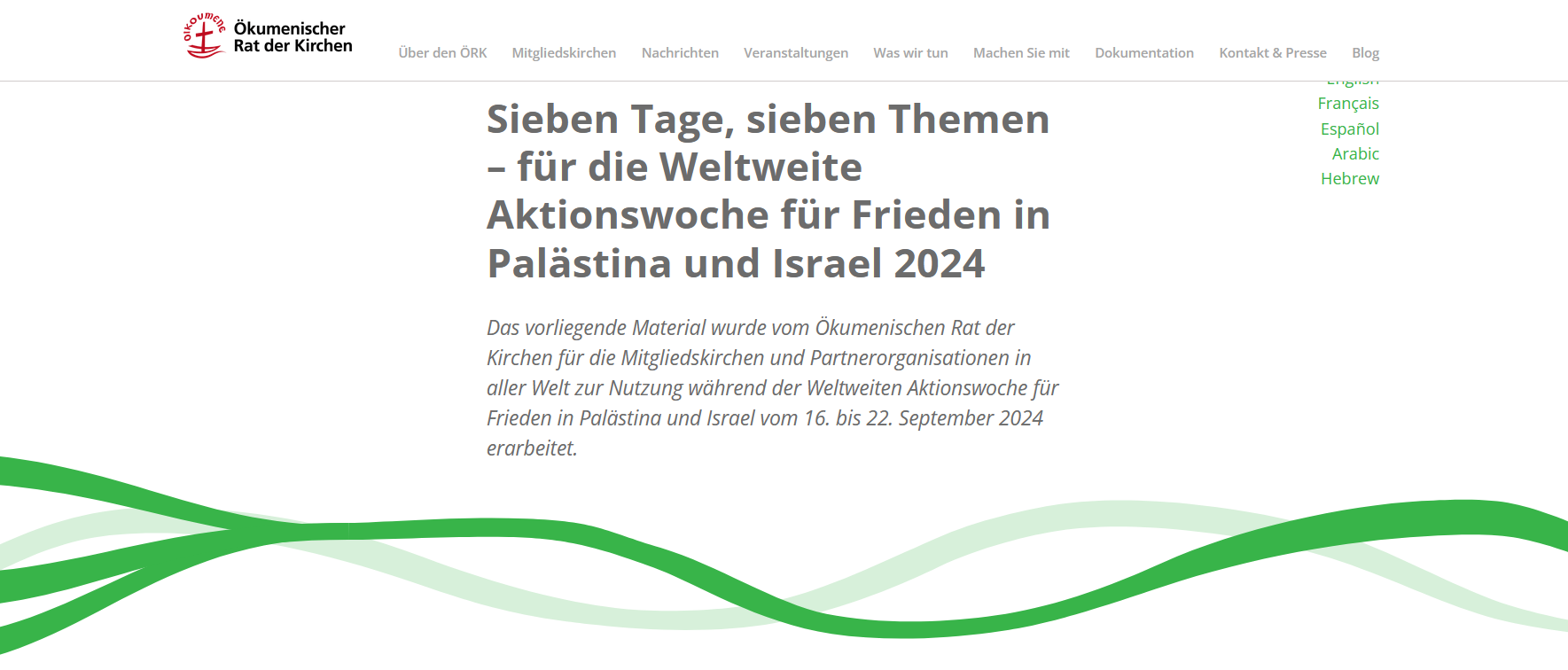
Weltwoche für Frieden in Palästina und Israel

Für die Weltwoche für Frieden in Palästina und Israel vom 16. bis 22. September 2024 hat der Ökumenische Rat der Kirchen (ÖRK) neue Materialien veröffentlicht. In dieser Woche findet am 21. September auch der Weltfriedenstag der Vereinten Nationen statt, der zum 25. Mal begangen wird.

Der Orient in Gotha

Sonntag, 8. September bis Sonntag, 3. November 2024

Schloß Friedenstein, Spiegelsaal

Kurator: Dr. Feras Krimsti

Öffnungszeiten: Dienstag bis Sonntag, 10 bis 17 Uhr sowie an den Feiertagen 20. September, 3. Oktober und 31. Oktober. Vom 25. bis 27. September bleibt die Ausstellung geschlossen.

Ende des 16. Jahrhunderts notierte ein Schüler osmanische Wörter in sein Schulheft. Er sollte später ein einflußreicher lutherischer Theologe werden. Vom Besuch eines äthiopischen Geistlichen in Gotha 1652 sind Übersetzungen religiöser Literatur erhalten, die er gemeinsam mit einem deutschen Gelehrten verfaßte, der die Äthiopistik begründen sollte. Im 17. Jahrhundert schrieb ein Numismatiker ein Lobgedicht in Arabisch und Latein auf den Gothaer Herzog, in der Hoffnung sich eine Position an der Herzoglichen Bibliothek zu sichern. Ein Naturforscher sandte im ersten Jahrzehnt des 19. Jahrhunderts von seiner Reise durch das Osmanische Reich und Arabien arabische, persische und osmanische Handschriften an die Gothaer Bibliothek. Auch sammelte er im Osmanischen Reich kulturelle Artefakte, wie etwa einzigartige historische Stoffproben, und schickte sie nach Gotha.

Diese und viele weitere Spuren der Auseinandersetzung mit dem Orient haben sich in Gotha erhalten. Sie verweisen auf das Wirken von Gelehrten, die es vom 16. bis zum 19. Jahrhundert in die Stadt zog. Dazu gehörten protestantische Theologen, aufklärerische Naturforscher, historisch-kritisch arbeitende Orientalisten, Dichter der Romantik oder auch Kartographen. Diesen Gelehrten und den Spuren, die sie hinterlassen haben, ist die Ausstellung „Der Orient in Gotha“ gewidmet. Jeder von ihnen prägte auf seine Weise die Sicht auf die Kultur, Geschichte, Literatur und Geographie des Osmanischen Reichs, der arabischen Halbinsel, Äthiopiens und weiterer Gebiete, die als Teil des Orients verstanden wurden. Vierhundert Jahre Orient-Studien in Gotha zeugen nicht nur vom Wandel der Wissenschaften, sondern beleuchten auch die Geistes- und Wissenskultur der Stadt Gotha.

Ausstellungsflyer

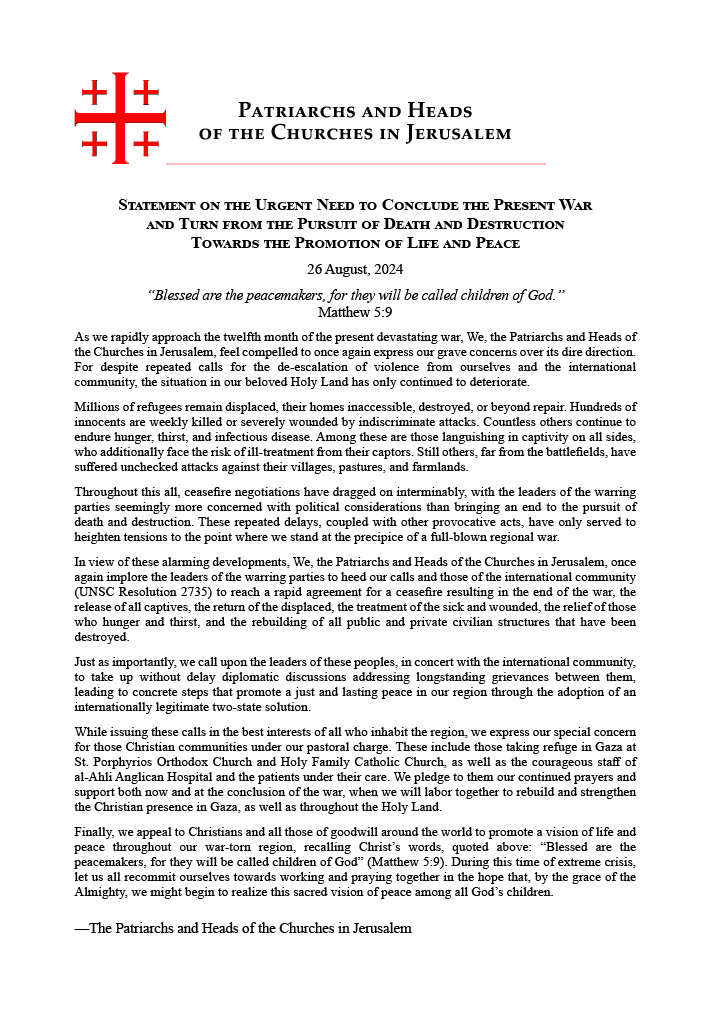
The urgent need to conclude the present war, to turn from the pursuit of death and destruction towards the promotion of life and peace

The Patriarchs and Heads of the Churches in Jerusalem have issued a statement, released on 26 August 2024

The statement says:

Millions of refugees remain displaced, their homes inaccessible, destroyed, or beyond repair. Hundreds of innocents are weekly killed or severely wounded by indiscriminate attacks. Countless others continue to endure hunger, thirst, and infectious disease. Among these are those languishing in captivity on all sides, who additionally face the risk of ill-treatment from their captors. Still others, far from the battlefields, have suffered unchecked attacks against their villages, pastures, and farmlands.

Throughout this all, ceasefire negotiations have dragged on interminably, with the leaders of the warring parties seemingly more concerned with political considerations than bringing an end to the pursuit of death and destruction. These repeated delays, coupled with other provocative acts, have only served to heighten tensions to the point where we stand at the precipice of a full-blown regional war.

In view of these alarming developments, We, the Patriarchs and Heads of the Churches in Jerusalem, once again implore the leaders of the warring parties to heed our calls and those of the international community (UNSC Resolution 2735) to reach a rapid agreement for a ceasefire resulting in the end of the war, the release of all captives, the return of the displaced, the treatment of the sick and wounded, the relief of those who hunger and thirst, and the rebuilding of all public and private civilian structures that have been destroyed.

Just as importantly, we call upon the leaders of these peoples, in concert with the international community, to take up without delay diplomatic discussions addressing longstanding grievances between them, leading to concrete steps that promote a just and lasting peace in our region through the adoption of an internationally legitimate two-state solution.

While issuing these calls in the best interests of all who inhabit the region, we express our special concern for those Christian communities under our pastoral charge. These include those taking refuge in Gaza at St. Porphyrios Orthodox Church and Holy Family Catholic Church, as well as the courageous staff of al-Ahli Anglican Hospital and the patients under their care. We pledge to them our continued prayers and support both now and at the conclusion of the war, when we will labor together to rebuild and strengthen the Christian presence in Gaza, as well as throughout the Holy Land.

Finally, we appeal to Christians and all those of goodwill around the world to promote a vision of life and peace throughout our war-torn region, recalling Christ’s words, quoted above: “Blessed are the peacemakers, for they will be called children of God” (Matthew 5:9). During this time of extreme crisis, let us all recommit ourselves towards working and praying together in the hope that, by the grace of the Almighty, we might begin to realize this sacred vision of peace among all God’s children.

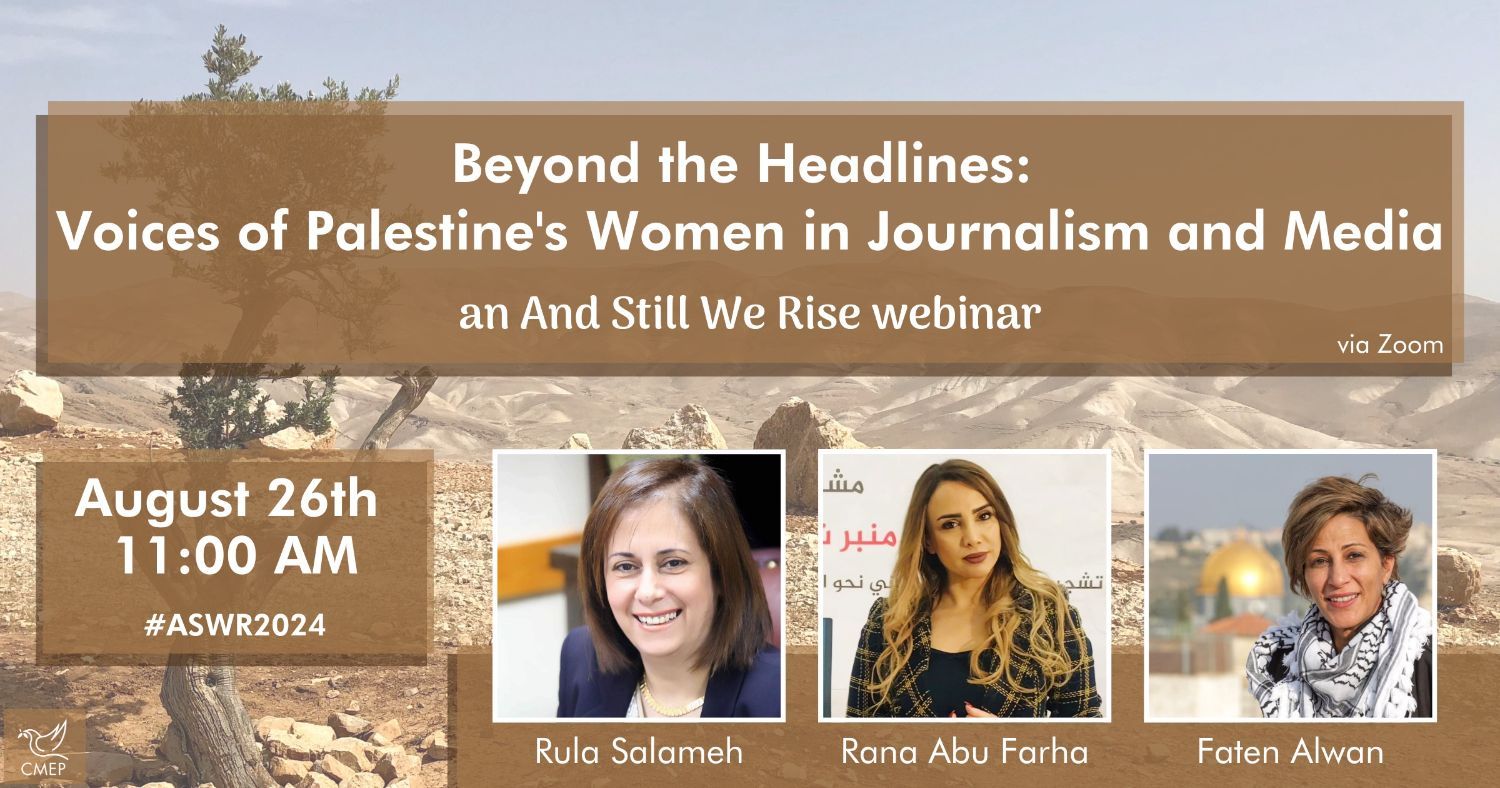
Die Stimme von Frauen im Konflikt

CMEP