Botschaft(en) aus Jerusalem

Inmitten der Gewalt und der Dunkelheit dieser Tage für viele, viele Menschen…

Easter Message – 2025 | Patriarchs and Heads of Churches in Jerusalem

Easter Message 2025 | Message from His Beatitude Pierbattista Cardinal Pizzaballa, Latin Patriarch of Jerusalem

Easter Message – 2025 | Bishop Sani Ibrahim Azar, Head of the Evangelical Lutheran Church in Jordan and The Holy Land (ELCJHL)

A Statement issued by The Orthodox Patriarchate of Jerusalem
Palm Sunday Grief: A Sanctuary of Healing Struck in the Land of the Divine Healer

A Statement issued by The Orthodox Patriarchate of Jerusalem
Palm Sunday: A passage from the Earthly Jerusalem to the Heavenly Jerusalem

Ostern im Heiligen Land – Im Schatten des Gazakrieges
WDR 5 Interview mit Ralf Melzer von der Friedrich-Ebert-Stiftung

Zusammen-leben in Israel …

Givat Haviva Survey on Attitudes Between Jews and Arabs in Israel 2025

„‘The level of fear is very, very high. Our job is to tell them that this is not the time to duck down and wait for the tsunami to end. This is the time to show up,’ said Mohammad Darawshe, director of strategy for Givat Haviva, which organized the survey.“

Bericht von Michele Chain auf RNS

Aus dem Bericht von Givat Haiva:

Haim Goren (1946-2025)

Am 1. März 2025 verstarb Prof. Haim Goren. Der 1946 geborene Historiker war lange Zeit Professor am Tel Hai-College im äußersten Norden Israels und DER Experte für den deutschen, v.a. auch katholischen Beitrag zur Geschichte des Heiligen Landes ab dem 19. Jahrhundert. Mehrere seiner zahlreichen Werke wurden deshalb auch in die deutsche Sprache übersetzt, die er selbst so gut beherrschte, daß er auch Quellen in Sütterlin lesen und auswerten konnte – in Israel heute eine Seltenheit.

Für deutsche Leser:nnen sind dementsprechend auch die diesbezüglichen Werke besonders interessant: So behandelte er in „Zieht hin und erforscht das Land“ (Göttingen 2003) die deutsche Palästinaforschung im 19. Jahrhundert, in „Echt katholisch und gut deutsch“ (Göttingen 2009) das Engagement der deutschen Katholiken in Palästina vor dem 1. Weltkrieg – insbesondere das des Deutschen Vereins vom Heiligen Lande (DVHL).

In dem von ihm und Yossi Leshem herausgegebenen Band über Pater Ernst Schmitz (2020) stellte er den Naturforscher und längjährigen Leiter der DVHL-Einrichtungen vor, und der Sammelband „Deutschland und Deutsche in Jerusalem“ (2011) versammelte Aufsätze zu ganz unterschiedlichen Aspekten – vom Besuch Kaiser Wilhelms II. bis zu deutschen Krankenhäusern und Photographen in Jerusalem. Weitere Werke aus den letzten Jahren waren den historischen Friedhöfen der Templer im Nahen Osten (1869-1948) gewidmet, aber auch dem ‚Vater‘ der modernen Palästina-Wissenschaft Edward Robinson oder der Erforschung des Toten Meeres. Außerdem galt sein besonderes Interesse der Geschichte Galiläas – wohnte er doch seit Jahrzehnten in Rosh Pinna.  

In zahlreichen Vorträgen und Exkursionen gab er sein Wissen weiter – selbst für den Tag vor seinem Tod war noch eine Führung in Tabgha geplant. Er wird fehlen.  

Dr. Georg Röwekamp (Tabgha)

Photo: Yoli Shwartz (יולי שוורץ) – Wikipedia

Rabbis for Human Rights

Der jüdisch-orthodoxe Israeli Anton Goodman ist am 27.02.2025 zu Gast in Berlin. Zeit: 18.30 bis 20 Uhr. Ort: Berliner Missionswerk, Georgenkirchstraße 69/70, im Knaksaal (2. Stock).

Wir lesen und hören aktuell in Nachrichten und sozialen Medien viel über die Situation in Israel und Palästina. Am 27. Februar 2025 haben Sie die Möglichkeit, in Berlin mit Anton Goodman über die aktuelle Entwicklung und die Stimmung im Nahen Osten ins Gespräch zu kommen.

Anton Goodman ist jüdisch-orthodoxer Israeli. Er ist bei der Organisation „Rabbis for Human Rights“ zuständig für Partnerschaften. Aktuell ist er regelmäßig in der Westbank, wo die Rabbis for Human Rights Präsenz zeigen und Palästinenser:innen begleiten. So begegnen sie der zunehmenden Siedlergewalt. Goodman ist verantwortlich für die Planting Justice-Kampagne, bei der in Kooperation mit palästinensischen Gemeinden, die von Gewalt und militärischen Restriktionen bedroht sind, über 1.000 Olivenbäume gepflanzt werden.

Die Veranstaltung ist auf englisch mit deutscher Übersetzung.

Zeit: 27. Februar 2025, 18.30 bis 20 Uhr
Ort: Berliner Missionswerk, Georgenkirchstraße 69/70, im Knaksaal (2. Stock)

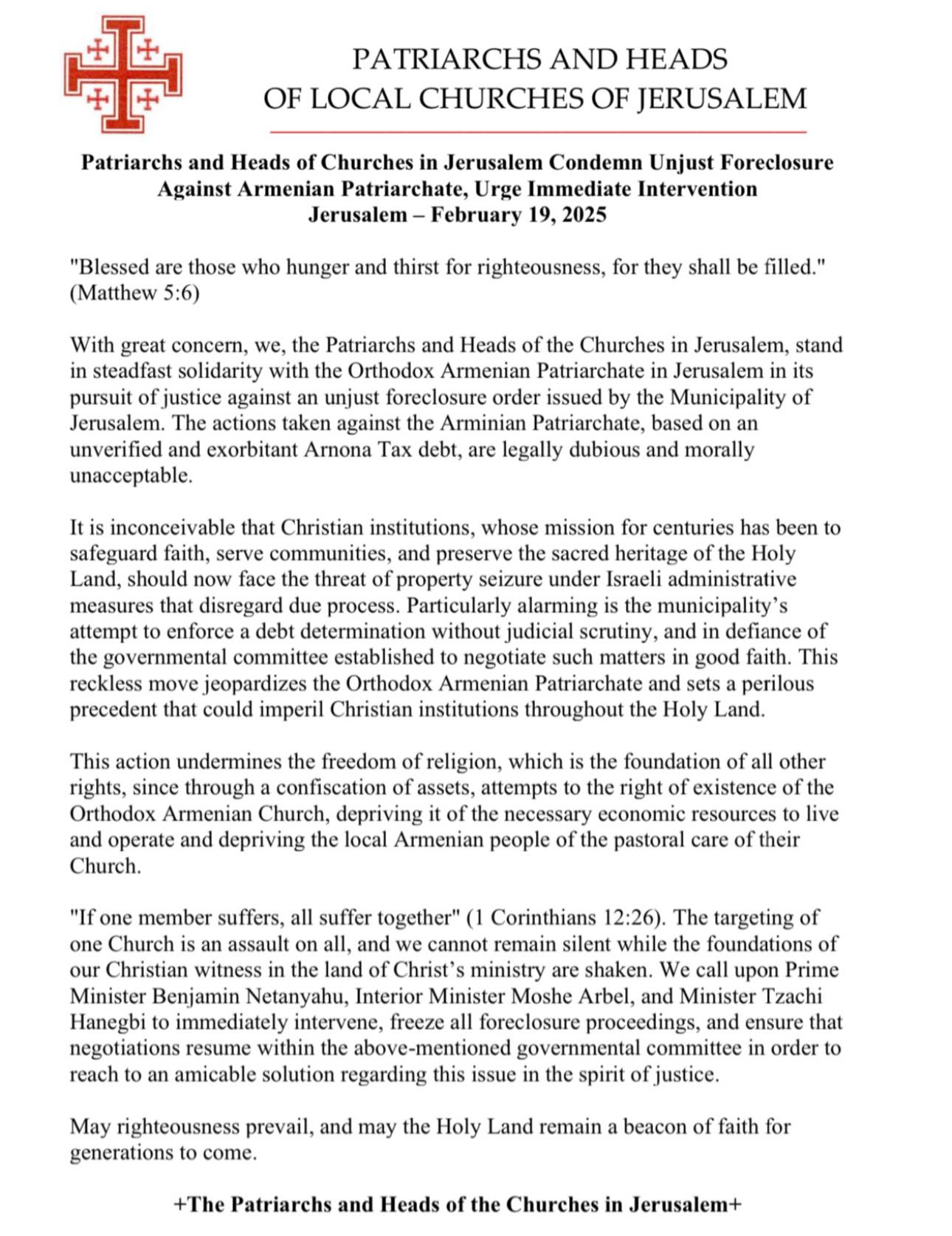
Zur aktuellen Situation des Armenischen Patriarchats in Jerusalem

Weitere Informationen:

# Word Council of Churches

# https://www.pillarcatholic.com/p/why-the-latin-patriarchate-is-in

# https://givebutter.com/Arq2025?fbclid=PAZXh0bgNhZW0CMTEAAaZXx715AGmPJHgs24SDu-68GGJAkysRZxI8nGLnAczU4RLCSANVYUNEzss_aem_SaUcSDCtMVt9fKw8XJFgaQ

Humanitarian plea from the Churches of Jerusalem

The Patriarchs and Heads of the Churches in Jerusalem have issued this statement on Feb 14, 2025:

As custodians of the Christian faith and conscience in this sacred land, we raise our voices in sorrow and steadfast resolve in the face of the ongoing suffering in Gaza. The devastation that has unfolded before the eyes of the world is a profound moral and humanitarian tragedy. Thousands of innocent lives have been lost, and entire communities stand in ruin, with the most vulnerable-children, the elderly, and the sick-enduring unimaginable hardship.

Amid this anguish, we are compelled to speak against the grave threat of mass displacement, an injustice that strikes at the very heart of human dignity. The people of Gaza, families who have lived for generations in the land of their ancestors, must not be forced into exile, stripped of whatever left of their homes, their heritage, and their right to remain in the land that forms the essence of their identity. As Christians, we cannot be indifferent to such suffering, for the Gospel commands us to uphold the dignity of every human being. The words of our Lord remind us: „Woe to those who make unjust laws, to those who issue oppressive decrees, to deprive the poor of their rights and withhold justice from the oppressed“ (Isaiah 10:1-2).

In this critical moment, we acknowledge and support the position of His Majesty King Abdullah II of Jordan, President El-Sisi of Egypt, and others, whose firm and principled stance have remained clear and unwavering in rejecting any attempt to uproot the people of Gaza from their land. Their relentless efforts to provide humanitarian aid, appeal to the world’s conscience, and insist on the protection of civilians exemplify leadership at its highest level of responsibility.

In this same spirit, we also call for the release of all captives from both sides so that they can be safely reunited with their families. We appeal to all people of faith, to governments, and to the international community to act swiftly and decisively to halt this catastrophe. Let there be no justification for the uprooting of a people who have already suffered beyond measure. Let the sanctity of human life and the moral obligation to protect the defenseless outweigh the forces of destruction and despair. We call for an immediate unfettered humanitarian access to those in desperate need. To abandon them now would be to abandon our shared humanity.

As we lift our prayers for those in mourning, for the wounded, and for those who remain steadfast in the land of their forefathers, we remember the promise of Scripture: „The Lord upholds all who fall and lifts up all who are bowed down“ (Psalm 145:14). May the God of mercy strengthen the afflicted, soften the hearts of those who hold power, and bring forth a peace that upholds justice, preserves human dignity, and safeguards the presence of all people in the land to which they
belong.

The Patriarchs and Heads of the Churches in Jerusalem

Future Realities!

You’re invited to a powerful and timely conversation with Hamze Awawde, a Palestinian peace activist, and Rabbi Cat Zavis as they explore the past, present, and future realities of Palestine—and the possibilities for justice, reconciliation, and peace.📅 Tuesday, February 11📍 Lakeshore Baptist Church, 3534 Lakeshore Ave., Oakland🕖 Doors open at 6:45 PM | Talk begins at 7:00 PM (PST)🎥 Live Stream: bit.ly/3E2aKdX

About Hamze Awawde:A lifelong advocate for peace and human dignity, Hamze Awawde is committed to amplifying Palestinian voices and fostering dialogue beyond cycles of violence. His latest initiative, the Center for Palestinian Renewal (CPR), is a groundbreaking think-and-do tank dedicated to empowering Palestinian perspectives and promoting citizen diplomacy.Join us for an evening of deep discussion and hopeful vision-building. Whether in person or online, we hope you can be part of this essential conversation.


A complete end to this war…

Today we hung banners with our message from Tel Aviv to Haifa to Jerusalem to make it clear that we won’t settle for less than a complete end to this war. Everyone must return home. (…)

We will not allow extremists to derail the deal. Now is the time to insist that our leaders end the war, withdraw from Gaza, and return every single hostage home. We are doubling down on our public pressure campaign, and we have a simple message: Complete ceasefire deal and nothing less.

Dr. Mahdi Abdul Hadi (1944-2025) r.i.p.

Schon am 15. Januar ist „Dr. Mahdi“ gestorben, eine Stimme Jerusalems, eine Stimme der palästinensischen Sache – eine Institution in sich selbst und untrennbar mit PASSIA verbunden … sein Büro in Wadi Joz war ein Anlaufpunkt für Information, für Analyse, für Kontakte, für Dialog und Gespräch …

Khalil Assali hat ihn in wunderbarerweise gewürdigt.

Der Nachruf von PASSIA, auch das Photo oben stammt von (c) PASSIA

Hoffen gegen alle Hoffnung

Der Lateinische Patriarch von Jerusalem, Pierbattista Cardinal Pizzaballa hat am 27. Dezember in einer Botschaft zum Heiligen Jahr an die Menschen appeliert, auf die zeichen der Hoffnung zu schauen …

Latin Patriarch’s Jubilee Year Message

  • Dec 27th, 2024

Dear Brothers and Sisters
of the Church who lives „as a pilgrim and guest“ (1 Pt. 2:11; Heb. 11:13) in the Holy Land,
may the Lord give you peace!

Pope Francis, in keeping with an age-old tradition, proclaimed 2025 a Holy Year, a year of special forgiveness and mercy from God, and December 24 last he opened the Holy Door at St Peter’s in Rome to begin this Jubilee.

As Ordinaries of the Holy Land, December 29 next, we too will open the Jubilee with a solemn celebration at the Basilica of the Annunciation in Nazareth, at the very place where the Virgin Mary opened her heart to the angel’s announcement and her womb to the Son of God so that He could be incarnate by the working of the Holy Spirit. With this act, both in Rome and Jerusalem the doors of divine mercy and reconciliation will be thrown wide open to all men and women who wish to experience divine forgiveness and its effects in a profound way.

Hope does not disappoint (Rm. 5:5)

The theme chosen by Pope Francis is: Pilgrims of Hope. For us, Catholics of the Holy Land, hope, precisely in these times, is especially necessary, and the Holy Father, in the Bull of Indiction for the Ordinary Jubilee, reminded us that hope does not disappoint. The verb used by the Apostle Paul stands to show that the solid foundation of Christian hope is the fact that God has accepted and justified us by giving His Son for us and has poured into our hearts His love, which is absolute and undeserved gratuitousness, through the gift of the Holy Spirit. Therefore, our Christian hope should not be confused with the vague desire for a better future rooted in an optimistic view of life but should be understood as the fruit of Jesus‘ passion, death and resurrection, and the gift of the Spirit that the Risen One has given us. Hope that does not disappoint is the very hope that springs forth from the empty tomb, that is, from Jesus‘ Passover, from His resurrection.

To hope against all hope (Rm. 4:18)

The situation of our Christian community in the Holy Land is, in many ways, similar to that of Abraham, who experienced having to „hope against all hope“ (Rm. 4:18). It is also similar to that of St. Paul himself, who reminds us that „we boast even in tribulation, knowing full well that tribulation produces patience, patience a tried virtue and tried virtue, hope“ (Rm. 5:3-4).

Over the past decades, and particularly over the past few years, we too have gone through a prolonged time of trial and tribulation. We think of the difficulties due to the inability to give a political solution to the Palestinian question and to the instability in the region. We think of the pandemic and war which have added to the economic difficulties that of coexistence. We think again of the endemic and growing violence in Israeli but also Palestinian Arab society, which produces discouragement in so many of our faithful and the temptation to leave the land of their fathers. We think again of the difficulties of the many migrants, displaced persons and refugees, political prisoners and hostages of war.

If we look at this time of trial and tribulation from a purely human point of view this inevitably leads us to discouragement, to a cynical view of the present and the future, to the very loss of faith and the consequent abandonment of the Church. It is precisely in this context that God’s word and the Jubilee year itself invite us to rediscover hope.

In fact, the biblical tradition itself presents the Jubilee year as a special year in which prisoners are set free, debts are forgiven, reconciliation with God and neighbor is experienced, peace is lived with all and justice is promoted, property is restored and even the land rests; there is personal and communal spiritual renewal (Lev. 25; Is. 61:1-2). At the beginning of His public ministry, precisely in Nazareth, Jesus said that the true Jubilee is realized in the today of meeting Him and hearing His word (Lk. 4:18-19)

Signs of Hope in the Holy Land

Pope Francis, in the Bull of Indiction of the Jubilee reminds us of how important it is to recognize the signs of hope that are nonetheless present in such a difficult historical period and context of life.

The first and most important is the yearning for peace. In our communities tried by endemic conflicts and the scourge of war, the yearning for peace is deep. And it is a sign of hope that the Christians of the small Christian community in Gaza have not been infected by the logic of hatred and enmity, but have actively cultivated, especially through prayer, a merciful heart open to reconciliation, sustained by a faith they have witnessed to the whole world.

It is a sign of hope that even in such difficult economic and social times, so many young couples in our communities have chosen to form a family, get married and stay in this land of ours.

It is a sign of hope that we have been able to live out our welcome to migrants, displaced persons and refugees in such a way as to show the welcoming and caring face of the Christian community that knows how to overcome the horizons of religious nationalism in order to live out openness to catholicity, that is, universality.

Also to be recognized as a sign of hope is the witness of priests and religious who shared the sufferings of the people, remaining close to their own people.

The solidarity that the universal Church manifested toward the Church living in the Holy Land, with prayer and concrete material gestures, was also a sign of hope for us.

Similarly, the closeness of Pope Francis toward all the peoples involved in the conflict and particularly toward the Christians of the Holy Land was a sign of encouragement to hope. Through many gestures, including the letter he wrote on March 27, 2024 for Holy Week and the one sent last October 7, in which he compared Catholics of the Holy Land to a seed of hope that, although covered by the earth and shrouded by darkness, bears fruit.

We have also been sustained in hope by the many appeals that both the Holy See and also Bishops‘ conferences and Sister Churches have constantly raised to call for the cessation of wars and the peaceful resolution of conflicts through negotiation and the instruments of diplomacy.

We think that each one of us can look at the reality in which we live and see it with the eyes of faith, which can grasp the good through which God makes Himself present in our history. We can also recognize and witness many other signs of hope present in our ecclesial context. We therefore invite each and every one of you to have the eyes of faith to recognize these signs within your families and communities, in the contexts in which you live and in daily environment.

A pilgrimage of hope

In order to live the experience of the Jubilee in its fullness, as an experience of reconciliation and indulgence, that is, as an experience of a mercy that heals us not only from our sins (forgiveness of sins), but also from the consequences they produce in our lives in its eternal perspective (forgiveness of punishments), we Christians of the Holy Land are offered a pilgrimage to three special places. They are the places from which the hope of Christians around the world originates and is nourished: Nazareth (Basilica of the Annunciation), Bethlehem (Basilica of the Nativity) and Jerusalem (Basilica of the Holy Sepulcher-Anastasis). Throughout the year, let us try to be ourselves pilgrims to these places, as a community, as families and also in a personal way.

In Nazareth, Christ our hope became flesh in Mary’s womb, and Mary teaches us that we need to believe that nothing is impossible for God. Like Mary be open to the fruitfulness of the Holy Spirit, so that God can work in our lives and in our history and transform it into salvation history.

In Bethlehem, hope has the face of a child and reminds us that God does not save with weapons and armies, nor with powerful means, but with the unarmed strength of a child in whom all the fullness of divinity dwells bodily, a child who is Emmanuel that is God with us and is Jesus that is God Himself who saves us by sharing our lives.

In Jerusalem, on Calvary, we realize the hope that comes from feeling loved gratuitously and infinitely, because there it is revealed to us that the Son of God loves us in a personal way and gives Himself for each of us. There we discover that reconciliation between peoples is possible because Jesus demolished the wall of enmity by dying for us on the cross. Finally, in passing through the empty tomb we discover the deepest content of our hope, which is the promise of the Risen One to take us with him into the glory of the Father, to bring us through the experience of death so that we can participate in the very life of the triune God, a communion of life and love.

To these we can also add the place of Jesus‘ Baptism, in Jordan, where the new Latin church will be consecrated January 10 next. It is a place that, by its nature, recalls John the Baptist’s invitation to conversion to prepare the way for the encounter with Jesus, to be welcomed as the Christ and as the Lord of our lives. The invitation to conversion, according to the Precursor, touches our mentality, our affections, our life choices and our everyday life (cf. Lk. 3:10-18).

It is certainly part of our mission to proclaim and offer hope to all people, but especially to the smallest, the frailest and the poorest, whether they are young people struggling to find a job, a home and start a family, or elderly people left alone and marginalized by society, or migrant workers, displaced persons and refugees who are looking for a better future for themselves and their families: if it is by giving that we receive, it is true that by sustaining the hope of others, our own is also strengthened.

Attached please find a brief fact sheet explaining what a Jubilee indulgence is, what conditions the Church sets for obtaining it and for whom it can be invoked. This will make it easier for the faithful to understand the meaning of the general indulgence linked to the Jubilee. An indulgence that is obtained through sincere repentance of sins and a deep commitment to conversion, the sacrament of reconciliation, participation in the Eucharist, profession of faith and prayer for the Roman Pontiff, with the addition of some works of charity, and that can be obtained for oneself but also for one’s deceased loved ones.

Grant us o Lord, the capacity to keep alive

After briefly reflecting on the meaning of this Jubilee that reopens our hearts to the hope that does not confuse, deceive or disappoint, we want to invite all of you, brothers and sisters of the Holy Land, to live intensely this Jubilee year, to participate in the pastoral and spiritual initiatives that will be proposed in your respective communities.

We ask the Lord for the ability to hope again, precisely because the times in which we find ourselves living demand a supplement of hope in order to be lived in fidelity to the Lord and in love for our brothers and sisters.

We entrust to you a much-loved traditional prayer, the Act of Hope. It is an ancient prayer, but its content is always new and makes us realize that having obtained mercy, we can go through the earthly pilgrimage with the prospect of eternal happiness.

O Lord God,
I hope by your grace for the pardon of all my sins
and after life here to gain eternal happiness
because you have promised it
who are infinitely powerful, faithful, kind, and merciful.
In this hope I intend to live and die. Amen.

Jerusalem, December 27, 2024
Pierbattista Cardinal Pizzaballa, Latin Patriarch of Jerusalem
President of the A.O.C.H.L.