Noch schwieriger: Permission granted …

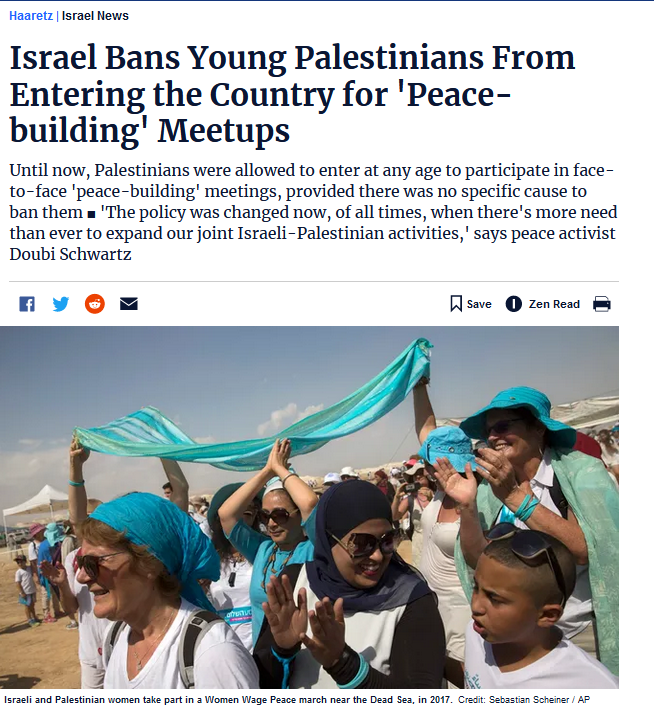
Israel Bans Young Palestinians From Entering the Country for ‚Peace-building‘ Meetups

Hagar Shezaf berichtet in Haaretz über eine weitere „kleine Hürde“ …

Until now, Palestinians were allowed to enter at any age to participate in face-to-face ‚peace-building‘ meetings, provided there was no specific cause to ban them ■ ‚The policy was changed now, of all times, when there’s more need than ever to expand our joint Israeli-Palestinian activities,‘ says peace activist Doubi Schwartz

Gemeinsames Statement zur Lage im Nahen Osten

Erklärung der Außenministerinnen und -minister Deutschlands, Frankreichs, Italiens, des Vereinigten Königreichs und der Vereinigten Staaten

[Angesichts der Lage kann einen die Frage überkommen, ob es sich dabei um das Pfeiffen im Wald handelt …, wenn den Worten keine Taten folgen …]

Wir, die Außenministerinnen und -minister Deutschlands, Frankreichs, Italiens, des Vereinigten Königreichs und der Vereinigten Staaten, sind zutiefst beunruhigt über die Ankündigung der israelischen Regierung, annähernd 10.000 Siedlungseinheiten zu genehmigen, sowie einen Prozess zur Normalisierung von neun Außenposten einzuleiten, die bislang nach israelischem Recht als illegal galten.

Wir lehnen diese einseitigen Maßnahmen entschieden ab, die lediglich dazu geeignet sind, die Spannungen zwischen Israelis und Palästinensern zu verschärfen und die Bemühungen um die Aushandlung einer Zweistaatenlösung zu untergraben.
Wir setzen uns weiterhin für einen umfassenden, gerechten und dauerhaften Frieden im Nahen Osten ein, der das Ergebnis unmittelbarer Verhandlungen zwischen den beiden Parteien sein muss. Israelis und Palästinenser verdienen es, in Frieden zu leben und gleichermaßen in den Genuss von Freiheit, Sicherheit und Wohlstand zu kommen.

Wir bekräftigen unser Eintreten dafür, Israelis und Palästinensern dabei zu helfen, die Vision eines vollständig in den Nahen Osten integrierten Staates Israel zu verwirklichen, der Seite an Seite mit einem souveränen, lebensfähigen Staat Palästina zusammenlebt. Wir werden die Entwicklungen vor Ort, die Auswirkungen auf die Realisierbarkeit der Zweitstaatenlösung und die Stabilität in der Region insgesamt haben, weiterhin aufmerksam verfolgen.

14. Februar 2023

Empathie als Aufgabe und Chance

Understanding the Pain of OthersThe Holocaust, the Nakba und German Memory Culture

Podiumsdiskussion vom Donnerstag, 2. Februar 2023, 19:00 h

Auf Youtube kann die Veranstaltung nachgehört/nachgeschaut werden.

Gesprächsleitung: Susan Neiman, Potsdam

 
In her book Understanding the Pain of Others, the author Charlotte Wiedemann pleads for a new inclusive memory culture that promotes solidarity instead of competition among victims. Doing justice to the victims of colonial crimes and their descendants does not call into question the specificity of the Shoah. On the contrary: the importance of human rights for all is a central lesson from the Holocaust. But tragically, Holocaust memory has not brought us much closer to such universal values.
In their co-edited volume The Holocaust and the Nakba: A New Grammar of Trauma and History Amos Goldberg, Bashir Bashir, and the contributors to the volume explore the possibility of creating a shared language for discussing the memories of two entangled, but entirely different historical events: the genocide of European Jews and the displacement of Palestinians. At the center of this new language is the concept of empathic unsettlement which challenges the mutual denial of the suffering of the Other, recognizes the political asymmetries in Israel-Palestine, and gives rise to an egalitarian binationalism.
This debate was originally scheduled to take place in the Goethe Institute Tel Aviv but was cancelled due to political pressure.


Charlotte Wiedemann
is a journalist and author. She has published numerous books on international topics, most recently Den Schmerz der Anderen begreifen. Holocaust und Weltgedächtnis (2022). Afflicted by silence in her own family, she has followed debates about German responsibility for National Socialism for four decades.

Bashir Bashir
is associate professor of political theory at the Open University of Israel and senior research fellow at the Van Leer Jerusalem Institute. His research interests are: democratic theory, nationalism and citizenship studies, liberalism, decolonization, and reconciliation. His most recent publication is The Arab and Jewish Questions: Geographies of Engagement in Palestine and Beyond (2020).
 
Amos Goldberg is associate professor of Jewish History and Contemporary Jewry at the Hebrew University of Jerusalem. For decades he has researched Holocaust memory at the intersection of history, critical theory, and literature. His publications include Trauma in First Person: Diary Writing during the Holocaust (2017) and his co-edited volume Marking Evil: Holocaust Memory in the Global Age (2015).

Multiperspective Holocaust Remebrance in Contemporary Europe

Insights from the Practice of European Holocaust Education and Exhibitions

Online Event – 7th February 2023, 3-5pm (CET)Link zu MuRem

How can the Holocaust be exhibited and educated alongside other historical and contemporary human rights and discrimination topics? What are the similarities in the challenges and approaches in different European contexts, and how do they differ? These are the questions we will discuss based on practical experiences from our European network at the online event. Representatives of Holocaust Education institutions in Poland, France, Belgium and Norway will give insights into their practical experiences with multiperspectivity. In dialogue with Hubert Strouk (Mémorial de la Shoah), Katarzyna Kulińska (POLIN museum) will explain, how the Holocaust Education at POLIN museum touches the contemporary refugee situation. Isabelle Diependaele (Kazerne Dossin) will address the question of multiperspectivity from the exhibition perspective in dialogue with Elise Grimsrud Christensen (Norwegian Center for Holocaust and Minority Studies). They will talk about their experiences in educational offers around special exhibitions on human rights and discrimination alongside main exhibitions on the Holocaust. We then present and launch a European survey on multiperspectivity in Holocaust education. The goal of the survey is to gain an insight into different approaches to addressing the various current challenges of Holocaust remembrance and education in Europe.

The survey is also supposed to give a better idea of what multiperspectivity could mean in different contexts and whether and how this approach is implemented. The event is part of the project „Multi-Perspective Holocaust Remembrance in Contemporary Europe“ (short: MuRem), coordinated by the Berlin-based NGO Minor. The goal is to build a network and strengthen multiperspectivity and interdisciplinarity in European Holocaust Education by taking into account the diversity of memory cultures and their consequences for the present.

Please find the full program attached and online, and register here.

Topographien von Flucht und Vertreibung

Narratives of Displacement with Prof. Dr. Yafa Shanneik – Zoomveranstaltung: 15.2.2023


Last fall‘s exhibition at the University of Würzburg, “Narratives of Displacement—Topographien von Flucht und Vertreibung“, presented art created by Iraqi and Syrian refugees in Germany, the United Kingdom and Jordan. Refugees shared their experiences of escaping war and settling into new countries. The exhibition included augmented and virtual reality technology to offer visitors an immersive and interactive experience.

The exhibition is part of the project ‘Negotiating Relationships and Redefining Traditions’ led by Prof. Dr. Yafa Shanneik who will be speaking about the project and its innovative techniques at the 25th DAFG Jour Fixe event.

Wednesday, 15 February 2023, 6 p.m. CET – Online Event via Zoom in English

Yafa Shanneik is Visiting Professor of Islamic Studies at the University of Lund/Sweden. She researches the dynamics and trajectories of gender in Islam within the context of contemporary diasporic and transnational Muslim women’s spaces. Currently, she is working on a project which explores women’s narratives of transnational marriage practices performed by Iraqi and Syrian women who have settled in Europe and other countries in the Middle East since the 1980s. She has published several articles and books on gender and Islam. Her monograph: The Art of Resistance in Islam. The Performance of Politics among Shi‘i Women in the Middle East and Beyond was published by Cambridge University Press in 2022.

More information on the exhibition is available here and more about the project here.

Please see also event invitation or visit the DAFG website.  

Please register online here: https://us02web.zoom.us/webinar/register/WN_IfUt3a4zSv6m-iNOvJ2Ajg

DAFG – Deutsch-Arabische Freundschaftsgesellschaft e.V. | Berlin

International Crisis Group

Der aktuelle Podcast zur Situation in Israel &Palästina

On Friday last week, a Palestinian gunman killed seven civilians in occupied East Jerusalem, the deadliest such attack for years. The shooting came the day after a raid by Israeli forces in a refugee camp in the West Bank city of Jenin, also the deadliest such operation for years. The week’s violence follows months in which more Palestinians died, according to human rights groups, than in the past almost two decades. More frequent Israeli raids, which Israel says aim to root out Palestinian militants behind an increasing number of attacks on Israelis, often provoke gun battles in West Bank cities. Militants have died, but also civilians, including many young Palestinians. In West Bank cities, new militias have formed, attracting young Palestinians angry not only at Israel but also at their own political leadership. Meanwhile, the new Israeli government of Prime Minister Benjamin Netanyahu, which is the most right-wing in Israeli history and comprises openly Jewish nationalist and anti-Palestinian ministers, promises an even tougher line on Palestinians. 

This week on Hold Your Fire!, Richard Atwood speaks with Mairav Zonszein and Tahani Mustafa, Crisis Group’s Israel/Palestine experts, about the latest spike in violence. They talk about Israel’s new government, its efforts to curb judicial power and what it might mean for policy toward the Palestinians. They also talk about Palestinian politics, many Palestinians’ disillusionment at their leadership, the emergence of new militias in West Bank cities and what might happen when ageing Palestinian President Mahmoud Abbas passes from the political scene. They ask whether there is any hope of change in policy from Washington and other Western capitals following U.S. Secretary of State Antony Blinken’s trip to the region this past week. They also talk about flashpoints in the months ahead.  

Wieder Vandalismus an christlicher Stätte in Jerusalem

Nachdem erst vor wenigen Tagen der protestantische Friedhof auf dem Zion Ziel der Zerstörungen war, brach am 2. Februar (Maria Lichtmeß) ein radikaler Jude in die Kirche der Flagellation (Geißelungskapelle am Beginn der Via Dolorosa) ein und zerstörte eine Christusfigur, bevor er von Wächtern überwältigt werden konnte.

Hier die Stellungnahme des Custos der Franziskaner, auf deren Gelände die Kapelle liegt, sowie ein kurzes Video.

Erst am Tag zuvor war es zu „violant attacks“ gekommen, wie es in Erklärung des Lateinischen Patriarchates heißt:

A STATEMENT ISSUED BY
THE JERUSALEM PATRIARCHATE
REGARDING THE RECENT RADICALS’ ATTACK ON THE CHRISTIANS OF THE NEW GATE AREA

A new plan to solve the Israeli-Palestinian Conflict

Veranstaltung des Deutschen Orient-Instituts (DOI) in Kooperation mit der Friedrich-Ebert-Stiftung (FES)

Informationen zur Veranstaltung „A new plan to solve the Israeli-Palestinian Conflict: The Holy Land Confederation“

Link – auch zur Online-Anmeldung | 8. Februar 2023 – 18.00-20.00 CET

* Holy Land Confederation

The Israeli-Palestinian Conflict has been overshadowed by other, global crises in the past years. Prospects to finding a solution appear to diminish. The recent formation of a new Israeli government – following the fifth parliamentary election since 2019 – and a weakening legitimacy of the Palestinian Authority do not, unfortunately, point to an imanent negotiated and accepted solution.

On 8th February 2023 we are hosting the initiators of the Holy Land Confederation. In their initiative, they offer a new contribution to thinking about how to untangle the conflict. We look forward to hearing first hand from the initiators and discuss their ideas on the panel and with the audience.

Presentation of the Initiative

Dr. Yossi Beilin
Former Israeli Minister and Knesset Member

Dr. Hiba I. Husseini
Chair of the Legal Committee to Final Status Negotiations between Palestinians and Israelis

Discussion and Comments

Huda Abuarqoub
Regional Director of the Alliance for Middle East Peace (ALLMEP)

Shlomo Brom
Senior Researcher at the Institute for National Security Studies (INSS)

Welcome Address and Moderation

Dr. Andreas Reinicke
Director of the German Orient-Institute

Erinnern – warum eigentlich?

Online-Lesung und Gespräch anläßlich des Gedenktages an die Opfer des Nationalsozialismus (27. Januar)

Mit Georg RößlerMittwoch, 01. Februar 2023 – 19.00 Uhr

In Kooperation mit der Gesellschaft für Christlich-Jüdische Zusammenarbeit Dillenburg

Der Toten zu Gedenken gehört zu den Ritualen einer Gesellschaft.  Mit Gedenkveranstaltungen würdigen wir Menschen, die ihr Leben dem Dienst der Allgemeinheit gewidmet haben, die sich für die Allgemeinheit geopfert haben oder die Opfer von Unrecht und Gewalt geworden sind.  Die Pflege einer Erinnerungskultur vor allem im Blick auf die Verbrechen des Nationalsozialismus gehört seit jeher zum ureigensten Selbstverständnis der Gesellschaften für Christlich-Jüdische Zusammenarbeit.

In letzter Zeit ist dieses Selbstverständnis ins Wanken gekommen. Es läßt sich darüber streiten, ob wir – die Kinder und Enkelkinder der sogenannten Zeitzeugen und Überlebenden – uns überhaupt an etwas ‚erinnern‘ können, was wir selbst nicht erlebt haben. Und gilt dies nicht erst recht für unsere Kinder und Kindeskinder? 

Vor diesem Hintergrund wird die Frage, wie eine gemeinsame Kultur des Gedenkens zwischen Juden/Jüdinnen und Christen/Christinnen gestaltet werden kann, zu einer elementaren Herausforderung für uns und unsere Zukunft.

In seinem Buch „Nicht für Deutsche…? Yad Vashem als Ort und Wirklichkeit“ (AphorismA Verlag Berlin 2021) führt Georg Rößler seine Leser und Leserinnen durch die Jerusalemer Shoa-Gedenkstätte am Herzlberg, wo die Frage nach einer Erinnerungskultur eine jüdische und israelische Antwort gefunden hat.

Unterwegs teilt er mit uns – als Deutsch-Israeli und langjähriger Reiseleiter deutscher Reisegruppen  – seine Gedanken über die Darstellung der Shoa aus deutscher und israelischer Perspektive, über den Umgang mit unserer Geschichte und über Wege, wie die Erinnerung an die Vergangenheit auch für nachfolgende Generationen eine Zukunft haben kann. 

***

Georg Rößler, gebürtiger Düsseldorfer, lebt seit über 30 Jahren in Jerusalem. Er ist Reiseveranstalter und Co-Direktor von SK-Tours in Nature, Gründer und ehrenamtlicher Co-Direktor von SOS-Gewalt/Zentrum für Friedenspädagogik in Israel.

Anmeldung bis 31. Januar 2023 an gcjz-dillenburg@gmx.de.  Eine E-Mail mit dem Link zum Zoom-Meeting wird zeitnah vergeschickt.

Aus dem babylonischen Gefängnis ausbrechen

Die religiösen Parteien in Israel sind seit längerem in einer „unheiligen“ Allianz mit der politischen Rechten, ein aufeinander angewiesen sein, das eine große Herausforderung für die prophetische Kraft der Religion ist. Einer der Gründe dafür ist sicher auch das Schweigen der „religiösen Linken“ – links und fromm scheint für viele unvereinbar.

Eine Konferenz in dieser Woche in Jerusalem versuchte, sich dem zu nähern, hier der Bericht von Yuval Abraham auf +972.