Das Editorial von Haaretz vom 2. Oktober 2024
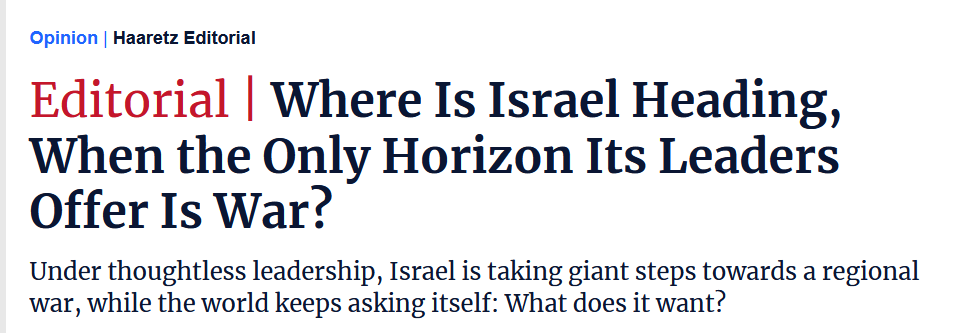
The State of Israel is in the midst of the most difficult period in its history, under a reckless leadership headed by a man whose only promise he has made and kept to his people was to live by the sword. In remarks made at a new year’s cabinet meeting, Prime Minister Benjamin Netanyahu briefly mentioned the 101 hostages whom he has abandoned to suffering and death in Hamas‘ tunnels in the Gaza Strip, half of whom are no longer alive.
Under its thoughtless leadership, Israel is taking giant steps towards a regional war, while the world keeps asking itself: What does it want? Where is it heading?
Ayman Safadi, the Jordanian foreign minister, best captured those feelings in a speech that has gone viral across the globe but has been completely ignored by Israel. At a press conference following a joint celebration by Arab representatives during the UN General Assembly session, Safadi exercised his right to speak and say things all Israelis must hear.
„The Israeli prime minister came here today and said that Israel is surrounded by those who want to destroy it,“ he began. „We’re here — members of the Muslim-Arab committee, mandated by 57 Arab and Muslim countries — and I can tell you very unequivocally, all of us are willing to guarantee the security of Israel in the context of Israel ending the occupation and allowing for the emergence of a Palestinian state.“
This is not to say that Hamas did not seek to vanquish Israel, that Hezbollah is not a bitter and cruel enemy or that Iran is not seeking the worst for us, but Safadi has served to remind us of an undeniable truth: Under its long years of rule by Netanyahu, Israel has not lifted a finger for the sake of peace with the Palestinians, but the reverse.
„Do they have a narrative other than ‚I’m going to continue to go to war and kill this and kill that‘?“ he asked. „Ask any Israeli official what their plan is for peace, you’ll get nothing because they’re only thinking of the first step – we’re going to destroy Gaza, inflame the West Bank, destroy Lebanon. After that, they have no plan. We have a plan, we have no partner for peace in Israel.“
On the eve of Rosh Hashanah 5785, when the only horizon Israel’s leaders offer is war, we can only hope that in the coming year we will be blessed with a profound change in leadership and a new vision for the country. May this year and its troubles soon be over.
The above article is Haaretz’s lead editorial, as published in the Hebrew and English newspapers in Israel.