Ein Blick auf den Tag danach, der sicher kommen wird …

Aus der Analyse von Jack Khoury in der heutigen Ausgabe (4. Juli 2023) von Haaretz:

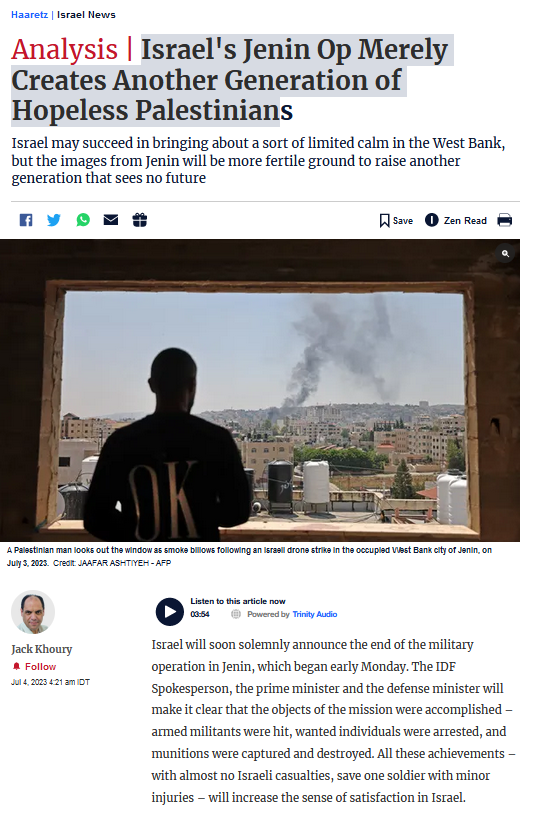
Israel’s Jenin Op Merely Creates Another Generation of Hopeless Palestinian

“ (…) Israelis will go back to normal in a few days, and they expect the Palestinians to do the same – lick their wounds, bury their dead and move on. No one will show any interest in the future, or think of an outline for an agreement, because Israel wishes to cement a reality in which the Palestinians become accustomed to living under Israeli occupation and control, their civil affairs managed by a hobbled Palestinian Authority. From time to time, there’s a limited military operation, which is met with thundering silence by the international community, and particularly Uncle Sam. The issue of control over the Palestinians is of no interest to the decision makers. To them, the Chosen People can rule forever, the Palestinians don’t deserve a future and Palestinian youth must accept the situation.

Two decades ago, Israel embarked on a much broader operation against militants in Jenin, then backed by a leader like Yasser Arafat, and far better organized and funded. Today, Israel fights those who were babies and toddlers then, or not yet born at all. The generation born after the Oslo Accords grew up on the devastation of 2002, on Israeli arrogance and defiance, international indifference, and the disintegration of Palestinian national unity. A generation has arisen of angry, frustrated and hopeless youngsters, who have no purpose but to bear arms and shoot. To Israeli public opinion, a victory photo might have been achieved, but each such operation paves the way for more rounds of fighting and bloodshed.“
OCHA Update Jenin, 3. Juli 2023

Israeli forces’ operation in Jenin | Flash Update #1 as of 16:30, 3 July 2023 | Full report

KEY POINTS

  • During the early hours of 3 July 2023, Israeli forces launched a large-scale air and ground operation in Jenin Refugee Camp and its surroundings. This is the second operation in Jenin involving air strikes within two weeks and since 2006.
  • Israeli forces carried out more than ten air strikes, most likely with drones, on several targets inside the refugee camp, followed by large numbers of Israeli ground forces entering the area, reportedly raiding several houses and positioning themselves on rooftops. During the operation, Israeli forces and armed Palestinians exchanged fire.
  • As of 16:30 on 3 July, the Palestinian Ministry of Health (MoH) confirmed the death of eight Palestinians, including two children, in the Jenin Refugee Camp. Additionally, one Palestinian man was fatally shot by Israeli forces in Ramallah, bringing the total death toll to nine. Furthermore, at least 50 others have been injured, of whom at least eleven are reportedly in critical condition.
  • As of 16:30 on 3 July, access to the refugee camp is mostly only possible from one entrance where Israeli forces conduct checks on vehicles, including ambulances. An Israeli military bulldozer has demolished most of the roads leading to the refugee camp, severely impeding access for ambulances to casualties inside the camp. 
  • The Israeli forces airstrikes caused significant damage to inhabited structures in the Jenin camp and in the surrounding neighborhoods. According to initial reports, Israeli airstrikes have hit houses and parts of apartment buildings. Some residents have reported receiving warning calls from Israeli forces prior to the airstrikes. As a result, at least 12 families have been forced to leave their homes. 
  • Due to damage to infrastructure, most of the refugee camp residents are currently without drinking water and electricity.
  • The Humanitarian Coordinator has expressed alarm at the scale of the operation in Jenin, noting that airstrikes were used in the densely populated refugee camp and that several people had been killed or wounded. She stressed the need to ensure access to all those injured.

SITUATION OVERVIEW

On 3 July at about 1:00 am, Israeli forces conducted a series of airstrikes in and around the Jenin Refugee Camp. The airstrikes hit multiple locations within the camp, including a residential structure in the central area. As a result, three Palestinians were killed, and others were injured. 

On 3 July at about 3:00 am, Israeli forces fatally shot a Palestinian man in the head with live ammunition near the Beit El DCO checkpoint in the northern entrance of Al Bireh (Ramallah). The man was shot as Palestinians protested the Israeli operation in Jenin, with some throwing stones and Israeli forces firing live ammunition. 

On 3 July at about 8:00 am, Israeli forces bulldozed roads leading to Jenin Refugee Camp. Consequently, ambulances were unable to access the camp except from one entrance, which is controlled and monitored by Israeli forces inspecting `vehicles, including ambulances. 

On 3 July about 10:00 am, the Israeli military stated that Israeli forces had discovered and destroyed a laboratory used to manufacture explosives. Additionally, they reportedly confiscated a rocket launcher along with other weapons.

On 3 July at about 10:40 am, Israeli forces prevented ambulances from entering and exiting Jenin Refugee Camp – a problem that has been reported by medical sources throughout the day. Paramedics entered the camp by foot to provide first aid to casualties. Exchanges of fire continued between Palestinians and Israeli forces while the latter also conducted air strikes hitting structures. Five Palestinians including two children were shot and killed with live ammunition fired by Israeli forces.  

On 3 July at about 12:50 pm, according to reports from medical sources, several teargas canisters fired by Israeli forces landed inside the courtyards of the Jenin Governmental hospital.

HUMANITARIAN OVERVIEW

  • UNRWA facilities remained closed in the refugee camp throughout 3 July. 
  • The Israeli forces’ operation has resulted in several casualties and destruction of property. According to initial estimates by the Ministry of Health, as of 15:30 on 3 July, eight Palestinians have been killed, including two children, and 50 Palestinians have been injured. Reportedly over half of these injuries were a result of shrapnel caused by the Israeli airstrikes and at least 11 are in critical condition.
  • Several inhabited structures in Jenin Refugee Camp and surrounding areas have been significantly damaged in airstrikes, most likely carried out with drones. At least 12 families, comprising 105 people, have been forced to leave their homes, due to the imminent risk of their house being shelled or seized by Israeli forces. 
  • Health structures in Jenin have been reportedly damaged and teargas canisters and sound grenades have landed in the courtyard of the Khalil Sleiman hospital where injured Palestinians were being treated.
  • Medical cases are being managed at the three main hospitals in Jenin: Khalil Sleiman Hospital, where a Médecins Sans Frontières (MSF) team is also located, Ibn Sina Hospital, and Al Razi Hospital.  Health Cluster partners are reviewing an initial list of urgent supplies shared by the MoH to support the Jenin Hospital. Pre-positioned supplies in Jenin have been released and are being utilized. 
  • The main water pipeline of the camp was severely damaged and water supply to residents is currently unavailable. Additionally, three main electricity transformers were damaged, and an initial estimation indicates that most of the camp is without electricity. The municipality is not able to access the affected areas to make the required maintenance for the damaged infrastructure.
  • Shops in the city of Jenin and in Jenin Refugee Camp are closed, including the three shops in Jenin City that provide e-voucher food assistance. The World Food Programme is contacting bakeries to assess and monitor their operational capacity and is preparing for potential emergency response in case the conflict extends for a longer duration.
  • Protection Cluster members and the human rights monitoring team of the United Nations Human Rights Office (OHCHR) are conducting initial monitoring and documentation of violations of international law. 
  • Technical partners specialized in mental health and psycho-social support (MHPSS) will assess any needs related to possible psychological harm, particularly of children.

Kalender 2023 – Juli

Essen verbindet

Ein Begleiter durch das Jahr 2023 – Mit Photos von Bärbel Doering und aus dem AphorismA Verlagsarchiv

Süß, süßer, …

Photo: AphorismA Archiv

israel & palästina – Zeitschrift für Dialog | Ausgabe 4-2022


Jahresbericht 2022 des FBI

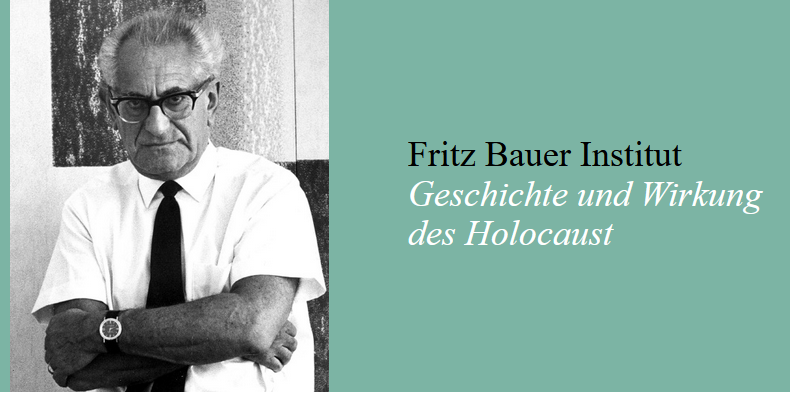
Das Fritz Bauer Institut – Geschichte und Geschichte des Holocaust legt seinen umfangreichen Jahresbericht vor, der auf jeden Fall die Lektüre lohnt. Sein Inhalt gibt einen guten Überblick über aktuelle Forschungen und Debatten.

Fritz Bauer Instiut Logo

Der Jahresbericht des Fritz Bauer Instituts informiert über die vielfältigen Tätigkeiten des Instituts im vorangegangenen Jahr. Er gibt einen Überblick über die Editions- und Forschungsprojekte, Lehre, Publikationen, Veranstaltungen und Ausstellungen, über Mitarbeiter und Mitarbeiterinnen sowie die Gremien der Stiftung.
Das Erscheinen des Jahresberichts wird unterstützt vom Förderverein Fritz Bauer Institut e.V.

Gedruckte Ausgabe JB Frirz Bauer Institut 2022

Vergessene NS-Opfer

Bundestag beschließt Mahnmal für Zeugen Jehovas

Für die in der nationalsozialistischen Diktatur verfolgten Zeug:innen Jehovas soll im Berliner Tiergarten ein Mahnmal errichtet werden. Den entsprechenden gemeinsamen Antrag von SPD, CDU/CSU, Bündnis 90/Die Grünen und FDP (20/6710) verabschiedete der Bundestag am 29. Juni 2023 gemäß einer Beschlußempfehlung des Kulturausschusses (20/7111) ohne Gegenstimmen.

Reise in die Finsternis

Nazijäger – bis 27. September 2023 in der ARD-Mediathek (3SAT)

Bild: ZDF/NDR/Spiegel TV/Michael Ihle/ bishara.design/Nelli Rödl

Herbst 1945: Deutsche Kriegsverbrecher im Visier britischer Soldaten. Sie fahnden nach SS-Leuten, KZ-Schergen und Tätern in Nadelstreifen. Sie suchen und finden Rudolf Höß, den Kommandanten von Auschwitz.

Die britischen Offiziere fahren 1945 und 1946 mit Jeeps durch Norddeutschland – auf der Jagd nach Naziverbrechern. Es sind die Männer der britischen „War Crimes Investigation Unit“. Einer von ihnen ist Captain Anton Walter Freud. Er ist der Enkel von Sigmund Freud, dem Begründer der Psychoanalyse. Anton Walter Freud floh 1938 mit seiner Familie vor den Nazis nach London.

Jetzt ist der Geheimdienstoffizier zurück, um Mörder aufzuspüren, die auf den Fahndungslisten der Alliierten stehen: Killer in Nadelstreifen, brutale SS-Schergen und erbarmungslose Ärzte, die medizinische Experimente an Kindern durchführten.

Freud ist stolz auf seine Herkunft, verehrt seinen weltberühmten Großvater. Der 24-Jährige verfügt über ein besonderes Talent: Er kann sein Gegenüber zum Reden bringen und davon überzeugen, Geheimnisse preiszugeben. Freud ist ein Freigeist, der sich nur ungern unterordnet. Er verabscheut Disziplin und ist für seine unkonventionellen Ideen bekannt. Sein Ziel ist nicht Rache, sondern Gerechtigkeit.

Er will die Täter vor Gericht bringen. „Alles unscheinbare kleine Leute“, wird Freud später in einem seiner seltenen Interviews sagen, „denen man überall begegnen kann, ohne zu ahnen, was sie getan haben.“

Im Team lernt er Hanns Alexander kennen. Der Sohn eines Berliner Arztes ist ebenfalls vor den Nazis nach England geflohen und 1945 als britischer Offizier nach Deutschland zurückgekommen. Im Konzentrationslager Bergen-Belsen hat er das Grauen gesehen, das die Nazis hinterlassen haben, und ist schockiert über die Kaltblütigkeit der inhaftierten Aufseher und SS-Offiziere.

Bergen-Belsen hat Alexander verändert. Er ist nicht länger der sorglose Mann von einst, sondern von einer kaum noch kontrollierbaren Wut erfasst. Das macht ihn zum „Brecher“, ein Ermittlertyp, der auch mit Drohungen operiert und manchmal Grenzen überschreitet – ganz anders als Anton Walter Freud.

Der verhaftet im Oktober 1945 Bruno Emil Tesch, den Geschäftsführer der Hamburger Firma „Tesch & Stabenow“, die das Insektenvernichtungsmittel „Zyklon B“ hergestellt und in die Vernichtungslager geliefert hat – vor allem nach Auschwitz. Die Beweise sind erdrückend, Tesch wird 1946 vor ein britisches Gericht gestellt und zum Tode verurteilt. …. weiterlesen

Syrien und die arabische Welt

Ein Kommentar zur Situation aus der International Crisis Group

The League of Arab States welcomed President Bashar al-Assad to its May summit, reinstating Syria’s membership, which it had suspended in 2011. The regime may look to have shrugged off the international opprobrium it earned for its brutality in repressing its opponents. But has it?

Weiterlesen

#Stolen Memory in Paris

Zusammen mit dem Ministère de l’Europe et des Affaires étrangères und der Fondation pour la Mémoire de la Shoah eröffnete am 27. Juni 2023 die erste Station der #StolenMemory-Wanderausstellung in Frankreich.

Jerusalem im gestern für morgen…

Da lohnt ein Blick, immer wieder mal …

The online catalog of the Open Jerusalem project is for researchers, students, professionals and members of the public interested in late modern history of Jerusalem. The catalog contains summary descriptions, transcripts or digitized documents of thousand of records from numerous archives. 

New archival and bibliographic records are added to the catalog on a regular basis and the development of the catalog is ongoing. Find out more about how to use the Open Jerusalem Catalog: please read the Help with your research page.

Welcome to the Open Jerusalem catalog.


Browse this catalog to search through archival and bibliographic records to discover Jerusalem’s history (1840–1940) through its sources all over the world.

Glocken läuten weiter

Auf dem Wege der Versöhnung:
Rückgabe von Glocken an die Gemeinden in Straszewo und Frombork

Bischof Gebhard Fürst von Rottenburg-Stuttgart und Baden-Württembergs Ministerpräsident Winfried Kretschmann (Bündnis90/Die Grünen) haben am Wochenende drei Glocken ihren früheren Besitzern in Polen zurückgebracht. Die Instrumente waren von den Nationalsozialisten abgehängt worden und wurden später in württembergischen katholischen Kirchen genutzt.

Die Geschichte braucht manchmal einen langen Atem. Gut 80 Jahre nachdem sie vom Nazi-Regime aus ihren Kirchtürmen heruntergenommen worden waren, um zur Rüstungsproduktion eingeschmolzen zu werden, sind am Samstag im Rahmen des Projektes „Friedensglocken für Europa“ zwei historische Glocken in ihre Heimat im Ermland zurück gekehrt: Im Anschluss an einen Gottesdienst am Vormittag in der Kathedrale St. Nikolaus in der polnischen Stadt Elbląg (Elbing) hat Bischof Dr. Gebhard Fürst eine Glocke aus der Kirchengemeinde St. Albertus Magnus in Oberesslingen an Vertreter ihrer Ursprungsgemeinde Straszewo (Dietrichsdorf) übergeben.

Artikel auf der Bistumsseite, auf Vaticannews.de, beim SWR.