
Dem Horror, dem Hunger, dem Tod etwas entgegensetzen!
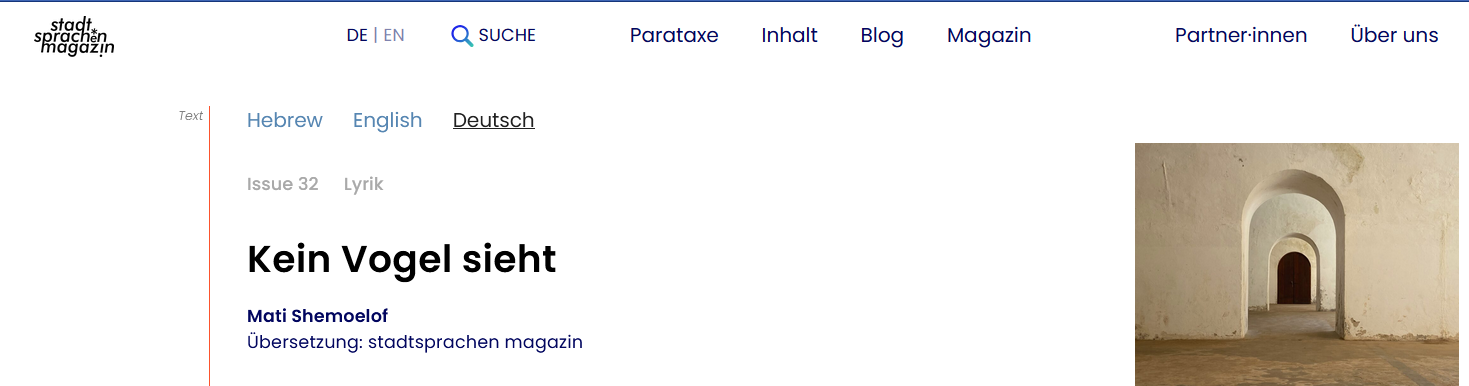
Mati Shemoelof hat im Stadtsprachenmagazin dieser Tage ein Gedicht veröffentlicht:
Dem Horror, dem Hunger, dem Tod etwas entgegensetzen!
Mati Shemoelof hat im Stadtsprachenmagazin dieser Tage ein Gedicht veröffentlicht:
Allianz für Frieden im Nahen Osten… – Zwölf Organisationen stellen sich vor
Ein Begleiter durch das Jahr 2025 – Im Juli ist es die Organisation THE PARENTS CIRCLE – FAMILIES FORUM– … festhalten an einer anderen, gemeinsamen Vision für die Zukunft, an solchen Tagen, wo ein Waffenstillstand, geschweige denn ein Ende des Krieges, noch imm weiter in die Ferne gerückt ist und Menschen weiter hungern und sterben …
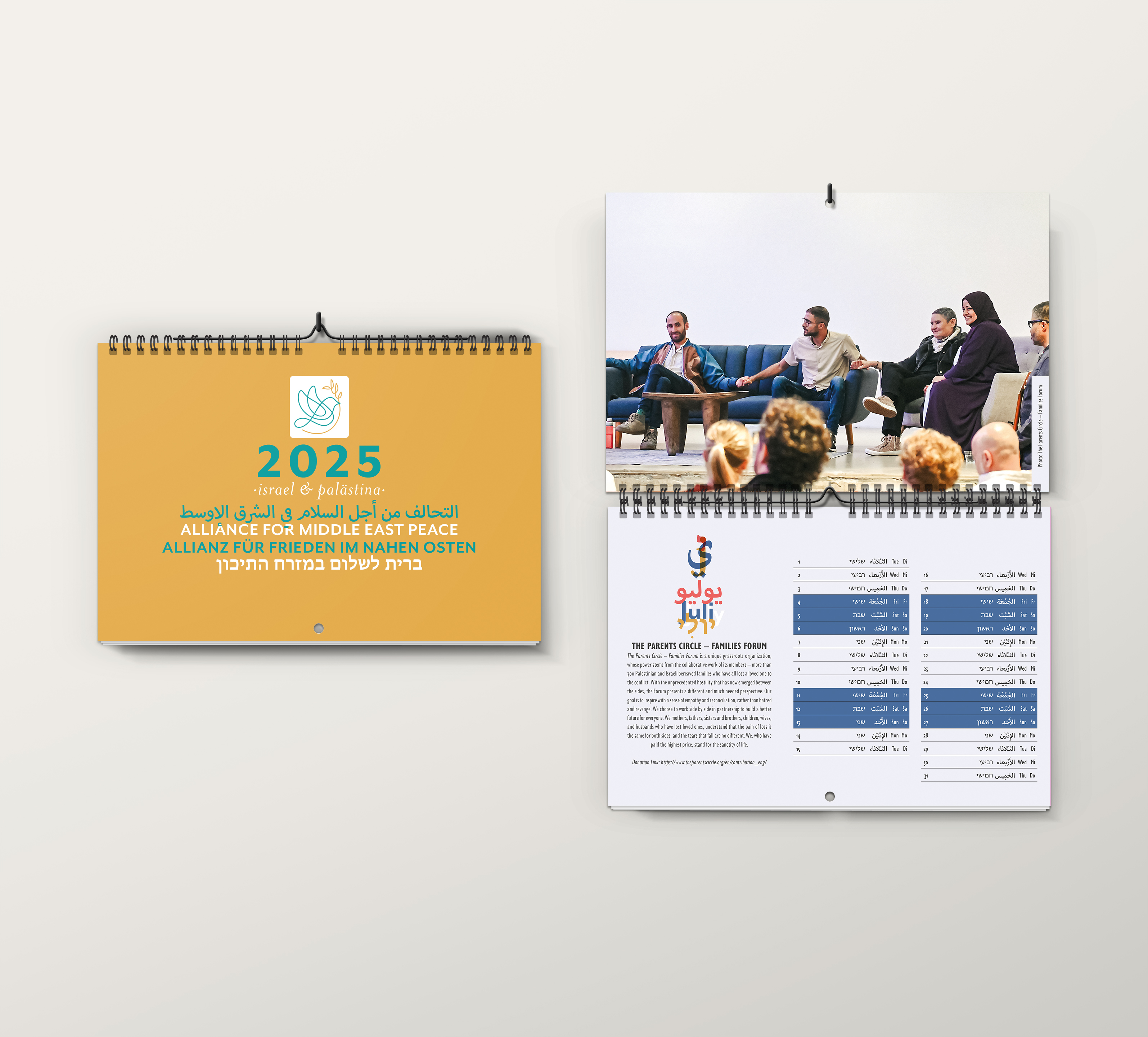
israel & palästina – Zeitschrift für Dialog | Ausgabe 4-2024
The Parents Circle – Families Forum is a unique grassroots organization, whose power stems from the collaborative work of its members – more than 700 Palestinian and Israeli bereaved families who have all lost a loved one to the conflict. With the unprecedented hostility that has now emerged between the sides, the Forum presents a different and much needed perspective. Our goal is to inspire with a sense of empathy and reconciliation, rather than hatred and revenge. We choose to work side by side in partnership to build a better future for everyone. We mothers, fathers, sisters and brothers, children, wives, and husbands who have lost loved ones, understand that the pain of loss is the same for both sides, and the tears that fall are no different. We, who have paid the highest price, stand for the sanctity of life. (Donation Link)
***
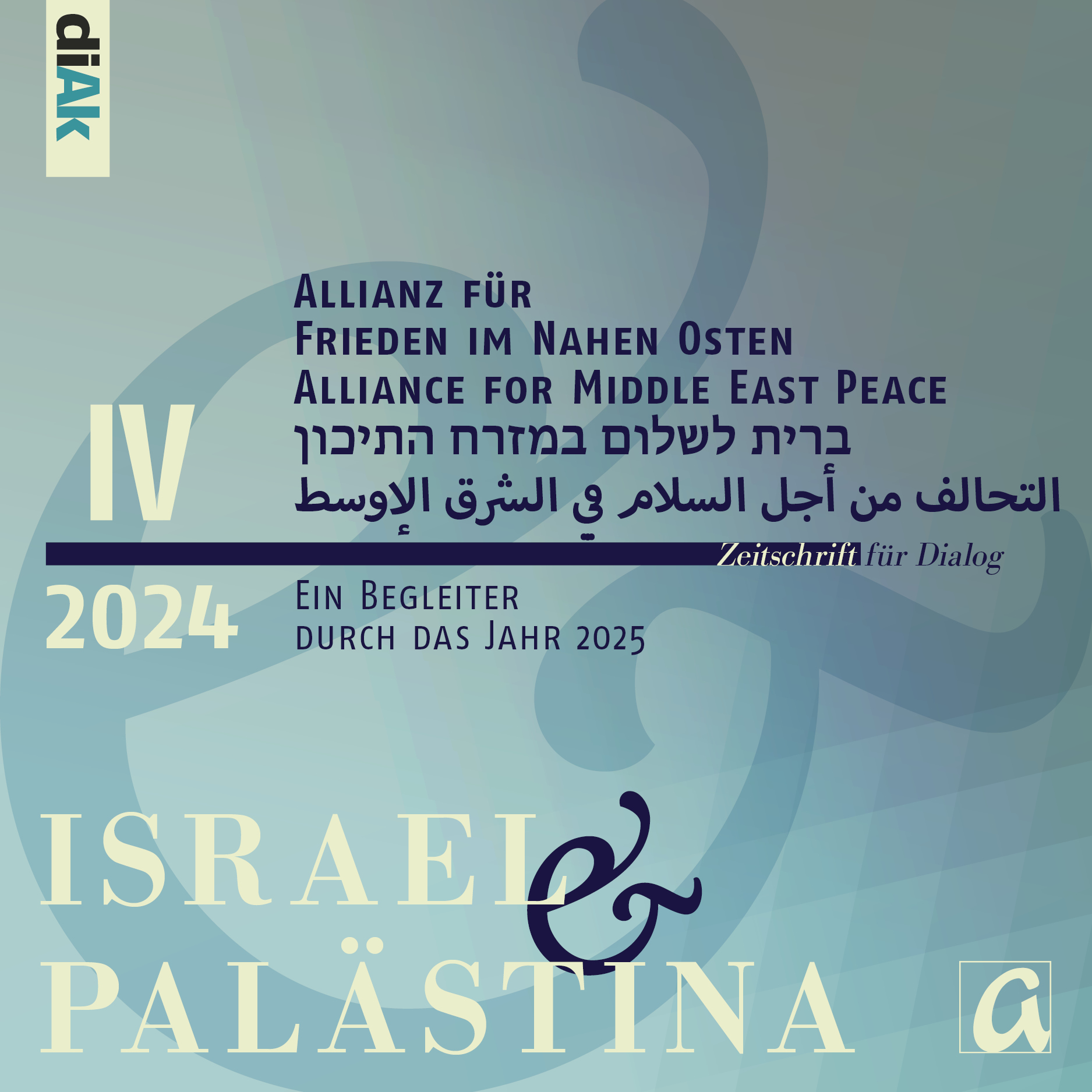
Es war das zehnte Mal, daß im Rahmen von israel & palästina | Zeitschrift für Dialog ein Photobegleiter in Kalenderform für das kommende Jahr erschienen ist:
Allianz für Frieden im Nahen Osten – Ein Begleiter durch das Jahr 2025
Erschienen in Zusammenarbeit mit allmep.org
Kalender 2025
Nach vielen weiteren Vereinigungen und auch wissenschaftlichen Gesellschaften, erreicht die Debatte über Umwege jetzt auch die DGS. Unabhängig, wie man:frau die Entscheidung bewertet, ist sie auch ein Indiz dafür, wie sich die Debatten international von denen in Deutschland unterscheiden.
Entscheidung der International Sociological Association (ISA), die kollektive Mitgliedschaft der Israelischen Gesellschaft für Soziologie (ISS) beim ISA Forum in Marokko auszusetzen.
Stellungnahme der Israeli Sociological Society (ISS) vom 5. Juli 2025
Stellungnahme der Deutschen Gesellschaft für Soziologie von 7. Juli 2025
Stellungnahme von Gabriele Rosenthal und Artur Bogner vom 3. Juli 2025
taz.Kolumne Schlagloch von Charlotte Wiedemann
Der Kulturzionist Martin Buber wird neu gelesen. Seine Utopie eines binationalen Israel-Palästina eröffnet Perspektiven, die es dringend braucht….
Briefing this Wednesday on Zoom
(In addition: Editorial from Haaretz)
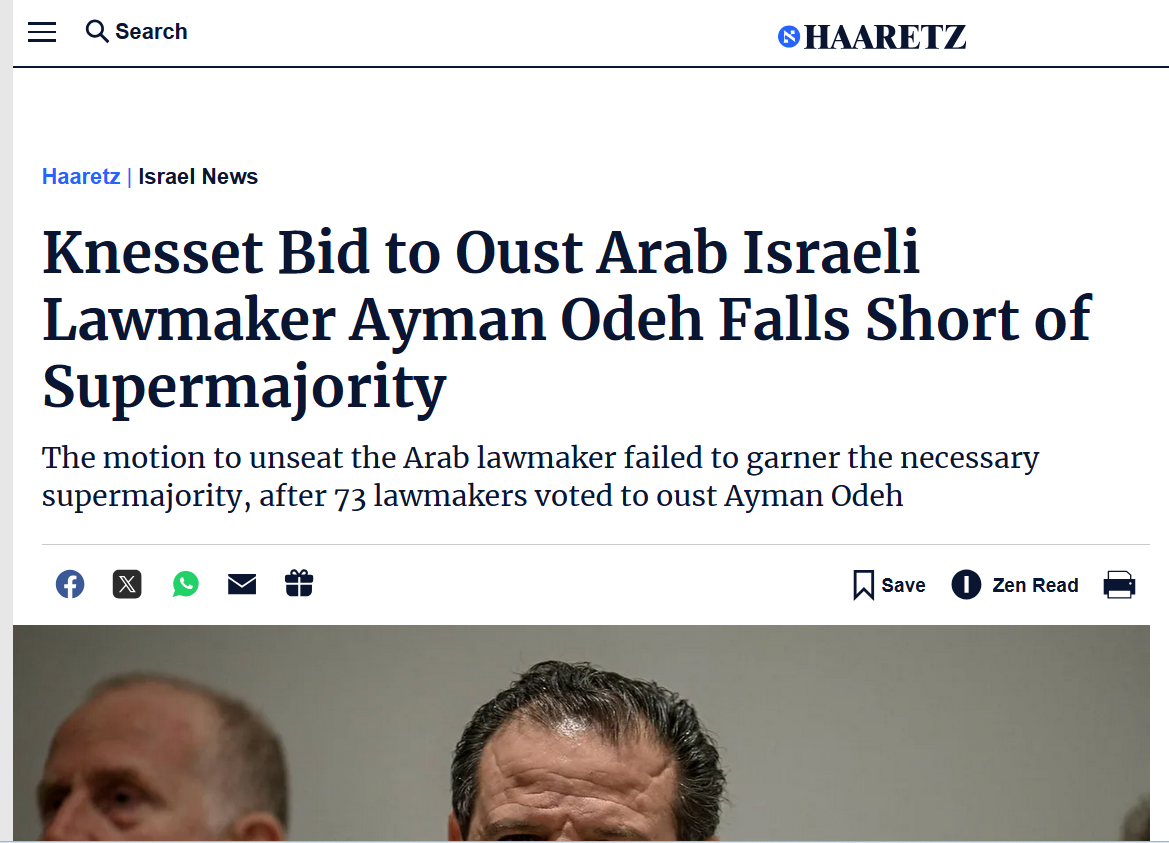
On Monday, July 14,2025 the Knesset will vote on the impeachment of Arab lawmaker Ayman Odeh, a longtime public leader who has consistently advocated for peace, civil rights, and Jewish-Arab partnership within Israel.
As The Abraham Initiatives’ Co-CEO, Amnon Be’eri-Sulitzeanu, explained in his recent op-ed, the campaign against Odeh threatens to undermine the democratic participation of Palestinian citizens across Israel and the future of Jewish-Arab political partnership. Though the proceedings were ostensibly sparked by a Twitter post by Odeh, legal experts agree that his statements fall far short of the standards for impeachment. In reality, the situation represents a targeted effort by far-right extremists to exclude the Arab public from civic life.
As the prospect of elections looms, efforts like these endanger the possibility of true political partnership between Arab and Jewish citizens of Israel. Indeed, in a recent survey, The Abraham Initiatives found that attempts to disempower Arab representatives are a major deterrent to Palestinian citizens considering whether or not to exercise their right to vote.
We hope you will join us for a briefing on Wednesday, July 16, at 9:00 a.m. PT / 12:00 p.m. ET with The Abraham Initiatives’ Co-CEO, Amnon Be’eri-Sulitzeanu, and Director of Public Affairs, Yanal Jabarin. They will discuss the full implications of the impeachment vote, whatever the outcome, and how it may impact our work to increase the Arab community’s democratic participation in the next elections.
****
Nachtrag: 22.00 Uhr (14.07.2025)
How to document the reality on the ground when reporters are systematically barred from accessing it?
Panel Discussion in English 16. Juli 2025 19.00 Uhr (Öffnung 18:30 Uhr)
im ACUD Studio, Veteranenstraße 21, 10 119 Berlin
Entrance: Donation (proceeds will pay technicians and go to Fatma Hassouna’s surviving mother)

With Israel blocking International press access, Gaza’s journalists and filmmakers have become essential witnesses – and paid a heavy price for it. In this conversation, we explore the role of local and western journalists and filmmakers in challenging enforced silence, and the emotional, ethical, and logistical complexities of bearing witness about inaccessible grounds – when the journalism quest for truth becomes a battle of its own.
The Gaza blockade on international press has left Western journalists struggling to inform impartially on a ground they can’t access. For too long they relied on Israel’s narrative as their only source, amid highly emotional domestic politics. In this context, Palestinian journalists have slowly imposed themselves as their Western colleagues’ eyes and ears in Gaza, and paid a high price for it. Israel has killed (and sometimes targeted) 220 media workers since October 2023, making Gaza the deadliest conflict for journalists in the world today, according to Reporters Without Borders (RSF).
At the heart of this reality stands the fate of the young Gaza photojournalist Fatma Hassouna whose determination and courage are the subject of Sepideh Farsi’s “Put Your Soul on Your Hand and Walk”. Hassouna was killed by an Israeli strike one day after the film’s selection at the Cannes Film Festival, but her testimony survives — through her photography and through Farsi’s documentary. This stresses the power of filmmaking as a critical tool in breaking through imposed silence. The collection of Gaza-made short films “From Ground Zero” is another instance of cinema of urgency, defying media blackouts through raw, firsthand depictions of inaccessible realities.
PANEL: The panel kicks off with an exclusive visual presentation of Hassouna’s photowork, as Sepideh Farsi shares intimate details of her collaboration with Fatma Hassouna. Researcher Aurélia Kalisky (Centre Marc Bloch) will contextualize the tactics of silencing war crimes and how film, including fiction, can defy dominant narratives and distributor and scholar Irit Neidhardt (mec film/distributor “From Ground Zero”) will the power of cinema of urgency in war contexts. Meanwhile, Middle-East Editor Lisa Schneider (taz), and Christopher Resch (Reporter Ohne Grenzen) will discuss the ethical and logistical challenges of reporting on Gaza, and the Western media’s work with Gaza journalists.
The conversation is curated and moderated by Nadja Vancauwenberghe who reported the Second Chechen War despite the Russian media blackout and currently coordinates a transnational investigation on the media and Gaza.
Our goal is to share knowledge and collectively reflect on how, in an age defined by global digital networks and real-time information flows, the total erasure of war crimes, crimes against humanity, and other forms of state violence is no longer possible. As seen in Gaza today, victims can document and share their own stories through social media, bypassing traditional gatekeepers. This marks a stark contrast to conflicts of the pre-digital world, like the Second Chechen War, where banning journalists truly meant no images, no news — leaving crimes shrouded in silence.
Joint statement on fuel shortage in Gaza
New York/ Geneva/ Rome/ Gaza, July 12, 2025
The United Nations warns that the fuel shortage in Gaza has reached critical levels.
Fuel is the backbone of survival in Gaza. It powers hospitals, water systems, sanitation networks, ambulances, and every aspect of humanitarian operations. Fuel supplies are needed to move the fleet used for transporting essential goods across the Strip and to operate a network of bakeries producing fresh bread for the affected population. Without fuel, these lifelines will vanish for 2.1 million people.
After almost two years of war, people in Gaza are facing extreme hardships, including widespread food insecurity. When fuel runs out, it places an unbearable new burden on a population teetering on the edge of starvation.
Without adequate fuel, UN agencies responding to this crisis will likely be forced to stop their operations entirely, directly impacting all essential services in Gaza. This means no health services, no clean water, and no capacity to deliver aid.
Without adequate fuel, Gaza faces a collapse of humanitarian efforts. Hospitals are already going dark, maternity, neonatal and intensive care units are failing, and ambulances can no longer move. Roads and transport will remain blocked, trapping those in need. Telecommunications will shut down, crippling lifesaving coordination and cutting families off from critical information, and from one another.
Without fuel, bakeries and community kitchens cannot operate. Water production and sanitation systems will shut down, leaving families without safe drinking water, while solid waste and sewage pile up in the streets. These conditions expose families to deadly disease outbreaks and push Gaza’s most vulnerable even closer to death.
For the first time in 130 days, a small amount of fuel entered Gaza this week. This is a welcome development, but it is a small fraction of what is needed each day to keep daily life and critical aid operations running.
The United Nations agencies and humanitarian partners cannot overstate the urgency of this moment: fuel must be allowed into Gaza in sufficient quantities and consistently to sustain life-saving operations.
Erzbischof Dr. Udo Markus Bentz, Vorsitzender der Arbeitsgruppe Naher und Mittlerer Osten der Deutschen Bischofskonferenz, äußerte sich mit deutlichen Worten zu den jüngsten Übergriffen extremistischer Siedler im Westjordanland:
„In diesen Tagen ist die mehrheitlich christliche Stadt Taybeh im Westjordanland in die Schlagzeilen geraten. Sie ist das vorerst letzte Beispiel für die unerträglichen Übergriffe extremistischer jüdischer Siedler auf palästinensische Orte. Längst handelt es sich nicht mehr um Einzelfälle, sondern um die Alltagserfahrung der dort ansässigen Bevölkerung, die eingeschüchtert werden soll, um sie zur Auswanderung zu veranlassen.
Die Gefahr, die von randalierenden Siedlern ausgeht, verschärft die Lebenssituation der Palästinenser, die ohnehin von der systematischen Zerstückelung der Infrastruktur im Westjordanland und der drastischen Einschränkung der Bewegungsfreiheit betroffen sind.
Der israelische Staat muss endlich seiner Verantwortung gerecht werden: Die Übergriffe müssen verhindert und Straftäter zur Verantwortung gezogen werden. Andernfalls wird nicht nur das internationale Renommee Israels beschädigt, sondern jeder Rest an Zukunftshoffnung, der unter den Palästinenser noch gegeben sein mag, zerstört. So ist ein Frieden in der Region auch langfristig undenkbar.
Angesichts des jüngsten Vorfalls sollte auch nicht vergessen werden, dass das christliche Leben ein wichtiger Bestandteil des palästinensischen Volkes ist. Es darf nicht vollständig aus der Region verschwinden!“

Interessant zu lesen in dem Spannungsverhältnis von USA-Israel-Palästina, aber vielleicht doch ein wenig optimisch von Peter Beinhart?

Rabbi David Rosen, Special Advisor to the Abrahamic Family House in Abu Dhabi, and Religions for Peace Co-President, shared his powerful remarks virtually to help drive our conversation from afar.
Von ihm ist in der Schriftenreihe des diAk im übrigen ein Band mit Reflektionen erschienen, die mit arabischen Zusammenfassungen versehen sind.
