Ein verlassenes Gelände mitten im Brandenburgischen Wald, im Norden von Berlin, am Bogensee. Wer heute dorthin fährt, kann nur raten, was das für ein Ort ist. Keine Infotafel deutet darauf hin, dass dieses Gelände von zwei deutschen Diktaturen geprägt wurde: Hier baute man den “Waldhof” von Nazipropagandaminister Joseph Goebbels und später eine DDR-Kaderschmiede.
In sechs Folgen gehen Markus Dichmann und Gina Enslin auf die Reise durch die Geschichte des Geländes: Welche Rolle spielte dieser Ort für Joseph Goebbels? Was erlebten die Student:innen hier in DDR-Zeiten? Warum liegt Bogensee seit über zwanzig Jahren so verlassen da? Wir sprechen mit Historiker:innen, Zeitzeug:innen und Expert:innen. Dabei wollen wir auch wissen, was aus diesem Ort werden kann und wofür das Gelände am Bogensee heute steht: Für Diktatur, Propaganda und Ideologie? Für Gemeinschaft und Visionen? Für verpasste Chancen und ungenutzte Möglichkeiten? Für Verdrängung und Vergessen?
Critics say Israeli judicial reform would end checks on Orthodox Jewish establishment
Critics of proposed judicial reform fear that it would allow the so-called religious parties that make up a crucial swing vote in Israel’s Knesset, or parliament, to impose fervently religious norms on the country’s non-Orthodox majority.
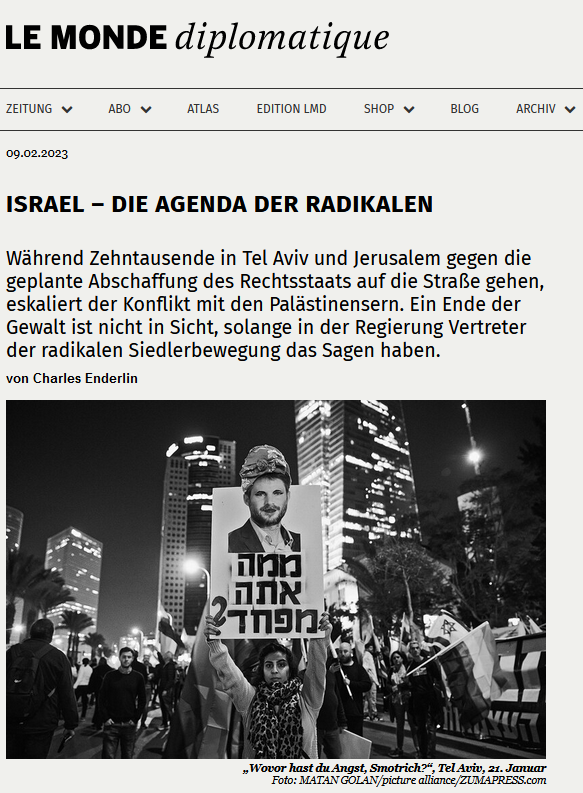
Charles Enderlin in einem längeren Beitrag in Le Monde diplomatique online nachzulesen
„Während Zehntausende in Tel Aviv und Jerusalem gegen die geplante Abschaffung des Rechtsstaats auf die Straße gehen, eskaliert der Konflikt mit den Palästinensern. Ein Ende der Gewalt ist nicht in Sicht, solange in der Regierung Vertreter der radikalen Siedlerbewegung das Sagen haben.“
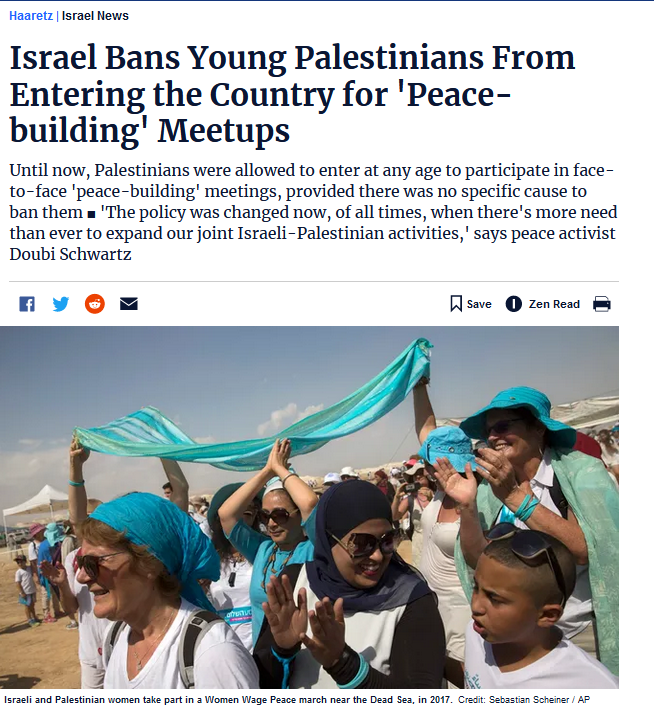
Israel Bans Young Palestinians From Entering the Country for ‚Peace-building‘ Meetups
Hagar Shezaf berichtet in Haaretz über eine weitere „kleine Hürde“ …
Until now, Palestinians were allowed to enter at any age to participate in face-to-face ‚peace-building‘ meetings, provided there was no specific cause to ban them ■ ‚The policy was changed now, of all times, when there’s more need than ever to expand our joint Israeli-Palestinian activities,‘ says peace activist Doubi Schwartz
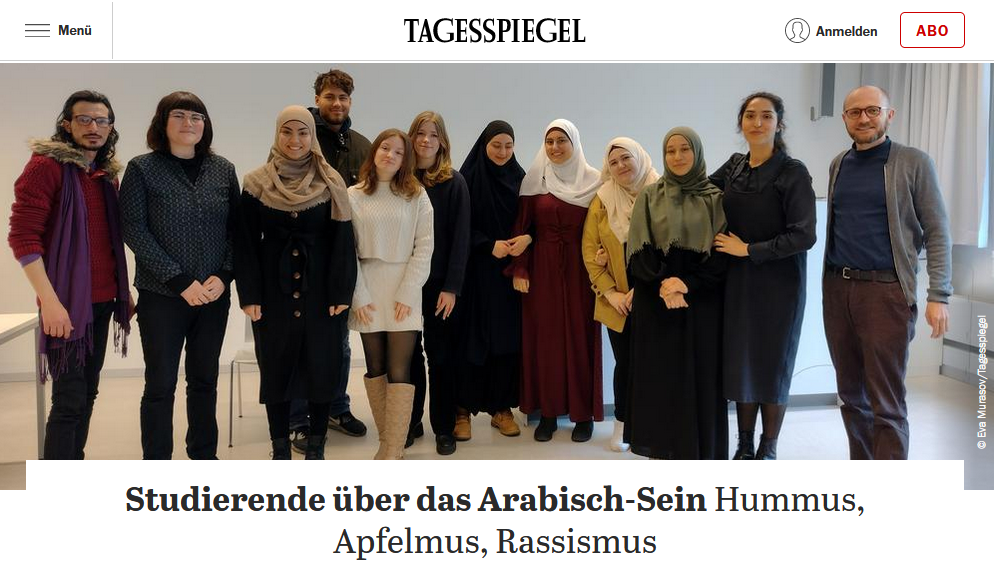
Arabistik-Studierende der FU Berlin haben kreativ erforscht, was es heißt in Deutschland arabisch zu sein. Ihre Antworten stellten sie in einer berührenden Performance vor – ein Beitrag von Eva Murašov im Tagesspiegel vom 14. Februar 2023.
Erklärung der Außenministerinnen und -minister Deutschlands, Frankreichs, Italiens, des Vereinigten Königreichs und der Vereinigten Staaten
[Angesichts der Lage kann einen die Frage überkommen, ob es sich dabei um das Pfeiffen im Wald handelt …, wenn den Worten keine Taten folgen …]
Wir, die Außenministerinnen und -minister Deutschlands, Frankreichs, Italiens, des Vereinigten Königreichs und der Vereinigten Staaten, sind zutiefst beunruhigt über die Ankündigung der israelischen Regierung, annähernd 10.000 Siedlungseinheiten zu genehmigen, sowie einen Prozess zur Normalisierung von neun Außenposten einzuleiten, die bislang nach israelischem Recht als illegal galten.
Wir lehnen diese einseitigen Maßnahmen entschieden ab, die lediglich dazu geeignet sind, die Spannungen zwischen Israelis und Palästinensern zu verschärfen und die Bemühungen um die Aushandlung einer Zweistaatenlösung zu untergraben. Wir setzen uns weiterhin für einen umfassenden, gerechten und dauerhaften Frieden im Nahen Osten ein, der das Ergebnis unmittelbarer Verhandlungen zwischen den beiden Parteien sein muss. Israelis und Palästinenser verdienen es, in Frieden zu leben und gleichermaßen in den Genuss von Freiheit, Sicherheit und Wohlstand zu kommen.
Wir bekräftigen unser Eintreten dafür, Israelis und Palästinensern dabei zu helfen, die Vision eines vollständig in den Nahen Osten integrierten Staates Israel zu verwirklichen, der Seite an Seite mit einem souveränen, lebensfähigen Staat Palästina zusammenlebt. Wir werden die Entwicklungen vor Ort, die Auswirkungen auf die Realisierbarkeit der Zweitstaatenlösung und die Stabilität in der Region insgesamt haben, weiterhin aufmerksam verfolgen.
Understanding the Pain of Others – The Holocaust, the Nakba und German Memory Culture
Podiumsdiskussion vom Donnerstag, 2. Februar 2023, 19:00 h
Auf Youtube kann die Veranstaltung nachgehört/nachgeschaut werden.
Gesprächsleitung: Susan Neiman, Potsdam
In her book Understanding the Pain of Others, the author Charlotte Wiedemann pleads for a new inclusive memory culture that promotes solidarity instead of competition among victims. Doing justice to the victims of colonial crimes and their descendants does not call into question the specificity of the Shoah. On the contrary: the importance of human rights for all is a central lesson from the Holocaust. But tragically, Holocaust memory has not brought us much closer to such universal values. In their co-edited volume The Holocaust and the Nakba: A New Grammar of Trauma and History Amos Goldberg, Bashir Bashir, and the contributors to the volume explore the possibility of creating a shared language for discussing the memories of two entangled, but entirely different historical events: the genocide of European Jews and the displacement of Palestinians. At the center of this new language is the concept of empathic unsettlement which challenges the mutual denial of the suffering of the Other, recognizes the political asymmetries in Israel-Palestine, and gives rise to an egalitarian binationalism. This debate was originally scheduled to take place in the Goethe Institute Tel Aviv but was cancelled due to political pressure.
Charlotte Wiedemann is a journalist and author. She has published numerous books on international topics, most recently Den Schmerz der Anderen begreifen. Holocaust und Weltgedächtnis (2022). Afflicted by silence in her own family, she has followed debates about German responsibility for National Socialism for four decades. Bashir Bashir is associate professor of political theory at the Open University of Israel and senior research fellow at the Van Leer Jerusalem Institute. His research interests are: democratic theory, nationalism and citizenship studies, liberalism, decolonization, and reconciliation. His most recent publication is The Arab and Jewish Questions: Geographies of Engagement in Palestine and Beyond (2020).
Amos Goldberg is associate professor of Jewish History and Contemporary Jewry at the Hebrew University of Jerusalem. For decades he has researched Holocaust memory at the intersection of history, critical theory, and literature. His publications include Trauma in First Person: Diary Writing during the Holocaust (2017) and his co-edited volume Marking Evil: Holocaust Memory in the Global Age (2015).
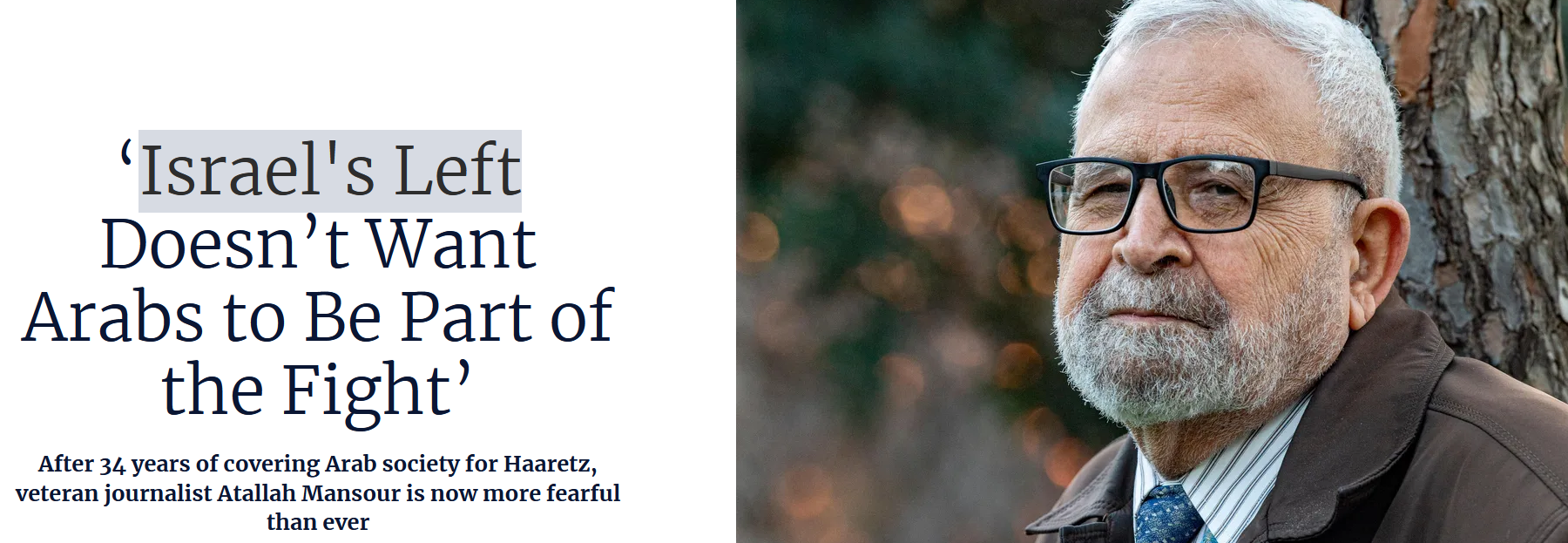
Jahrzehntelang war Atallah Mansour eine bekannte Stimme der linksliberalen Tageszeitung Haaretz. Nun kommt der palästinensich-israelische Journalist (Jg. 1934) in einem ausführlichen Interview (9. Februar 2023: Israel’s Left Doesn’t Want Arabs to Be Part of the Fight’ – After 34 years of covering Arab society for Haaretz, veteran journalist Atallah Mansour is now more fearful than ever) zu dem Schluß, daß die Lage der arabisch-palästinensischen Israelis nie so gefährdet war wie heute. Das Nationalstaatgesetz von 2018 machte sie zu Bürgern zweiter Klasse. Die geplante ‚Revolution‘ der neuen Regierung hat nicht nur fatale Folgen für den rechtlichen Status aller Minderheiten in Israel, sie wird diese weiter sozial und politisch diskriminieren.
Hier Auszüge aus dem Gespräch:
”Mansour, the first Arab journalist to work in Israeli media, began his career at Haaretz in 1958 and covered Arab society over the next 34 years. “I wasn’t in anyone’s pocket nor was I a spokesman for any particular community. I did my work as a journalist,” he says. From the start, he understood the challenges involved in covering the Arab community for the Israeli media.”
My meeting with Mansour took place at his home in Nazareth several days after another round of protests against the judicial revolution planned by the Netanyahu government. Like many Arab Israelis, he expresses fear and uncertainty about the plan. He says that compared to all the other events of his long career, including the Second Lebanon War and the second intifada, “the situation this time is different from anything I’ve seen.”
“The changes this right-wing government is now proposing didn’t happen suddenly but have been taking place gradually and over an extended period of time,” he says. “In July 2018, they submitted the nation-state law [Basic Law on Israel as the Nation-State of the Jewish People, which critics say turns non-Jews in Israel into second-class citizens] – that was the first breaking point. … The Declaration of Independence takes into account minorities, among them Arabs, and recognizes the principle of equality, human dignity and freedom, even if it is only in theory. But the nation-state law doesn’t relate to equal rights for minorities – even the Druze who serve in the army aren’t mentioned. The nation-state law erases minorities – we’re no longer thought of as equals. That’s the worst thing that’s happened, not just on the level of the law. We’ve seen the consequences of it and they are far-reaching.”
Even the Joint List broke up. “That happened as part of changes underway in Arab society. I voted for the Joint List – it’s the only choice left for me – but over the years we’ve seen support for Hadash [whose roots are in the Communist Party] weaken. Once they were as strong as the sun; today, they’re barely candlelight. Meanwhile, the Muslim tendencies have strengthened throughout the Arab world – the United Arab List and Mansour Abbas are part of that phenomenon.”
Do you still believe in the two-state solution? Do you think it’s a realistic scenario?
“There’s no other solution apart from two states. But if there really isn’t any readiness to compensate the families that were expelled from here, it will never happen. Peace has a price and Israel needs to make an effort. Annexation, if it happens, will ultimately harm the State of Israel – it will no longer be the same country. How long can the Palestinians remain without equality? The number of Arabs when the state was established was about 160,000. Today we are 2 million, and we are still fighting for full equality of rights.”