Im ORF heißt es dazu: „Mehr als zwei Jahre nach dem beispiellosen Massaker der Terrororganisation Hamas und anderer Extremistengruppen in Israel verweigert Ministerpräsident Benjamin Netanjahu weiterhin eine unabhängige Untersuchung der Vorfälle. Statt der Einrichtung einer staatlichen Untersuchungskommission befürwortet der 76-Jährige die Ernennung einer Regierungskommission.“
Times of Israel: „Lawmakers advance bill for politically appointed Oct. 7 probe in place of state inquiry“
Haaretz: Netanyahu Ministers Approve Government-controlled Oct. 7 Probe, Push Judicial Overhaul Bills – A committee of Israeli ministers has approved on Monday to advance a bill establishing an investigation into Hamas‘ October 7 attack, a Likud-sponsored proposal that would give Prime Minister Benjamin Netanyahu’s government influence over the inquiry’s composition and mandate.
An ecumenical witness for equality and a just peace in Palestine/Israel
Jerusalem, 20. Dezember 2025 | A Christmas Message – 2025
The cities of the Holy Land are adorned with lights and trees during this Christmas season, and markets and festivals abound, spreading a festive atmosphere. Many of us participate in these gatherings, as if we are thirsting for life after witnessing death and destruction over the past two years. Joy radiates from the faces of children and adults alike, in the carols and hymns, and in the markets and gifts.
We must ask: How can we celebrate while our people in Gaza are still suffering the effects of war, destruction, genocide and now face a harsh, rainy winter? Many are exposed to the elements, trying to survive without the most basic necessities. People are still dying: killed by the Israeli army, dying of starvation, disease and exposure to the cold.
How can we celebrate when, in the West Bank, terror reigns as the army imposes its regime of assassinations, mass arrests, house demolitions, land confiscation, while the settlers continue their rampage? Among those suffering under this regime of terror are our Christian brothers and sisters in Taybeh and Abboud. Their villages, like so many others, are attacked, their fields pillaged and their ancient churches desecrated.
We ask ourselves: How can we celebrate? Yet, celebrate we must!
We might indeed be powerless in the face of Israeli intransigence, which prevents life from entering Gaza, preventing law enforcement in the West Bank. However, the message from Bethlehem, Nazareth, and Jerusalem is that equality must come, injustice must end and light must triumph. Our Christmas celebration proclaims a message of life in the face of death and darkness.
Our celebrations are filled with Christmas carols and messages of hope, raised by faithful and pastors from the depths of our hearts, offering us a glimmer of hope after the horrors of the past two years. We revive hope by reliving the memory of Christmas, the birth of the Prince of Peace. Christmas is a holiday for everyone; it is a prayer, a celebration of humanity, and also a national holiday.
Some may ask: Have the celebrations and events become excessive? Have they burdened families already struggling with difficult economic circumstances? However, the number of participants in these celebrations gives the impression that they enrich the Christmas season, revitalize the economy, and bring joy and hope back to families who have waited so long.
This Christmas, we want to celebrate, but we continue, at the same time, to remain committed to our mission and our peaceful resistance, striving for equality, freedom, justice, and peace. Our hope is the hope of the shepherds at the coming of Christ. The angel told them: “I am bringing you good news of great joy for all the people: to you is born this day in the city of David a Savior, who is the Messiah, the Lord.” (Luke 2:10-11).
We rejoice and we celebrate, but with awareness and caution, for we are exposed every day to the danger of death and war in Gaza and throughout Palestine. We celebrate with our souls burdened by death in our land. Even in the heart of our city, Jerusalem, the City of God, at its so-called New Gate, there are attempts to deprive us of the serenity and sanctity of our feast, especially the municipality’s policy aimed at Judaizing the city and undermining the status quo that guarantees pluralism and the unique character of this neighborhood and the city as a whole.
Despite all this, we celebrate with our hearts lifted up to the sublimity of God, filled with the joy of the coming of the eternal Word of God, who became man and dwelt among us, our Savior and the Savior of all humanity. Through Him, we are free, witnesses and messengers of the message of love in our beloved Holy Land. Glory to God in the highest, and on all our land, peace from God, love, justice, and equality. Happy Feast!
Signatories: Latin Patriarch of Jerusalem Michel Sabbah (emeritus) Greek Orthodox Archbishop Attallah Hanna Lutheran Bishop of the Holy Land Munib Younan (emeritus) Mr. Yusef Daher Ms. Sawsan Bitar Mr. Samuel Munayer Ms. Dina Nasser Mr. John Munayer Ms. Sandra Khoury Rev. David Neuhaus SJ Rev. Frans Bouwen MAfr Rev. Firas Abdrabbo Mr. Rafi Ghattas Rev. Alessandro Barchi and other members
Key Words for the Study of the Arabic Literary and Manuscript Tradition
Logo created by Nadia El Obaidi, FUB-IT, 2025
kalimatin Arabic means ‚words‘; the Acronym stands for “Key Words for the Study of the Arabic Literary and Manuscript Tradition” (in Arabic: كلمات مفتاحية لدراسات المخطوطات والنصوص الأدبية في التراث العربي).
kalimat is the first online handbook of Arabic literature from the pre-modern and early modern periods. The new publication format promotes Arabic and English as the two languages of academic research and learning in the field.
Thus, all articles are to be published in both Arabic and English, just as the platform is bilingual in all its functionalities. Both the editorial workflows, the editing and incremental publication of the articles will be facilitated by the open source software Open Encyclopedia System (OES)engineered by the project partner FUB-IT at the Freie Universität Berlin directed by Brigitte Grote. The entire platform is published in open access.
kalimatconsists of short articles that translate Arabic literary concepts into modern usage, as well as analyze and contextualize them in specified corpora. The main goal of kalimat is to emphasize the complexity and multi-layered semantic nature of literature as a meta-concept. Another goal is to account for the polysemy and mutability of the rich repertoire of Arabic literary concepts. The terms and concepts to be included in our living handbook will bring together research in philology and literary and intellectual history as well as cultural studies and are drawn from the fields of literary genres and institutions, literary theory including poetics, rhetoric, and linguistics, literary ethics (adab), as well as textual practices.
The kalimat project and editorial team at Freie Universität Berlin under the academic lead of Johannes Stephan are hosting a pilot project in Arabic Digital Humanities to facilitate access to the latest academic research in the field, promote young academics and their contributions and to open the floor for new readings of literary concepts in the Arabic tradition.
Freie Universität Berlin, Department of History and Cultural Studies, Arabic Studies, Fabeckstraße 23/25, 14195 Berlin-Dahlem
Anläßlich von Chanukka und der Adventszeit bittet der NIF Deutschland um Unterstützung für das NIF Peace and Security Programm. Aus diesem Programm fördert der NIF Organisationen, die sich für eine friedliche und gleichberechtigte Zukunft für Israelis und Palästinenser:innen einsetzen. Auf den Social-Media-Kanälen Instagram, Facebook und LinkedIn findet sich die Kampagne „8 Tage Chanukka. 8 Initiativen für Frieden“ bereits gestartet. Jeden Tag wurde /wird dort eine Initiative vor, die 2025 mit Unterstützung des NIF Hoffnung geschenkt und Licht in dunkle Zeiten gebracht hat.
Auch solche Nachrichten gibt es (noch nicht genug…)
London to Host the World’s First Summit for the International Fund for Israeli-Palestinian Peace
In a landmark move backed by overwhelming public support, Foreign Secretary Yvette Cooper announces she will host an inaugural meeting of the International Fund for Israeli-Palestinian Peace in March 2026 in London, at Lancaster House.
Announced on December 8th, the government confirmed its goal to “bring together international peacebuilding expertise and civil society organisations from the Middle East, to map existing peace-building work and support the establishment of an International Peace Fund for Israel and Palestine”, highlighting the important role that civil society organisations can play.
Foreign Secretary Cooper stated that “this conference will be a crucial step in that journey, bringing together representatives of Palestinian and Israeli civil society to build common ground between their communities, challenge entrenched divisions, and work towards a future where both states can live side-by-side in peace and security”
Yvette Cooper stated that the UK is “well placed to host and facilitate these talks, and the new International Peace Fund we are helping to create will provide the practical support to drive this work forward.”
Later that day, ChancellorRachel Reeves re-iterated her government’s support for this initiative at LFI’s annual lunch, stating: “I can confirm today that Foreign Secretary Yvette Cooper will host representatives from Israeli and Palestinian civil society in March at Lancaster House to support the establishment of an International Fund, and ensure civil society groups are at the forefront of our efforts to advance long-term peace, and a two-state solution”
The announcement coincides with new UK polling showing that among respondents who expressed an opinion 84% of the UK public support creating the Fund, and 73% want the UK to contribute at least £10 million towards it. Global polling shows the same appetite: 88% of respondents support their country joining international peace efforts, and a majority back participation in the Fund.
The announcement fulfills a pledge made last year by Prime Minister Sir Keir Starmer, following a private meeting with peacebuilders Ibrahim Abu Ahmed and Barak Talmor, alongside ALLMEP’s Executive Director John Lyndon and UK Advocacy Manager Rachael Liss. There, the Prime Minister heard first-hand how grassroots initiatives are reducing violence, building trust, and creating the conditions for a lasting and just peace.
The UK’s decision comes at a decisive moment. A fragile ceasefire was secured in October, yet progress toward subsequent stages remains limited. Experience from other successfully resolved conflicts suggests that turning a temporary truce into lasting peace requires sustained engagement with the communities directly affected by the conflict—support that can help generate the trust, ideas, policies, and future leadership essential for long-term conflict resolution.
The International Fund for Israeli-Palestinian Peace is designed to meet this need by providing robust, multi-year support for civil society initiatives that promote relationship-building, shift public attitudes, and catalyse the societal change that political agreements alone cannot achieve.
The UK’s decision reflects a recognition that transforming a ceasefire into a durable peace will require integrating civil society as a central component of the process. The announcement also positions the UK as a leader in advancing commitments made in the 2024 G7 Leaders’ Communiqué to “coordinate and institutionalise support for civil society peacebuilders as part of a wider diplomatic strategy.” The approach also aligns with the New York Declaration and with the Trump 20 Point Plan, each of which articulate a role for civil society recognising that peace cannot be secured solely through political negotiation.
Aus dem Mailing der American Friends of Combatants for Peace
Yesterday, I was moved to my core as we gathered in shared witness: listening, reflecting, and holding what it means to respond to immense human need with compassion and responsibility.
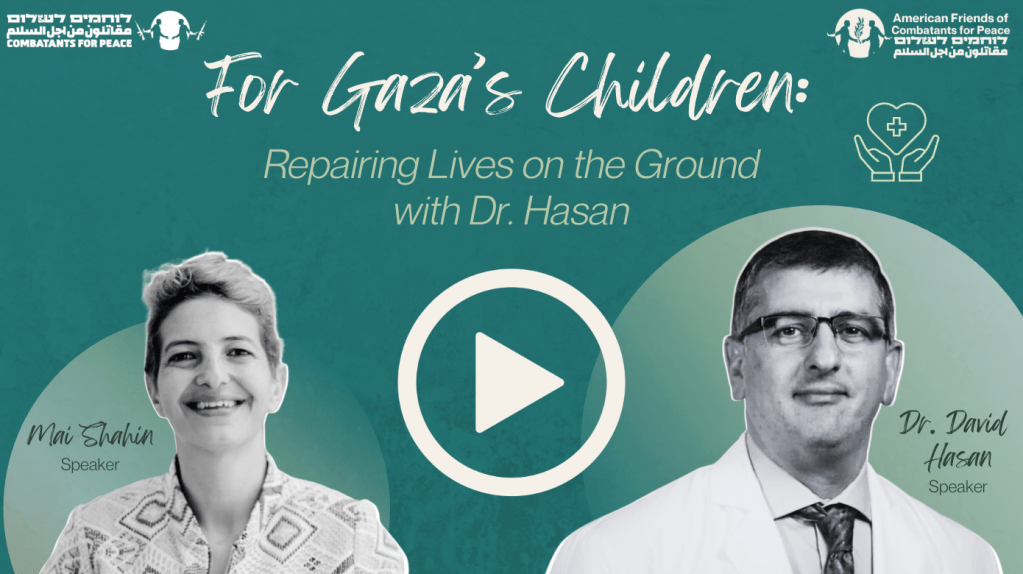
We heard from Dr. David Hasan, a Palestinian-American neurosurgeon, Duke University professor, and the founder of the Gaza Children Village (GCV). Drawing on his frontline medical missions in Gaza, Dr. Hasan spoke about the collapse of critical systems and his decision to envision something more: a community-led model of care that protects children not only in moments of crisis, but also over the long term.
He also spoke of the urgent effort underway to convert an existing facility into what will become Gaza’s only tertiary children’s hospital, a lifeline for newborns, children with injuries, and families who have nowhere to turn.
GCV has become a refuge for orphaned and highly vulnerable children across the Gaza Strip. Today, they serve more than 8,500 children, providing safe, structured daily environments where children can learn, heal, and grow, supported by education, nutrition, medical care, and psychosocial support.
As we close 2025, we invite you to join the work of repair in Gaza by supporting GCV directly. You can learn more about their mission and support their work here: 👉 https://www.thegazachildrenvillage.org/
Thank you for being a part of the collective movement of healing, humanity, and hope. Together, we can help build a future worthy of Gaza’s precious children.
Der Internationale Strafgerichtshof (IStGH) hat einen israelischen Antrag auf Einstellung seiner Ermittlungen zum Gaza-Krieg abgelehnt und die Gültigkeit der Haftbefehle gegen Premierminister Benjamin Netanjahu und den ehemaligen Verteidigungsminister Yoav Gallant bestätigt.
Die Ermittlungen erstrecken sich auch auf die Ereignisse nach dem Hamas-Angriff vom 7. Oktober 2023. Israel lehnt jedoch die Zuständigkeit des IStGH ab und bestreitet, Kriegsverbrechen begangen zu haben, und behauptet, daß seine Kampagne im Gazastreifen darauf abziele, die Hamas auszuschalten.
Der IStGH hatte ursprünglich auch gegen den Hamas-Führer einen Haftbefehl erlassen, der jedoch nach Berichten über seinen Tod aufgehoben wurde. Die aktuelle Entscheidung betrifft nur einen von mehreren israelischen Einsprüchen. Wann der IStGH über die weiteren entscheidet, ist noch unklar.
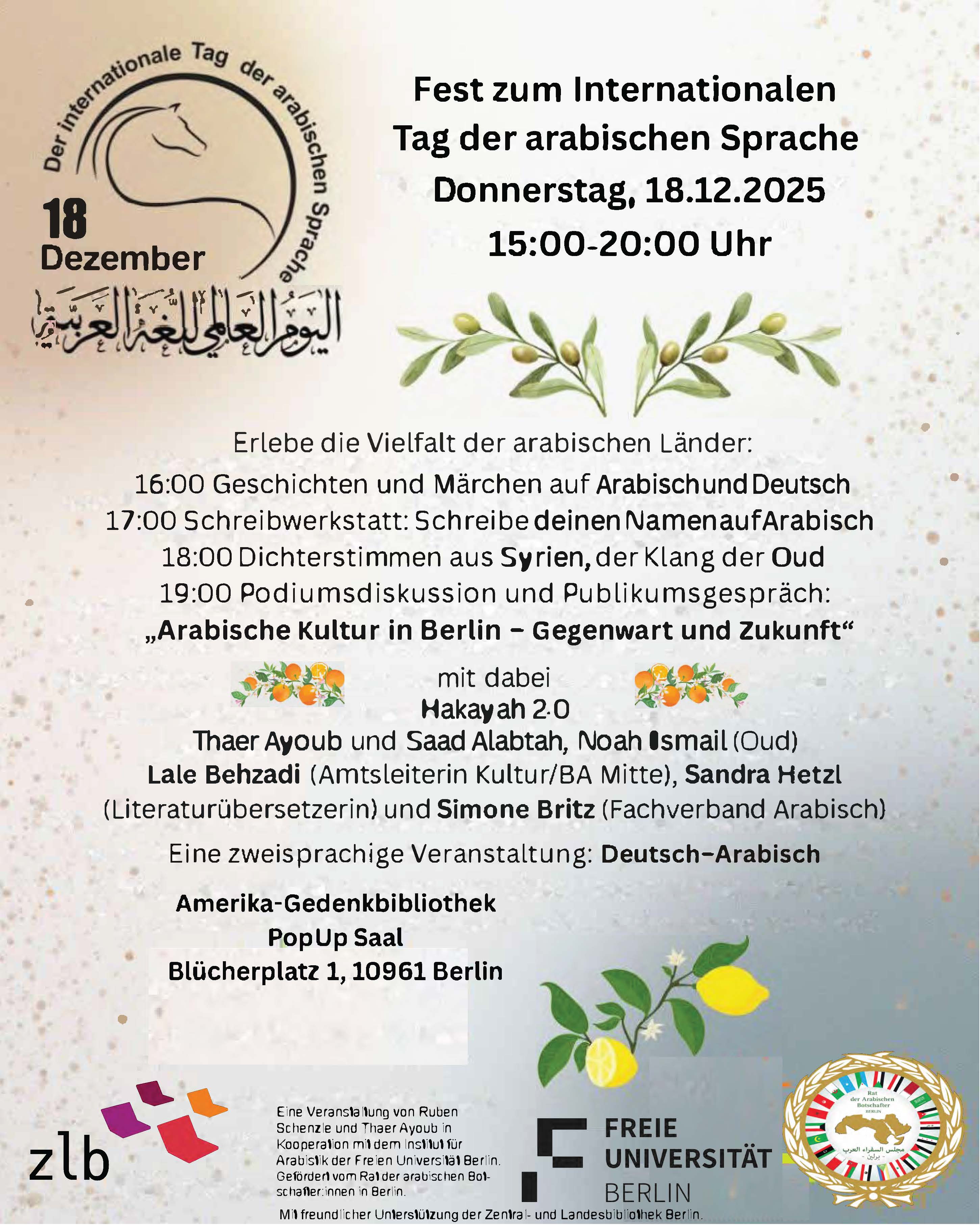
Mit Kunst und Kultur wird in Berlin (und anderenorts?) ein Fest der arabischen Sprache gefeiert: Am 18. Dezember 1973 wurde Arabisch als eine der sechs offiziellen Amtssprachen der Vereinten Nationen anerkannt.
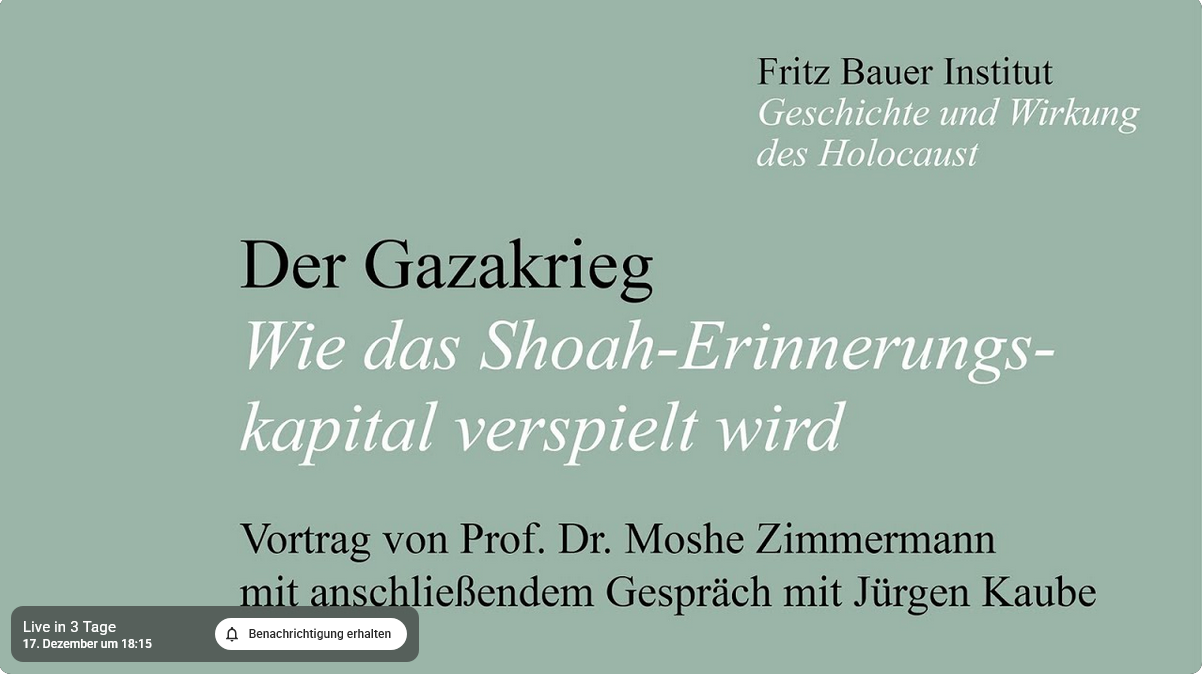
Der Zionismus präsentiert sich als absolute Alternative zur »Endlösung der Judenfrage«. Entsprechend schöpft der zionistische Staat aus dem Erinnerungskapital der Shoah seine Rechtfertigung und viele seiner politischen Argumente. Der inflationäre Griff nach diesem Erinnerungskapital verbraucht und verspielt es, besonders seit dem 7. Oktober 2023, mit dem Ergebnis, daß der Zionismus nicht mehr auf diese Erinnerung zurückgreifen kann und er seine Manifestation, den Staat Israel, delegitimiert.
Prof. Dr. Moshe Zimmermann ist Professor emeritus für Neuere Geschichte an der Hebräischen Universität (West-)Jerusalem. Zwischen 1986 und 2012 war er Direktor des Richard-Koebner-Minerva-Zentrums für Deutsche Geschichte.
Jürgen Kaube ist Herausgeber sowie Chef des Feuilletons der Frankfurter Allgemeinen Zeitung und Träger des Ludwig-Börne-Preises 2015.