Die Stimme von CfP

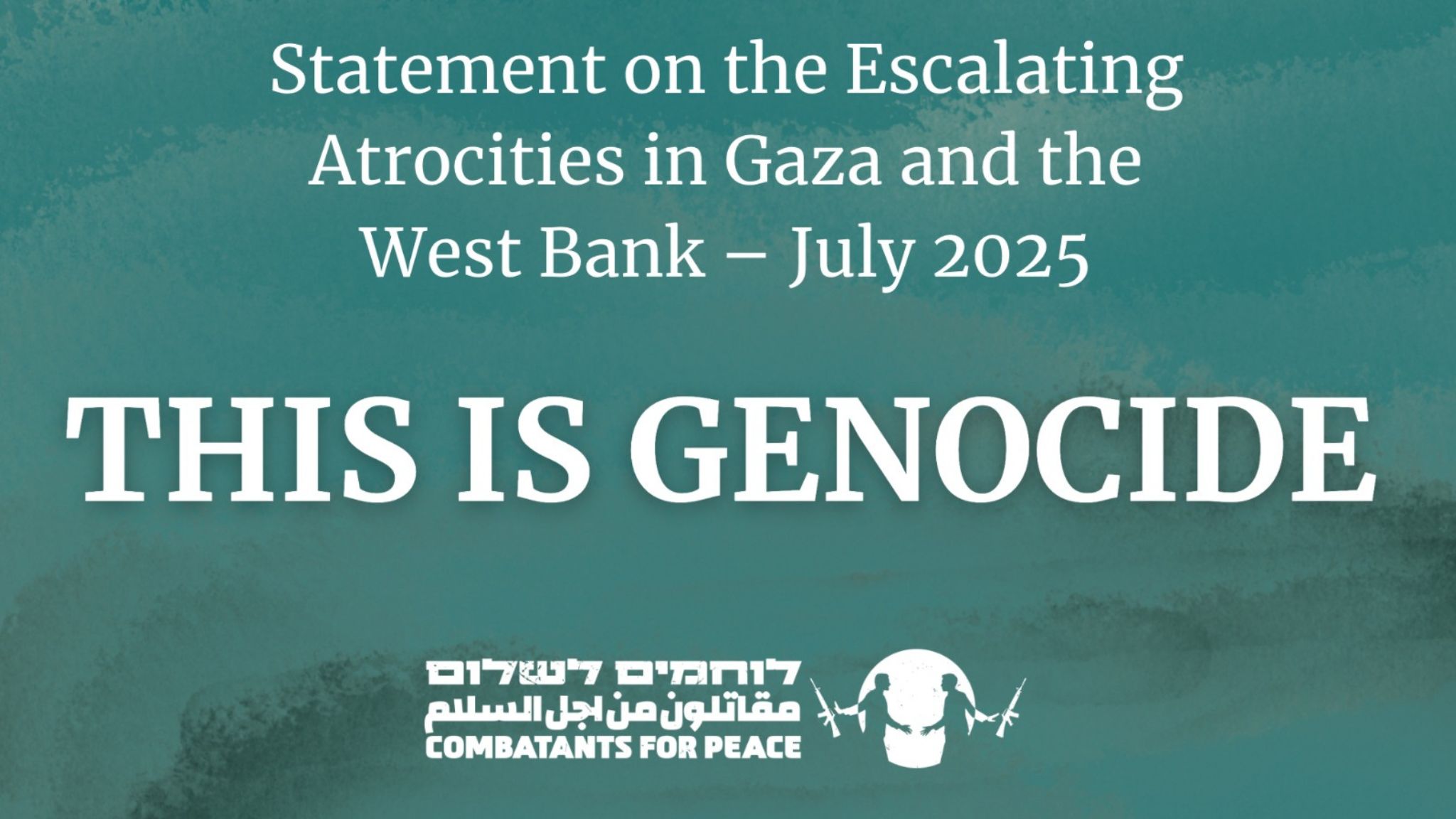
As a binational movement of Palestinians and Israelis committed to nonviolence and equality, Combatants for Peace issues this urgent statement in light of the deepening humanitarian and political crisis across Gaza and the West Bank:

In response to the continued policy of starvation in Gaza and the accelerating ethnic cleansing of Palestinian communities in the West Bank, we are compelled to speak clearly: this is genocide – and it must be stopped.

We do not use this word lightly. As outlined in B’Tselem’s recent report, Our Genocide  what we are witnessing is not simply a failure to protect civilian life – it is the deliberate, state-enabled destruction of it.

In Gaza, more than 60,000 people have been killed, including thousands of children. Families are dying of hunger, and entire neighborhoods have been reduced to rubble. Israel has systematically and deliberately destroyed over 70% of Gaza’s buildings, damaged or destroyed 94% of hospitals, and wiped out 89% of schools. Aid is obstructed, water is cut off, and civilians are being shot as they attempt to reach food. This is not a natural disaster – it is a deliberate policy choice aimed at destroying the conditions for civilian life.  

In the West Bank restrictions on movement have worsened dramatically, with checkpoints multiplying, roads closed without notice, and entire villages cut off from hospitals, schools and markets – all while entire rural Palestinian communities are being displaced by armed settlers and military units working in tandem. In the Jordan Valley, South Hebron Hills, and northern districts, homes have been torched, water sources poisoned, livestock killed, and people forced to flee. Just last night, Awdah Hathaleen – a well-known and loved community activist from Umm al-Khair – was shot and killed in yet another murderous settler attack. Weeks earlier, Sayfollah Musallet was beaten to death in the village of Sinjil while defending his family’s land from encroaching settlers. These are not isolated acts. They are part of a clear and documented strategy to remove Palestinians from their land – what international law recognizes as ethnic cleansing.

We also recognize the pain and anguish of Israeli families whose loved ones remain held hostage in Gaza. These hostages must be returned unharmed now – or, where necessary, given a respectful burial. Their immense suffering cannot be ignored. But it also cannot justify the starvation and mass killing of an entire civilian population. 

At the same time, thousands of Palestinian political prisoners remain imprisoned in Israeli jails, held in inhumane and degrading conditions. Many have endured years without trial, in solitary confinement, or denied access to legal recourse. Their release must be part of any just and lasting political resolution.

Any meaningful path toward peace must confront the full scope of human rights violations in this conflict – including the systemic use of unlawful detention and collective punishment against Palestinians, and the ongoing trauma, insecurity, and targeting of civilians experienced by Israelis. Justice must be extended to all who live here, without exception.

As Palestinians and Israelis who have chosen to walk the path of nonviolence – even in a time of war – we call on all people of conscience, within our societies and beyond them, to speak out. To act. To refuse complicity, and to reject the lies that tell us there is no other way.

We remain committed to peace, to nonviolence, and to each other. 

This commitment is rooted in the belief that the occupation must end, and that justice is not a dream – it is a requirement. Only then can we begin to repair what has been broken – and begin to build the future we know is possible: a future where Palestinians and Israelis live in freedom and equality, guided by a shared commitment to nonviolence and humanity.

In solidarity and hope,

Combatants for Peace

Halachic Left

Ein Beitrag von Yonat Shimron auf RNS

Statement on Gaza

By Tom Fletcher,
Under-Secretary-General for Humanitarian Affairs and Emergency Relief Coordinator

As the world is witnessing, the humanitarian crisis in Gaza is devastating. One in three people in Gaza hasn’t eaten for days. People are being shot just trying to get food to feed their families. Children are wasting away. This is what we face on the ground right now.

We welcome Israel’s decision to support a one-week scale-up of aid, including lifting customs barriers on food, medicine and fuel from Egypt and the reported designation of secure routes for UN humanitarian convoys. Some movement restrictions appear to have been eased today, with initial reports indicating that over 100 truckloads were collected.

This is progress, but vast amounts of aid are needed to stave off famine and a catastrophic health crisis. Across the UN agencies and humanitarian community, we are mobilized to save as many lives as we can.

But we need sustained action, and fast, including quicker clearances for convoys going to the crossing and dispatching into Gaza; multiple trips per day to the crossings so we and our partners can pick up the cargo; safe routes that avoid crowded areas; and no more attacks on people gathering for food.

Fuel must be allowed in consistently and at the volume needed to keep aid operations running.

More than 59,000 people have reportedly been killed in Gaza since 7 October 2023, nearly 18,000 of them children.

International humanitarian law must be respected. Aid must not be blocked, delayed or come under fire. Hostages must be released, immediately and unconditionally.

Ultimately of course we don’t just need a pause – we need a permanent ceasefire.

The world is calling for this lifesaving aid to get through. We won’t stop working for that.

In diesen Minuten

Israelis für Frieden | Israelis for Peace

29, (zum fremdschämen)

Nicht einmal das glaubt die Bundesregierung unterschreiben zu können.

[Und es ist keine Erklärung des Iran, Rußlands, Nordkoreas und …]

sondern ein Joint statement by:

EU Commissioner for Equality, Preparedness and Crisis Management and

Foreign ministers of

Australia,
Austria,
Belgium,
Canada,
Cyprus,
Denmark,
Estonia,
Finland,
France,
Iceland,
Ireland,
Italy,
Greece,
Japan,
Latvia,
Lithuania,
Luxembourg,
Malta,
The Netherlands,
New Zealand,
Norway, (da hat der Kanzler noch mal am selben Tag die großen Gemeinsamkeiten betont, als der PM in Berlin zu Gast war …)
Poland,
Portugal,
Slovenia,
Spain,
Sweden,
Switzerland and the
UK

We, the signatories listed below, come together with a simple, urgent message: the war in Gaza must end now.

The suffering of civilians in Gaza has reached new depths. The Israeli government’s aid delivery model is dangerous, fuels instability and deprives Gazans of human dignity. We condemn the drip feeding of aid and the inhumane killing of civilians, including children, seeking to meet their most basic needs of water and food. It is horrifying that over 800 Palestinians have been killed while seeking aid. The Israeli Government’s denial of essential humanitarian assistance to the civilian population is unacceptable. Israel must comply with its obligations under international humanitarian law.
The hostages cruelly held captive by Hamas since 7 October 2023 continue to suffer terribly. We condemn their continued detention and call for their immediate and unconditional release. A negotiated ceasefire offers the best hope of bringing them home and ending the agony of their families.
We call on the Israeli government to immediately lift restrictions on the flow of aid and to urgently enable the UN and humanitarian NGOs to do their life saving work safely and effectively.
We call on all parties to protect civilians and uphold the obligations of international humanitarian law. Proposals to remove the Palestinian population into a “humanitarian city” are completely unacceptable. Permanent forced displacement is a violation of international humanitarian law.
We strongly oppose any steps towards territorial or demographic change in the Occupied Palestinian Territories. The E1 settlement plan announced by Israel’s Civil Administration, if implemented, would divide a Palestinian state in two, marking a flagrant breach of international law and critically undermine the two-state solution. Meanwhile, settlement building across the West Bank including East Jerusalem has accelerated while settler violence against Palestinians has soared. This must stop.
We urge the parties and the international community to unite in a common effort to bring this terrible conflict to an end, through an immediate, unconditional and permanent ceasefire. Further bloodshed serves no purpose.  We reaffirm our complete support to the efforts of the US, Qatar and Egypt to achieve this.
We are prepared to take further action to support an immediate ceasefire and a political pathway to security and peace for Israelis, Palestinians and the entire region.

Deutsches Geld …

…. soll es, soll was richten? Es fehlen einem die Worte …

Die Bombadierungen, die Tötungen, die Gewalt geht weiter im Gazastreifen. Und die deutsche Ministerin für Entwicklungszusammenarbeit redet in Kairo mit palästinensischen Flüchtlingen, dafür auf Arabisch…

20. Juli

Der 20. Juli erinnert an den militärischen Widerstand und das Attentat auf Adolf Hitler 1944.

Der Widerstand war viel breiter (- wenn auch klein…) lange übersehen wurder das Wirken der Frauen.

Ihrem Einsatz gilt eine Wanderausstellung und seit dem November 2024 auch eine auf zehn Jahre angelegten Edition von Sonderbriefmarken, die mit Elisabeth von Thadden (1890-1944) begonnen hat und im August mit Donata Helmrich (1900-1986) fortgesetzt wird.

Wanderausstellungen

Der Deutsche Bundestag hat 2019 „den Mut und die Leistungen der Frauen im Widerstand gegen die nationalsozialistische Diktatur“ ausdrücklich anerkannt und gewürdigt. Er beschloß, ein Projekt der Stiftung Gedenkstätte Deutscher Widerstand zur weiteren Erforschung des Themas und eine Ausstellung zu fördern. Diese Ausstellung stellt die Ergebnisse vor. Sie wurde vom 10. Juli 2024 bis zum 3. November 2024 in der Gedenkstätte Deutscher Widerstand gezeigt. Als Wanderausstellung steht sie in zwei Versionen zur Verfügung, die Sie für die Präsentation bei Ihnen vor Ort entleihen können.

Anual Report 2024

Zum blättern

UNIVERSITÄT UND SCHOLASTIZID: VON KOMPLIZENSCHAFT ZU SOLIDARITÄT

Spore hosts: Erste Jahreskonferenz – Verein palästinensischer und jüdischer Akademiker*:innen (PJA)

Diese Konferenz möchte das Konzept des Scholastizids für ein Verständnis der aktuellen Situation in Palästina kritisch einsetzen und dadurch die Verantwortung von Universitäten und Bildungskräften, insbesondere in Deutschland, herausarbeiten. Seit Jahrzehnten und insbesondere seit Oktober 2023 wird der von Karma Nabulsi geprägte Begriff Scholastizid verwendet, um die absichtliche und systematische Zerstörung der Bildungsinfrastruktur in Palästina und die Unterdrückung des akademischen Lebens aufgrund der israelischen Militäraktionen im Gazastreifen zu beschreiben. Die intensiven Bombardierungen und Bodenoperationen werden gezielt gegen Schulen, Universitäten und akademische Einrichtungen eingesetzt und sind für Tod von Studierenden, Lehrenden und Verwaltungsangestellten sowie für die Zerstörung von Bibliotheken, Unterrichtsräumen und Forschungszentren verantwortlich.  

Die Verwendung des Begriffs Scholastizid neben verwandten Konzepten wie Educide und Epistemizid ermöglicht es, die Zusammenhänge zwischen Kausalität, Kontinuität und Interdependenz zwischen der Zerstörung eines Bildungssystems und der Auslöschung des palästinensischen Lebens, der palästinensischen Kultur und Erinnerung nachzuvollziehen. Er befasst sich auch mit der Unterdrückung, Marginalisierung und Ausgrenzung palästinensischer Wissenschaftler*innen in Europa. Darüber hinaus kann die Verwendung dieser Konzepte dazu beitragen, Probleme, wie den seit Jahrzehnten bestehenden erschwerten Zugang zu Bildung für Palästinenser*innen sowie die Zerstörung zukünftiger Bildungschancen zu beleuchten.

Angesichts dieser verheerenden Situation stellt diese Konferenz die Frage: Welche Verantwortung tragen Wissenschaftler*innen, Forscher*innen und Universitäten weltweit? Inwiefern sind bestimmte akademische Disziplinen und Bildungseinrichtungen explizit oder implizit an diesem anhaltenden Scholastizid beteiligt? Welche Formen nimmt diese Komplizenschaft an? Welche Strategien wenden Studierende, Lehrende und Forschende an, um über die Mittäterschaft hinaus Solidarität mit einem Volk zu entwickeln, dessen Zugang zu Bildung nicht nur gestört, sondern systematisch und gewaltsam zerstört wurde?  

Als Vereinigung palästinensischer und jüdischer Akademiker*innen (PJA), die sich für Gerechtigkeit, Wissenschaftsfreiheit und antikoloniale Wissenschaft einsetzen, veranstalten wir diese Konferenz, um kritisch zu untersuchen, wie die globale akademische Gemeinschaft auf die Zerstörung des palästinensischen Bildungswesens reagiert. Diese Auftaktveranstaltung spiegelt unsere gemeinsame Sorge um die Auslöschung der intellektuellen Zukunft Palästinas und die moralischen und rechtlichen Verpflichtungen wider, denen sich Wissenschaftler*innen und Institutionen weltweit, insbesondere in Deutschland, stellen müssen. Wir laden die Teilnehmenden ein, darüber nachzudenken, welche Handlungsmöglichkeiten angesichts institutioneller Komplizenschaft und epistemischer Gewalt bestehen. 

Organisiert vom Verein palästinensischer und jüdischer Akademiker*innen (PJA)

Teilnehmende 
  
Dana Abdel Fatah* (Berlin, DE), Najat Abdulhaq (Birzeit, PA), Alice von Bieberstein (Berlin, DE), Luis Cortés (Berlin, DE), Roser Garí Pérez (Berlin, DE), Aurélia Kalisky* (Berlin, DE), Feras Hammami (Göteborg, SE), Elad Lapidot* (Lille/Berlin, FR/DE), Nitzan Lebovic (Bethlehem, USA), Agata Lisiak (Berlin, DE), Rafaëlle Maison (Paris, FR), Mimo (Berlin, DE), Dirk Moses (New York, USA), Ben Ratskoff (Los Angeles, USA), Nahed Samour* (Nijmegen, NL), Sbeih Sbeih (Lyon, FR), Marc Siegel* (Mainz, DE), und Jorge Vega (Berlin, DE).

UNESCO-Weltdokumentenerbe

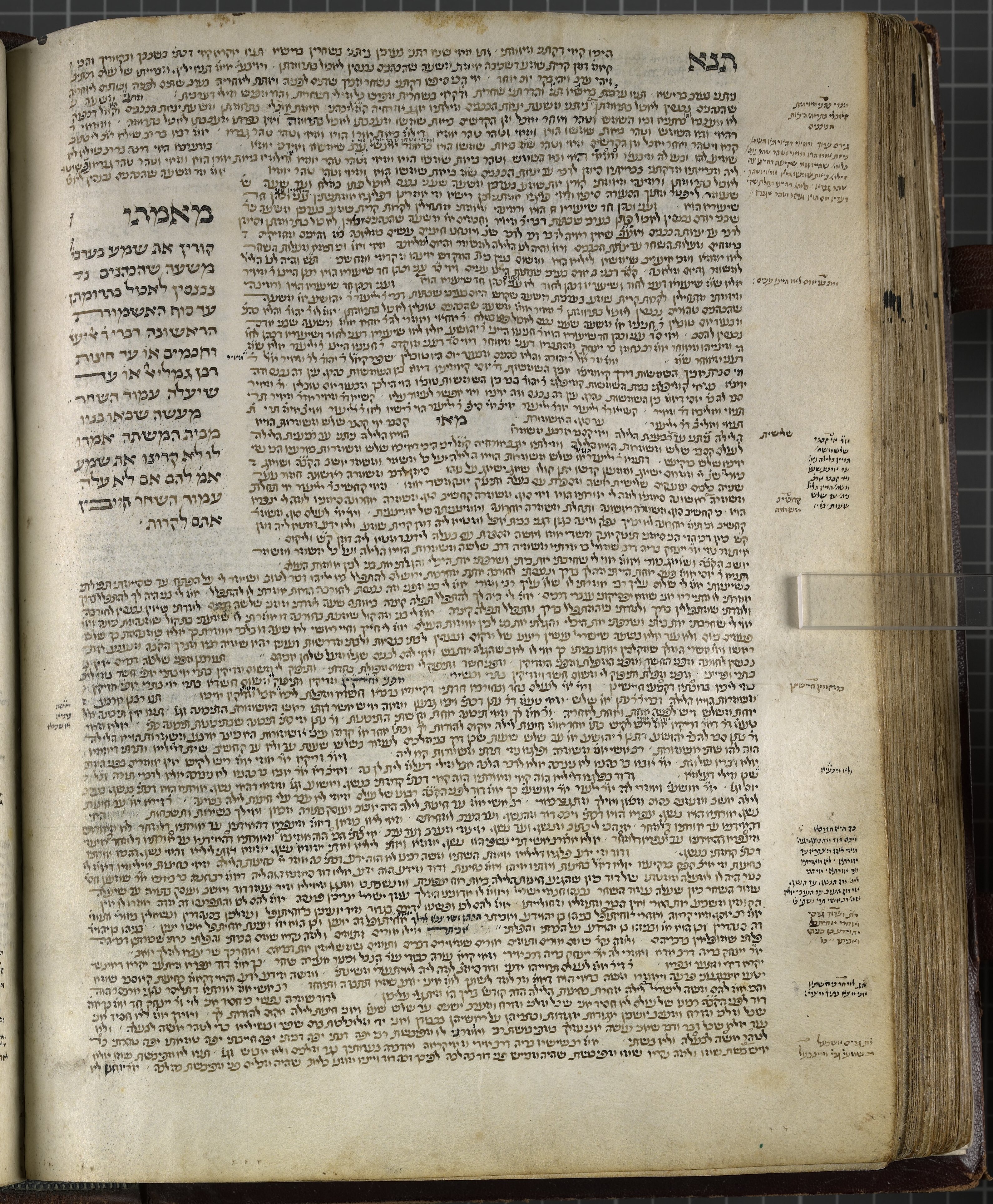
Das Exemplar des Babylonischen Talmuds der Bayerischen Staatsbibliothek ist in die Liste aufgenommen worden

Der bedeutende Babylonische Talmud der Bayerischen Staatsbibliothek ist in das Register des UNESCO-Weltdokumentenerbes aufgenommen. Die Münchner Handschrift des Babylonischen Talmuds (Cod.hebr. 95) ist die einzige weltweit, in der der gesamte Text des Talmuds enthalten ist.

Neben der Hebräischen Bibel ist der Talmud die zweite textliche Grundlage des Judentums. Dieses Kompendium von Kommentaren zur Torah, von gottesdienstlichen Praktiken, Verhaltensregeln, Überlieferungen und Erzählungen ist in zwei Versionen bekannt: dem ‚Palästinischen‘ oder ‚Jerusalemer Talmud‘, der im oströmischen Palästina zusammengestellt wurde, und dem ‚Babylonischen Talmud‘ im sassanidischen und früharabischen Irak. Der umfangreichere Babylonische Talmud wird als vorrangig angesehen. Der Codex hebraicus 95 der Bayerischen Staatsbibliothek, bekannt als die Münchner Handschrift des Babylonischen Talmuds, ist die einzige erhaltene Handschrift weltweit, die den gesamten Text umfaßt. Sie bewahrt eine Textquelle von größter Bedeutung für das Judentum und einen der wichtigsten religiösen Quellentexte der Menschheit. Der Codex ist eine der wertvollsten Handschriften in der reichen Handschriftensammlung der Bayerischen Staatsbibliothek. Die UNESCO hat sie im April 2025 in das Internationale Register Memory of the World aufgenommen.

Die beiden Teile des Babylonischen Talmuds, die Mischna und die Gemara, wurden etwa vom 2. bis zum 8./9. Jahrhundert n. Chr. schriftlich fixiert. Die Münchner Handschrift wurde am 17. Tevet 5103 (hebräisches Datum), d. h. am 15. Dezember 1342 n. Chr., in Frankreich fertiggestellt, wie das Kolophon auf Blatt 563 verso vermerkt. Seit dem Ende des 15. Jahrhunderts befindet sich der Codex in Deutschland. Er wurde Ende des 18. Jh. vom Augustinerchorherrenstift Polling erworben und gelangte 1803 im Rahmen der Säkularisation in den Besitz der Bayerischen Staatsbibliothek. Der Codex überlebte Jahrhunderte der Verfolgung im Mittelalter, in der Neuzeit und selbst die Greueltaten der Nazis in Deutschland und die Zerstörung der Bibliothek durch Fliegerbomben im Zweiten Weltkrieg.

Mit ihrem Kontext und ihrer Geschichte bildet diese Handschrift eine Brücke zwischen Orient und Okzident und ist von wahrhaft weltweiter Bedeutung. Aufgrund ihrer Unikalität, ihrer Geschichte, ihres wissenschaftlichen Wertes und ihrer religiösen Bedeutung zählt die Münchner Handschrift des Babylonischen Talmuds zu den kostbarsten Buchschätzen der Menschheit.

Generaldirektor Dr. Klaus Ceynowa: „Wir freuen uns sehr über die Aufnahme des Babylonischen Talmuds in die Liste des UNESCO-Weltdokumentenerbes. Dies unterstreicht die Einzigartigkeit und globale Bedeutung dieser wertvollen Handschrift.“

Die Handschrift wurde bereits 2003 von der Bayerischen Staatsbibliothek vollständig digitalisiert. Sie wird im Katalog und in den Digitalen Sammlungen der Bibliothek sowie in der Deutschen Digitalen Bibliothek präsentiert.

Codex Hebr. 95 536 verso – Kolophonvermerk

(c) Bayerische Staatsbibliothek (https://syncandshare.lrz.de/getlink/fiH1zYj3mw6Y1WQzBu73iv/)