Libanons fragile Gegenwart

Aktuelles Crisis Group Briefing (Langfassung)

What’s new? Even as a fragile ceasefire holds, Lebanon is grappling with questions raised by the devastating 2023-2024 Israel-Hizbollah war. These include how hard Hizbollah’s opponents will press the weakened group to disarm, as the truce requires, and whether intracommunal tensions provoked by the displacement crisis will subside or flare again. 


Why does it matter? Lebanon has just emerged from two years with no president and only a caretaker government. The new leadership faces enormous economic challenges, including post-war reconstruction, and can ill afford a return to either political paralysis or domestic strife. 


What should be done? The country’s competing camps should move carefully and gradually rather than risk confrontation over Hizbollah’s disarmament. Foreign countries should no longer meddle in this debate. Instead, they can bolster Lebanon’s stability by financially supporting the cash-strapped army and organisations serving the tens of thousands who remain displaced.

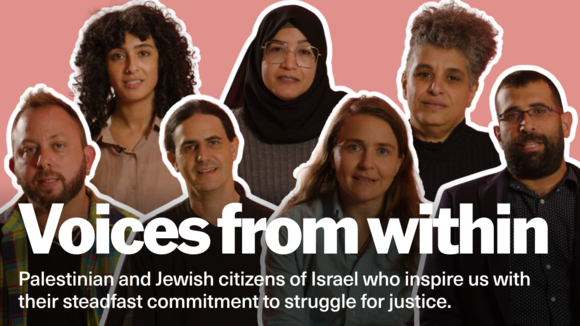
Film-Launch – „Voices from Within“

Aus dem Mailing der Rosa-Luxemburg-Stiftung Israel,

Am 24. und 25. November 2024 versammelte sich eine Gruppe diverser Akteur:innen – palästinensische und jüdische Staatsbürger:innen Israels, politische und soziale Aktivist:innen, die tief in ihren jeweiligen Communities verwurzelt sind – in den Büros der Rosa-Luxemburg-Stiftung in Tel Aviv.

Diese Aktivist:innen sind langjährige Partner:innen für das Israel-Büro der RLS vor Ort und wir unterstützen sie daher in ihrem Engagement für politische, wirtschaftliche und soziale Gerechtigkeit für alle Menschen in Israel. Seit dem 7. Oktober 2023 sehen sie sich mit noch existenzielleren Bedingungen als zuvor konfrontiert, weshalb ihre Arbeit auch wichtiger ist als je zuvor. Wir baten sie daher, vor der Kamera eine Reihe von Fragen zu ihren Erfahrungen und Reflexionen der vergangenen knapp 14 Monate zu beantworten, und dokumentierten in diesem Film ihre bewegenden und inspirierenden Antworten für das deutschsprachige Publikum.

Dieses Projekt entstand aus dem Wunsch unserer Mitarbeiter:innen, Raum für persönlich-politische Geschichten zu schaffen, die oft ungehört bleiben. Es vereint authentische Zeugnisse von Trauer, Kampf, aber auch Hoffnung und unerschütterlicher Stärke von Menschen, die seit fast eineinhalb Jahren im Krieg leben und dennoch weiterhin sprechen, handeln und auf eine bessere Zukunft hoffen.

Wir sind dankbar für ihre Bereitschaft, ihre Geschichten mit uns und dem interessierten Publikum zu teilen. Sie geben persönliche Einblicke und bieten zugleich umfassendere politischen Reflexionen über die aktuelle unhaltbare Situation. Nicht zuletzt dokumentieren wir mit diesem Film, dass es weiterhin diejenigen progressiven Stimmen in Israel gibt, die Solidarität und die Unterstützung der internationalen Linken benötigen, heute mehr denn je.

Aktuelles von B’Tselem

https://www.btselem.org/donate

Turning Holocaust Slang into Art: Between K. Tzetnik and Chava Rosenfarb

Prof. Hannah Pollin-Galay, Tel Aviv University – Zoom 3. März 2024 – Details

2025 Annual Naomi Prawer Kadar Memorial Lecture

Esteemed scholar Hannah Pollin-Galay explores how the Yiddish language evolved in Nazi ghettos and camps, gaining roughly 3,000 new words. Examining the works of K. Tzetnik and Chava Rosenfarb, this talk considers how these writers transformed „Khurbn Yiddish“ into powerful expressions of horror, resilience, and artistic memory.

***

The Yiddish language drastically changed in the ghettos and camps of Nazi Europe. By one estimate, roughly 3,000 new words and phrases were added to the language. Many of these neologisms were of a vulgar nature, relating to topics like theft and sex work. While some people found these new words embarrassing, unseemly and just plain ugly, others attempted to uplift them and transform them into art. Among the writers that incorporated Khurbn Yiddish (Yiddish of the Holocaust), into their postwar poetry and prose, the authors K. Tzetnik and Chava Rosenfarb stand out. Each extracted and presented the aesthetic potential of Khurbn Yiddish words in different ways.  K. Tzetnik emphasized the horrifying, bizarre side of Khurbn Yiddish words, molding them into an expressionistic scream. Rosenfarb, by contrast, shined a light onto the small acts of resilience contained within Khurbn Yiddish words, memories of self-expression and communication against the odds. Her ghetto terms become beautiful in the way they invite readers into scenes of everyday life under Nazi rule, moments from the margins of history that are rarely considered worthy of notice. The two authors also clash on the topic of female sexuality—and the ways that words relate to the body.

Hannah Pollin-Galay is Associate Professor in the Department of Literature at Tel Aviv University, where she is also Head of the Jona Goldrich Institute for Yiddish Language, Literature and Culture. Pollin-Galay researches and teaches primarily in the fields of Yiddish literature and Holocaust Studies, and has recently begun to foray into the field of ecocriticism. Her first book, Ecologies of Witnessing: Language, Place and Holocaust Testimony came out with Yale University Press in 2018 and her second, Occupied Words: What the Holocaust Did to Yiddish (U Penn Press, 2024) asks how the Holocaust changed the Yiddish language. She is currently working on a project exploring the fraught connections between Jews and non-human nature, across time and space. In addition to being a 2024-2025 Senior Scholar at the Fortunoff Archive for Holocaust Testimony at Yale University, Pollin-Galay is also a Yiddish Book Center Translation Fellow, where she is translating Yiddish ecopoetry from the Holocaust.

Rabbis for Human Rights

Der jüdisch-orthodoxe Israeli Anton Goodman ist am 27.02.2025 zu Gast in Berlin. Zeit: 18.30 bis 20 Uhr. Ort: Berliner Missionswerk, Georgenkirchstraße 69/70, im Knaksaal (2. Stock).

Wir lesen und hören aktuell in Nachrichten und sozialen Medien viel über die Situation in Israel und Palästina. Am 27. Februar 2025 haben Sie die Möglichkeit, in Berlin mit Anton Goodman über die aktuelle Entwicklung und die Stimmung im Nahen Osten ins Gespräch zu kommen.

Anton Goodman ist jüdisch-orthodoxer Israeli. Er ist bei der Organisation „Rabbis for Human Rights“ zuständig für Partnerschaften. Aktuell ist er regelmäßig in der Westbank, wo die Rabbis for Human Rights Präsenz zeigen und Palästinenser:innen begleiten. So begegnen sie der zunehmenden Siedlergewalt. Goodman ist verantwortlich für die Planting Justice-Kampagne, bei der in Kooperation mit palästinensischen Gemeinden, die von Gewalt und militärischen Restriktionen bedroht sind, über 1.000 Olivenbäume gepflanzt werden.

Die Veranstaltung ist auf englisch mit deutscher Übersetzung.

Zeit: 27. Februar 2025, 18.30 bis 20 Uhr
Ort: Berliner Missionswerk, Georgenkirchstraße 69/70, im Knaksaal (2. Stock)

Völkerrechtliche Herausforderungen der deutschen Nahostpolitik: Verpflichtungen vor IGH und IStGH?

Die Arbeitsgemeinschaft sozialdemokratischer Juristinnen und Juristen in der SPD Berlin (ASJ Berlin) lädt zu einem Online-Fachgespräch ein:
Dienstag, den 18. Februar 2025 von 20:00 Uhr bis ca. 22:00 Uhr.

Das Thema des Abends lautet: 

„Völkerrechtliche Herausforderungen der deutschen Nahostpolitik: Verpflichtungen vor IGH und IStGH?“

Dieses Fachgespräch soll eine Plattform bieten, um die völkerrechtlichen Verpflichtungen und Implikationen des Gutachtens des Internationalen Gerichtshofs (IGH) vom 19. Juli 2024 sowie der Haftbefehle des Internationalen Strafgerichtshofs (IStGH) gegen Mitglieder der Hamas-Führung und der israelischen Regierung vom 21. November 2024 aus verschiedenen Perspektiven zu beleuchten.

Unser Ziel ist es, eine informierte und offene Diskussion mit einem völkerrechtlichen Schwerpunkt zu ermöglichen. Es geht vor allem darum, Brücken zu bauen und Räume für einen guten Austausch zu schaffen.

Expert*innen und Panelist*innen:

·        Valentin Jeutner, Außerordentlicher Professor für Völkerrecht an der Universität Lund, Schweden

·        Frank Meyer, Inhaber des Lehrstuhls für Strafrecht und Strafprozessrecht mit Schwerpunkt auf internationalen Bezügen an der Universität Heidelberg

·        Silvia Steininger, Postdoktorandin und Dozentin für Völkerrecht, EU-Recht und Rechtsvergleichung an der Hertie School of Governance in Berlin sowie Referentin am Max-Planck-Institut für ausländisches öffentliches Recht und Völkerrecht in Heidelberg

Die Moderation übernimmt Katja Anders (ASJ Berlin).

Die Zugangsdaten zur Veranstaltung lauten wie folgt:

Link:https://spd-konferenz.webex.com/spd-konferenz/j.php?MTID=mcb0727da53ca0838f1c6a96f29df1a9d

Meetingkennnummer: 2788 612 6780

Passwort: YFkY3HtBU37 (i.d.R.n.n.)

Telefonische Einwahl: +49-619-6781-9736

UNRWA and the Palestinian Refugees at a Crossroads

Dr Lex Takkenberg will be speaking on a webinar hosted by the Balfour Project entitled: UNRWA and the Palestinian Refugees at a Crossroads on Thursday 20th February at 3pm UK time.

A Dutch National, Dr Takkenberg is Senior Advisor on the Question of Palestine at ARDD. From 1989 until 2019, he worked in various field and headquarters positions with UNRWA, the UN agency for Palestinian refugees, most recently at its Amman headquarters as the agency’s first Chief Ethics Officer.

He was previously UNRWA’s General Counsel, Director of Operations, and (Deputy) Field Director in Gaza and Syria.

Before joining UNRWA, he was the Legal Officer of the Dutch Refugee Council, from 1983 until 1989. A law graduate from the University of Amsterdam, where he also worked as an Academic Assistant from 1987-1989, he obtained a Doctorate in International Law from the University of Nijmegen, the Netherlands, in 1997 after having successfully defended his doctoral dissertation entitled The Status of Palestinian Refugees in International Law. Oxford University Press (OUP) published a commercial edition of the dissertation in 1998; an integral Arabic translation was published by the Institute for Palestine Studies in 2003. A new version of the book – co-authored with Francesca Albanese – was published, also with OUP, in 2020.

The webinar takes place on Thursday 20th February at 3pm UK time
Register here:

https://us02web.zoom.us/webinar/register/WN_YfoSUveZQOur6vr5eK4Uuw#/registration

Narrative im Nahost-Konflikt

Ein Vortrag des Islamwissenschaftlers Florian Zemmin: Neue Erzählungen für eine friedlichere Zukunft

Hörsaal – Deutschlandfunk Nova

Die Geschichten, die wir uns über uns erzählen, sind mächtig – und gefährlich. Im Nahostkonflikt etwa sind alle Parteien überzeugt, historisch im Recht zu sein. Narrative könnten aber auch eine Chance sein. Ein Vortrag des Islamwissenschaftlers Dr. Florian Zemmin. Er ist Professor für Islamwissenschaft an der Freien Universität Berlin und Co-Direktor der Berlin Graduate School Muslim Cultures and Societies.

Seinen Vortrag mit dem Titel „Konflikt ohne Ende? Welche Geschichte(n) wir heute für die Zukunft brauchen“ wurde ursprünglich am 19. November 2024 im Rahmen der Ringvorlesung
„Die Vielfalt Palästinas – eine kulturelle Zeitreise:“ an der FU Berlin gehalten und wurde für Deutschlandfunk Nova noch mal eingesprochen.

Humanitarian plea from the Churches of Jerusalem

The Patriarchs and Heads of the Churches in Jerusalem have issued this statement on Feb 14, 2025:

As custodians of the Christian faith and conscience in this sacred land, we raise our voices in sorrow and steadfast resolve in the face of the ongoing suffering in Gaza. The devastation that has unfolded before the eyes of the world is a profound moral and humanitarian tragedy. Thousands of innocent lives have been lost, and entire communities stand in ruin, with the most vulnerable-children, the elderly, and the sick-enduring unimaginable hardship.

Amid this anguish, we are compelled to speak against the grave threat of mass displacement, an injustice that strikes at the very heart of human dignity. The people of Gaza, families who have lived for generations in the land of their ancestors, must not be forced into exile, stripped of whatever left of their homes, their heritage, and their right to remain in the land that forms the essence of their identity. As Christians, we cannot be indifferent to such suffering, for the Gospel commands us to uphold the dignity of every human being. The words of our Lord remind us: „Woe to those who make unjust laws, to those who issue oppressive decrees, to deprive the poor of their rights and withhold justice from the oppressed“ (Isaiah 10:1-2).

In this critical moment, we acknowledge and support the position of His Majesty King Abdullah II of Jordan, President El-Sisi of Egypt, and others, whose firm and principled stance have remained clear and unwavering in rejecting any attempt to uproot the people of Gaza from their land. Their relentless efforts to provide humanitarian aid, appeal to the world’s conscience, and insist on the protection of civilians exemplify leadership at its highest level of responsibility.

In this same spirit, we also call for the release of all captives from both sides so that they can be safely reunited with their families. We appeal to all people of faith, to governments, and to the international community to act swiftly and decisively to halt this catastrophe. Let there be no justification for the uprooting of a people who have already suffered beyond measure. Let the sanctity of human life and the moral obligation to protect the defenseless outweigh the forces of destruction and despair. We call for an immediate unfettered humanitarian access to those in desperate need. To abandon them now would be to abandon our shared humanity.

As we lift our prayers for those in mourning, for the wounded, and for those who remain steadfast in the land of their forefathers, we remember the promise of Scripture: „The Lord upholds all who fall and lifts up all who are bowed down“ (Psalm 145:14). May the God of mercy strengthen the afflicted, soften the hearts of those who hold power, and bring forth a peace that upholds justice, preserves human dignity, and safeguards the presence of all people in the land to which they
belong.

The Patriarchs and Heads of the Churches in Jerusalem

Hunderte US-Rabbiner:innen u.a.

(Liste – Stand 14.2.2025, 0:30 MEZ) unter Link zu finden

Ergänzung 15.2.25 (mit einem Screenshot der Anzeige):https://www.indcatholicnews.com/news/51731